It is where the things you came for sit, relative to where the buses go. Greek island buses are built for the people who live there and for the boat, so they run between the port, the capital and the two or three big resorts. If what you want is on that line, you can have a full trip without ever holding a key. If what you want is a cove at the end of a dirt track, a mountain village or a trailhead, the bus was never going to take you, and no amount of patience changes that.
So the useful question is not which islands need a car. It is which island are you actually going to.
The test: four questions, answered before you book
Run these in order. The first two decide it; the last two decide how much car you need.
Where does your list live? Write down the five things you actually want to do on the island. If four of them are the old town, the main beach and the harbour restaurants, you are on a bus-and-feet trip. If four of them are village names, a gorge, a monastery and a beach someone described as hard to reach, you need wheels.
Does the island’s network radiate, or does it knit? A radial network runs everything out of one hub and back. That is most Greek islands. It means a village-to-village day, the thing that makes a mountainous island worth visiting, turns into two journeys through the capital and a wait in the middle. A car is what turns two spokes into one short drive.
How long are you staying? On a three-night stop, a car you use twice is money parked outside your room. On a week, the arithmetic flips fast.
Do you need it for the whole stay, or for two days? This is the question most people never ask, and it is where the money is. Naxos is the clean example: base yourself by the bus for the town and the sand, then rent for the two or three interior days, and you have paid for a car only on the days it does something.
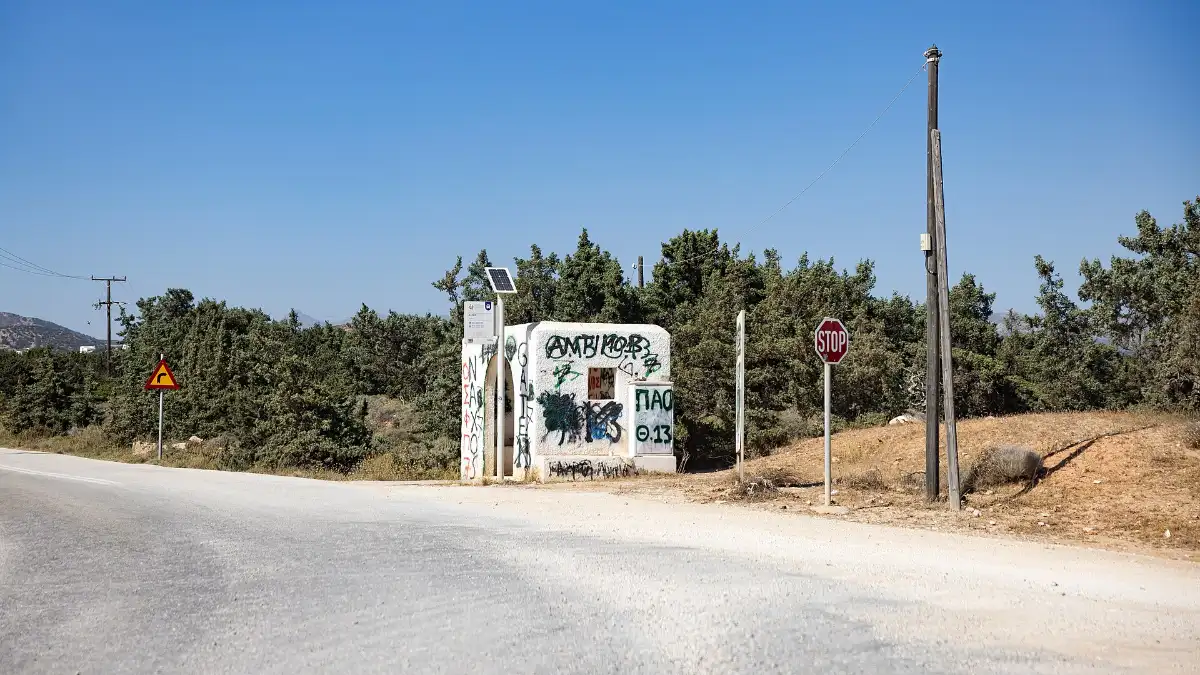
Nothing here says driving is easy or difficult. The roads are what they are, and what they are is set out in driving in Greece.
Islands where a car is close to the whole trip
These are the islands where a carless week does not give you a smaller version of the island. It gives you a different one.
Crete is the clearest case in the country, and it is a scale problem. The intercity buses along the north coast between Chania, Rethymno and Heraklion are frequent and comfortable, so you can see Crete’s cities without a car. You cannot see Crete. Elafonisi, Balos, the Samaria gorge, the Lasithi plateau and the whole south coast effectively need one.
Karpathos, Chios, Andros, Tinos, Kea and Samos share a shape: a big or mountainous island where the villages, the trailheads and the good beaches are strung along winding roads that the bus routes do not follow. Without wheels, Karpathos shrinks to a town and its nearest beach. On Tinos the marble villages sit along narrow mountain roads in the northwest, which is the first plain sign that this is an island you see by car.
Kefalonia is the one where the rental is effectively part of the ticket. Buses link Argostoli with the main towns, but they are shaped around package schedules, and the headline stops, the Myrtos viewpoint above all, are not usefully served.
Zakynthos and Ikaria are the same argument in different terrain: the west-coast villages on one, the mountain villages on the other, both reached on roads that make a short distance take a long time.
Milos adds a wrinkle worth knowing before you book. Several of the best beaches sit at the end of unpaved roads, so on Milos the question is not only whether you rent, but what you rent.
And two islands answer the question before you ask it. You drive onto Lefkada across a bridge and onto Evia the same way, so on both the car is already with you and the trip is a road trip by design.
Islands you can genuinely do without one
Here the bus, the boat or your own feet cover the island, and a rental would spend the week outside your room.
Paros is the Cycladic exception people are surprised by: the network out of Parikia genuinely reaches Naoussa, Lefkes, the main beaches and the airport. Skiathos does it with one main route down the developed south coast to Koukounaries, plus boats to the coves the road misses, so a carless week there is normal rather than a compromise.
Mykonos surprises people for a different reason. Chora is pedestrian-only and deliberately maze-like, parking near it is a real headache, and the buses run out to the beaches cheaply and late in high summer. On Mykonos the rental is often the worse option, not the freer one.
Symi is small, its two towns are walkable, and the beaches are reached by the shuttle boats that leave the harbour through the day. Folegandros stops cars at the edge of Chora anyway and carries a network of old stone footpaths between the town, Ano Meria and the coves. Paxos is under half an hour end to end, so basing in one village and moving by foot and small boat is a genuine choice rather than a sacrifice.
Then there is Hydra, where the question does not arise. No cars, no scooters and no bicycles run anywhere on the island; you move on foot, by mule and by water taxi. It is the only place in this guide where renting is not a decision you get to make.
The middle case, and it is the biggest one
Most islands are neither. They are places where a car buys you a specific half of the island, and the smart move is to buy exactly that half.
On Rhodes you need nothing for an Old Town and east coast trip, because the buses out of Rhodes Town run the east coast reliably as far as Lindos. You rent the moment you want the west: the mountain villages and the inland roads. On Corfu the same rule holds from a Corfu Town base, and the car appears when you want Paleokastritsa and the northwest capes.
On Kos the town end is bicycle country and the buses cover the resorts, so a car for a day or two picks up Kefalos and Zia. On Ios the bus handles the port, Chora and Mylopotas, which is most of what most people come for, and wheels are what open the far beaches that stay empty precisely because of that. On Patmos the beaches are spread around the island and reaching them is a drive rather than a stroll, so the decision shapes where you choose to sleep.
Two more that reward reading their own pages before you decide. Amorgos has an island bus company that reaches the villages, both ports and the beaches daily, so a car there changes the trip less than you would assume, though it still buys you the freedom to chase a sheltered cove on a windy afternoon. And on Ithaca a car or scooter makes life much easier, while a Vathy base built around boats and walks works well if you plan it deliberately.
The pattern across all of them: rent for the days that need it, not for the length of the holiday.
What the alternatives actually cover
A car is not the only set of wheels, and each substitute solves a different part of the problem.
- Scooters and ATVs solve the road but not the load. Two adults with beach bags, a windy afternoon and a loose gravel surface are three separate problems, and a quad is not a small car. Whether to ride one is your call to make with your own experience; this page describes what it does and does not carry, and certifies nothing.
- Taxis work well for a specific run and badly as a strategy. On the busier islands they are famously scarce at exactly the hours everyone wants one.
- Boat taxis and day boats are the real answer on the small islands, and they beat a car outright where the coast is better connected than the interior. Symi and Skiathos both run on this.
- Organised excursions cover the headline sights on a fixed rota, which means what you see depends partly on which day you arrived.
- Your feet cover more than people expect on the small Cyclades, where old footpaths still link the villages to the sea.
The wider mechanics of all of it are in getting around Greece.
Book the car before you fly, and know the ferry rule
Two practical things decide whether the plan survives contact with the island.
The first is timing. Island rental fleets are small, and in the peak weeks they run out. Reserve before you land rather than at the port, and if you need an automatic, say so at the moment you book and treat it as a scarce option rather than a default. The full set of traps, the excess, the fuel policy and the five minutes at the desk that decide every damage dispute, is in renting a car in Greece.
The second only matters if you are moving a car between islands. Ferry tickets in Greece are issued in a named passenger’s name, and Blue Star Ferries’ own conditions of travel state plainly that tickets cannot be issued on board, that passengers travelling with a car should be at the embarkation area at least an hour before departure, and that the driver takes the vehicle aboard while everyone else walks on. Check whether your own rental agreement allows the crossing at all before you plan one; many do not, and that clause is covered on the renting page. How the boats work generally is in Greek island ferries.
Answer it for your own trip
Take your list of five things. If most of them sit on the port-to-capital-to-main-beach line, book nothing and spend the money on a boat day instead. If most of them are inland or at the end of a track, book the car with the flight, because on those islands the car is not a convenience, it is the access.
And if you are still choosing the island itself, let this decide it rather than surprise you afterwards. Browse all our destinations or the island groups, and read the getting-around section of the hub page before you book the room. Which islands you can fly to directly is a separate filter, and it is in which islands have an airport.
Common questions
Do you need a car in Greece?
Not everywhere. In Athens the metro and your feet beat a rental outright, and on islands like Paros, Skiathos, Symi and Mykonos the buses, boats and walkable towns cover the trip. You need one on large or mountainous islands where the villages, trailheads and best beaches sit off the bus corridors, which includes Crete, Karpathos, Tinos, Andros, Kefalonia and Chios. Decide by where your list of things to do actually sits.
Which Greek islands need a rental car most?
Crete, Karpathos, Chios, Andros, Tinos, Samos, Kea, Kefalonia, Zakynthos, Ikaria and Milos are the ones where a carless week gives you a fraction of the island. Lefkada and Evia are reached by road rather than ferry, so a car is already part of the journey. On all of them the reason is the same: the roads that matter are not the roads the buses use.
Can you visit the Greek islands without a car?
Yes, and on several islands it is the better plan. Paros, Skiathos, Symi, Folegandros, Paxos and Mykonos all work well on buses, boats and feet, and Hydra allows no vehicles at all. The trick elsewhere is to base yourself where the bus is, then rent for only the two or three days you want the interior, rather than paying for a car that sits still.
Is it better to rent a car or use buses in Greece?
Buses win where the network reaches your list, and they are cheap and easy to use. A car wins the moment you want village-to-village days, trailheads or beaches at the end of unpaved roads, because most island networks radiate from one hub rather than linking the villages to each other. Renting for part of a stay rather than all of it is usually the best value of the three options.
Do you need a car on a Greek island for a week?
Often for part of the week rather than all of it. Work out which days are inland days and rent for those, which is the standard approach on Naxos, Rhodes, Corfu and Kos. On the big mountainous islands a full-week rental earns its keep; on the small walkable ones it rarely does.
Can you take a hire car on a ferry between Greek islands?
Sometimes, and the rental agreement decides it rather than the ferry company. Many Greek rental contracts prohibit taking the vehicle off the island, so check the clause before you plan the crossing. Where it is allowed, Blue Star Ferries’ conditions have the driver embark and disembark the vehicle while the other passengers board on foot, and tickets must be issued ashore in each passenger’s name.
Do I need a car on Santorini or Mykonos?
On Mykonos the buses generally beat a rental, because Chora is pedestrian-only and parking near it is difficult. On Santorini the caldera towns are stepped and closed to through traffic, so you walk inside them and use buses or transfers between them. Both are islands where a car spends more time parked than driven.