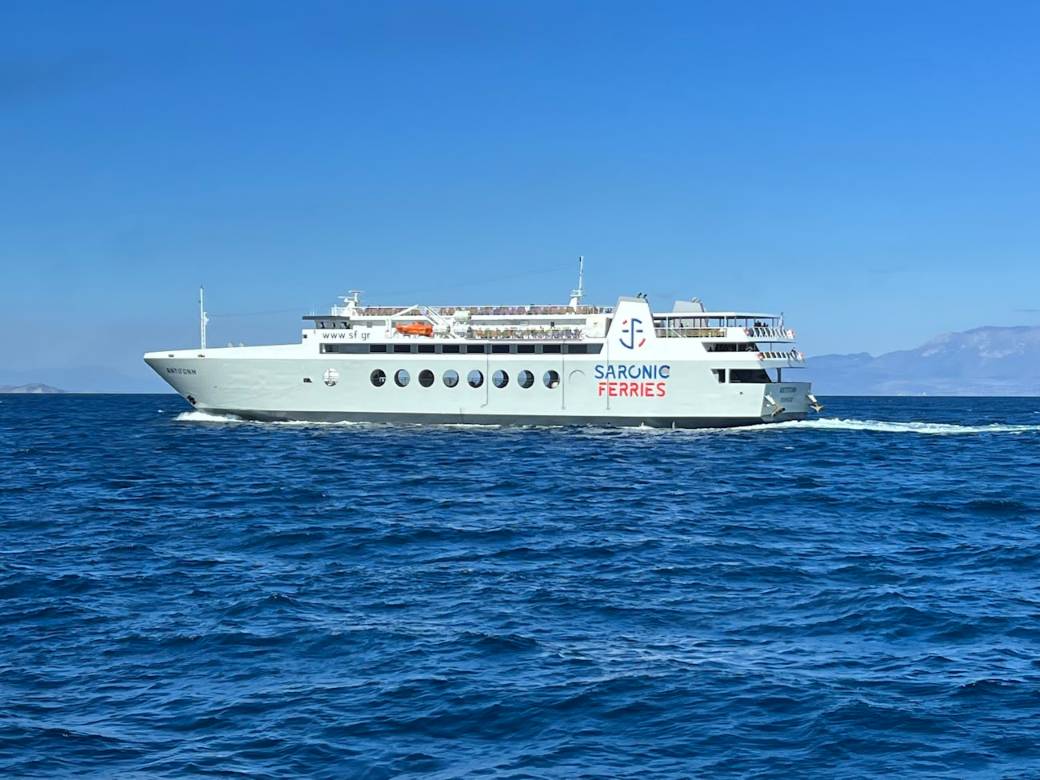
Greek island ferries look like a wall of timetables, but they behave like a system, and the system has only a few rules that matter. Learn which port serves your islands, which boat suits the sea that day, and when the booking window closes, and any route you sketch starts to plan itself. This guide teaches those durable rules. It does not print live sailing times or fares, because those change every season and a page that pretends otherwise will be lying to you by August. For the current timetable and prices you’ll go to the operators and the booking sites. We’ll show you which ones, and how to read what they tell you.
Start with the port, not the boat: Piraeus, Rafina or Lavrio
The highest-leverage ferry decision you make is which Athens port you leave from, and it is also the most durable. The boat and the time on any given day shift from year to year, but which broad region a port serves barely moves.

Diagram by Greece Trips. Free to reuse with credit - CC BY 4.0.
Piraeus is the main hub. It sends daily boats to the Saronic Gulf, the Cyclades, the Dodecanese, Crete and the north-east Aegean. If your island is Santorini, Naxos, Paros, Milos, Rhodes or Crete, you are most likely sailing from here.
Rafina is the smaller port on the east coast of Attica, and its edge is geography. It sits about 25 km from Athens airport, a 20-to-40-minute drive depending on traffic. For the northern and central Cyclades - Andros, Tinos, Mykonos, and often Paros, Naxos, Ios and Santorini in season - that makes it frequently faster and cheaper than crossing the whole city to Piraeus.
Lavrio is the quiet third option, near the southern tip of Attica and also close to the airport. It serves Kea and Kythnos and a rotating set of quieter Cyclades, with fewer daily sailings.
| Athens port | Island groups served | Closest to the airport | Good to know |
|---|---|---|---|
| Piraeus | Saronic, Cyclades, Dodecanese, Crete, NE Aegean | No - cross-city transfer | The big hub; the widest choice of routes and departures |
| Rafina | Andros, Tinos, Mykonos, much of the northern Cyclades | Yes - about 25 km | Often faster and cheaper for the northern Cyclades |
| Lavrio | Kea, Kythnos, Andros, Syros and the northern Aegean | Yes - about 37 km | Small and calm; fewer sailings. Port authority |
Here is the judgement the booking sites bury. If you land at the airport and your island is in the northern Cyclades, check Rafina before you default to Piraeus. You may save an hour of transfer and a slice of fare. The catch is that not every island is served from every port on every date, so confirm your specific island and day with the operator first. And know that Piraeus is vast, a working commercial port with numbered gates spread along a long waterfront, so give yourself time to find the right one. Our getting-around-Greece guide covers the airport transfers to each port; if you’re flying into Greece first, Rafina’s airport proximity is worth more to you. The Piraeus Port Authority publishes gate and terminal maps on its official site - olp.gr.
Conventional or high-speed? Choose by sea, budget and stomach
Two kinds of boat run these routes, and picking between them is a real decision, not a formality. A big conventional ferry is slower, cheaper and steadier, has open decks, and carries cars. A high-speed catamaran is noticeably quicker - up to about twice as fast on the shorter hops - and noticeably pricier, but it is enclosed, it feels every wave, and it is the first thing cancelled when the wind gets up.
The rule that matters is about the sea, not the spec sheet. In a strong summer meltemi - the northerly wind that blows hardest in July and August - light high-speed craft are grounded or turned rough well before the heavy conventional ferries even slow down. The exact wind thresholds vary by route, but the pattern is consistent: fast boats stop first. Our month-by-month weather guide tracks when the meltemi is at its worst.
So choose by who you are that day. On a budget, or prone to seasickness, or holding a connection you cannot miss - take the big conventional boat. Short on time with a calm forecast - the high-speed earns its premium. Travelling with a rental car - you need a conventional car ferry, though on most island hops you’ll return the car and rebook rather than pay to ship it.
| Conventional ferry | High-speed catamaran | |
|---|---|---|
| Speed | Slower | Noticeably faster |
| Fare | Cheaper | Pricier |
| Ride in wind | Steadier | Bouncier |
| Carries cars | Yes | Usually no |
| Cancelled in a meltemi | Last | First |
| Best for | Budget, seasickness, cars, critical connections | Saving time on a calm day |
We keep the actual durations and fares off this page on purpose. The same crossing can take about half as long on a high-speed at a higher fare, and the precise numbers move every season, so check the current figure with the operator or a booking site before you choose.

Diagram by Greece Trips. Free to reuse with credit - CC BY 4.0.
Who runs the boats: the operators worth knowing
You don’t need to memorise every company, but a handful of names turn a wall of search results into a short list. Match the operator to the region and the boat type, and most routes sort themselves.
Blue Star Ferries is the conventional workhorse of the Cyclades and Dodecanese: big, steady boats out of Piraeus, and the reliable default when you want a calm crossing or a connection you can’t miss. SeaJets runs the high-speed fleet across the Cyclades and to Crete, trading comfort for speed. Golden Star Ferries and Fast Ferries work the Rafina routes to Andros, Tinos and Mykonos, mixing conventional and fast boats. Hellenic Seaways covers the Saronic Gulf and parts of the Cyclades. For Crete and the Adriatic, Minoan Lines and ANEK/Superfast run the big overnight ships. The Small Cyclades Lines link the little islands between Naxos and Amorgos, while Aegean Sea Lines runs a Piraeus line to the western Cyclades - Serifos, Sifnos, Milos and Kimolos.
| Operator | Main region | Type | Official site |
|---|---|---|---|
| Blue Star Ferries | Cyclades, Dodecanese | Conventional | bluestarferries.com |
| SeaJets | Cyclades, Crete | High-speed | seajets.com |
| Golden Star Ferries | Rafina to Andros/Tinos/Mykonos | Mixed | goldenstarferries.com |
| Fast Ferries | Rafina to Andros/Tinos/Mykonos | Mixed | fastferries.com.gr |
| Hellenic Seaways | Saronic, Cyclades | Mixed | hellenicseaways.gr |
| Minoan Lines | Crete, Adriatic | Conventional | minoan.gr |
| ANEK / Superfast | Crete, Adriatic | Conventional | anek.gr |
| Small Cyclades Lines | Small Cyclades (Naxos to Amorgos) | Conventional | Book at the port office or through an aggregator |
| Aegean Sea Lines | Piraeus to the western Cyclades (Serifos, Sifnos, Milos, Kimolos) | Conventional | aegean-sealines.gr |
Two things stay true while the details shift. Blue Star’s large ferries are the dependable choice most travelers reach for, and the high-speed operators win on time but lose on comfort in wind - a trade every regular islander makes on purpose. And the roster of names is durable even though the routes are not: which company runs a given line, and when, is reshuffled between seasons, so confirm the current operator for your date rather than trusting last year’s blog. If you’re coming from Turkey, small day boats cross from Bodrum to Kos and from the Turkish coast to Rhodes and other Dodecanese islands in season - a useful back door, but seasonal and worth confirming.
When to book, and why July punishes procrastinators
Off-peak, you can usually buy a ferry ticket a day or two ahead, or at the port on the morning you sail. In July and August, on the popular routes - Athens to Santorini and Mykonos, and the busy inter-Cyclades high-speed hops - book weeks to a few months out. The risk is not the price; it is a sold-out sailing that breaks your whole route.
Real travelers report a useful split. Deck-class tickets on the big Blue Star ferries rarely sell out, but high-speed seats, cabins and car spaces go early on peak dates and busy weekends. So the tickets to lock in first are the hard-to-change ones: fixed peak days, overnight cabins, and anything carrying a car. Our trip-cost breakdown covers where fares sit in the wider budget.
Schedules follow a rhythm you can plan around. Winter timetables run through the cold months, and the following summer’s sailings are published gradually across winter and spring - mainland-to-island routes first, the inter-island connections later. So if you’re planning in January, next August’s fast-boat times between two small islands may not be online yet.
Plan around that. Pin down the legs you know and the peak dates early, and leave the flexible middle of the trip to firm up once its timetable appears. Our guide to when to go and how busy it gets helps you place those peak dates.
How weather cancels ferries, and how to plan around it
Cancellations in a Greek summer are usually the wind, not a storm. The meltemi is a strong, dry northerly that funnels down the Aegean and peaks in July and August. When it blows hard, the light high-speed catamarans are grounded or delayed before the big conventional ferries feel it. Most of the time it costs you a rough ride or a lost half-day, not a ruined trip, but it is predictable enough to plan for.
When a sailing is cancelled, operators typically move you to a later or alternative boat, or refund the fare. You rarely simply lose your money. What you can lose is the day. Policies differ by company, so read the terms when you book rather than assuming a blanket rule.
Here is the planning rule the booking sites never give you. Never hang a cancellable ferry on a same-day international flight or a non-refundable first night with no cushion. Leave the wind a day of slack on the legs that truly matter, and prefer a conventional ferry for any connection you cannot miss. The island-hopping guide shows how to build that slack into a multi-island route.
There is a second, rarer disruptor: national ferry strikes. Greek seafarers occasionally call a 24-to-48-hour strike, usually announced a few days ahead, that pauses most sailings. Check for any announced strike near your dates and keep the same buffer you’d leave for weather. On the day itself, the operator’s site or app and the port authority hold the real status - trust those over any printed schedule.
Sequencing islands so you never backtrack
The difference between a smooth trip and a wasted day is the order you visit islands in. Plan your route around the ferry links that actually exist, not the map you wish existed. A ferry route map of the Greek islands makes the strong corridors and the gaps obvious at a glance.
Some island pairs are strongly connected and some are not. The central Cyclades run as a natural corridor: Mykonos, Paros, Naxos and Santorini are well linked in season, so you can hop down the line without doubling back. Jump between different groups, though - a Cyclades island to a Dodecanese one, or an Ionian island to the Cyclades - and there is often no direct summer boat at all. Those are the weak links, and they usually force a bounce back to a mainland port or a short flight. Check the connection before you commit a route to it.
That gives you two shapes of trip. Base yourself on one well-connected island, day-hop out and back, and keep a single set of bags in one room. Or move one way down a corridor and fly home from the far end. The island-hopping guide works through the strong and weak links in detail, and the ready-made Cyclades route sequences one you can copy.
One more thing about cars. You generally do not ferry a rental between islands. Return it, sail, and rent again on the next island - it is cheaper and simpler than paying for a vehicle deck. Ferry a car only when the island rewards a road trip of its own, like Crete.
One-way beats round-trip: fly out of the far end
Ending your hop on an island with an airport usually beats sailing all the way back to Piraeus. Hop down the corridor, then fly to Athens from Santorini, Mykonos or Naxos instead of re-crossing the sea you already saw. The Athens–Santorini–Crete backbone route is built on exactly this logic, and our flights guide covers which islands have airports for the flying legs.
Booking, tickets and boarding: the mechanics
Once the route is set, the mechanics are simple and mostly durable. You can book three ways, each with a trade-off. Aggregators like Ferryhopper and Direct Ferries let you compare operators on one screen and stitch multi-leg trips together. An operator’s own site is best when you already know the company you want. The port ticket office is the fallback for a same-day seat. Prices for the identical crossing can differ between aggregators, so it pays to compare rather than book the first result. We name these as neutral tools; there are no affiliate links here.
Most operators now issue e-tickets you show on your phone. A few routes or companies still ask you to collect a paper ticket at the port before boarding, though that requirement keeps shrinking. Read your confirmation so a surprise doesn’t cost you the sailing.
Ticket classes are straightforward. Deck or economy is a seat or open-deck space, fine for short and medium hops. Assigned airline-style seats cost a little more. Cabins are for long overnight crossings, like Piraeus to Crete. Vehicle tickets are separate and booked alongside the passenger fare.
Boarding at Piraeus rewards early arrival. It is a large port, with gates spread along a couple of kilometres of quay, and the gate belongs to the vessel rather than to the island: two boats to Santorini on the same morning can sail from different gates. Take the gate from your ticket, not from memory, and check the operator’s own port map if you are unsure - Blue Star publishes one. Arrive with time to spare, expect a scrum as foot passengers and cars load together, and stow big bags on the luggage racks or vehicle deck while you keep valuables with you. Rafina and Lavrio are smaller and calmer.

Diagram by Greece Trips. Free to reuse with credit - CC BY 4.0.
To find and book current sailings and ferry timetables, cross-check Greek Travel Pages, the operator sites, and aggregators like Ferryhopper and Direct Ferries. The next section covers how to read what they show you. If you’re arriving by cruise ship rather than scheduled ferry, that’s a different animal - see our cruises guide.
What the crossing is actually like
On a big conventional ferry, a several-hour crossing is one of the nicer parts of the trip. There are open decks to stand on, airline-style seats inside, a cafeteria, and the islands sliding past the rail. A high-speed catamaran is the opposite experience: enclosed, air-conditioned, quick, and bouncy when the sea is up.
If you’re prone to seasickness, the fixes are boring and effective. Take the big boat, sit mid-ship near a window, take your medication before you board rather than after, watch the horizon, and go easy the night before. Travelers who do all that rarely have a bad crossing.
Families do fine on the large ferries - kids have room to move, and there’s space to spread out. Stow the big bags on the racks, keep a small one with water, snacks and essentials, and board early enough to sit together. Onboard food exists but is basic and priced for a captive audience, so bring your own for the long legs. If you’re travelling with children, our family trips guide has more on the practicalities.
Why Greek island ferries change schedule every year
This guide stays useful because it teaches you to read a moving system instead of memorising a snapshot. Here is the split worth keeping in your head.
| Durable - learn once | Perishable - look up each time |
|---|---|
| Which port serves which island group | Exact sailing times |
| Conventional vs high-speed trade-offs | Fares and ticket prices |
| The operator roster | Which operator runs a route this year |
| How meltemi cancellations work | Precise crossing durations |
| Corridor and weak-link route logic | Seasonal start and end dates |
The durable half is what this page teaches. The perishable half is what you look up close to travel, and the workflow is short. To confirm a specific sailing, cross-check the operator’s official site, an aggregator such as Ferryhopper or Direct Ferries, and Greek Travel Pages, which pulls timetables across companies. For day-of status and cancellations, go to the operator’s app and the port authority.
Why does so much move each year? Greek coastal ferries are a mix of commercial routes and state-supported lifeline services. Operators re-file their seasonal deployments annually, and the subsidised island routes are awarded by government contract, so a route list dates quickly while the logic behind it does not.
That is why we don’t reprint timetables here, and why every stale-able fact on this page carries a “last checked” date when it publishes. Treat any printed schedule as a draft, and confirm the sailings that matter close to your travel date. Our wider transport overview sets ferries alongside flights and driving.
Plan the ferries, and the trip plans itself
That’s the whole system: pick the right port for your islands, pick the right boat for the sea, book the hard legs early, and leave the wind a day of slack. Everything else is a lookup. The next move isn’t a timetable - it’s a route. Our island-hopping guide turns these ferry rules into a full plan, the Cyclades hopping route hands you a sequenced one to copy, and the map of Greece and its islands shows how the pieces fit. Start from the port, and the sea legs stop being the part you worry about.
Frequently asked questions
Do you need to book Greek island ferries in advance?
Off-peak, no - you can usually buy a day or two ahead or at the port. For popular July and August routes like Athens to Santorini or Mykonos, and busy inter-Cyclades high-speed hops, book weeks to a few months ahead. The risk isn’t price; it’s a sold-out sailing that breaks your route. Next summer’s inter-island times may not appear until spring, so lock in the hard-to-change legs - peak dates, cars, cabins - first.
Are Greek ferries often cancelled?
Not often, and when they are it’s usually wind rather than storms. The summer meltemi peaks in July and August, and light high-speed catamarans are grounded before the big conventional ferries. You’re normally rebooked or refunded, but you can lose a day. Leave slack before flights and non-refundable nights, and take a conventional ferry for any connection you truly cannot miss.
What’s the difference between high-speed and conventional Greek ferries?
Conventional ferries, such as Blue Star, are slower, cheaper, steadier, and carry cars. High-speed catamarans, run by operators like SeaJets, Golden Star and Fast Ferries, are noticeably faster, pricier, enclosed, bouncier in wind, and the first to be cancelled. Choose conventional for budget or seasickness; choose high-speed to save time on a calm day.
Which Athens port do ferries to the Greek islands leave from?
Three ports. Piraeus is the big hub for the Saronic Gulf, Cyclades, Dodecanese, Crete and the north-east Aegean. Rafina, closest to Athens airport, serves Andros, Tinos, Mykonos and much of the northern Cyclades. Lavrio serves Kea, Kythnos and some quieter Cyclades. Check your specific island and date, since seasonal sailings shift between ports.
How do you get to Hydra?
Hydra is car-free and reached only by boat - no bridge, no airport. Fast ferries and catamarans run from Piraeus across the Saronic Gulf, so the ferry is the only way in or out. See our Hydra guide and the wider Saronic islands for day-trip and overnight options.
Can you island hop by ferry in Greece?
Yes - ferry island hopping is the classic way to see the Greek islands. It’s easiest within one group, like the Cyclades, where the central islands are well linked. Jumping between different groups often needs a bounce back to a mainland port or a short flight. Our island-hopping guide and this Cyclades hopping route show how to line it up.
How much do Greek island ferries cost?
Fares depend on the route, the boat type and the class you pick. A high-speed ticket costs noticeably more than a conventional deck seat on the same crossing, and cabins or vehicles add more again. We don’t print live fares - check the operator or an aggregator for the current number, and see our trip-cost breakdown for how ferries fit the budget.