Island group
Cyclades (the southern Cyclades, with Sikinos, Ios, Anafi and Santorini), South Aegean, Greece
Area and population
about 32 square kilometres (32.216 km2); around 719 residents (2021 census)
Highest point
around 455 m
Capital and port
Chora, the capital, on the cliff; Karavostasi, the port, a small village on the south-east coast where every boat lands
Getting there
ferry only - no airport; the nearest airports are on Santorini and on Milos, which is a genuine alternative rather than a distant one. From Santorini (Athinios) roughly forty-five minutes to just over an hour by high-speed boat, closer to three hours by conventional ferry; direct from Piraeus a little under four hours by high-speed catamaran, roughly seven to eight and a half hours on a slower car ferry depending on how many islands it calls at
Best months
late May into June and September into early October (warm enough to swim, best light and trails, milder meltemi; July and August are hottest, busiest and windiest, with ferries and beds fullest)
Travel details last checked July 2026.
Folegandros in one look: the cliff, the ferry, the quiet
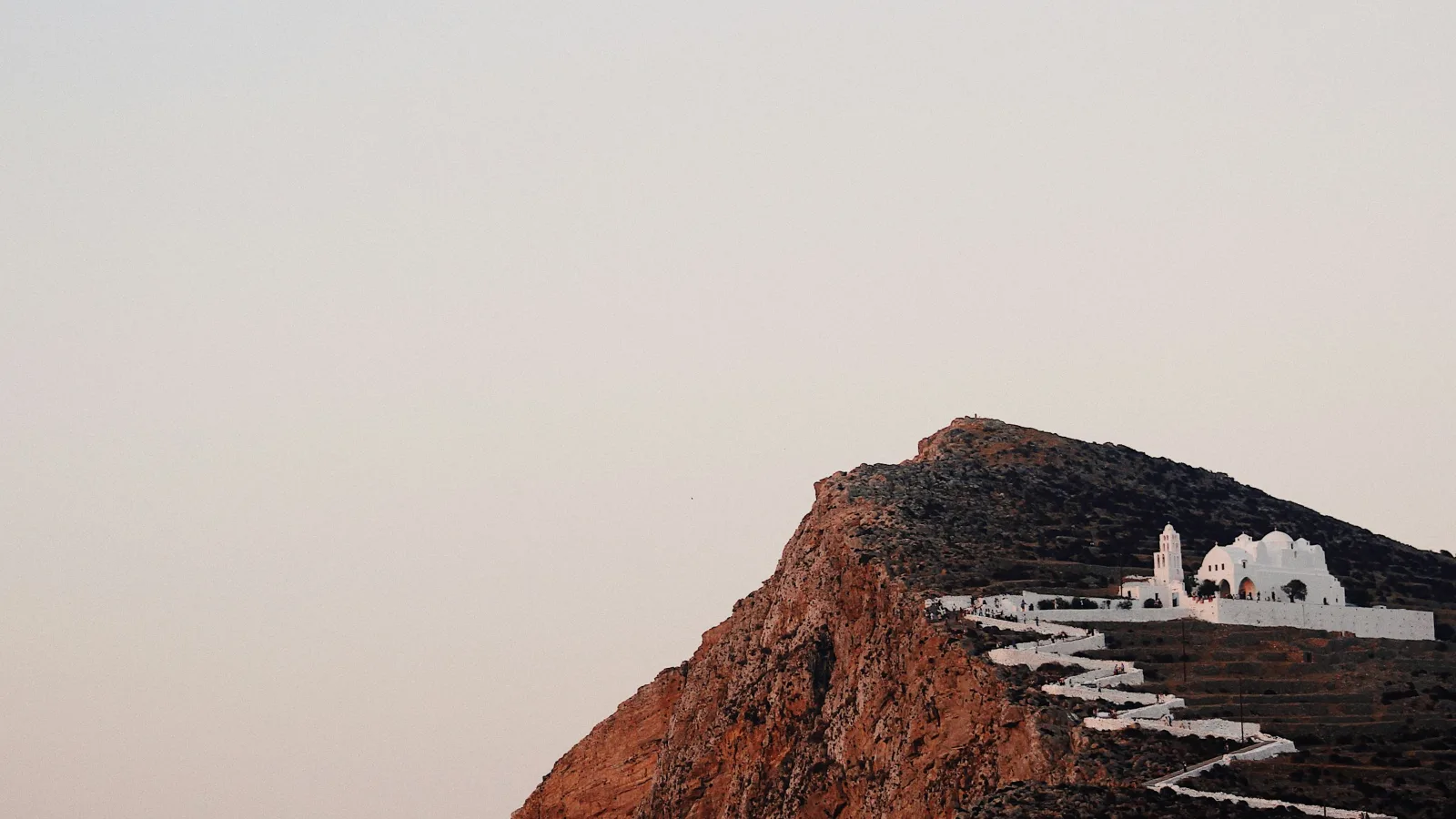
Folegandros, Greece, sits at the southern edge of the Cyclades - a small, steep island reached only by ferry, with no airport of its own and the nearest one over on Santorini. Its whitewashed capital, Chora, stands on the lip of a high sea cliff, the church of Panagia on the hill above it and the open sea a long drop below. This is not the quick, step-off-the-plane beach break that Santorini or Ios an hour away can be. Folegandros stays far quieter than either, and the quiet is the point - the direct result of how hard the island is to reach and how little it ever set out to build.
Where Folegandros is, and why it stays quiet
Folegandros is a small island in the southern Cyclades, south-west of Ios and lying roughly between Sikinos and Santorini. It covers about 32 square kilometres and holds only around 719 residents at the 2021 census, long and narrow, high and steep, and reached only by ferry.
The quiet has a cause you can point to. Folegandros simply never built the things that pull a crowd. There is no airport, there is one small ferry harbour, and the big cruise liners that unload thousands onto Santorini’s caldera each morning do not call here - Karavostasi is a harbour built for ferries, not cruise ships. So the island never fills the way its famous neighbours do, even in August.
Three places are worth fixing in your mind before anything else, because they shape every decision that follows. Karavostasi is the port, a small village on the south-east coast where every boat lands. Chora, the capital, sits up on the cliff just above it. Ano Meria is a long, spread-out farming settlement strung along the road to the north-west. Between them is not much except rock, terraces and old footpaths.

Diagram by Greece Trips. Free to reuse with credit - CC BY 4.0.
The Cyclades are usually shorthand for sun-bleached and crowded, and most of them earn it. This one does not: it is small, out at the southern edge of the group and off the busiest ferry routes, which the map makes plain at a glance. Small, ferry-only, and quieter for both - that is the orientation to carry into the rest of the trip.
Chora on the cliff, and the sunset climb to Panagia
Chora is the reason most people come. The capital sits on the very edge of a high sea cliff - a drop commonly given as around 200 metres - a pedestrianised warren of whitewashed houses whose lanes keep opening into a run of linked, plane-shaded squares. Cars stop at the edge of town; from there you walk. The squares are where the day slows down and the evening happens, one flowing into the next under the trees.

Diagram by Greece Trips. Free to reuse with credit - CC BY 4.0.
Inside the town is the Kastro, the medieval quarter the Venetians fortified, reported to date from the early thirteenth century. Its tall houses stand shoulder to shoulder along the cliff edge, their back walls forming a continuous rampart against the drop, and people still live in them. You enter through old gates and come out on lanes barely wide enough for two.
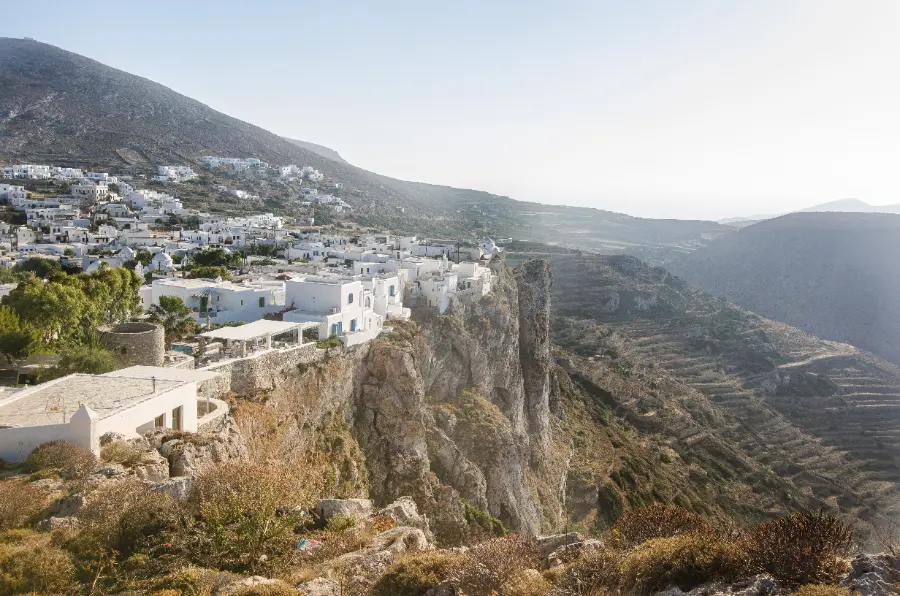
The climb to Panagia is the thing to time well. The church of Panagia stands on the hill above Chora, reached by a zig-zag paved path that switchbacks up from the top of the village - a short walk, but a steep one, roughly ten to fifteen minutes. It is the island’s trademark view and the place people gather for sunset. Go up before the sun actually drops, both for the light on the way and to be there ahead of the small crowd. Wear real shoes for the path. If you step inside, it is a working church, so cover your shoulders and knees; how to behave at Greek churches and monasteries is worth a look if you are unsure.
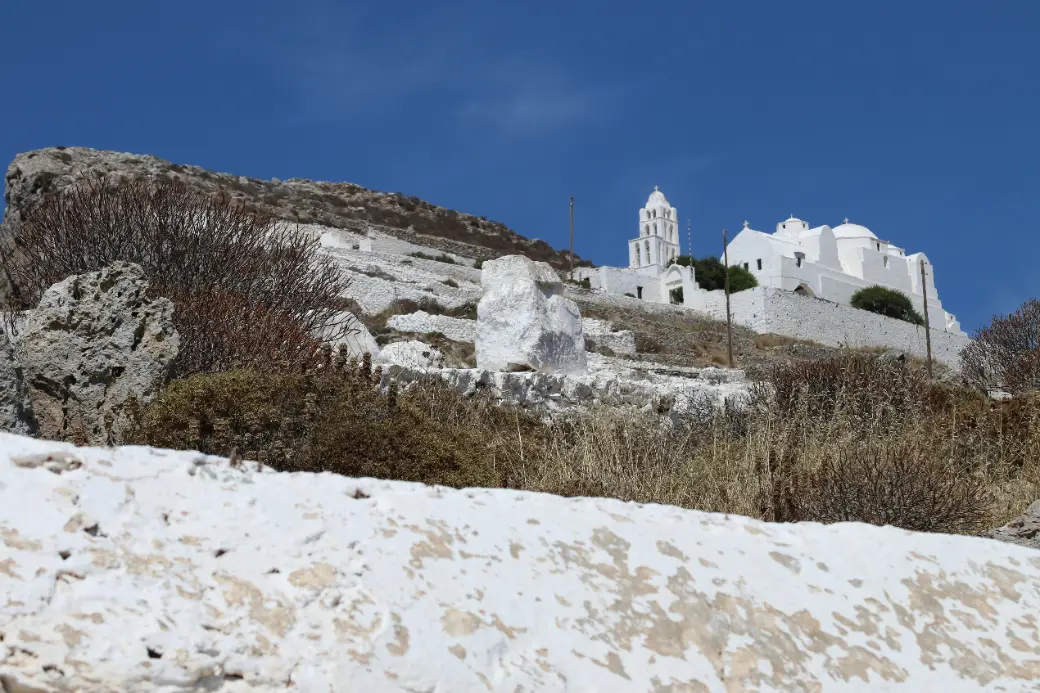
The church also stands on something older. The municipality’s own account has it built on the site of an ancient temple, using stone taken from it, and you do not have to take that on trust: ancient inscriptions, carved fragments and statue bases are set into the courtyard and the interior, where anyone can see them. Which god the sanctuary served is the looser part. The inscriptions recorded there are described as dedications to Artemis the Light-bearer and her brother Apollo the Protector, so if you have read that the church sits on a temple of Apollo, that is half the story at best - the dedications lead with Artemis.
None of Chora is a photo you take from the road. It is a place you walk into and stay in until dark.
The beaches, and the boat-or-hike reality
Folegandros is not a step-off-the-road beach island, and it is honest to say so before you book. A couple of coves are easy to reach. Most of the good beaches are not: you get to them by a small boat from Karavostasi or Agali, or by a hike down a rough, largely shadeless path. Which coast is worth the effort depends on the day’s meltemi, the north wind that blows through the Aegean summer. This is a feature, not a flaw - it is why the water stays clear and the sand stays empty - but plan for it.
Sorted by how you reach them, the beaches break down like this:
- Agali (Angali) is the easy one - reached by road and the island bus, sandier than most, the friendliest for families, and the jumping-off point for a short boat hop to smaller neighbouring coves.
- Katergo, near Livadi and south-east of Karavostasi, is the famous strip of pebble and sand, reached by a boat from Karavostasi or a walk of roughly half an hour from Livadi. There is no shade and no facilities.
- Livadaki and Agios Nikolaos are reached by boat or a longer walk over the hill.
- Ampeli and Agios Georgios are the remote end - down rough tracks that really want a quad, with no facilities when you arrive.
The useful habit is to pick the beach by the day’s wind rather than by a ranking. When the meltemi is up, which is most of high summer, the sheltered choice is a south-facing cove; leave the exposed sand for a still day. The beach boats run on their own schedule from mid-morning on, so an early walker often has a cove more or less to themselves for an hour. Reading the wind before you choose is the whole skill, and it helps to understand what the Greek sea is actually like day to day before you commit to a beach base.
Ano Meria and the walking that ties the island together
Beyond Chora and the port, the island opens into Ano Meria - a long, thin farming settlement strung along the north-west road, not a village with a centre so much as a scatter of old stone farmsteads, the thimonia, with small churches between them and an ecomuseum, set in one such farmstead, that lays out the island’s rural past. It keeps a short summer season and opens in the late afternoon and evening rather than through the day, so check before you make the trip out. This is working Folegandros, the part that never turned into a resort, and it is the clearest answer to anyone who calls the island empty.
What stitches it all together is the walking. Folegandros carries a network of footpaths that link Chora, Ano Meria and the coves along old stone tracks - the municipality lists five routes totalling about twenty kilometres - a gentle village loop for an afternoon, or a longer through-walk with big sea-and-cliff views for a serious morning. The paths are a large part of why the quiet reads as character rather than emptiness: there is plenty to do here, it just moves at walking pace.
The one real caution is heat. The trails are exposed and largely shadeless, and high summer is hard on them, so walk in the cool of the morning or come in the shoulder season, and carry more water than you think you need. That thread runs straight into when to come at all, because the shoulder season is when these walks are at their best.
Getting to Folegandros: Santorini is the practical gateway
There is no airport on Folegandros, so every route in ends on a ferry. The realistic ways to reach it are these:
- Fly into Santorini and hop across. Santorini has the nearest airport that takes international flights, and Milos is a real alternative rather than a distant one, and the crossing to Folegandros runs roughly forty-five minutes to just over an hour on a high-speed boat, closer to three hours on a conventional ferry. Boats leave Santorini from Athinios, the ferry port, not from the old port below Fira.
- Take the direct ferry from Piraeus. From the main Athens port, a high-speed catamaran is a little under four hours; a slower car ferry runs roughly seven to eight and a half, depending on how many islands it calls at.
- Hop from another Cyclades island. In season, the same lines connect Folegandros with Ios, Milos, Sifnos, Paros, Naxos and others, so it slots into a wider route rather than sitting at a dead end.
Every arrival finishes the same way - by boat, at the island’s one port, Karavostasi. That single fact is worth holding onto, because it shapes the risk. Connections are far more frequent in summer than in winter, high-speed catamarans cost more and move faster than the conventional car ferries, and both the timetable and the crossing time shift with the season and the operator, so treat any single figure as a starting point and check the day’s sailings when you book. How Greek island ferries actually work - ports, tickets and boarding - is worth reading once first.
The honest risk on a small, remote island is the wind. High-speed boats are the first to be pulled in a strong meltemi, and a cancelled or full sailing can leave you a day behind, so build slack around a flight home and never pin a same-day international departure to a single afternoon ferry. If a boat does fall through, what to do when a ferry is cancelled is the page to have open. Fly into Santorini with a night’s margin and the whole thing gets easier.
When to go, and getting around once you land
Late May into June and September into early October are the sweet spot. The sea is warm enough to swim, the light and the trails are at their best, the meltemi is milder than it will be at the peak, and Chora stays calm in the evening. July and August are the hottest and busiest stretch - August in particular fills with Greek holidaymakers - and the windiest, with ferries and beds at their fullest, so book well ahead if those are your dates. Reasons beat degrees here; for the country-wide picture, see the best time to visit Greece.
Getting around is simple once you accept the scale of the place. A small local bus links Karavostasi, Chora, Ano Meria and Livadi, with a stop at the Agali junction rather than down at the beach itself, and it runs more often in summer, though the timetable is limited. For the freedom to reach a trailhead or catch a morning beach boat, many visitors rent a quad or a scooter; a full car is rarely worth it on an island this size, and whether you need one at all is a fair question to ask before you pay for it. If you do rent, how hiring a car or ATV in Greece works covers the paperwork. Chora is pedestrianised, so wherever you stay up there, you park at the edge and walk in.
As for the evenings: this is not a party island, and nobody should sell it as one. After dark the linked squares of Chora fill with tavernas and a handful of small bars, and the scene is a long dinner, a drink and a stroll between the trees - good company rather than a dance floor.
Where to base yourself: port, Chora, or a beach
There are only a few places to stay on Folegandros, and the choice sets the rhythm of your day more than any single room does. Looking for hotels in Folegandros comes down first to picking between three areas.
Karavostasi, the port on the south-east coast, is the practical base - handy for ferries, with a couple of swimmable coves within reach and quieter evenings, a short bus ride or drive below the capital. Chora, up on the cliff, is the heart of the island: the evening life, the squares and the sunset church are all on your doorstep, but it is pedestrianised, so you carry your bags in from the edge, and it is the busiest base in high season. Agali, the small beach bay on the south coast, is the one to choose if you want to swim straight from your base and keep things low-key, though it is limited in what it offers and tied to the bus and the road.
Beds are few whichever you pick, and they fill through July and August, so reserve early in high summer - what to book ahead on a small island is the short version of why.
Who Folegandros is for, and who should skip it
Folegandros is worth it if you want a small, dramatic, uncrowded Cyclades island - a cliff-top Chora, a sunset church, clear-water coves and a genuinely slow pace - and you do not mind a ferry to get there and a bit of effort to reach the beaches. It is the wrong island if you came for nightlife, easy access or resort sand.
It fits couples and quiet-seekers, walkers, slow travellers, and island-hoppers building a calm leg into a busier route. The mismatch is a matter of temperament, not shortcoming: this is not the place for a party week or a fly-in beach resort, and it does not pretend to be. If that trade sounds right, it pairs well with a bigger, better-connected island - weigh it as a couples-and-quiet trip, slot it into a Cyclades island-hopping route, or set it beside Amorgos, another island that wears its quiet on purpose.
Folegandros FAQ
Where is Folegandros?
Folegandros is a small island in the southern Cyclades, south-west of Ios and roughly between Sikinos and Santorini. It covers about 32 square kilometres, has around 719 residents, and has no airport, so you reach it only by ferry. It belongs to the Cyclades, out at the group’s southern edge.
Does Folegandros have an airport, and how do you get there?
Folegandros has no airport. You reach it by ferry - most easily by flying into Santorini and taking a short crossing of roughly forty-five minutes to an hour, or by the direct ferry from Piraeus, which runs a little under four hours on a high-speed boat and roughly seven to eight and a half on a conventional one. Every boat lands at the one port, Karavostasi.
Is Folegandros worth visiting?
Yes, if you want a small, dramatic, uncrowded Cyclades island - a whitewashed Chora on the edge of a high cliff, a sunset church, clear-water coves and a slow pace - and you do not mind reaching it by ferry and working a little for the beaches. It is a poor fit for nightlife or an easy resort week.
How many days do you need in Folegandros?
Two or three nights is enough to slow down, walk Chora, watch a sunset from the church and reach a couple of beaches. Give it four or more if you want the remote coves, the walking and time to do very little, which is rather the point of the island. The ferry effort makes a single night rarely worth it.
Is there nightlife in Folegandros?
Not in the club sense - Folegandros is a quiet island. After dark the linked squares of Chora fill with tavernas and a handful of small bars, good for a long dinner, a drink and a stroll, and that is the whole of the scene. People come here to wind down, not to stay out late.
Is Folegandros good for families with young children?
It can be, with one caveat: most of the good beaches need a boat or a hike down a rough path, which is hard going with small children. Families tend to base near Agali, the most accessible beach, sandier and shallower than the rest and reachable by the island bus. It is still a slow, walk-heavy island, so set expectations to match.
Plan by category
The Folegandros guides
5 guides, each scoped to a decision you actually have to make.
 Attractions
Things to do
See the attractions →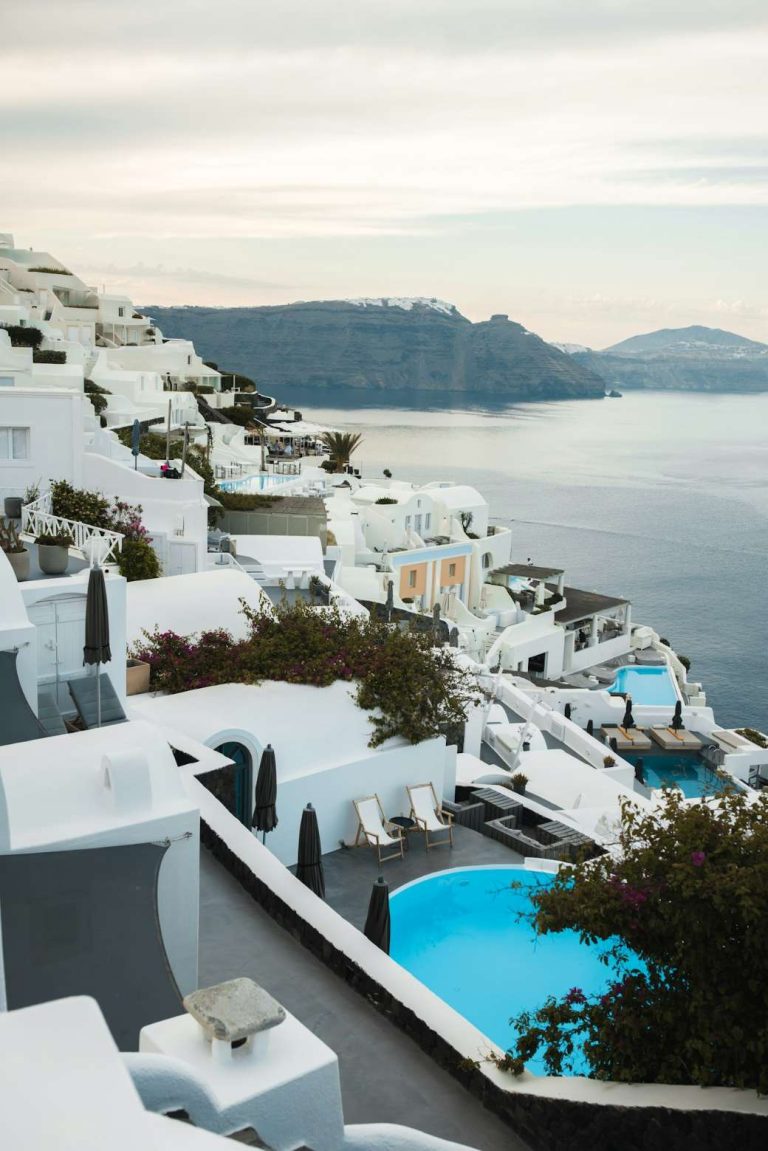 Hotels
Where to stay
Compare the areas →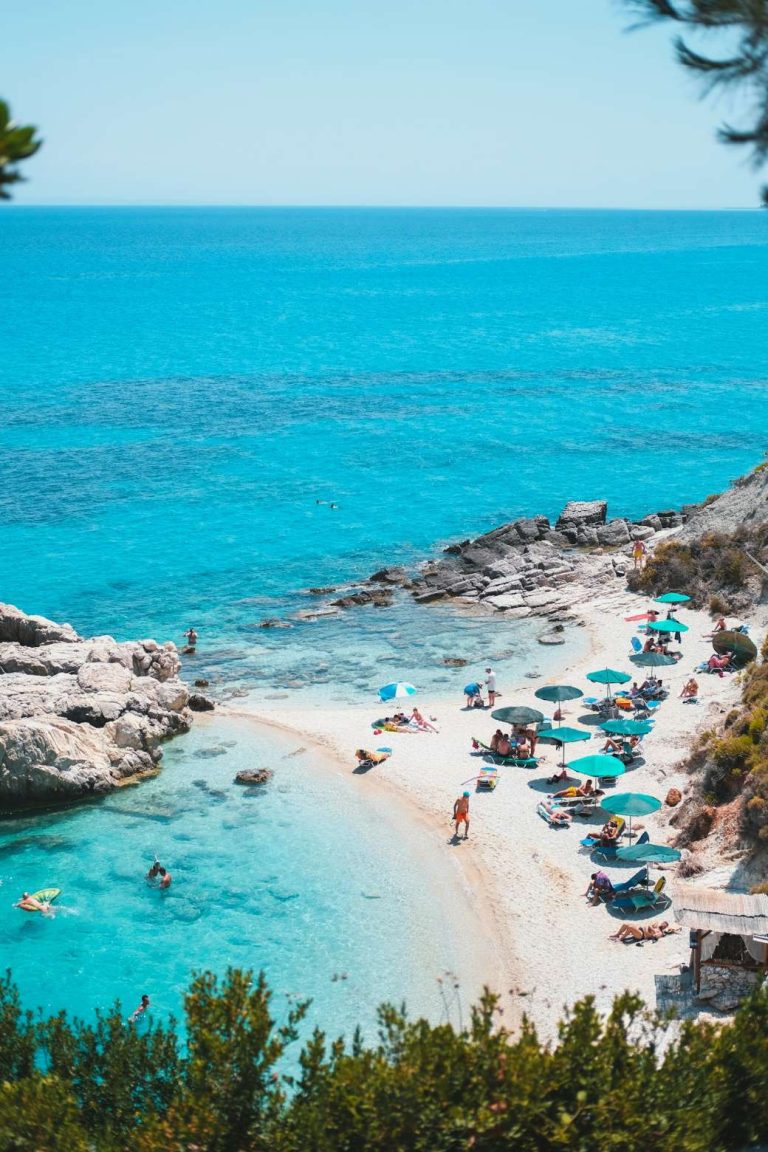 Beaches
The beaches
See the beaches →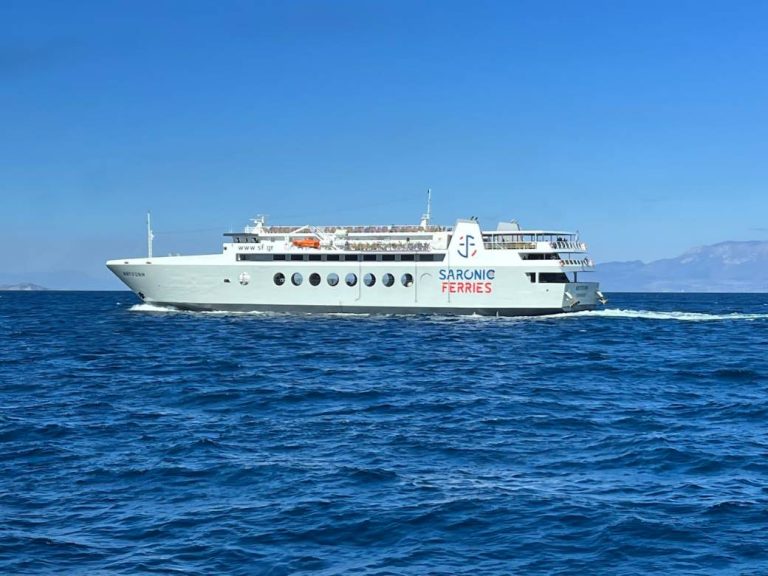 Itinerary
Day by day
See the itinerary →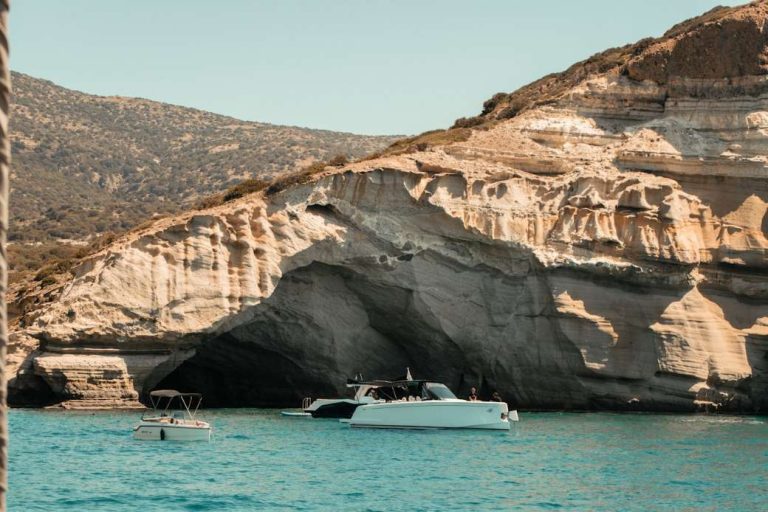 Day trips
Day trips
See the day trips →
Booking
We sell nothing and book nothing for you. Every guide on this page tells you how to arrange each piece yourself - which ferry operator, when to book, what to prebook and what to leave loose.