Island group
Cyclades (central Cyclades, mid-way on the Piraeus-Paros-Naxos-Ios-Santorini ferry spine), South Aegean, Greece. Given as roughly 18 km end to end and about 10 km across
Airport
None. Ios has no airport; you reach it only by ferry. Nearest airports are Santorini (international) and Naxos or Paros (domestic), from which you cross by boat
Getting there
By ferry only, most often from Piraeus, also Rafina and Lavrio, plus short hops from neighbouring islands; the Naxos-Ios crossing is the shortest hop, around 25 minutes on the fast boats. Other durations vary by vessel and season, so take them from the operator or the ferries guide rather than a fixed number here
Best months
May to early October, with June and September the sweet spots (warm sea, long days, thinner crowds); July-August is peak heat and peak party; outside the season most seasonal businesses close and the island turns inward.
Known for
An accurate party reputation concentrated in Chora and on Mylopotas, balanced by a quiet coast (Manganari in the south, the beaches of the north and east); the Homer’s-tomb tradition at Plakotos; the Early Cycladic settlement at Skarkos near the port
Travel details last checked July 2026.
Two islands on one hill
Ios Greece is not one island. It is two, stacked on the same hill, and the one you get is a choice you make before you book, not a matter of luck. The whole place turns on a single hilltop town, Chora, with one long beach, Mylopotas, on the slope just below it, a single ferry port down at Gialos, and a quiet coast to the south and north that most of the summer crowd never lays eyes on.
Which of the two islands you end up on depends on two dials: the month you come, and the base you pick. In August, Chora is a party that runs until the first ferries move again. In late September the same lanes are a silent Cycladic village with the sea still warm. Both are the real Ios, at different hours.
This page gives you both without selling either, and it hands the going-out detail to a page built for it. One durable fact to start with: there is no airport, so you arrive by boat. If the party is what you came for, the nightlife runs here.
Where Ios sits, and why its shape decides your trip
Ios sits in the middle of the Cyclades, in the southern Aegean, roughly halfway between Santorini to the south and Paros and Naxos to the north. It is small, small enough to drive end to end in well under an hour, with a single main port and a single main town on the hill above it.
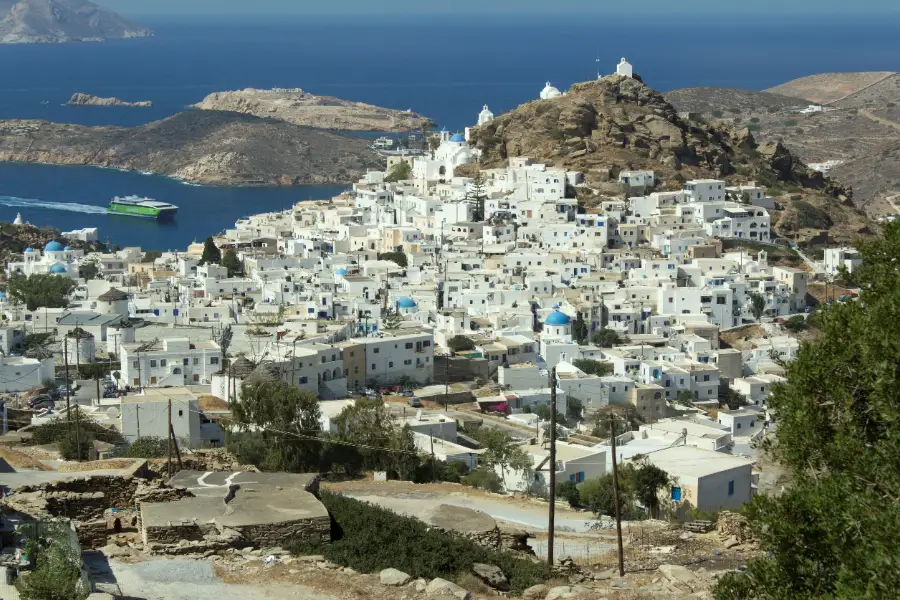
The anatomy is easy to hold in your head. You land at the port, which the maps call Gialos or Ormos; Chora, the whitewashed main town, sits on the hill directly above it; Mylopotas, the long sandy beach, is a short way down the far side of that hill. Everything else, the south around Manganari and the north toward Plakotos, is quieter and needs wheels to reach.
Here is the part the guides leave you to work out for yourself. Because the loud half of Ios is packed into one small town and one beach, the rest of the island stays genuinely quiet at the very same time. You do not have to wait for the shoulder season to find an empty stretch of sand in July; you just have to drive past Mylopotas. The duality is built into the geography, not only into the calendar.
Ios is small, given as roughly 18 kilometres end to end and about 10 across by the standard geographic references, and that scale is the whole reason it can be two islands at once. Loud and quiet are ten minutes apart, so nothing here is far from anything else, and the same afternoon can hold a packed beach and an empty one. It is also why Ios reads so well as one stop on a Cyclades island-hopping route rather than a destination you fly into and settle.

Diagram by Greece Trips. Free to reuse with credit - CC BY 4.0.
Getting to Ios is always a boat
Ios has no airport. Every arrival is by sea: a ferry from one of the Athens ports, most often Piraeus, or a shorter hop from a neighbouring island. If you want to fly, you fly to a neighbour that has a runway and cross the last stretch by boat.
That neighbour is usually Santorini or Mykonos, which both take international flights, or Naxos or Paros, which take domestic ones from Athens. From any of them you finish the journey on a ferry, and the Naxos-Ios crossing is the shortest hop onto the island, timetabled at around twenty-five minutes on the fast boats. Exact crossing times are set by the operators and change with the vessel and the season, so take them from the ferry company rather than from a guide.
This is worth planning around rather than working around. Ios sits mid-corridor on the busy run that threads Piraeus to Paros to Naxos to Ios to Santorini, which makes it one of the easiest islands in Greece to add to a hopping plan and one of the worst to pick for a fly-in, fly-out week. The boat is not a hurdle on the way to Ios; it is the reason Ios works as a link in a chain.
Once you are on the island, the core is covered by the bus that runs between the port, Chora and Mylopotas, which is all most people need for the town and the main beach. What opens up the rest, Manganari in the south, Agia Theodoti in the northeast, the road out to the north point, is an ATV, a scooter or a small car. The far beaches stay empty largely because you have to want them enough to rent wheels.
There is one more piece of the transport story, and it matters only after dark. It is genuinely unusual for a party island, but it belongs on the page built for the night rather than here: the night bus keeps Ios moving after the bars close. For how ferries, buses and transfers fit together across the country, see getting around Greece, and for the boats themselves, how Greek island ferries actually work.
When to go, and what each month actually gives you
The season on Ios runs from May to early October. June and September are the sweet spots: warm sea, long days, and a thinner crowd. July and August are the hottest and by far the busiest, when the party is at full volume. Outside that window most of the island closes down.
Picking the month is the same decision as picking which Ios you get, so make it on purpose. If the party is the point, come in July or August, when the town is full and the beach bars run from midday. If the quiet island is the point, come in June or September and you get the empty beaches and the calm village with water still warm enough to swim. The shoulders on either side, late May and early October, are quieter still, and the sea stays swimmable into the autumn even as the venues thin out.
Then the honest warning the bed-sellers will not print. If you want calm, do not book a room in Chora in August. Not because the town is bad, but because the town is the venue then, and it is small enough that the party fills all of it. The fix is simple and it is in your hands: come in the shoulder months, or base yourself outside the town. Get the month right and Ios gives you the holiday you pictured; get it wrong and it gives you someone else’s.
If you are choosing the month before you choose the island, which is usually the right order, start with the best time to visit Greece.
Chora and Mylopotas: the loud half
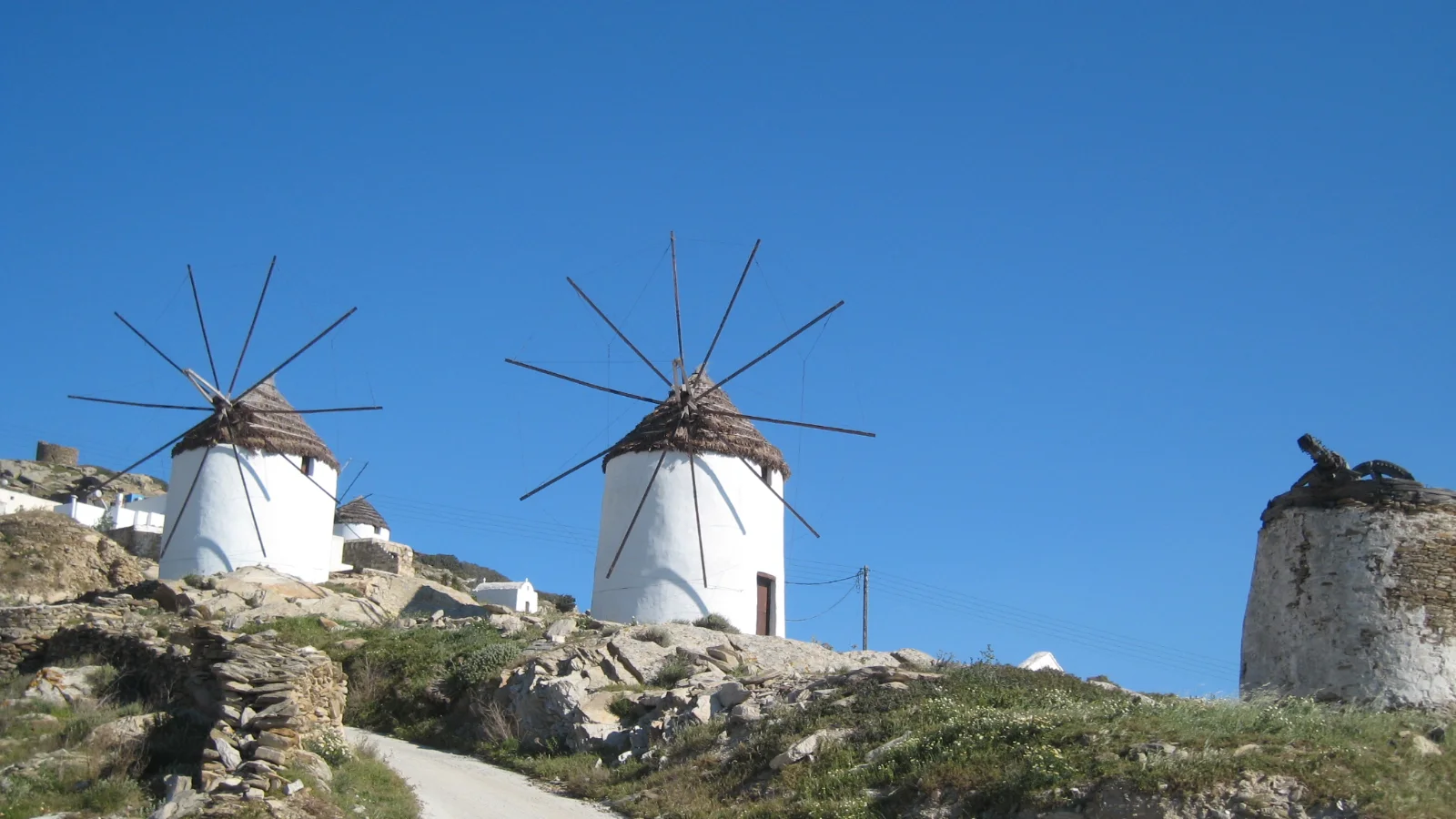
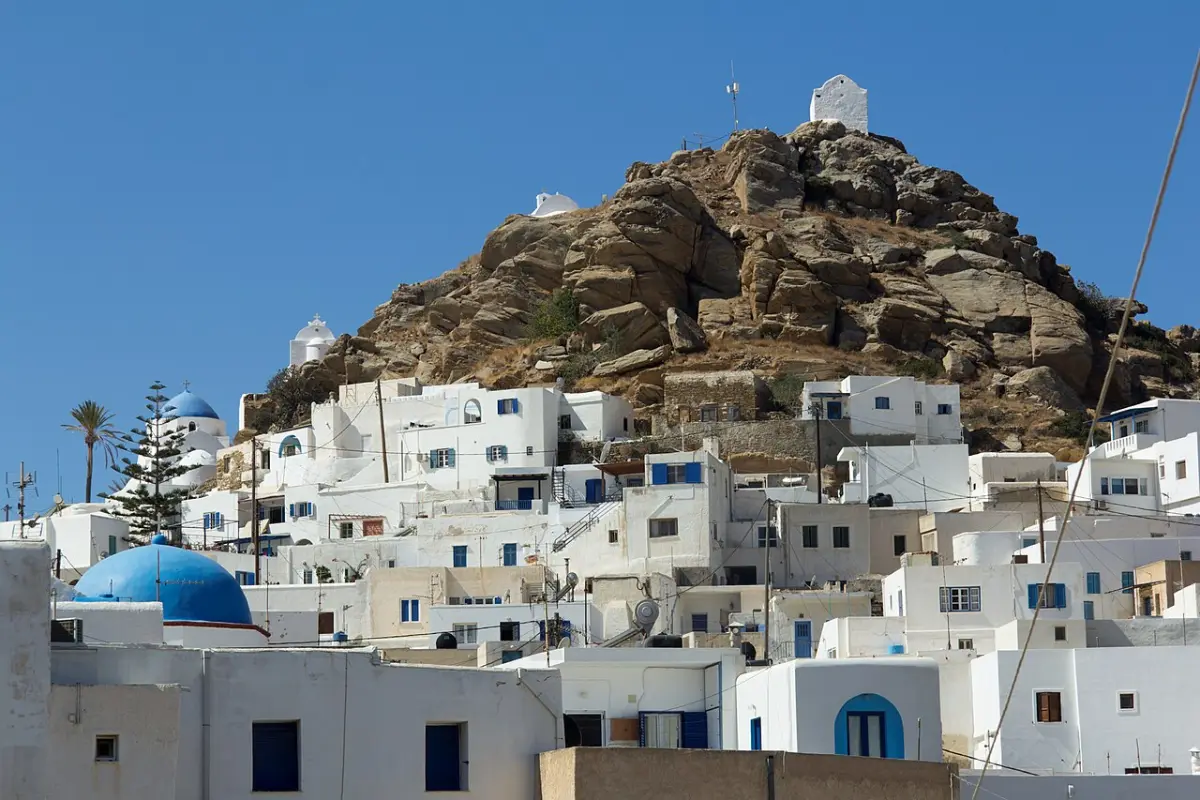
Chora is a real Cycladic hill village that happens to hold the island’s entire nightlife inside its lanes. Strip away the reputation and it is a working town: whitewashed houses stacked up a slope, a main square, alleys too narrow for a car, a row of windmills along the ridge, the sunset church of Panagia Gremiotissa at the top, and the small open-air Odysseas Elytis theatre. The bars are wedged into that fabric, in the houses along the lanes and around the square, which is exactly why a night here is walkable and needs no taxi. The lanes are worth walking in their own right, before any of it opens.
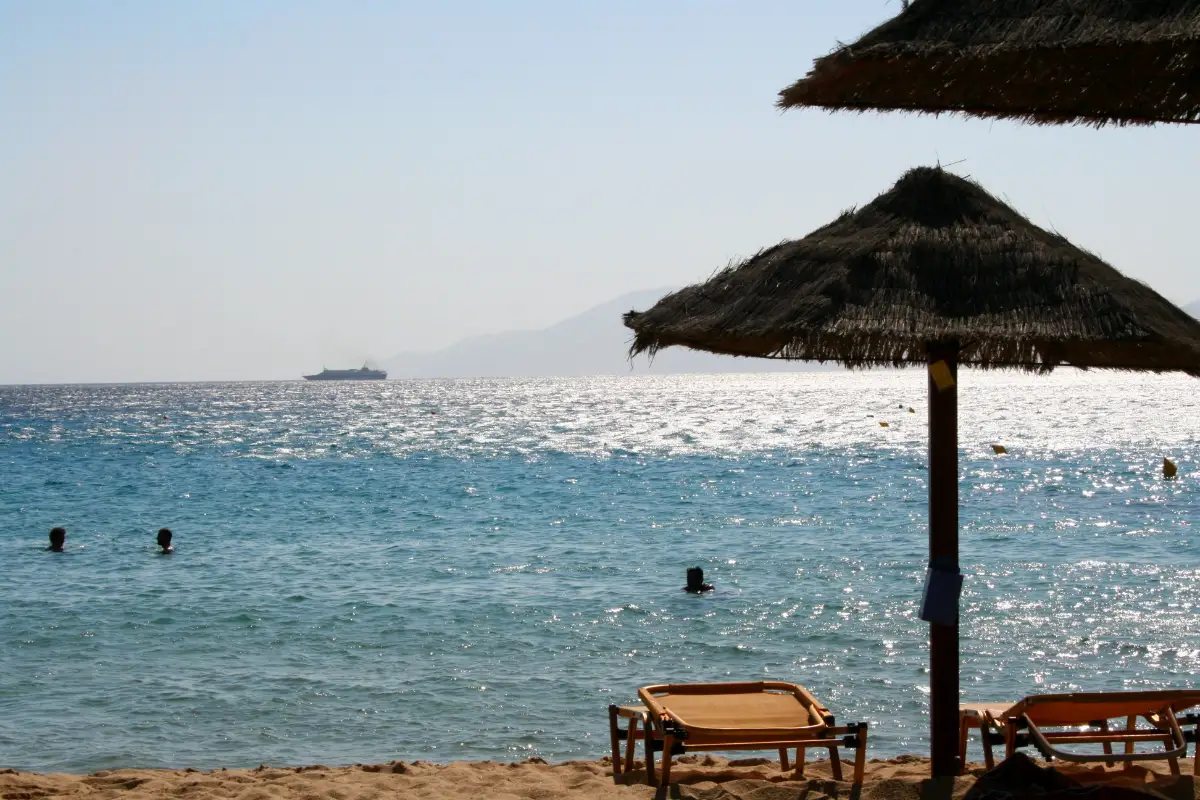
Mylopotas is the other half of the loud island, and it runs in daylight. It is the long sandy beach a short way below the town, and in season its beach bars carry music and day parties from the middle of the afternoon. Between the two, the town above and the beach below, you have the whole Ios of the reputation, and it is a small footprint on a much larger island.
This page stops at the character of those two places on purpose. What the night is actually like, where it sits, who it is for, when it runs and how you get home from it, all lives on a page built for the question. If the going-out is why you are here, read where the nightlife actually is, and how you get home; if you are still deciding which party island suits your group, compare them by what you actually want.
And if the loud half is not why you are here at all, the good news is that it stops at the edge of town. The nightlife stays in Chora and on Mylopotas rather than colonising the coast, which is what every guide to the island reports. Drive ten minutes south and Ios becomes a different island entirely, which is where this guide goes next.
The quiet Ios: beaches beyond Mylopotas
Leave Mylopotas behind and Ios turns into a coast of long, mostly empty beaches, and the effort it takes to reach them is exactly what keeps them empty. Most need a scooter, an ATV or a car, and a few need a short walk on top of that, which is a filter the day crowd rarely passes.
The ones worth knowing:
- Mylopotas - the main event, long sand below the town, the liveliest and the easiest to reach.
- Manganari - a run of sheltered, shallow bays across the south, calm and widely rated among the best water in the Cyclades, and the place to head when the wind is up.
- Agia Theodoti - a broad sandy bay on the northeast coast, quiet and open, with an old church and a slow feel.
- Psathi - remote and low-key on the east side, reached on a rougher road.
- Koumbara - the closest quiet beach to the town, just past the port, with a headland and clearer water.
- Valmas - a small cove near the port, a quick escape when you do not want to travel far.
Pick your beach by the wind as much as by the map. When the meltemi blows through the Cyclades in high summer, the exposed beaches get choppy and the sheltered south around Manganari is the calm choice; on a still day the whole coast is fair game. None of this is a promise about conditions on the day you swim, so read the water when you arrive rather than the descriptor here.
The walks between the beaches and up onto the ridge are part of the quiet island too, and on somewhere this small they add up: a morning on foot from the town to a beach and back is one of the better things to do here, and it costs nothing and books nothing. It is also the clearest argument for treating Ios as one leg of a Cyclades route rather than a single fixed base.
Homer’s tomb and Skarkos: the island’s older claim
Long before the bars, Ios made a much older claim: that the poet Homer is buried here. A site at Plakotos, on the northern tip of the island, has been called Homer’s tomb since antiquity. Ancient writers put the story on record, with Pausanias and Strabo both naming Ios as the place where Homer died, the Suda repeating it, and the tradition running back through the reports of Herodotus, and a seventeenth-century traveller’s identification is where the modern location hardens into a spot you can walk to.
What none of that does is prove it. The tomb has never been confirmed as Homer’s, and the honest thing to say is that Ios has held the tradition for a very long time, not that the poet lies there. Say it that way and the walk out to the north still earns itself: a quiet road, rock cairns, the wind, and an empty headland at the end of it, worth the trip whoever is or is not buried under it.
The island’s other deep-history site sits much closer to the port. Skarkos is an Early Cycladic settlement from the Bronze Age, one of the better-preserved of its kind anywhere in the Aegean, with its finds held in the small archaeological museum in Chora. It is the part of Ios the party guides skip entirely, and reaching it, like reaching the tomb, is a walk. Both the site and the museum are run by the Ephorate of Antiquities of the Cyclades and both are ticketed and closed one or two days a week, so take the current hours from the ephorate close to your visit rather than from a number printed in a guide.

Who Ios is for, and how many nights it earns
Ios rewards two travellers who want opposite things, and it does both well, as long as each one gets the month and the base right.
If you are in your twenties, travelling with friends, and you want a party that starts on a beach in the afternoon and ends at dawn without a taxi fare in the middle of it, this is your island. Come in July or August, base yourself in or just below the town, and read the full nightlife guide before you go.
If you are a couple, a family, or an older independent traveller who has heard “party island” and wants the quiet Cycladic one underneath, it is here and it is real. Come in June or September, or base south of the town, and you get empty beaches and a silent village. The one genuine mismatch is booking a room in Chora for calm in August, because the town is the venue then; the fix is the shoulder season or a base outside the centre, and it is entirely avoidable.
On where to sleep, think in areas rather than addresses. Chora puts you inside the night and the village life. Mylopotas puts you on the main beach with the town a short hop above. The quiet south, reached with a car, gives you calm and distance from both. Which area you choose matters more than which building.
As for length, Ios earns two or three nights on a route, and rarely a full week. It pairs naturally with its ferry neighbours: hop it with Santorini to the south or Naxos and Paros to the north, and let the island-hopping guide build the chain. If it is the budget you are weighing rather than the days, what a Greece trip costs has the mechanics.
One island, your choice of hour
So the whole decision about Ios comes down to two dials, and you now know what each one moves. The month sets the volume: August for the party, June or September for the quiet, with the sea warm either way. The base sets your pace: the town to be in the night, the beach or the south to be out of it. Set both on purpose, arrive by boat because it is the only way in, and give the island two or three nights inside a wider Cyclades route rather than a week of its own. Do that and Ios is not a gamble; it is the island you chose. The going-out detail waits on the nightlife guide, and the route it belongs to is island-hopping the Cyclades.
Ios FAQ
Is Ios worth visiting?
Yes, for the right traveller. Ios is worth it if you want either an accurate party island or a quiet Cycladic one, because it is genuinely both at once. The trick is matching your month and your base to the half you want. Come for the party in high summer, or for the calm in June and September; the only way to be disappointed is to book one half expecting the other.
Does Ios have an airport?
No. Ios has no airport, and the only way to reach it is by sea. You take a ferry from one of the Athens ports, or you fly into a neighbouring island that has a runway, Santorini, Mykonos, Naxos or Paros, and hop across on a shorter boat. For the boats themselves, see the Greek island ferries guide. No timetable here, because they change every season.
How many days do you need in Ios?
Two to three nights suits most trips: enough for the town, the main beach and one of the quiet ones, with a night out folded in if you want it. A week is usually too long unless you are settling in specifically for the party or the calm. Ios works best as one stop on a Cyclades island-hopping route, not as a base for the whole holiday.
What is the best beach in Ios?
Mylopotas is the main one: long sand below the town, easy to reach, and the liveliest. Manganari, in the south, is its opposite, a run of sheltered, shallow bays that stay calm and quiet. Choose by what you want, facilities and company or space and stillness, and by the wind, since the sheltered south is the better bet when the meltemi is up. Read the water on the day rather than any ranking.
Is Ios a party island?
Yes, and its reputation is one of the more accurate in Greece. But nearly all of the nightlife is packed into one small hilltop town and the beach below it, so the rest of the island stays quiet at the very same time. For where the night actually is, who it is for and how you get home, see the full nightlife guide.
Is Ios expensive?
Ios has long been one of the cheaper Cyclades islands for a young traveller, built on a backbone of hostels and budget rooms rather than five-star resorts. High summer and the party economy push prices up, and a quiet luxury end does exist, so what you spend depends on when you come and how you travel. For the mechanics of a Greece budget, see what a Greece trip costs.
Plan by category
The Ios guides
5 guides, each scoped to a decision you actually have to make.
 Attractions
Things to do
See the attractions → Hotels
Where to stay
Compare the areas →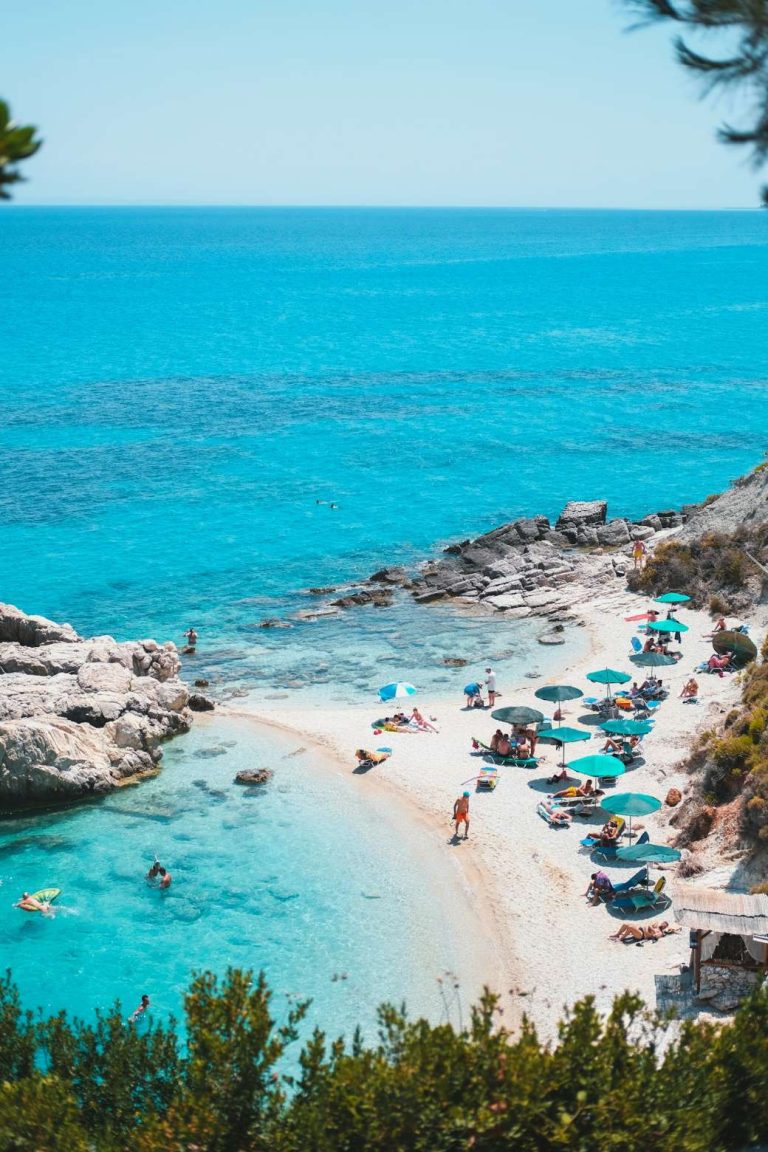 Beaches
The beaches
See the beaches →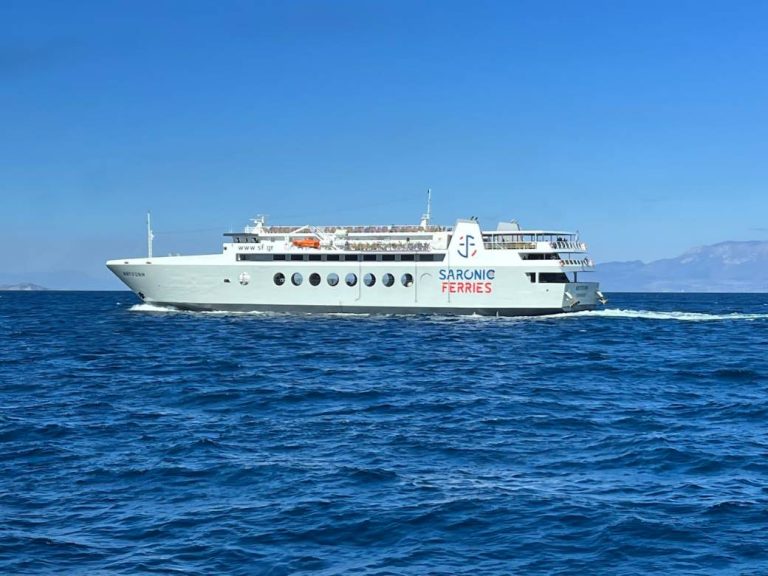 Itinerary
Day by day
See the itinerary →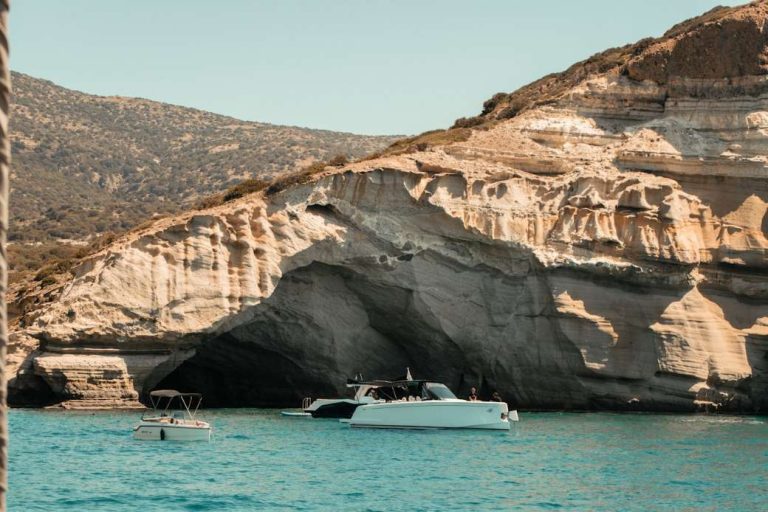 Day trips
Day trips
See the day trips →
Booking
We sell nothing and book nothing for you. Every guide on this page tells you how to arrange each piece yourself - which ferry operator, when to book, what to prebook and what to leave loose.