Island and scale
Paxos (Paxi/Paxoi) is the smallest of the main Ionian islands, in the Ionian Sea just south of Corfu - about 10 km long by up to 3 km wide, which is 6 miles by 2. The island covers about 25 sq km; the municipality, including Antipaxos and the islets, about 30. Population about 2,470 at the 2021 census. Main town: Gaios
Access
by boat only. No scheduled flights land on Paxos; the usual route is to fly into Corfu International Airport (CFU) and cross by ferry to the new port beside Gaios - about 55 minutes from Corfu Town or 45 from Lefkimmi - with a daily year-round crossing from Igoumenitsa of about 1h 30m and a seasonal August-to-October line from the southern Ionian. Parga runs day cruises, not a scheduled ferry
The villages
three harbour villages - Gaios (capital and main port, south), Lakka (a horseshoe bay at the north tip) and Loggos (a small former fishing harbour on the northeast coast) - with Antipaxos, the sandy-beached islet, a short boat hop off the south coast
Best months
late May-June and September; May-October is the season, July-August is peak, and the island half-closes by late October. Warm sea, everything open, and none of the August squeeze
Travel details last checked July 2026.
Paxos: the small Ionian island you reach by boat
Paxos is the smallest of the main Ionian islands, and the one you cannot fly to. It sits just south of Corfu, barely six miles of olive groves end to end, with three small harbour villages - Gaios, Lakka and Loggos - and the near-empty islet of Antipaxos a short boat ride off its south coast. You can see it on a day boat from Corfu, and plenty of people do. But the island is built for a slow stay rather than a checklist: quiet coves, long dinners, and evenings the day boats never see. This page is written for the multi-night version - how to reach Paxos, where to base, and what the coast and the water are actually like.
Where Paxos sits, and how small it really is
Paxos is the smallest of the main Ionian islands: about ten kilometres long, which is six miles, and no more than three kilometres across at its widest. The island itself covers around 25 square kilometres; the municipality, which takes in Antipaxos and the smaller islets, comes to about 30. Roughly 2,500 people live in it, counted at the 2021 census. You can drive its length in under half an hour and walk a good deal of it, which is the first thing to grasp before you plan a stay.
It lies in the Ionian Sea just south of Corfu, the big island that is also its gateway, and it is a different kind of place from the Aegean islands most people picture. Low olive-green hills stand in for bare rock, and a spine of ancient olive groves runs the length of it.
That spine divides two very different coasts, and the difference is a planning decision, not just scenery. The east side is low and sheltered, a run of pebble and shingle coves with easy access from the road and the villages. The west is the wild side: high white cliffs and sea caves that most people meet from a boat or by walking down to a single bay. Where you swim, and to some degree where you sleep, follows that split.
The three villages sit around the sheltered side. Gaios, the capital and main port, is in the south; Loggos is halfway up the northeast coast; Lakka fills a bay at the northern tip. Antipaxos, the islet that holds the sand, is a short hop off the south coast.
You reach Paxos by sea. It has no airport, so the next question, and the one that shapes everything after it, is which boat.
Getting to Paxos: it is a boat, and usually through Corfu
No scheduled flights land on Paxos, so every arrival is by boat. The usual route is to fly into Corfu International Airport and take a ferry across to Paxos, which docks at the new port just outside Gaios; from there the town is a ten to fifteen minute walk.

Diagram by Greece Trips. Free to reuse with credit - CC BY 4.0.
From Corfu you have a real choice, not just a timetable. A high-speed passenger boat runs direct from Corfu Town in about fifty-five minutes, year-round, three to seven days a week depending on the season. That is the simple option: step off your flight, cross the town to the old port, and you are on Paxos before lunch. The cheaper alternative is a car ferry from Lefkimmi, at the southern end of Corfu, about forty-five minutes across but with the drive or bus down the length of Corfu first. You trade a little money for time and some faff.
The mainland is the route most guides bury, and it is the most dependable of the lot. Igoumenitsa, the port on the Epirus coast opposite Corfu, sails to Paxos daily and all year, in about an hour and a half. If your dates fall outside the summer, or if the Corfu boats are full, that is the crossing to look at first.
Parga, a little further south, is a different animal and worth naming as such. What runs from Parga through the warm months is day-cruise boats, not a scheduled ferry line, so treat it as an excursion that shows you the island rather than a crossing you can build a one-way arrival around.
There is one more door, and it only opens late. From roughly August into October a southern Ionian line links Paxos with Lefkada, Meganisi, Ithaca, Kefalonia and even Zakynthos, a few days a week. It is slow, most of those are half a day or more on the water, but it means a late-summer trip can reach Paxos without going through Corfu at all.
Operators swap vessels and times every season, so the useful thing to carry is not a number but a habit: this is a popular summer route, the Corfu boats sell out in July and August, and you want to book the crossing before you travel rather than turn up at the quay. Kerkyra Lines is one of several names on the Corfu run, alongside Kamelia Lines and Ionian Blue Wave, but check the current sailings yourself, and read how Greek island ferries work once before a first crossing. The ticket, not the guidebook, is the authority on the day.
The three villages, and which one to base in
Paxos has three harbour villages and very little built up between them, so choosing a base is really the main decision you make about where to sleep, and it is a choice of pace rather than of hotel. They run from busiest to quietest, and on an island this small even the busiest is calm.
Gaios
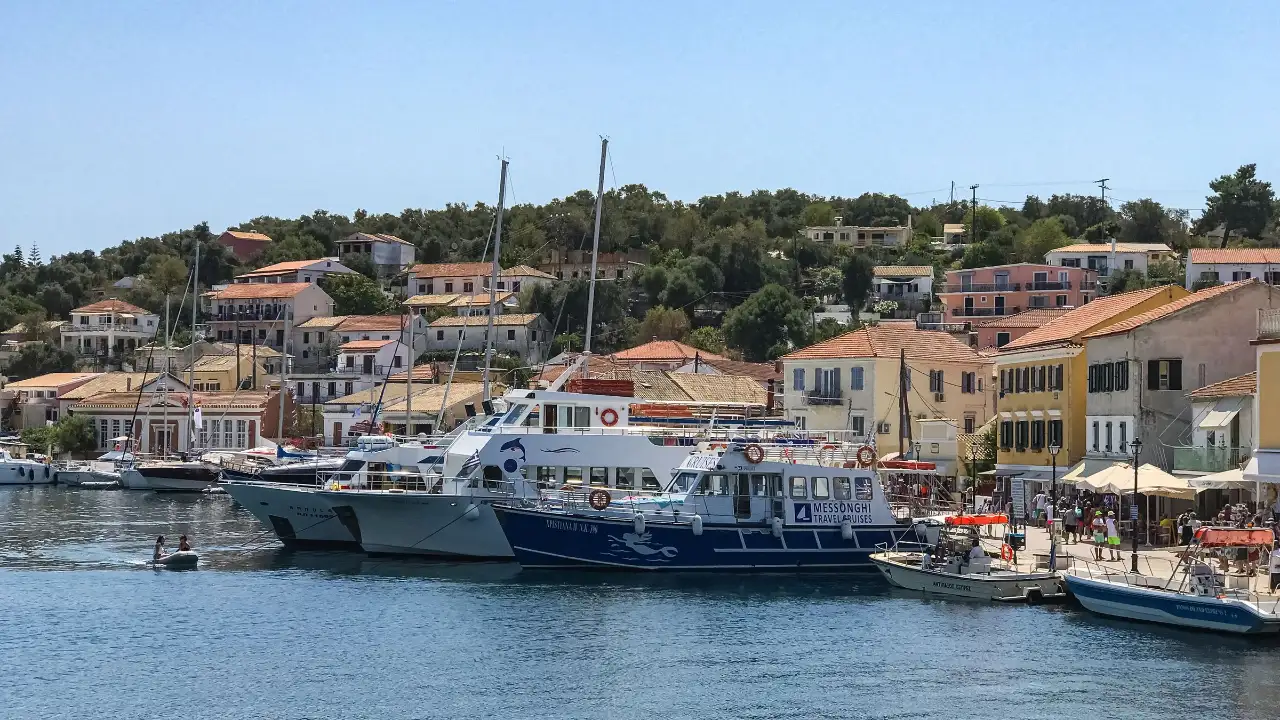
Gaios is the island’s front door and its only real town. The capital and main ferry port, it wraps around a natural harbour that two little wooded islets, Agios Nikolaos and Panagia, screen almost entirely from the open sea, which is why the water inside stays flat. Most of what the island keeps in the way of shops, services, ATMs and boat hire is here. As a base it is the most practical of the three and the liveliest, which on Paxos still means quiet: the right choice if you want to arrive, stock up, and not move far to do anything.
Lakka
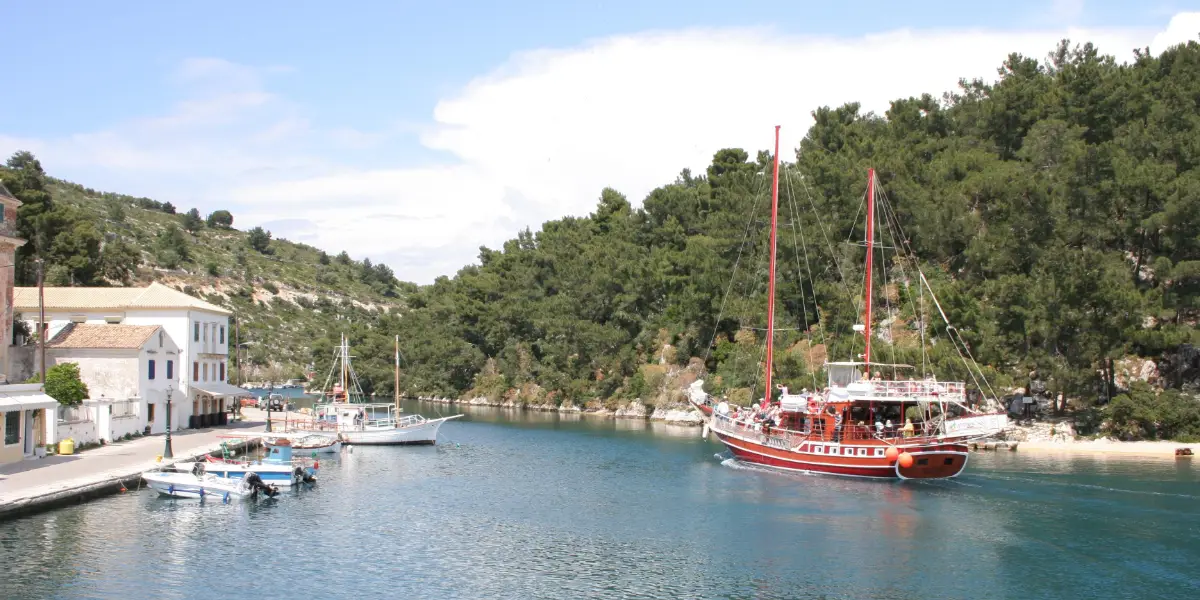
Lakka sits in a near-enclosed horseshoe bay at the northern tip, ringed by olive-covered hills, and it is the village travellers most often name as their favourite. The bay’s calm water makes it the island’s small centre for swimming and sailing, and short walks lead out to nearby coves, with Plani the closest. Base here for a slower stay built around swimming and walking, well clear of the ferry comings and goings at Gaios. It is far enough from the port to feel like a retreat and small enough that you will recognise faces by the second evening.
Loggos
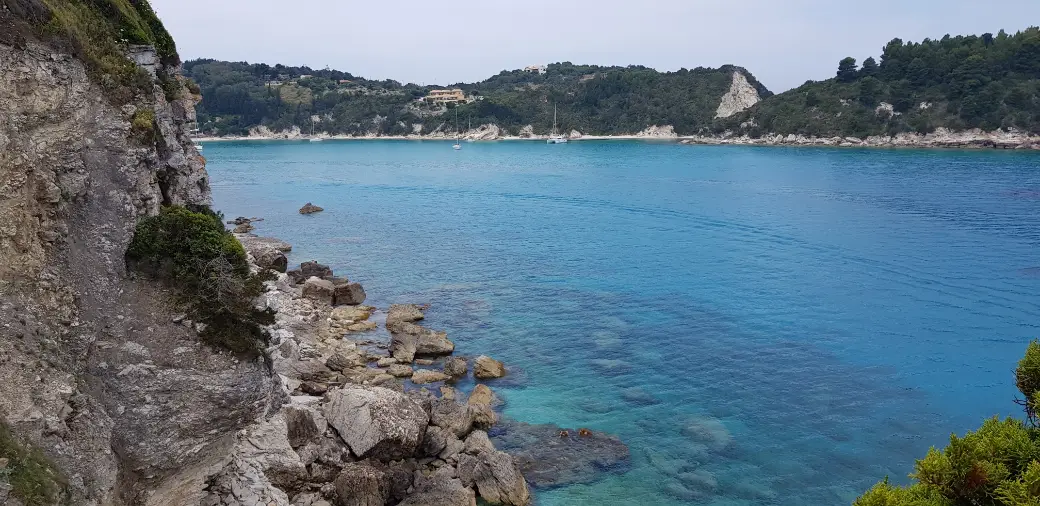
Loggos is the smallest of the three, a former fishing harbour tucked into a narrow inlet on the northeast coast. It is the quietest base on an already quiet island, and its reputation rests on its waterfront, where a cluster of tables along the water makes dinner the event of the day. There is little to do here beyond swim, read and eat, which is precisely the appeal for couples and anyone who wants the least happening. Gaios and Lakka are both an easy drive or water-taxi away when you want a change of scene.
Beaches and the coast: pebble coves east, cliffs and caves west
Set your expectations at the quay: Paxos does not have a wide sandy beach. Its own coast is pebble and shingle coves, sometimes just a few metres of shore below the olives, and if it is broad soft sand you are picturing, that is Antipaxos, across the water and covered next. Knowing that before you land saves the one disappointment first-timers report.
The easy swimming is all on the east coast. A string of small, sheltered coves sits within reach of the villages and the road, shallow and calm, the kind of place you walk to before breakfast or once the heat has dropped. For families and for a low-effort swim, this side is most of the answer.
The drama is on the west. Here the land rises into high white cliffs pierced with sea caves, and two features are worth knowing by name. Erimitis is the island’s newest beach: pale pebbles below towering cliffs halfway down the western side, opened up in 2008 when an earthquake brought the cliff down and left a new shore behind it. It has since become the place the island sends you for the sunset, which is reputation rather than anything published. Tripitos, on the west coast toward the southern end, is a large natural arch left standing when part of a sea cave collapsed. You reach it by walking a few hundred metres of footpath from the hamlet of Ozias, or you see it from the water on a boat trip. Both repay the effort of getting to them.
Most people meet the west coast from the water, on a boat trip that runs the cliffs and noses into the caves. That is not only for the view. The west is exposed and the caves sit under high rock, so a small hired boat is the wrong tool there in any swell, and the organised trips go when conditions allow. What the Greek sea is like from one coast to the next is worth reading before you rent anything that floats.
Antipaxos: the swim everyone crosses for
Antipaxos is a tiny islet about three kilometres off the south coast of Paxos, reached only by small boat or water taxi from Gaios. The hop is a matter of minutes rather than an hour, but no operator publishes a timetable for it: these are water taxis and excursion boats, and the boatman sets the time. There is no ferry terminal or airport on the islet, and nowhere much to stay, so it is strictly a day trip: people cross for two beaches, Vrika and Voutoumi, and go back to Paxos to sleep.
This is the water people are picturing when they picture Paxos, clear and shallow and pale over sand. Vrika is the sandy one, a small bay you can wade into from soft sand; Voutoumi is pebbles under exceptionally clear water. Both sit beneath low cliffs and vineyards, because Antipaxos, tiny as it is, makes a little wine of its own.
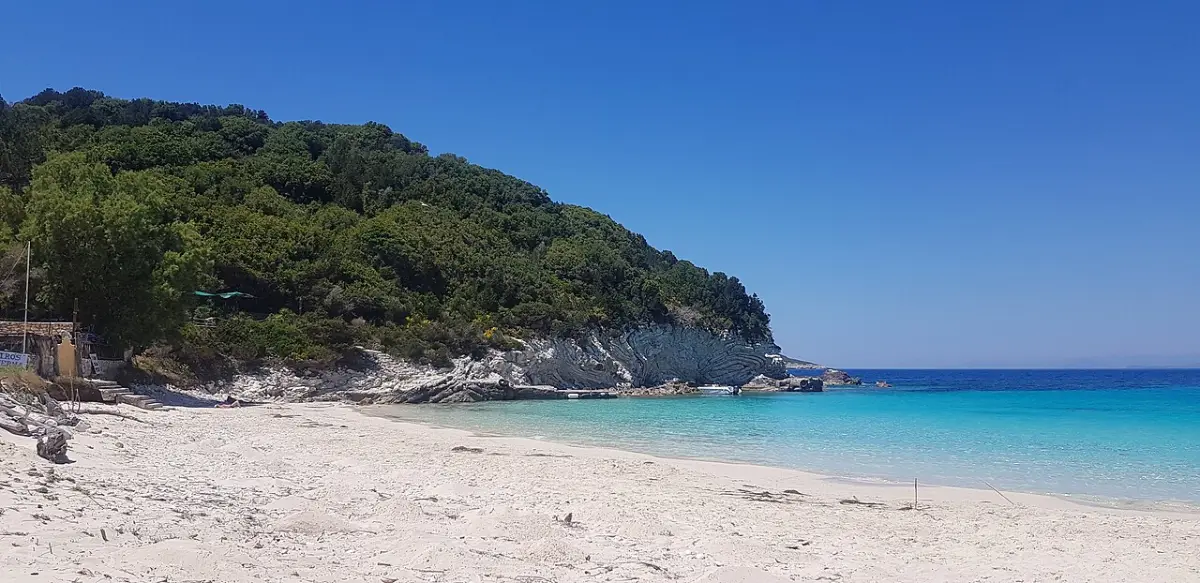
The real advice is about timing, and it is a mechanism rather than a number. In July and August both beaches fill around the middle of the day, when the day boats arrive together from Paxos, Corfu and Parga; go early or late, or come in the shoulder months, and you can have them close to empty. A day cruise that lands at noon sees Antipaxos at its most crowded and its least like the photograph that brought you.
Boats leave Gaios through the day: water taxis, larger tourist boats, or a self-drive rental if you are confident on the water, with fares that change by season and operator. Ask at the quay in Gaios the day before rather than expecting a published schedule. Bring water and a plan, because there is almost no shade on Antipaxos and only a handful of seasonal beach tavernas, which come and go with the years.
When to go
Paxos runs roughly from May to October, and its two best windows are the shoulders: late May and June, and September. In those weeks the sea is warm enough to swim, the villages and the boats are all open, and the crowds and heat of high summer have eased off. That is the stay to aim for.
July and August are the peak. It is the hottest and busiest stretch, the ferries and the Antipaxos boats are fullest, and anything you want, a crossing or a room or a table, wants booking ahead. By the middle of October many tavernas and boat services begin to wind down, and the island settles toward its quiet winter. Spring greens the olive groves and the coves; autumn holds onto a sea that has had all summer to warm.
The season also changes what a day trip is worth. In high summer the day-boat crowds are exactly what a shoulder-season stay escapes, which is why the same three harbours can feel like a different island in June or late September than they do in the second week of August. For the wider calendar there is the best time to visit Greece, and the case for the quieter months in shoulder season in Greece.
Who Paxos suits, and who should skip it
Paxos rewards a particular kind of traveller and quietly bores the rest, and it is worth being honest about which you are before you book. It suits couples who want quiet, families who want a calm base and easy coves within reach, sailors and anyone who likes being on the water, and travellers happy to let a day be a swim, a walk and a long dinner.
Its character is the opposite of a resort, and that cuts both ways. The beaches are pebble coves, the sightseeing is the villages and the coast themselves rather than a museum or a ruin, and the evening runs on dinner and a drink by the water rather than a club. None of that is a flaw; it is the whole point of the place. But if nightlife or a packed sightseeing list is what you are after, another island will serve you better, and you should give one to it.
You can, of course, do Paxos as a day boat from Corfu or Parga, and many people do. But a day trip lands you in Gaios and on Antipaxos at exactly the hours they are busiest, and it sends you home before the evening, which is the part worth coming for. If your trip has the room, give the island three nights or more.
The natural way to build that is with Corfu, which is both the gateway and the obvious other half of the trip. The rest of the country waits in the destinations index for another time.
Practical Paxos: money, getting around, staying connected
Whether you even need a car is a real question here, because the island is under half an hour end to end. Base yourself in one village and you can get by on foot within it, with scheduled water taxis and small boats linking the harbours and reaching some of the beaches. A car or a scooter earns its keep if you want the west-coast bays and the quieter coves without waiting on a boat; it is the difference between the island the ferry crowd sees and the one you go looking for. Neither choice is wrong, and the decision is really about how much you intend to roam. If you do hire, the mechanics are the same as anywhere else in renting a car in Greece.
Cash matters more than on the mainland. ATMs are limited and cluster in Gaios, with a little provision in Lakka, and some smaller places prefer cash, so draw what you will need before you need it rather than assume a machine in every harbour. The wider picture is in money in Greece.
For anything minor the island has its own public health centre, on the road out of Gaios toward Lakka, and pharmacies in the villages. Anything more serious is dealt with on Corfu or the mainland, which is one more reason to keep the Corfu link in mind when you plan, and worth reading alongside pharmacies and health. Mobile coverage and wifi are reliable enough in the villages that staying in touch is no trouble, though a strong signal in every remote cove is not something to count on.
Make it a stay, and make it part of a wider Ionian trip
The friction is the feature. Because you can reach Paxos only by boat, and usually only through Corfu, it never grew the airport strip and the package resorts that reshaped louder islands, which is exactly why it is still three olive-grove harbours and a near-empty islet. The island asks for slow days, and the reward for giving them is the version of Paxos the day boats never see. So build it as a stay, and hang it off its gateway: fly into Corfu, give the big island a few days, then cross for a few more, and you have one composed Ionian trip rather than a snapshot.
Paxos FAQ
Does Paxos have an airport?
No scheduled flights serve Paxos, so travellers reach it by sea. The usual way is to fly into Corfu International Airport and cross by boat, most often the high-speed ferry from Corfu Town, about fifty-five minutes, or the car ferry from Lefkimmi at Corfu’s southern end. From the mainland, Igoumenitsa sails daily and year-round in about an hour and a half. Parga sends summer day cruises rather than a scheduled ferry.
How many days do you need in Paxos?
Three nights is the sweet spot: enough to see Gaios and one other village, swim the east-coast coves, take the boat round the west-coast caves, and cross to Antipaxos, without rushing the slow pace that is the reason to come. More days suit anyone after a genuine unwind, and a single day sees the island at its most crowded.
Can you visit Paxos as a day trip from Corfu?
Yes: day boats run from Corfu, and seasonally from Parga. But they land you in Gaios and on Antipaxos around midday, when both are busiest, and they take you home before the evening, which is the part worth staying for. If your trip allows it, come for a few nights instead.
How do you get from Paxos to Antipaxos?
By small boat only. Water taxis and tourist boats leave Gaios through the day for the Vrika and Voutoumi beaches, a short hop of minutes rather than an hour, and you can also hire a small boat yourself. No operator publishes a timetable, so ask at the Gaios quay. There is no ferry terminal on Antipaxos, so go early or late in summer to beat the day-boat crowds, and take water with you.
Do you need a car on Paxos?
Not necessarily. If you base in one village and use the water taxis and boats between the harbours, you can manage without one on an island you can cross in under half an hour. A car or scooter mainly buys you the west-coast beaches and the quieter coves on your own schedule. It is a decision about how much you want to roam, not a requirement.
Is Paxos or Corfu better for a first Ionian trip?
Corfu is the easier first base: it is bigger and better connected, it has its own airport, and it has far more to see. Paxos is the quieter, deeper cut you add on for a few slow days once the logistics of arriving are behind you. For most first-timers the honest answer is to do both, Corfu first, then Paxos.
Plan by category
The Paxos guides
3 guides, each scoped to a decision you actually have to make.
 Attractions
Things to do
See the attractions →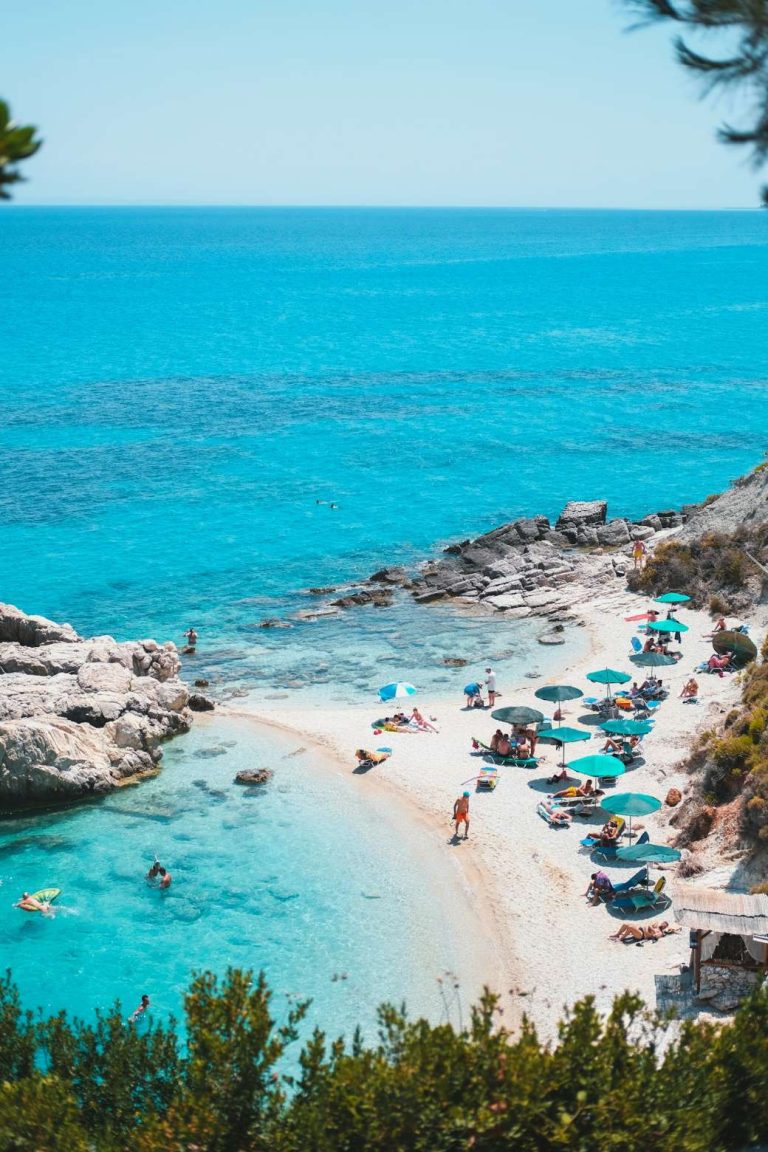 Beaches
The beaches
See the beaches →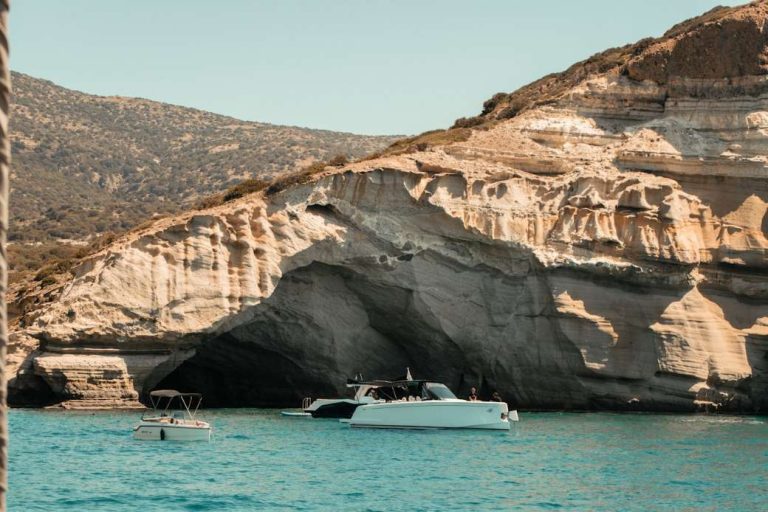 Day trips
Day trips
See the day trips →
Booking
We sell nothing and book nothing for you. Every guide on this page tells you how to arrange each piece yourself - which ferry operator, when to book, what to prebook and what to leave loose.