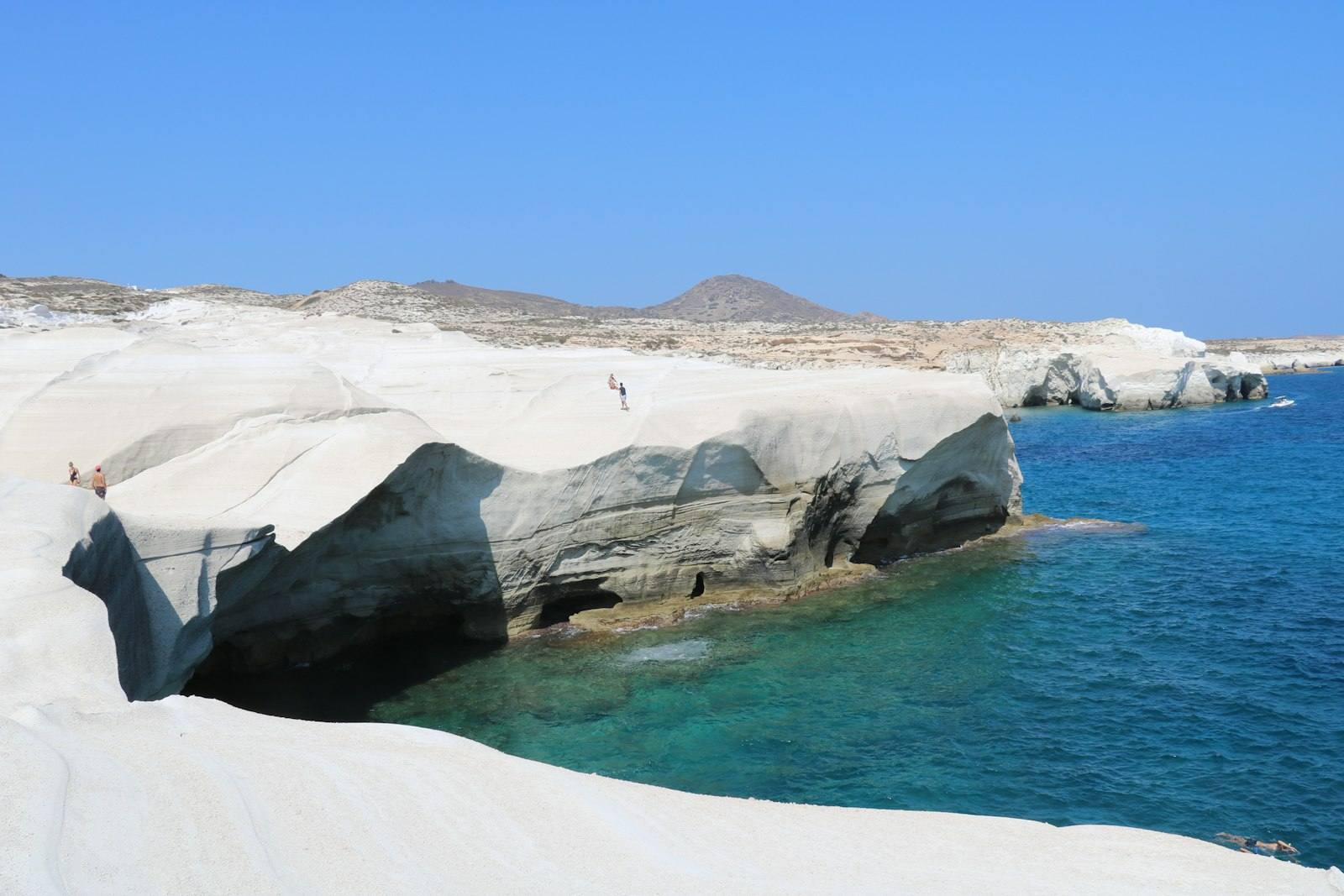
Island group
Cyclades (western Cyclades), South Aegean, Greece
Airport
Milos National Airport - IATA code MLO (domestic only; from Athens ATH in roughly 40–45 minutes on Sky Express and Olympic Air/Aegean)
Ferry from Piraeus
~2h40m by high-speed (SeaJets) up to ~7h on the multi-stop western-Cyclades line (Kythnos, Serifos, Sifnos, Kimolos); a conventional direct sailing is ~4–5h. Arrives at Adamas (Adamantas)
Best months
May–June and September–early October (shoulder-season sweet spot; July–August is hottest, busiest and windiest as the meltemi peaks)
Travel details last checked July 2026.
Milos in one look: a mined volcano ringed by beaches

Diagram by Greece Trips. Free to reuse with credit - CC BY 4.0.
Milos is a volcanic island in the western Cyclades, in the South Aegean, reached by a short flight or a ferry south from Athens. It is shaped like a drowned volcano: an ancient eruption blew out the island’s centre and the sea flooded in, leaving the huge natural bay that the port town of Adamas sits on. That geology is the whole point of the place.
Milos is also a mining island, and always has been. It traded obsidian - volcanic glass sharp enough for blades - across the prehistoric Aegean, and it still quarries bentonite, perlite and other minerals today. The mining is why the coast looks the way it does: white pumice at Sarakiniko, red and orange rock at Paliochori, sulphur-yellow streaks and sea caves bored into soft stone. Few beaches here are even the same colour.
The human map is small. Adamas (Adamantas) is the port town and the hub, and ferries, buses and boat tours all leave from here. Plaka, the whitewashed capital, sits on the hill above with a Venetian castle on top. Scattered around the shore are the syrmata, tiny fishing hamlets where boats are garaged in colour-painted caves cut into the rock.
Milos island is small on the map, yet its coast is long and deeply folded - which is why simply reaching a beach can eat a chunk of the day. Of all the Greek islands, Milos is remembered for that coastline rather than for a capital or a skyline, and that is exactly why how you reach it decides the trip. The western Cyclades frame everything that follows.
The one rule that shapes a Milos trip: how you reach each beach
Milos has something like 70 beaches, and the useful way to sort them is not by looks but by how you get to them. Four modes cover almost the whole coast, and each asks something different of your planning.
- Boat-only. The roadless southwest - Kleftiko’s white sea-stacks, the Sykia sea cave, Gerakas, and the Polyaigos shore across the water - has no land access at all. You reach it on a boat tour out of Adamas, and only when the wind allows.
- Paved road, easy. Sarakiniko, Firiplaka, Paliochori, Provatas and the town beaches sit at the end of sealed roads, and a few are on the bus route. These are the ones you can do on a whim.
- Scramble or ladder. A handful reward a short climb. Tsigrado is reached down a rope-and-ladder descent through a gap in the rock, and Papafragas, whose descent is unstable and signposted as such (see below), was always a steep scramble.
- 4×4 or dirt track. A long run of the south and west coast is coves at the end of unpaved roads, where a low-slung rental car or a scooter struggles and a 4×4 or a capable ATV does not.

Diagram by Greece Trips. Free to reuse with credit - CC BY 4.0.
Two conclusions fall straight out of this. You will want one full day given over to a boat tour for the boat-only coast, and for everything else you will want a vehicle, ideally one that can take a dirt road. Plan those two things and the rest of Milos arranges itself around them. Which beaches are worth which effort comes further down this page, and in detail in the best beaches in Milos.
How many days Milos needs
Three to four days is the honest minimum, and four to five is the sweet spot. Two days only skims the island, because so much of your time here goes on getting to beaches rather than lying on them.
Here is what each length buys you.
Two days covers Sarakiniko, one boat tour and a village or two. It works only if Milos is a single stop on a longer western-Cyclades hop and you have made your peace with missing most of the coast.
Three to four days is the real minimum. It gives you beaches across the different access modes, a full-day Kleftiko boat tour, the syrmata villages, and an afternoon of the island’s culture around Plaka and Tripiti.
Four to five days is where Milos relaxes. You add slow beach days, the better tavernas, and a boat or ferry across to Kimolos or Polyaigos - the day trips that need a slot of their own.
Milos rewards a slower pace than its size suggests. To fit the island into a wider route, start with Cyclades island hopping.
When to come, and the wind that runs the summer
The best time to visit Milos is May to June and September to early October. You get warm days, a sea still swimmable into September, thinner crowds and lower rates than the July-August peak - and, on Milos especially, the calmer water that lets the boat tours sail.
July and August are the trade-off. It is the hottest, busiest and priciest stretch, and it is also the windiest, because this is when the meltemi blows hardest. The meltemi is the dry north wind of the Aegean summer, and on Milos it does more than ruffle your hair. It is the single thing most likely to cancel a Kleftiko boat tour, and it turns exposed north-coast beaches like Sarakiniko choppy and no fun to swim. On a windy day the island quietly reorganises itself: the sheltered south coast fills up and the north empties out.
So read the forecast for wind, not just temperature. A hot, blustery day makes for a worse swim than a cooler, still one.
Winter is mild but wet and windy, and most tourist services shut down.
| Season | Crowds | Prices | Sea and wind |
|---|---|---|---|
| May–Jun | Moderate | Mid | Warm, sea warming, wind usually light |
| Jul–Aug | Heavy | Highest | Hot and windiest - the meltemi peaks |
| Sep–early Oct | Moderate | Mid | Warm, sea still swimmable |
| Late Oct–Apr | Light | Lowest | Cool, wet, windy; most services closed |
The same shoulder-season logic holds across the country; see the best time to visit Greece and Greece weather month by month.
Getting to Milos: the western Cyclades ferry line, or a short flight
Milos sits on the western Cyclades ferry line out of Piraeus, the route that calls at Kythnos, Serifos, Sifnos and Kimolos on its way down. This matters more than it sounds. It means Milos pairs naturally with those islands, and that it is a slow, indirect hop from the central-Cyclades spine of Mykonos, Naxos and Santorini, which sit on a different line. If someone tells you to just ferry over from Santorini, check the schedule before you believe them.
From Piraeus you have a spread of crossings. A high-speed catamaran (SeaJets among others) can do it in around 2 hours 40 minutes; a conventional direct ferry runs closer to four or five hours; and the slower multi-stop sailings on the western-Cyclades line can take up to about seven, depending on how many islands they call at. All of them dock at Adamas.
Flying is the shortcut. Milos National Airport (MLO) takes only domestic flights, from Athens, in roughly 40 to 45 minutes on Sky Express or Olympic Air. There is no international service, so an overseas trip routes through Athens either way.
| Mode | Roughly | Arrives | Choose it if |
|---|---|---|---|
| Flight (ATH→MLO) | ~40–45 min | Milos airport | Your days are tight and you fly via Athens anyway |
| High-speed ferry (Piraeus) | ~2h40m+ | Adamas port | You want speed but also deck views |
| Conventional / western-Cyclades ferry | ~4–7 hrs | Adamas port | You are hopping the western Cyclades or saving money |
How the boats, ports and this western-Cyclades line actually work is covered in Greek island ferries; for the air route, see flights to Greece.
Why you’ll want a car, and why to book it before you land
A rental car on Milos is close to essential. The beaches are spread around the island, several of the best sit at the end of dirt roads, and there is no way to string a proper day together on foot. For the rough tracks down to the south and west coast coves, an ATV or quad handles what a low rental car cannot; scooters technically go anywhere but are genuinely risky on loose gravel, and no answer for two people plus beach bags.
The public bus is a real fallback, not a plan. It costs around 2 euros, runs cash-only, and links Adamas with Plaka, Pollonia and a few of the main beaches such as Sarakiniko - useful, but tied to a timetable that will not match the beach day you had in mind.
Taxis exist but are few, and a short hop can cost many times the bus fare, so agree the fare before you set off.
The blunt part: rental cars and ATVs sell out in July and August. Book before you land, not at the port, or you may find nothing left. For the wider picture, see getting around Greece and what a Greece trip costs.
Which base fits your trip: Adamas, Plaka, or Pollonia
Three towns hold almost all the places you would want to stay, and they suit different trips.
Adamas is the port and the transport hub - ferries, the bus network and every boat tour leave from here, and it has the most tavernas and shops within walking distance. It is practical rather than pretty. Pick Adamas if you are skipping the car, staying only a night or two, or want to roll off the ferry straight into your room.
Plaka is the whitewashed old capital on the hill, with lanes too narrow for cars, the Venetian Kastro for the island’s best sunset, and cafes looking out over the bay. It is the most atmospheric base and central to the Tripiti sights, but it is steep and parking is tight. Pick Plaka for character and the view.
Pollonia is a calm seaside village in the northeast, with waterfront fish tavernas and the short ferry across to Kimolos. It is the quiet, couples-and-honeymoon choice, and the furthest from the airport and port. Pick Pollonia to slow down.
Tripiti and Triovasalos, just below Plaka near the Catacombs, make a well-placed and often better-value overflow.
| Base | Vibe | Best for | Trade-off |
|---|---|---|---|
| Adamas | Busy port hub | No-car stays, short trips, arrivals | Functional, not scenic |
| Plaka | Whitewashed hilltop | Character, the sunset, the sights | Steep, tight parking |
| Pollonia | Quiet seaside | Couples, food, the Kimolos ferry | Furthest from port and airport |
Which actual hotel, in which town, is the real decision - we break it down by area in where to stay in Milos, and the case for the island as a couples trip is in Milos for couples.
The beaches worth the effort, by how you reach them
With the access modes in mind, here are the beaches that earn the effort.
Off a paved road, Sarakiniko is the one on every Milos photo: a moonscape of wind-smoothed white rock about 5 km from Adamas, ten minutes by car and on the bus route. Go early or late - there is no shade, it turns rough and unswimmable in a north wind, and the rocks near the water hide sea anemones worth stepping around. Paliochori and Firiplaka are long sweeps of sand under red and ochre cliffs, both drivable; at Paliochori the sand is warmed from below by geothermal heat.
Down a scramble, Tsigrado is a small, sheltered cove reached by a rope-and-ladder descent through a gap in the rock - good fun for the sure-footed, no place for a dodgy knee or a nervous child.
Papafragas is the cautionary one. Once a careful climb down to a slot of turquoise water between white cliffs, its descent is a steep scramble on crumbling ground, and signs at the rim warn of falling rock. We found no official notice closing the path, so treat the hazard as real and the status as changeable: look at the cove from the rim, and reach the water by boat rather than climbing down.
Reachable only by sea, Kleftiko is the headline: white sea-stacks and swim-through caves at the roadless southwest tip, visited on a boat tour from Adamas. Gerakas and the Sykia cave lie on the same boat-only coast.
One honest note on naturism: no Milos beach is officially designated for it, but a few quiet, harder-to-reach coves - Gerakas, the far side of Sarakiniko, Agios Konstantinos - tolerate it in practice.
The full rundown is in the best beaches in Milos, and Sarakiniko has its own page.
Beyond the coast: villages, catacombs, and a mining past
When the wind is up, or you have had your fill of sand, Milos has a second layer inland and around the shore.
The syrmata are the island’s signature: rows of boat garages cut into the coastal rock and painted sea-blue, red and ochre, with fishermen’s houses stacked above. Klima is the classic one, best in late-afternoon light; Firopotamos, Mandrakia and Skinopi are quieter versions of the same idea.
Around Tripiti, three sights sit within a short walk. The Ancient Theatre, Roman-era and marble-seated, looks out over the bay and is open to wander. The Catacombs of Milos, cut in the 1st to 5th centuries AD, are among the most important early-Christian burial sites anywhere - they keep set opening hours, so check before you go. A signposted spot nearby marks where a farmer unearthed the Venus de Milo in 1820; the statue itself has sat in the Louvre ever since.
For the island’s obsidian-and-minerals story, the Mining Museum in Adamas joins the dots, and for a walk, the coastal path toward Kleftiko and the trails around Plaka reward a cooler morning. It all runs deeper on the things to do in Milos page.
Eating on Milos: the Cyclades’ quiet food island
Milos eats better than a small island has any right to, and it is quiet about it. The best tables are not fancy - they are the fish tavernas at the water’s edge in Mandrakia, Klima and Pollonia, where the catch is whatever came in that morning.
Look for the local cheeses, manoura and xinomizithra; slow-cooked lamb and goat; and the island’s watermelon pie, karpouzopita. Book the waterfront tables in Pollonia and Mandrakia in high season - they are small, and they fill.
Where to eat, dish by dish and taverna by taverna, is on the where to eat in Milos page.
Day trips and where Milos fits in a bigger trip
The best day off Milos is spent on the water.
Kimolos, the small island a short ferry from Pollonia, is the easy one: quiet, walkable, with a handful of good tavernas and beaches emptier than anything on Milos itself. Polyaigos, uninhabited and just beyond it, has some of the clearest water in the Cyclades and is reached only on a boat tour - the same wind that governs Kleftiko governs this trip too.
Milos also makes more sense as a leg than as a whole holiday. On the western-Cyclades line it pairs naturally with Sifnos and Serifos, and quieter Folegandros is the obvious next slow island; onward, indirectly and only in season, it connects toward Ios and Santorini. If you are weighing Milos against the famous two, the honest steer is simple: choose Milos for otherworldly coastline, space and food, Santorini for the caldera, and Mykonos for beaches and nightlife. Milos trades the icons for room to breathe.
To build the route around it, see a ready-made Cyclades hopping route.
Browse all our Greece destinations to build the trip Milos belongs to.
Milos FAQ
How many days do you need in Milos?
Three to four days is the honest minimum - enough for beaches across the different access modes, a Kleftiko boat tour and the villages. Four to five is the sweet spot, adding slow beach days and a trip to Kimolos or Polyaigos. Two days only skims it. Milos rewards a slower pace than its size suggests; to slot it into a route, see Cyclades island hopping.
How do you get to Milos from Athens?
Fly from Athens to Milos National Airport (MLO) in about 40 to 45 minutes on a domestic flight, or take a ferry from Piraeus - roughly 2 hours 40 minutes on a high-speed boat, up to about 7 hours on the slower western-Cyclades line - arriving at Adamas port. That line calls at Serifos, Sifnos and Kimolos on the way. More in Greek island ferries.
Do you need a car in Milos?
Effectively yes. Milos’s best beaches are spread out and many sit at the end of dirt roads, so a rental car - or an ATV for the rough tracks - is close to essential. The bus is cheap but limiting, taxis are scarce, and vehicles sell out in high summer, so book ahead. The wider picture is in getting around Greece.
How do you get to Kleftiko in Milos?
Kleftiko is reached only by sea, on a boat tour from Adamas. Half-day cruises focus on it in about 3 to 4 hours; full-day sailings run 6 to 10 hours with several swim stops and lunch. Boats run roughly May to October, and the meltemi can cancel them. A land hike exists but is long, steep and dangerous, so the boat is the real answer. See the best beaches in Milos.
What is the best time to visit Milos?
May to June and September to early October: warm days, a sea still swimmable in September, thinner crowds and lower rates than the July-August peak, when heat, prices and the meltemi wind are all at their highest. Winter is mild but windy, with most services closed. More in the best time to visit Greece.
Are there nudist beaches on Milos?
No Milos beach is officially designated for naturism - only three beaches in Greece hold that status, and none is here - but a few quiet, harder-to-reach coves, such as Gerakas, the far side of Sarakiniko and Agios Konstantinos, are where naturism is tolerated in practice.
Is Milos better than Santorini or Mykonos?
It depends what you want. Choose Milos for quiet, otherworldly coastline and food, and for beaches you reach by boat or backroad rather than by crowd. Santorini is the caldera and the scenery; Mykonos is beaches and the party. Milos trades the icons for space. Weigh them across all our destinations.
Plan by category
The Milos guides
6 guides, each scoped to a decision you actually have to make.
 Attractions
Things to do
See the attractions → Hotels
Where to stay
Compare the areas → Beaches
The beaches
See the beaches →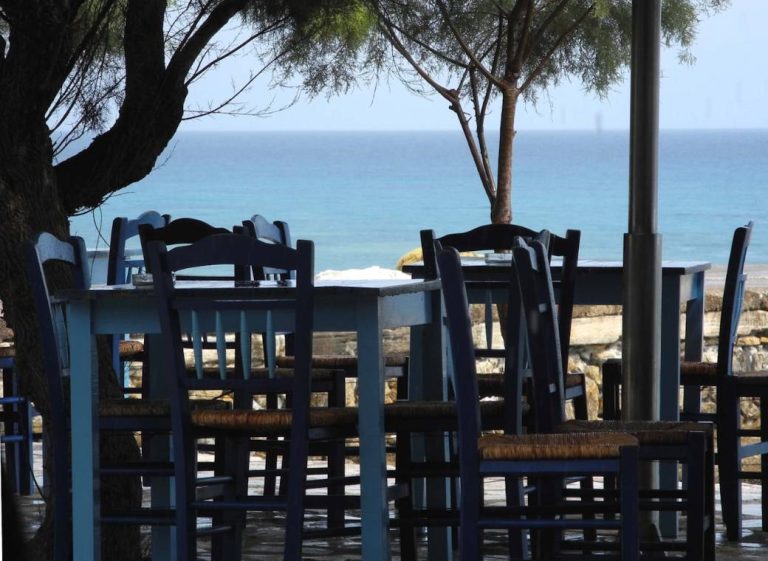 Restaurants
Where to eat
See where to eat →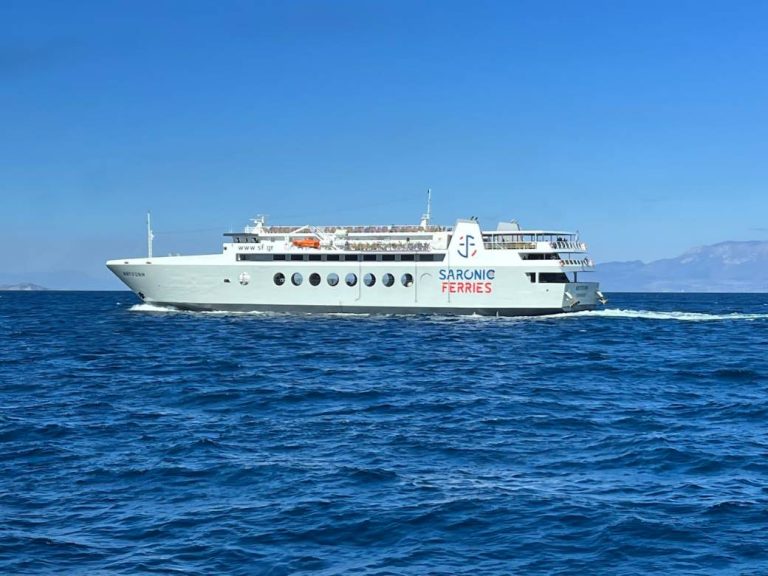 Itinerary
Day by day
See the itinerary →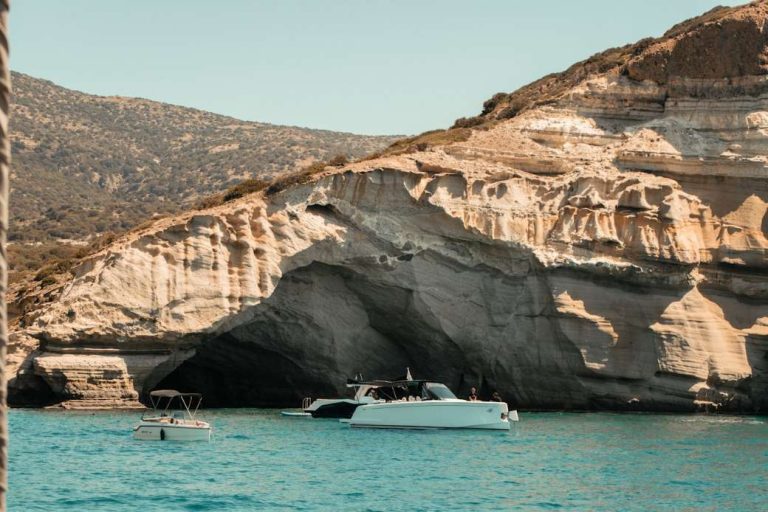 Day trips
Day trips
See the day trips →
Booking
We sell nothing and book nothing for you. Every guide on this page tells you how to arrange each piece yourself - which ferry operator, when to book, what to prebook and what to leave loose.