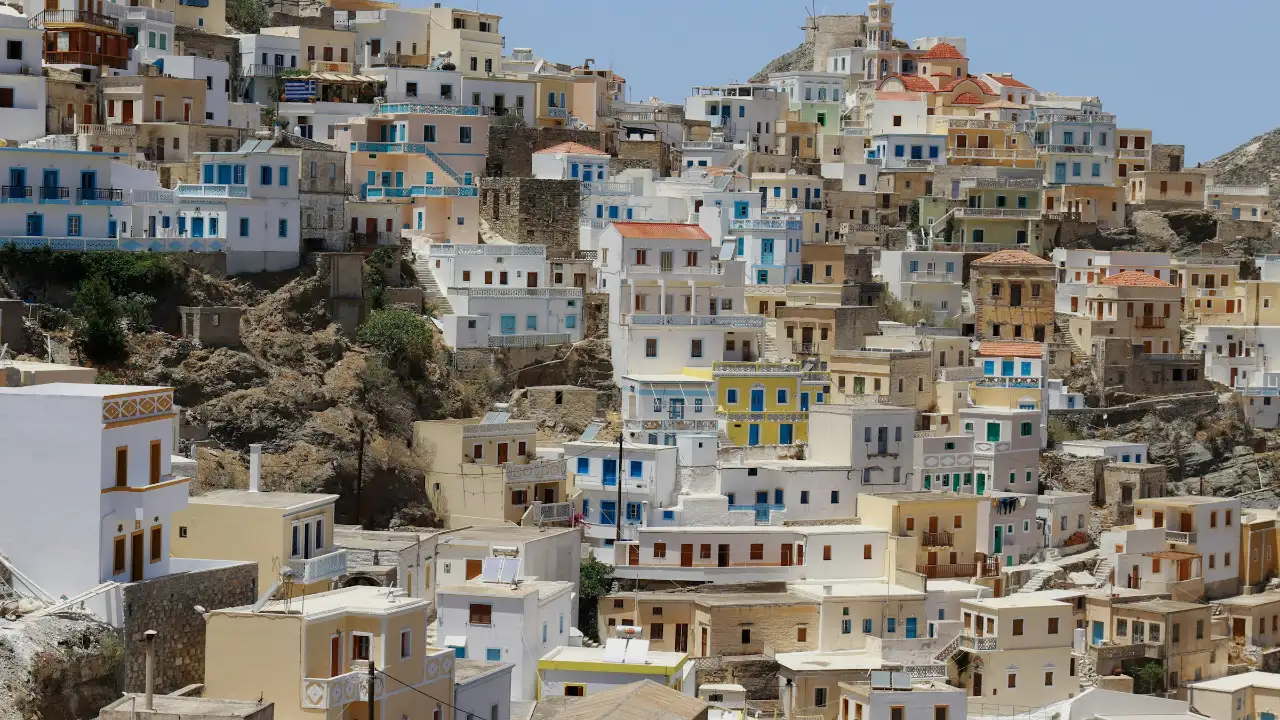
Island group
Dodecanese, South Aegean, Greece; the second-largest island of the group, in the southeastern Aegean midway between Rhodes and Crete
Shape and terrain
a long, narrow island on a north-south axis, spined by a mountain range along its length; capital and main port Pigadia in the southeast
Airport
Karpathos national airport (AOK), in the south about 14 km from Pigadia; domestic flights from Athens, with Sky Express and Olympic Air as the carriers, and Olympic also linking Rhodes and Kasos
Ports
two - Pigadia (main, south) and Diafani (small, north)
Ferry from Piraeus
Blue Star Ferries, over thirteen hours to Pigadia and nearer fifteen to Diafani, three to seven sailings a week by season. Hops: Rhodes about 3h35, Sitia (Crete) about 3h20, Heraklion about 6h, two to seven a week
Olympos custom
the kanakara - firstborn-daughter inheritance and matrilocal residence gave women unusual economic standing; the practice is declining. Documented by France24 and New Lines Magazine; matrilineal inheritance, not a political “matriarchy”
Windsurf and kitesurf
Afiartis (Kipi-Afiartis) beside the airport is the wind-sports hub, a run of bays for different levels; dedicated kitesurf water around Agrilaopotamos; meltemi season roughly May to September, strongest July and August
Saria
an uninhabited Natura 2000 islet off the north coast, reached by boat from Diafani
Best months
spring (April and May) for walking; July and August for the strongest wind (busiest, hottest); June and September the all-round shoulder.
Travel details last checked July 2026.
Where Karpathos is, and why the distance shapes it
Karpathos is the second-largest island of the Dodecanese, in the southeastern Aegean, sitting roughly midway between Rhodes to the northeast and Crete to the west. It is long and narrow, drawn out on a north-south axis, with a mountainous spine running almost its full length. The capital and main port, Pigadia, sits in the southeast.
That position, out in open water rather than tucked into an archipelago, is half the story. The other half is the shape. Karpathos, one of the Greek islands in the Dodecanese group, runs long and thin, and a chain of mountains rises down the middle like a wall. For most of the island’s history there was no easy road along the coast, so the settlements in the north lived largely by sea and largely apart from the south.
Olympos is the clearest case. The village sits high on a ridge near the northern end, and until a mountain road was cut in recent decades it was reached mainly by boat into the little port of Diafani and a climb from there. Generations of that isolation are why the north kept a distinct dialect, distinct dress and distinct customs while the south modernised. The geography did not just decide where people live. It shaped how differently they came to live at the two ends of the same island.
You can place Karpathos against its neighbours on the Dodecanese islands page.
Getting there: the flight, the long ferry and the Rhodes hop
There are three ways to reach Karpathos, and only one is quick: a domestic flight from Athens to the airport in the south, a very long direct ferry from Piraeus, or a shorter ferry hop from Rhodes or Crete. Depending on the route and the season, ferries run anywhere from twice a week to daily, so here you build the trip around the boat rather than the other way round.

Diagram by Greece Trips. Free to reuse with credit - CC BY 4.0.
Flying is the fast way in, and on this island it is worth the fare. A domestic flight from Athens reaches Karpathos national airport (code AOK) in the south, about 14 km from Pigadia, and it is short in the air. Sky Express and Olympic Air are the carriers to check, and Olympic also links the island sideways to Rhodes and to tiny Kasos. The aircraft are small and the seats sell out in summer, so book well ahead, and read the current timetable at the airline rather than anywhere else.
The direct ferry from Piraeus is the cheap way, and it is genuinely long: the fastest sailing to Pigadia takes over thirteen hours, and the northern port of Diafani is longer still. In practice that is a day and a night on the boat. Blue Star Ferries runs it, three to seven times a week depending on the season. Book a cabin if you want to sleep, and confirm the timing close to your dates.
The third way is the hop, and it is the one most people underrate. From Rhodes it is about three and a half hours to Pigadia; from Sitia in eastern Crete about the same, and from Heraklion closer to six. Those run between two and seven times a week depending on the route and the month, so the sailing that fits your plan may still be days from the one you want.
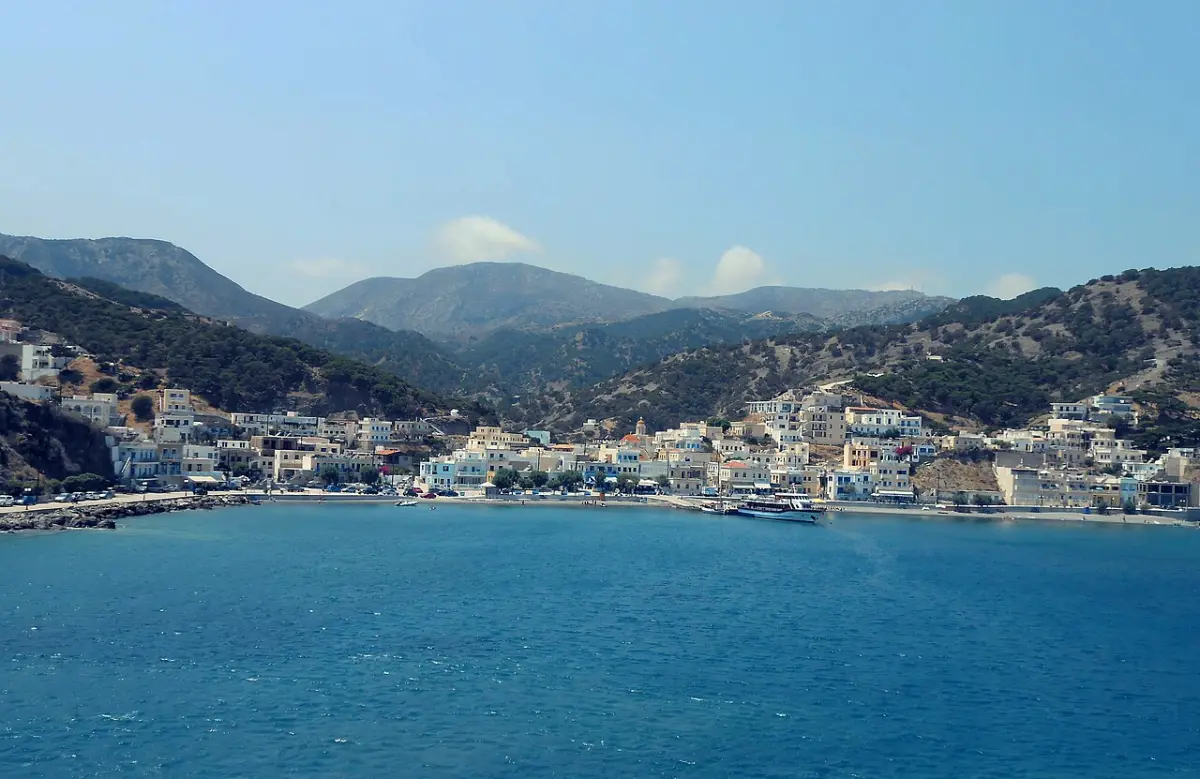
Two ports handle all of it. Pigadia, the capital in the south, is the main one and takes the Piraeus, Rhodes and Crete boats; Diafani, far smaller, sits in the north, and the same long-distance line calls there too, less often and later.
How the boats really work is in Greek island ferries, the domestic network in flights within Greece, and which islands have a runway at all in which islands have an airport.
Olympos and the north: a working village, not a costume show
Olympos is a working mountain village near the northern end of Karpathos, and its traditions survived for a plain reason: until recently, almost nobody could get to it. Isolation, not a decision to perform for visitors, is why the north kept what the rest of the island let go.
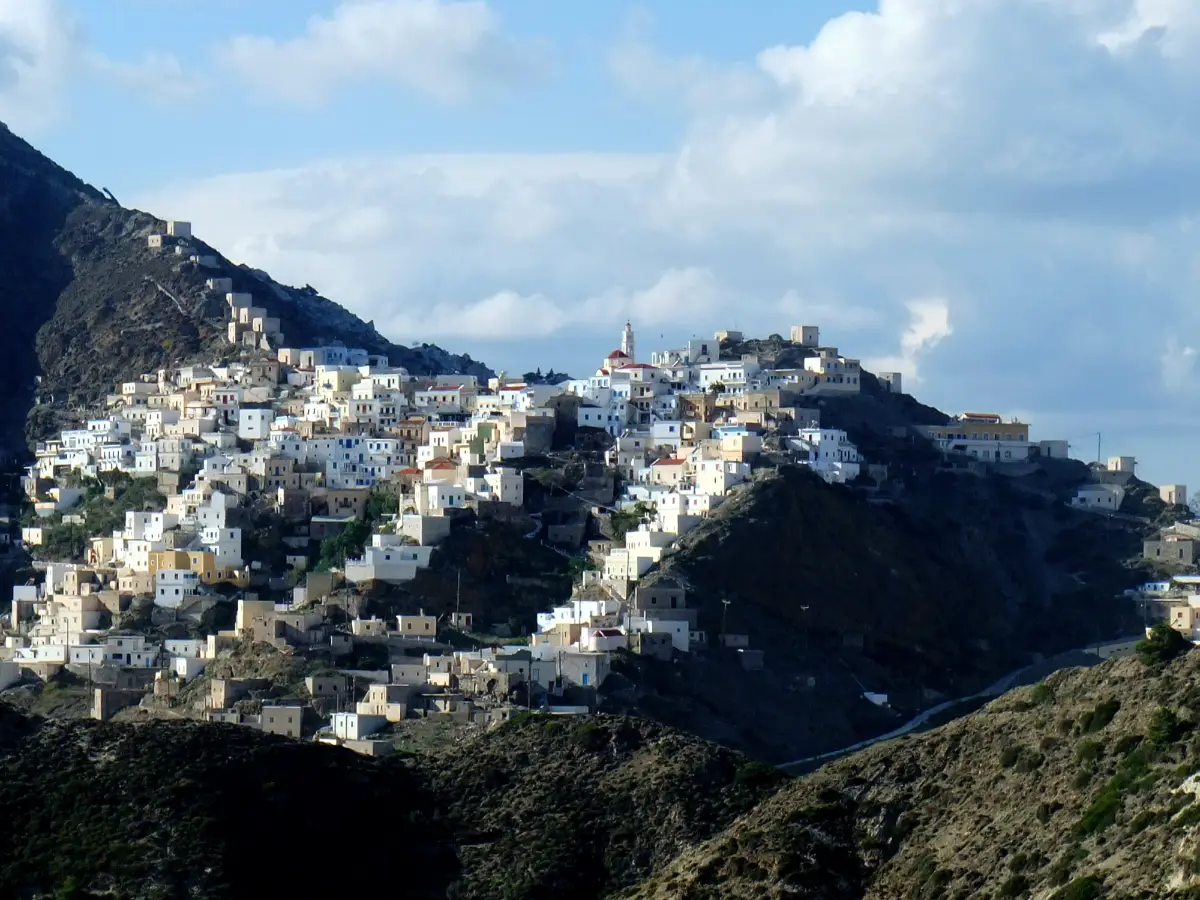
Start with what is documented. The village has its own dialect, which linguists and locals describe as unusually archaic; you will read that it preserves elements of ancient Doric Greek, and that is a claim to report with care rather than state as settled fact. The custom most written about is inheritance. Traditionally the firstborn daughter, the kanakara, inherited her mother’s house and the bulk of the family property, and a newly married couple settled with the wife’s family rather than the husband’s. That matrilineal inheritance and matrilocal residence gave women in Olympos an unusual economic standing, documented in detail by reputable reporting, France24 and New Lines Magazine among them.
Two honest qualifications belong right beside that. First, the practice is declining rather than thriving: New Lines described it as one of Europe’s last such societies and near its end, with the young increasingly leaving or marrying out. Second, the popular “island where women rule” framing oversimplifies it. What is documented is matrilineal inheritance and matrilocal residence, which is not the same thing as a political matriarchy, and repeating the slogan flattens a specific custom into a headline.
The dress works the same way. Today it is mainly older women who wear the traditional dress day to day; younger women and girls put on the embroidered festive version for feast days, above all the Assumption on the fifteenth of August. What you will not see is a whole village dressed up for your benefit. Olympos is lived in, not staged.
As a visit, it has a rhythm, and of everything on a list of things to do in Karpathos this is the one most rewarded by timing. Tour groups fill the lanes around midday and thin out by evening, so come early or stay the night. Reach it by the mountain road of steep hairpins, or by boat to Diafani and up. Either way, it is somebody’s home, not an exhibit.
The wind, and the sports that live on it
The wind that empties the south-coast sun-loungers is the same wind that made Karpathos a windsurfing name. The mechanism is the island’s shape. That long north-south spine funnels the summer meltemi, the Etesian wind, straight down the southern coast, so from roughly May to September the afternoons blow hard and reliably, hardest in July and August. The windsurf centres and spot guides that work this coast report July and August afternoons in the region of 35 to 40 knots, which is small-sail weather; treat that as what the people who sail here every summer say, rather than as a measured average.
The hub is Afiartis, more properly the Kipi-Afiartis settlement beside the airport in the south. A short run of bays there sorts riders by level: a shallow, sheltered bay for beginners and freestylers, a larger bay that builds a rideable wind-wave for bump-and-jump and slalom, and an exposed bay with the strongest wind that has hosted speed-sailing championships. Dedicated kitesurf water sits a little apart, around Agrilaopotamos, and the windsurf and kite zones are kept separate during centre hours so lines and boards stay out of each other’s way.
If you are weighing up things to do in Karpathos, the durable, weather-proof shortlist looks like this:
- Windsurf or kitesurf the Afiartis bays in the south
- Spend a morning in Olympos before the tour boats arrive
- Walk the old mountain paths between the northern villages
- Take a boat from Diafani to the islet of Saria
- Swim the sheltered east-coast bays out of the wind
That last point is the payoff for everyone who did not come to sail. The wind that makes Afiartis great makes the whole exposed south blustery, so if you want calm water and a still afternoon, the same fact points you across to the sheltered east coast.
Beaches and the coast, read by wind and by access
Karpathos beaches sort themselves on two questions, and answering both before you set out is most of the planning. The first is shelter. The east coast largely sits in the lee of the mountains and out of the meltemi, so its bays stay calm and clear, the water for families, snorkelling and an unhurried swim. The south and much of the west catch the wind head-on, which is glorious for a sail and wearing for a picnic.
The second question is access, and it is the one the beach lists tend to skip. Some of the most striking bays on the island reach only by rough track or by boat, and many have no sunbeds, no taverna and no shade, so you carry your own water and cover. Others sit right off the road.
Names help only as examples, not as a ranking. On the sheltered east, Apella, Kyra Panagia and Achata are the ones people cross the island for: deep, clear coves under the mountains, some reached down a steep approach or by the summer boats out of Pigadia. Elsewhere, Diakoftis near the southern tip has pale sand and shallow water, Amoopi strings together easy bays close to town and the airport, and Lefkos breaks up the quieter west coast. Treat them as illustrations of the two axes rather than a leaderboard, because the useful skill here is reading a beach by its exposure and its access, not memorising a top ten.
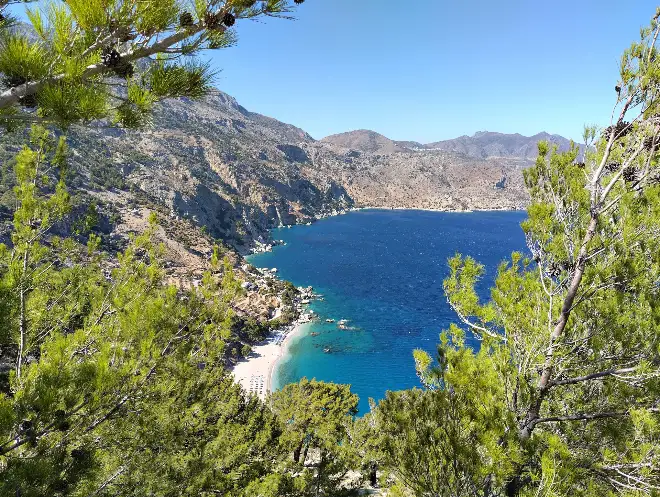
All of this comes back to the wind. The east-coast calm is not luck; it is the flip side of the same meltemi that powers Afiartis, and knowing that lets you pick the right coast for the day you actually want. What the Greek sea is like, and how that summer wind behaves, is in what the sea is like.
Hiking and the interior
Leave the coast and Karpathos has a quieter second life: an old network of footpaths that linked the mountain villages back when walking and the sea were the only ways between them. Hiking in Karpathos is best understood as that network rather than a set of numbered trails, paths threading from village to village and out to older sites, through pine forest on the higher ground.
The classic lines run in the north. A long route joins Spoa to Olympos along the spine, and shorter walks lead out of Olympos toward the remains at Vrykounda (Vroukounda) on the coast. Off the northern tip, the uninhabited islet of Saria, a Natura 2000 protected area, is reached by boat from Diafani and rewards a day of walking and empty coves.
Spring is the season for all of it. In April and May the island is green, the wildflowers are out, the air is cool and you can walk for hours without meeting anyone. High summer is hot and exposed for the longer routes.
Come prepared rather than assuming the paths are marked for you. Some are clear, some are faint and easy to lose, so carry water, tell someone your route, and check the current state of a path locally before you commit to it. To fold a walk on Saria into a wider plan of boat days, see the island-hopping guide.
When to go
There is no single best month for Karpathos, because the island wants a different season depending on what you came to do. Sort it by purpose and the choice is easy.

Diagram by Greece Trips. Free to reuse with credit - CC BY 4.0.
Come in spring, April and May, to walk. The mountains are green, the wildflowers are out, the paths are cool underfoot and the whole island is quiet, though the sea is still on the cool side for long swims.
Come in high summer, July and August, for the wind. This is peak windsurf and kite season, the meltemi at its strongest and most reliable, and it is also the hottest, busiest stretch, busy by the island’s own modest standard, which stays calm next to Santorini or Mykonos. If you are here to swim rather than sail, this is when the sheltered east coast earns its keep.
Come in June or September for the all-rounder. The sea is warm, the crowds are gentler, the wind is easing off its summer peak, and for most travellers this shoulder is the sweet spot that balances everything.
One date overrides the rest. The Assumption festival on the fifteenth of August fills Olympos and draws people from across the island and beyond, so plan around it deliberately, whether you want to be there for it or well clear of it.
The wider logic of Greek seasons is in the best time to visit Greece, and the month-by-month detail is in Greece weather by month.
Getting around once you land
Without your own wheels, Karpathos shrinks to a town and its nearest beach. With them, it opens up, and the drives themselves, especially the climb north, become part of the trip. A rental car, or a scooter if the wind is behaving, is close to essential here.
Buses do run, but they are infrequent and stick to the main settlements, so most of the beaches and the mountain villages sit beyond where they go. Plan to reach the good stuff under your own steam. You can hire a car at the airport or in Pigadia; rates move with the season, so treat any quoted price as one to confirm when you book.
The roads ask for a little respect. The route north to Olympos is a series of steep hairpins, much improved in recent years but still a demanding drive, and several beach approaches are rough gravel where a small, higher-clearance car and an unhurried pace both help. For the bays no road reaches, and for Diafani and Saria in the north, boats and water-taxis out of Pigadia fill the gap.
Whether an island like this really needs a car of your own is worth settling before you book; see renting a car in Greece and which islands you actually need a car for.
Who Karpathos suits, and who should skip it
Karpathos is worth visiting if you want a quiet, genuine, windswept island and you will accept a longer journey and a rental car to get it. It rewards windsurfers and kitesurfers, walkers, couples and independent travellers who prefer the real thing to nightlife, and families happy to base on the calm east coast. It is the wrong island for anyone island-hopping on a tight schedule, chasing a party or a luxury resort, or hoping to see a lot without a car.
Where you base yourself matters more than which room you book, so think in areas. Pigadia, the capital, has the most connections, tavernas and daily life. Amoopi, just south, is an easy family and couples base near both town and the airport. Lefkos is quieter, over on the west. Afiartis is where the surfers stay, right by the wind and the runway. Olympos or Diafani, up north, trade convenience for atmosphere and real remoteness. Pick the area that matches your trip and the specific bed matters far less.
If the island is a couples’ escape, the wider case is in Greece for couples; if you are bringing children, Greece with the family sets out how to make an island like this work.
Planning it from here
Two decisions shape a Karpathos trip, and the rest follows from them: how you get in, and when you come. Settle the flight or the ferry first, because the boat’s rhythm will not bend to your schedule, then pick the season by whether you came for wind, water or walking. Do that, book a car, and the island pays back the effort in the quiet most of Greece has lost. To place it in a wider plan, browse all the Greece destinations, find it on the interactive map, or set it against its neighbours on the Dodecanese islands page.
Karpathos FAQ
Is Karpathos worth visiting?
Yes, if you want a quiet, authentic, windswept island and will accept a longer trip and a rental car. It is less suited to tight-schedule island-hoppers, party-seekers or luxury-resort travellers. What makes it worth the effort is Olympos, the wind and the empty beaches; the one real cost is simply getting there.
How do you get to Karpathos?
By a domestic flight from Athens to the island airport in the south, by the direct ferry from Piraeus, which takes over thirteen hours, or by a shorter hop from Rhodes or eastern Crete of about three and a half hours. Sailings run between twice a week and daily depending on the route and the season, so plan the trip around the boat rather than the other way round.
What is Karpathos known for?
Strong summer winds and world-class windsurfing and kitesurfing around Afiartis in the south, the isolated mountain village of Olympos with its enduring dialect and dress, rugged and often empty beaches, and being genuinely hard to reach. That remoteness is why the island still feels the way it does.
Is Karpathos windy?
Yes, the south is windy right through the summer. That is the meltemi, the Etesian wind, and it is exactly why Karpathos is a windsurf and kitesurf destination. If you want calm water for swimming, choose the sheltered east coast, or come in June or September when the wind eases.
What is there to do in Karpathos?
Windsurf or kite at the Afiartis bays, visit Olympos early before the tour boats, walk the old mountain footpaths, take a boat from Diafani to the islet of Saria, and swim the sheltered east-coast beaches such as Apella and Kyra Panagia. The island is for the outdoors, not for nightlife.
Do you need a car in Karpathos?
Effectively yes. Buses are infrequent and stick to the main settlements, so they miss most of the beaches and mountain villages. A car or a scooter is how you actually see the island. The northern road is steep hairpins, some beach tracks are rough, and boats from Pigadia reach the bays no road does.
Plan by category
The Karpathos guides
5 guides, each scoped to a decision you actually have to make.
 Attractions
Things to do
See the attractions → Hotels
Where to stay
Compare the areas → Beaches
The beaches
See the beaches → Itinerary
Day by day
See the itinerary →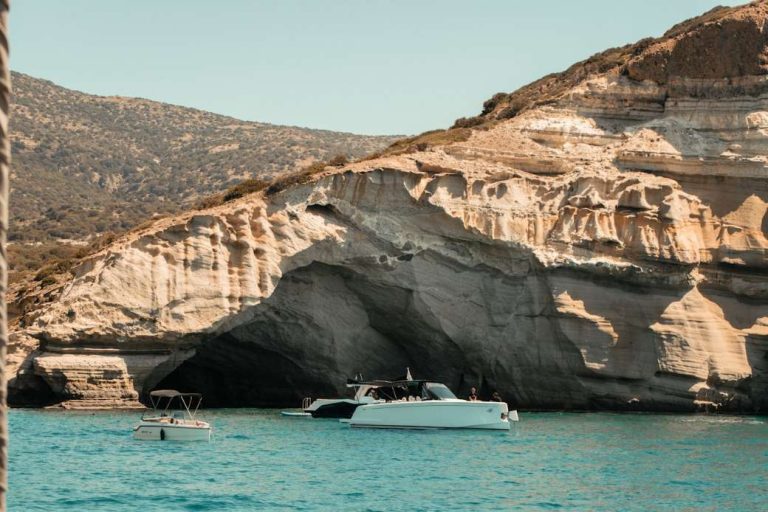 Day trips
Day trips
See the day trips →
Booking
We sell nothing and book nothing for you. Every guide on this page tells you how to arrange each piece yourself - which ferry operator, when to book, what to prebook and what to leave loose.