Island group
Cyclades (South Aegean, Greece). Stable geographic fact
Airport
Mykonos Island National Airport (JMK), about 4 km from town, operated by Fraport Greece
Ferry from Piraeus
about 2 hr 40 min to 3.5 hrs by high-speed catamaran; about 4.5 to 5.5 hrs by conventional ferry
Ferry from Rafina
fastest high-speed about 2 hr 10 min, typically 2.5 to 3.5 hrs; Rafina is about 30 min from Athens airport
Best months
June and September (shoulder season) - warm, swimmable sea either side of the July-August crowd, price and wind peak. Editorial; confirm climate normals against HNMS at publish
Travel details last checked July 2026.
What Mykonos is, and what it sells
Mykonos is a small Cyclades island in the South Aegean, about 150 km southeast of Athens, and it sells one thing better than anywhere else in Greece: a polished, engineered good time. Beach clubs, DJ sets, design hotels and a whitewashed town that photographs beautifully - that is the product, and the island is very good at delivering it.
Knowing that up front is the first honest step in planning a trip here. The main town, Chora, or simply Mykonos Town, is a whitewashed maze above an old fishing harbour that turned itself into the Aegean’s most stylish party over sixty years of catering to a jet-set crowd. Mykonos has also been an openly gay-friendly destination for decades, and that history shaped the nightlife, the beaches and the tone of the place as much as any hotel group did.
The catch is the cost. Mykonos is one of the most expensive islands in Greece, and in peak season a beach-club afternoon or a harbour-front dinner can run to what a whole day would cost elsewhere in the Cyclades. That does not make it a bad choice; it makes it a deliberate one. You come for the scene and you pay for the scene - then you plan around the two things that actually shape your days, the wind and the boat to Delos.
Mykonos sits in the Cyclades, the island group that also holds Santorini, Paros and Naxos. This guide orients you, tells you plainly what it costs, and routes you into the detail.
How many days Mykonos needs
Three to four days is the sweet spot. That is enough for the town, two or three contrasting beaches, a half-day boat to Delos and one proper night out, without paying to linger on an island this expensive.
Here is what each length actually buys you.
- Two days is a fast taste: Chora, one beach and one dinner. It works when Mykonos is a single leg on a wider Cyclades hop rather than the trip itself.
- Three to four days is the balance most people want - the town at both ends of the day, one windy-coast and one calm-coast beach, the Delos crossing, and a big night that does not wreck the next morning.
- Five days or more only pays off if the beach clubs and slow sun-lounger days are the actual point, because a week here costs more than a week almost anywhere else in Greece.
Whatever length you pick, do not try to see every beach; the island rewards choosing two or three and settling in. For the hour-by-hour version, see the Mykonos itinerary; to fit the island into a longer route, start with Cyclades island hopping.
When to come, and the meltemi that shapes it
Come in June or September. Those two months give you warm, swimmable sea and the scene in full swing, without the July-August peak in crowds, prices and wind. May and early October are quieter and cheaper still, with the trade-off that the sea is cooler and some venues are only half open.
July and August are the opposite of a bargain: the hottest, priciest and most crowded stretch, when clubs are booked out and the town is shoulder to shoulder after dark. It is also the windiest, which brings up the one weather fact that will change your plans.
The meltemi is the dry north wind of the Aegean summer. It blows down from the north, strongest from roughly July into September, and on a bad day it can keep up for two or three days at a stretch - kicking up whitecaps, flattening beach umbrellas and sometimes disrupting the smaller boats. It is not a storm, and it is not a reason to stay home; locals plan around it without a second thought. But it is why the developed beaches all cluster on one coast, and why your beach choice on any given morning depends on which way the wind is blowing. The next section turns that into a rule.
| Month | Crowds and prices | Weather and wind |
|---|---|---|
| May–early Jun | Building, lower prices | Warm days, cooler sea, light winds |
| Late Jun | Busy, rising | Warm sea, scene on, meltemi building |
| Jul–Aug | Peak, highest | Hot, packed, strongest meltemi |
| Sep | Busy, easing | Warm sea, scene still on, meltemi fading |
| Oct | Quiet, lowest | Cooler, some venues closing, calmer seas |
For the wider seasonal picture, see the best time to visit Greece and Greece weather month by month.
Getting to Mykonos: fly, or ferry from Piraeus or Rafina
Flying from Athens is the fast way in: the hop from Athens (ATH) to Mykonos (JMK) takes roughly 40 to 45 minutes, and in summer the island takes direct flights from across Europe, so many visitors skip Athens entirely.

Diagram by Greece Trips. Free to reuse with credit - CC BY 4.0.
The decision that matters more than fly-or-ferry is which port you sail from, because Athens has two and most guides flatten them into a single “take a ferry.” Mykonos runs from both Piraeus and Rafina, and they suit different trips.
Piraeus is the big port, linked to central Athens by metro and the obvious choice if you are already in the city. High-speed catamarans make the crossing in about 2 hours 40 minutes to 3.5 hours; slower conventional ferries take roughly 4.5 to 5.5 hours.
Rafina is the quieter port, and here is the fact worth knowing: it is only about 30 minutes from Athens airport, against well over an hour to Piraeus. Connecting straight off a flight, it is often the faster and calmer way across, with the quickest boats reaching Mykonos in a little over two hours. It is awkward to reach from central Athens, so it wins for airport connections, not city stays.
Either way, you do not land in the town. Ferries dock at the New Port at Tourlos, about 2 km north of Chora, where buses and transfers meet the boats.
| Route in | Roughly | Choose it when |
|---|---|---|
| Flight (ATH to JMK) | ~40–45 min | Time is tight, or you fly direct from Europe |
| Ferry from Rafina | Fast boat ~2 hr+ | You are connecting off a flight at Athens airport |
| Ferry from Piraeus | Fast boat ~2 hr 40 min+ | You are already in central Athens |
Durations shift with season and operator, so confirm live schedules before you book. For how Greek ferries actually work - booking, high-wind cancellations, the vehicle decks - see Greek island ferries; for routes and airlines, flights to Greece.
Getting around once you’re there
Chora is pedestrian-only and deliberately maze-like, and parking anywhere near it is a genuine headache, so for most trips the buses beat a rental. KTEL Mykonos runs services from two stations in town - Fabrika and the Old Port - out to Ornos, Platis Gialos, Paradise, Elia, Ano Mera and the airport. Fares are cheap, and in high summer some routes run late to move the nightlife crowd.
A car or an ATV only earns its keep if you want the quieter north beaches or the inland village of Ano Mera on your own schedule. Be honest with yourself about the quad bikes, though: they look like fun, and rented ATVs and scooters on busy, unfamiliar summer roads are a common cause of holiday injuries here. If you are not a confident rider, skip them.
On the south coast, small sea taxis hop between the beaches, with Platis Gialos as the main hub - a quick, scenic way to reach Paradise, Super Paradise or Elia without backtracking through town.
The weak link is taxis. Mykonos has famously few of them, and on a busy club night you can wait a long time or not get one at all. Sort your way home before you go out, and default to the bus. For the wider picture, see getting around Greece.
Where to base yourself
Where you sleep sets the tone of the whole trip, and Mykonos gives you five broad choices.
Chora (Mykonos Town) puts you inside the maze, bars and restaurants on the doorstep and the nightlife a stumble away - the priciest and loudest base, and one with no proper beach of its own. Ornos is the balanced pick, a small sheltered beach a short bus ride from town, easy for couples, families and anyone who wants the scene without sleeping in it. Platis Gialos is a south-coast beach hub and the centre of the sea-taxi network, practical if beaches are your priority. Psarou is the glamour address, home of the Nammos beach-club crowd; book far ahead and expect to pay for the postcode. Paradise and Paraga are the party beaches, younger and louder, built around the beach club and the after-party. Ano Mera, the inland village, is where you spend less: quieter, cheaper and more local, at the cost of needing a bus or car to reach the coast.
| Area | Vibe | Best for | Trade-off |
|---|---|---|---|
| Chora / Mykonos Town | Buzzing, central | Nightlife, walkability | Priciest, loud, no beach |
| Ornos | Balanced, sheltered | Couples, families, first-timers | Small, busy beach |
| Platis Gialos | Beach hub | Beach days, south-coast access | Developed, packed in season |
| Psarou | Glamour, upscale | Beach clubs, splashing out | Very expensive, book ahead |
| Paradise / Paraga | Party | Nightlife, younger crowd | Loud, not restful |
| Ano Mera | Quiet, local | Value, calm, longer stays | Needs a bus or car |
Which specific hotel, in which pocket, is the real decision - we break it down by area in where to stay in Mykonos.
The beaches, and how the wind picks them for you
Here is the one rule that saves a Mykonos beach day: when the meltemi is blowing, head to the south coast, and save the north for calm mornings. The island’s developed beaches nearly all sit on the sheltered south side for exactly this reason, so knowing which way the wind is going the night before tells you where to aim.
The south coast is the club coast - Platis Gialos, Psarou, Ornos, Paradise, Super Paradise, Paraga, Elia and Kalo Livadi - a run of organised, sandy bays that stay swimmable when the north is blown out. This is where the sunbeds, the music and the crowds concentrate, and it is the safe default on a windy day.
The north coast is the wilder side - Panormos, Ftelia and Agios Sostis - less developed, quieter, and lovely on a still day. When the meltemi is up it turns choppy and cool, which is exactly why the same wind that ruins it for swimming makes Ftelia a well-known windsurf and kite spot.

Diagram by Greece Trips. Free to reuse with credit - CC BY 4.0.
A few beaches carry a long-standing nude and gay reputation, matter-of-factly signposted on the ground: Super Paradise, Elia and Agrari among them. And set your expectations before you arrive: in high season many of the famous south-coast beaches are wall-to-wall sunbeds with a paid minimum, not open stretches of free sand.
For which beach suits which day, see the best beaches in Mykonos, and Paradise Beach in depth.
Beach clubs and nightlife: the island’s real business
On most Greek islands the nightlife is a bonus. On Mykonos it is the main product, and it runs on two mechanics first-timers should understand before they arrive: the reservation game, and how fast the bill climbs.
The scene has layers. It starts gently, with sunset drinks in Little Venice and older Chora cocktail bars like Astra, then moves to the beach clubs through the afternoon and evening - Scorpios at Paraga, Nammos at Psarou, Principote at Panormos - and ends, for those still going, at a big late club like Cavo Paradiso. You can dip into as much or as little of that as you like.
The reservation game catches people out first. In peak season the marquee beach clubs are booked weeks ahead, and turning up on the day for a good table is often not an option. If a specific club is on your list, reserve before you fly.
The second is cost. A sunbed or a table at the name venues usually comes with a minimum spend, and a relaxed afternoon can quietly become a serious bill. There is a cheaper Mykonos alongside the expensive one, though: the same beaches keep public stretches, the sunset is free from anywhere on the west side, and taking the bus home means you are not hostage to a scarce, pricey late-night taxi.
For the venues in depth, see Mykonos nightlife; to weigh it against the other party islands, Greece’s nightlife and party scene.
Mykonos Town: windmills, Little Venice, and the maze
Chora is the one part of Mykonos that costs nothing to enjoy. It is a whitewashed maze of lanes, built deliberately confusing centuries ago to slow raiding pirates, and getting a little lost in it is the point.
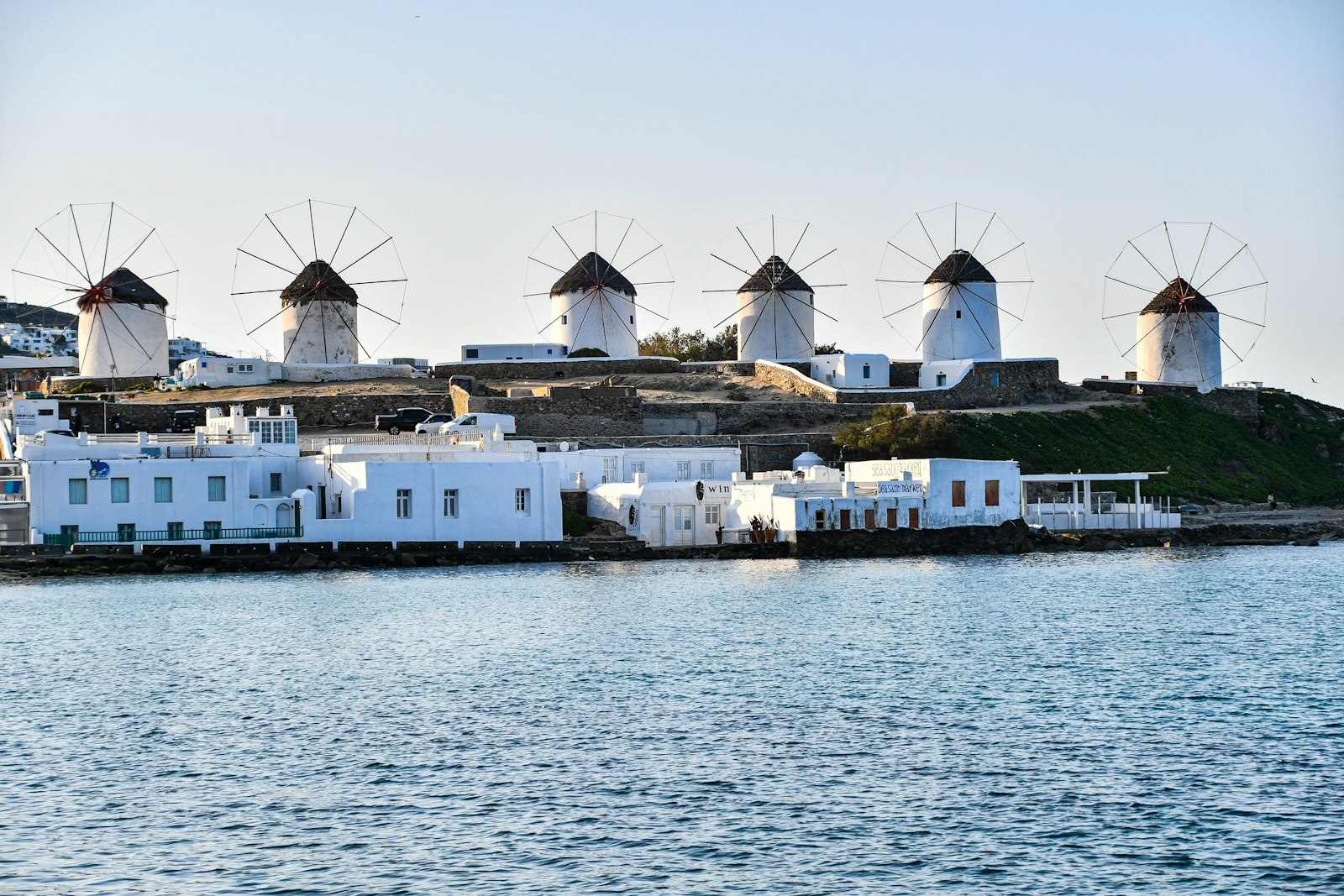
Four things anchor a first walk. The Kato Mili windmills - the row of round, thatched mills on the ridge above the harbour - are the island’s signature view. Below them, Little Venice (Venetia) is a line of old sea-captains’ houses built right at the water’s edge, their balconies now sunset bars with the waves breaking underneath. Nearby stands Panagia Paraportiani, a whitewashed knot of four chapels merged into one sculptural white mass and one of the most photographed churches in Greece. Threading through it all is Matoyianni, the main shopping lane, lined with boutiques and busy until late.
One honest steer: Chora is magic early in the morning and after the day-trippers leave, and a slow crush of cruise passengers and shoppers through the middle of the day. Time your wandering for the edges of the day. The full run of sights is on the things to do in Mykonos page.
Delos: the sacred island 30 minutes across the water
You reach Delos by boat from the Old Port in Chora, a crossing of roughly 30 to 45 minutes each way, and it is the most memorable half-day on the island - which is worth sitting with, because nobody has lived on Delos for a very long time.
The whole island is an archaeological site. In Greek myth it is the birthplace of Apollo and Artemis, and in antiquity it was one of the most sacred places in the Greek world and a wealthy trading port. What survives is an entire ruined city - temples, mosaics, the famous terrace of marble lions - spread across an uninhabited island. It has been a UNESCO World Heritage Site since 1990, and it is the honest counterweight to the beach clubs: the profound half-day that stops a Mykonos trip being only a party.
The logistics reward planning. The site is seasonal, open roughly from April to November and closed through winter; boats run across the day in high season and the good departures fill up, so book ahead or take an early one. Entry to the site is paid separately from the boat ticket - reckon on around €20, and confirm the current rate. There is no town, no shade and nowhere to hide from the sun once you land, so bring water, a hat and real shoes, and keep clear of the midday heat.
Delos has its own guide, with the boat times and the site in detail, at Delos travel guide.
What Mykonos costs, and where it fits in a bigger trip
Mykonos is expensive, and it is fair to say so plainly. Beach-club minimums, scarce taxis and waterfront markups add up fast, and the island runs noticeably pricier than its Cyclades neighbours. You blunt that without much effort: ride the buses, use the public ends of the beaches, base yourself in Ano Mera or Ornos rather than on the harbour, and eat a few streets back from the water. The full breakdown is in what a Greece trip costs. The EU Entry/Exit System (EES) began a phased rollout in October 2025 and now applies at Schengen borders; the separate ETIAS travel authorisation for visa-exempt visitors is expected to follow in late 2026, so check what applies to your passport before you travel, in visas and entry requirements.
Mykonos also works best as one leg of a bigger trip rather than the whole of it. It is a natural stop on a Cyclades hop - Delos is a morning away, and Tinos, Paros and Naxos are all short ferry rides - while Santorini is about two to three hours off by high-speed ferry, so plenty of travellers do both. The short version: Santorini for scenery and romance, Mykonos for beaches and nightlife, weighed side by side in Santorini vs Mykonos.
Get the season, your base and the boat to Delos right, and Mykonos delivers exactly what it promises.
Browse all our Greece destinations to build the trip Mykonos belongs to.
Mykonos FAQ
Where is Mykonos, and what island group is it in?
Mykonos is a Greek island in the central Cyclades, in the South Aegean Sea, about 150 km southeast of Athens. You reach it by a short flight or a ferry from Athens, sailing from either Piraeus or Rafina.
How many days do you need in Mykonos?
Three to four days is the sweet spot - enough for Mykonos Town, a couple of contrasting beaches, a half-day boat to Delos and one big night out. Two days is a quick taste; five or more suits beach-club devotees with the budget to linger. See the Mykonos itinerary.
When is the best time to visit Mykonos?
June and September - warm, swimmable sea and the scene in full swing, without the July-August peak in crowds, prices and wind. The meltemi north wind is strongest in high summer and decides which beaches stay sheltered. May and October are quieter and cheaper. More in best time to visit Greece.
Is Mykonos expensive?
Yes - it is one of Greece’s priciest islands, driven by beach-club minimum spends, scarce taxis and waterfront restaurant markups. You cut the cost with public buses, the free stretches of the same beaches, an Ano Mera or Ornos base, and eating away from the harbour. See what a Greece trip costs.
What is the closest island to Mykonos?
The closest island is uninhabited Delos, the sacred archaeological island about 30 minutes by boat from Mykonos Town, along with neighbouring Rineia. The closest inhabited island is Tinos, a short ferry away, with Paros and Naxos easy onward Cyclades hops. More at Delos travel guide.
Who is Mykonos really for?
Mykonos suits couples, groups of friends and anyone who wants beach clubs, nightlife and a photogenic town, and it has a long-standing, welcoming LGBTQ+ scene. If you are chasing quiet, low cost or unspoilt Greece, weigh Naxos, Paros or Milos instead.
Santorini or Mykonos - which should you choose?
Choose Santorini for scenery, caldera views and romance; choose Mykonos for beaches, beach clubs and nightlife. Many travellers do both in one Cyclades trip, since a high-speed ferry links them in roughly two to three hours. We compare them in Santorini vs Mykonos.
Plan by category
The Mykonos guides
6 guides, each scoped to a decision you actually have to make.
 Attractions
Things to do
See the attractions → Hotels
Where to stay
Compare the areas → Beaches
The beaches
See the beaches → Restaurants
Where to eat
See where to eat → Itinerary
Day by day
See the itinerary → Day trips
Day trips
See the day trips →
Booking
We sell nothing and book nothing for you. Every guide on this page tells you how to arrange each piece yourself - which ferry operator, when to book, what to prebook and what to leave loose.