Island / region
Crete is the largest Greek island and its own administrative Region of Crete (four units: Chania, Rethymno, Heraklion, Lasithi), not part of the Cyclades or Dodecanese
Airports
two - Heraklion “Nikos Kazantzakis” (HER), about 5 km east of Heraklion and the island’s busiest, and Chania “Ioannis Daskalogiannis” (CHQ), on the Akrotiri peninsula near Souda
Overnight ferry from Piraeus
to Heraklion with Minoan Lines (also Blue Star), about nine hours, departing around 21:00; to Souda, the port for Chania, with ANEK Lines, about nine hours, arriving early morning. Pick the boat by the port that matches your base
Best months
May-June and September-early October (shoulder season); Crete also runs year-round, with cities and sites open on reduced winter hours
Time zone
EET (UTC+2), switching to EEST (UTC+3) from late March to late October - the same as the rest of Greece
Travel details last checked July 2026.
Crete is a country-sized island, not a three-day stop
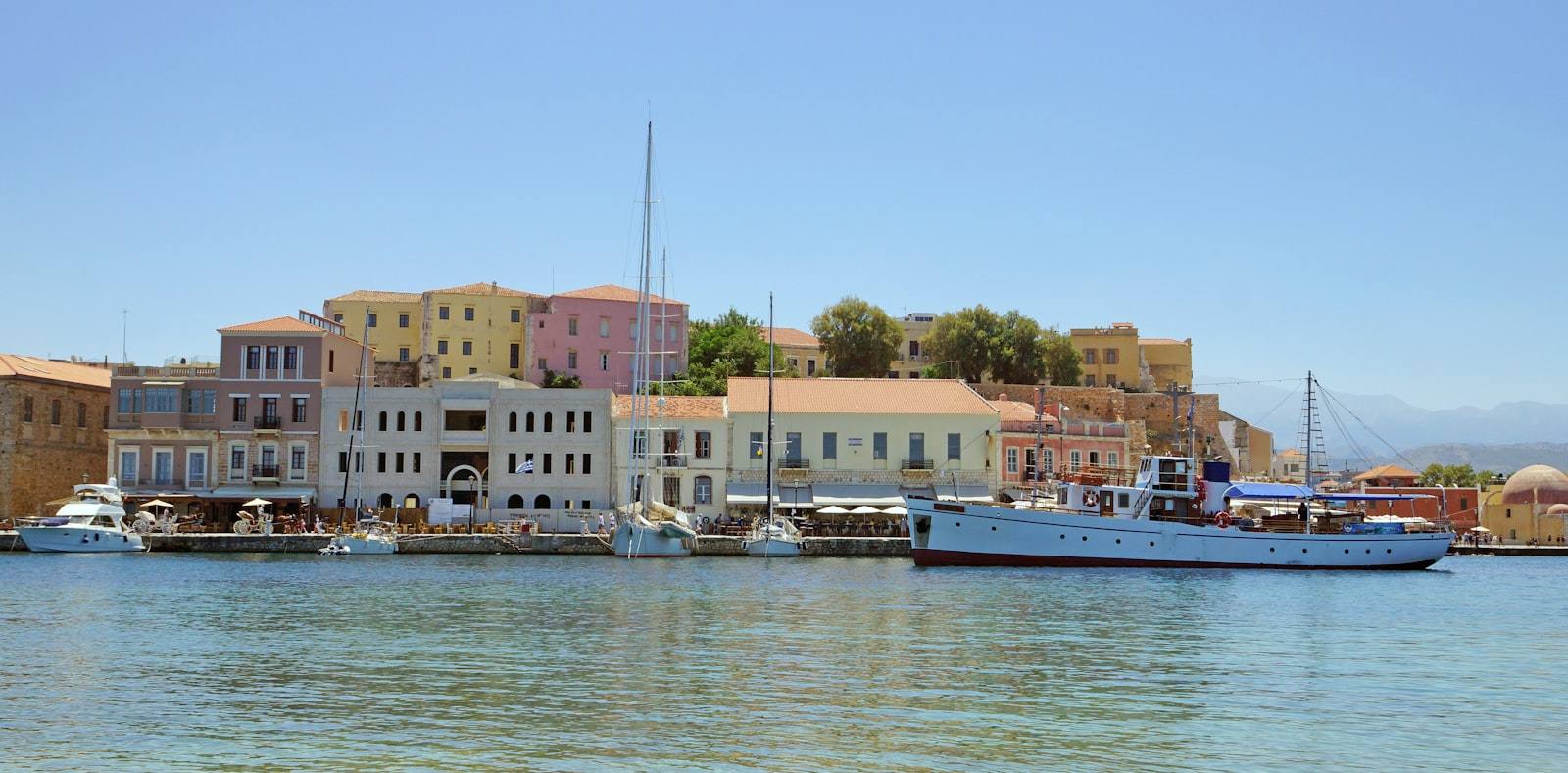
Crete is the largest Greek island, sitting in the far south of the country between the Cretan and Libyan Seas. It belongs to no island group: it is its own administrative Region of Crete, divided into four units that run west to east - Chania, Rethymno, Heraklion and Lasithi.
That last fact is the one that catches people out. Most travellers picture a small, white-and-blue Cycladic island and book accordingly: one hotel, three nights, a rented scooter. Crete does not work that way. It runs roughly 250 km end to end, about the distance from London to Manchester, and a single drive from the far west to the far east eats most of a day.

Diagram by Greece Trips. Free to reuse with credit - CC BY 4.0.
The interior is mountains, not a backdrop. The Lefka Ori (White Mountains) above Chania and Psiloritis in the centre hold snow into late spring, and the roads over and around them are slow going. Below them the coast changes character by the hour: Venetian harbours on the north shore, palm-backed lagoons in the south-west, a fortified islet and a natural palm forest in the east.
So arrive with the right mental model. Crete is not “an island” so much as a small country with four regions, and you do not see it from one base. You choose a region, or two, and go deep. Which region you pick is the decision this whole page is built around, and it starts before you book a flight - because the region also picks your airport.
For where Crete sits among the rest of the country’s islands, see the Greek islands overview.
How many days Crete actually needs
How long you need in Crete depends on how many of its regions you take on, not on the island as a whole. Three to four nights buys one region done well. Five to seven buys two. Ten to fourteen buys the whole island at a road-trip pace.
| Days | Regions | Suggested bases |
|---|---|---|
| 3–4 | One | Chania, or Heraklion |
| 5–7 | Two | West (Chania/Rethymno) + centre (Heraklion) |
| 10–14 | All four | West-to-east road trip, 2–3 nights each |
Three to four days works when Crete is one leg of a bigger Greece trip. Base in Chania or Heraklion, see that region’s headline sights, and leave the rest for next time. Do not try to “cover” the island in this window; you will spend it in the car.
Five to seven days is the sweet spot for most first visits, and the honest default is two bases rather than one - usually the west (Chania or Rethymno) plus the centre (Heraklion). That split gives you the Venetian old towns and the famous west-coast beaches, then Knossos and the museum, without a long transfer bookending every day.
Ten to fourteen days is what the full east-to-west road trip needs, at two to three nights per region. This is the version where Lasithi, Spinalonga and the south coast stop being “if there’s time” and become the point.
The mistake to avoid is the one forum travellers report most: booking a single hotel in Chania and day-tripping to Agios Nikolaos or Elounda in the east. That is close to a three-hour drive each way, about 200 km, and you will do it tired. For the day-by-day, see the Crete itinerary; to slot the island into a wider route, see the Athens-Santorini-Crete run.
Pick your base first: Chania, Rethymno, Heraklion or the east
If you get one decision right on Crete, make it this one: which town you sleep in. Each base owns a different region and a different set of day trips, so your hotel choice quietly decides most of your days. Here is the shortlist at a glance.
| Base | Region and vibe | Best for | Airport | Trade-off |
|---|---|---|---|---|
| Chania | West; prettiest Venetian old town, best food | First-timers, couples, food | CHQ | Old-town stairs and parking |
| Rethymno | Centre-west; old town plus a long town beach | All-rounders, families | CHQ or HER (about an hour each) | Less of a headline than Chania |
| Heraklion | Centre; a working port city | Knossos, the museum, ferries, 1–2 nights | HER | Gritty, not a resort |
| Agios Nikolaos / Elounda | East (Lasithi); quieter, resort-led | Repeat visitors, road-trippers, quiet | HER | Spread out, far from the west |
Chania is the first-timer’s default, and for good reason. It has the prettiest Venetian old town on the island, the best food and atmosphere, and it is the launch pad for Samaria, Elafonisi, Balos and Falassarna. The trade-off is that the old town means stairs, narrow lanes and awkward parking. It has enough to fill its own trip, so we cover it in the standalone Chania guide rather than here.
Rethymno is the balanced all-rounder. It keeps a Venetian and Ottoman old town but adds a long sandy town beach right beside it, and it sits roughly an hour from either airport, which makes it the easy pick if you cannot decide between west and centre.
Heraklion is a working city, not a resort, and it is honest to say so. What it gives you is substance: Knossos, the Heraklion Archaeological Museum, the island’s ferry connections and its busiest airport. It is smart for one or two nights at the start or end of a trip rather than the whole stay.
Agios Nikolaos and Elounda, out east in Lasithi, are quieter and more spread out - luxury resorts, the boat to Spinalonga, and a slower pace. They suit repeat visitors and road-trippers more than a first, short trip.
Once you have your region, the specific area and hotel is the next call. We break down where to stay and the best hotels in Crete by base in where to stay in Crete, and Crete nightlife covers which base gives you which kind of night.
Which airport to fly into: Heraklion or Chania
Crete has two international airports, and the cheapest fare is not always the right one - the wrong airport can cost you a two-hour cross-island drive on day one. Choose by where you are basing.
Heraklion “Nikos Kazantzakis” (HER) sits about 5 km east of Heraklion, in the centre of the island, and it is the busiest airport in Crete. It is the one to fly into for Heraklion, Rethymno, Agios Nikolaos, Elounda and anywhere in the east.
Chania “Ioannis Daskalogiannis” (CHQ) is out on the Akrotiri peninsula near the port of Souda, about 14 km from Chania town, and it serves the west. Fly into CHQ if you are basing in Chania or Rethymno.
The rule in one line: west base, fly Chania; central or eastern base, fly Heraklion.
For a full-island trip, the smart move is the open-jaw one most guides miss. Fly into one airport, drive the island once, and fly out of the other. You never double back, and the 250 km spine becomes a route instead of a return leg.
One forward note: a replacement Heraklion airport is under construction inland at Kastelli, so re-check the airport name and location before a future trip. For reaching the island in the first place, see flights to Greece.
Getting to Crete: fly, or take the overnight ferry
From Athens you have two ways to reach Crete, and they suit different trips. Flying takes under an hour; the overnight ferry from Piraeus takes about nine hours and doubles as a night’s accommodation. The boat has one wrinkle nobody warns you about: it lands at one of two different ports, and which one decides which end of the island you wake up on.
| Route | Operator | Duration | Arrives at | Choose it if |
|---|---|---|---|---|
| Athens (ATH) → HER or CHQ | Aegean, Sky Express and others | ~45–55 min | Your base’s airport | Your days are tight |
| Piraeus → Heraklion | Minoan Lines (also Blue Star) | ~9 h, overnight | Heraklion (centre/east) | You are basing central or east |
| Piraeus → Souda (Chania) | ANEK Lines | ~9 h, overnight | Souda, ~7 km from Chania | You are basing in the west |
| Santorini / Cyclades → Heraklion | High-speed ferry | ~1h45–2.5h | Heraklion | You are island-hopping in |
Fly when your days are tight. Athens (ATH) to Heraklion (HER) or Chania (CHQ) is a short hop, and in summer there are direct international flights that skip the mainland entirely.
Take the overnight boat when you want to save both a day and a hotel night. From Piraeus, Minoan Lines (and Blue Star Ferries) sail to Heraklion, while ANEK Lines sail to Souda, the port about 7 km east of Chania. Both leave around 21:00 and dock early the next morning. Book a cabin rather than a deck seat; it is a real night’s sleep, not a nap.
Here is the point competitors gloss over with a vague “6 to 10 hours”: choose the ferry by the port that matches your base, not just by the timetable. Souda for a western trip, Heraklion for the centre and east.
From the islands, a high-speed ferry links Santorini and the Cyclades to Heraklion in season - the easy “Santorini to Crete” hop, and one of the closest islands to Crete you can reach directly. More on all of it in Greek island ferries and the Santorini guide.
Renting a car, and why you’ll want one
You can see Crete’s cities without a car, but not Crete. Intercity KTEL buses run frequently along the north coast between Chania, Rethymno and Heraklion, and they are cheap and comfortable. Everything that makes the island worth the trip, though - Elafonisi, Balos, the Samaria Gorge, the Lasithi plateau, the south-coast ports - effectively needs a car.
Pick it up on arrival if you are touring, and drop it before you fly home. One habit worth forming: plan drives shorter than the map suggests. Mountain and coastal roads here are slow and winding, and a route that looks like an hour can take two.
A couple of honest warnings. Some famous beaches sit at the end of rough tracks - the road to Balos is notorious, and many hire cars are not insured for it, so people either walk the last stretch or take the boat from Kissamos instead. And skip the quad bikes and ATVs; Crete’s fast, open roads are no place for them, and rented ones are a common cause of holiday injuries. For the wider picture, see getting around Greece.
When to come, and why Crete keeps running in winter
The best time to visit Crete is May to June and September to early October. You get warm, settled days, a sea that stays swimmable well into autumn, the Samaria Gorge open, and noticeably fewer crowds and lower prices than the July-August peak. Spring is the standout: the island is green, the wildflowers are out, and the walking is at its best before the summer heat sets in.
| Season | Crowds | Prices | Weather | Samaria Gorge |
|---|---|---|---|---|
| May–Jun | Moderate | Mid | Warm, green, swimmable sea | Open |
| Jul–Aug | Heavy | Highest | Hot, dry, busy coast | Open |
| Sep–early Oct | Moderate | Mid | Warm, sea still swimmable | Open, closing mid/late Oct |
| Late Oct–Apr | Light | Lowest | Mild and cooler; cities open, sites on winter hours | Closed |
July and August are hot and dry, and the north-coast resorts are at their fullest and priciest. Book early if that is your only window.
What sets Crete apart from a small Cycladic island is the other end of the calendar. Crete keeps running in winter. Its four cities are real, working towns rather than seasonal resorts that shutter in November, so the tavernas, museums and archaeological sites stay open on reduced winter hours while the crowds and prices fall away. A quiet, mild, cheap city break in Chania or Heraklion is a genuine option when Santorini has largely closed. Our best time to visit Greece guide makes the same point, and the month-by-month weather breakdown goes deeper.
One seasonal constraint to plan around: the Samaria Gorge is a national park that opens and closes by decree, not by the calendar. It typically runs from around the start of May to mid or late October and is shut all winter, but the exact opening shifts each year with weather and safety works - the 2026 season opened on 19 May. Check the current season before you build a day around it.
What to actually do, region by region
Crete’s headline sights sort cleanly onto the four regions, which is the real reason your base picks most of your days. Here is what each part of the island is for.
The centre, around Heraklion, is the history. Knossos, the vast Bronze Age palace at the heart of the Minoan world, sits just south of the city, and the Heraklion Archaeological Museum holds the finds that make sense of it. Go to both, on two separate tickets, since the old combined ticket for the pair is no longer valid. Further south lie the quieter palace of Phaistos and the Peza and Archanes wine country.
The west, around Chania, is the scenery and the walking. The Venetian harbour is the prettiest townscape on the island; behind it, the Samaria Gorge cuts down through the White Mountains to the Libyan Sea over some 13 km to its southern gate; and the coast holds the famous beaches - Elafonisi, Balos, Falassarna.
The east, Lasithi, is the quieter, stranger corner. Spinalonga, the fortified islet that served as a leper colony into the 1950s, is reached by boat from Elounda or Plaka; the Lasithi plateau sits high and green inland; and Vai, on the far eastern tip, keeps a natural palm forest behind its beach.
The south is the wild side. Matala’s caves, the palm-lined river mouth at Preveli, and the roadless Sfakia coast - villages like Loutro reached only on foot or by boat - are where Crete feels least packaged.
And then there is the food, a reason to come in its own right: dakos (barley rusk, grated tomato and mizithra cheese), slow-cooked mountain lamb, and raki poured at the end of every meal. For the full run of sights, see things to do in Crete, and for the big one, the Knossos guide.
Beaches worth the drive
Crete’s famous beaches are real, and they are far. The postcard lagoons of the west - Elafonisi’s pink-tinged sand and shallow turquoise water, Balos’s sandbar strung between the headlands - are genuine day trips, not a stroll from your hotel, and the drive is the catch. Elafonisi is roughly a two-hour drive from Chania; Balos is reached either by a rough unpaved road or by boat from Kissamos. Either one eats a full day.
That is the trade-off to plan for. If you want beaches on your doorstep rather than at the end of a drive, the north-coast town beaches are the answer - Rethymno’s long sandy strip runs straight from the old town, and the organised beaches east and west of the cities give easy swimming.
The south and east spread the load. Preveli, with its palm-lined river, and the caves at Matala sit on the south coast; the east has quieter bays around Lasithi and the palm beach at Vai. Which beaches you can realistically reach is, again, an argument for choosing your region rather than hoping to see them all. We cover the pick in the best beaches in Crete, with Elafonisi in depth.
Where Crete fits in a bigger Greece trip
Treat Crete as the anchor of a Greece trip, not a day trip you tack on. It rewards four to seven nights of slowing down, which is why the natural route runs Athens first, then Santorini or the Cyclades, then Crete last - the island you settle into after the fast-moving early legs. Fly in and ferry out, or the reverse, and you never retrace your steps.
It also costs less than you might fear. Outside the Elounda luxury strip, Crete is generally better value than Santorini or Mykonos for both hotels and food - more island for the same money. The what a Greece trip costs guide has the numbers, and if you are weighing it against the other big southern island, Crete vs Rhodes puts the two side by side.
The whole trip gets simpler the moment you make the two decisions this page opened with: pick your base, and book the airport that matches it. Do that first, and a country-sized island stops being overwhelming and starts being a route.
Browse all our Greece destinations to build the trip Crete anchors.
Crete FAQ
Where is Crete and what island group is it in?
Crete is the largest Greek island, in the far south of the country in the Cretan and Libyan Seas. It belongs to no island group - it is its own administrative Region of Crete, divided into four units: Chania, Rethymno, Heraklion and Lasithi. See the Greek islands overview.
How many days do you need in Crete?
Three to four days covers one region; five to seven lets you split between two, usually the west and the centre; ten to fourteen covers the whole island at two to three nights per region. At 250 km end to end, one hotel cannot cover it. The Crete itinerary has the day-by-day.
What is the best time to visit Crete?
May to June and September to early October: warm days, a swimmable sea, the Samaria Gorge open, and fewer crowds and lower prices than the July-August peak. Crete also stays open year-round, unlike smaller Greek islands, so a winter city break works too. More in best time to visit Greece.
Which airport should you fly into for Crete - Heraklion or Chania?
Crete has two international airports. Fly into Chania (CHQ) if you are basing in the west (Chania or Rethymno), and into Heraklion (HER) for the centre or east (Heraklion, Agios Nikolaos, Elounda). For a full-island trip, fly into one and out of the other so you never double back.
How far is Crete from Santorini?
Crete’s port of Heraklion is about 120 km south of Santorini, roughly 1 hour 45 minutes to 2.5 hours by high-speed ferry in season. It is one of the easiest island hops in Greece, though the boats thin out in the off-season, so check current schedules. See the Santorini guide.
Where should you stay in Crete?
Base in Chania or Rethymno in the west for old-town atmosphere and the famous beaches, Heraklion in the centre for Knossos, the museum and ferries, or Agios Nikolaos and Elounda in the east for a quieter, resort-led stay. Match the base to the region you most want. See where to stay in Crete and the Chania guide.
Do you need a car in Crete?
For the towns alone, no - KTEL buses connect Chania, Rethymno and Heraklion along the north coast. For the beaches, gorges, mountain villages and the south coast, effectively yes: a car is what turns a single base into the whole region. More in getting around Greece.
Is Crete good for families and couples?
Yes to both, and the base is what tailors it. Rethymno and the north-coast beach towns suit families for space and easy swimming, while Chania’s old town and the quiet east around Elounda suit couples. See Greece for families and for couples.
Plan by category
The Crete guides
6 guides, each scoped to a decision you actually have to make.
 Attractions
Things to do
See the attractions → Hotels
Where to stay
Compare the areas → Beaches
The beaches
See the beaches → Restaurants
Where to eat
See where to eat → Itinerary
Day by day
See the itinerary → Day trips
Day trips
See the day trips →
Booking
We sell nothing and book nothing for you. Every guide on this page tells you how to arrange each piece yourself - which ferry operator, when to book, what to prebook and what to leave loose.