Best months
May-June and September-early October; July-August is peak. Kefalonia is a seasonal island - directs and island-to-island ferries run roughly May-October, and resort bases go quiet in winter while Argostoli lives year-round
Travel details last checked July 2026.
The largest Ionian island, rebuilt from scratch
Kefalonia, also spelled Cephalonia, is the largest of the Ionian islands, off the west coast of mainland Greece between Zakynthos and Lefkada. Its capital is Argostoli, it has its own international airport (EFL), and its ferries arrive from the western mainland ports, not from Piraeus.
It is also the sixth-largest Greek island overall, and it behaves like it. Mount Ainos, at 1,628 m the highest peak in the Ionian islands, fills the middle of the island as a national park of Greek fir, the species named after the island, and the land drops from that summit forest to white-pebble coves in a few winding kilometres. The island of Kefalonia is big, green, mountainous and awkwardly shaped, and all four adjectives will shape your trip.
One date explains what you will and will not find. In August 1953 an earthquake devastated the southern Ionian and destroyed nearly every building on Kefalonia; the towns you see today were rebuilt from scratch in the decades after. That is why Argostoli looks like a working Greek town rather than a Venetian set piece, and why Fiskardo, the harbour village on the far northern tip that survived, is the exception people drive an hour to see. You come to Kefalonia for landscape, sea and food. The postcard old town, it has exactly one.
Tourism came late too - the island stayed off the package map until the late 1980s - so Kefalonia still feels quieter than its fame. And some of that fame is dated by design: Captain Corelli’s Mandolin, the novel set here and filmed around Sami and Antisamos in 2001, still gets asked about more than it shapes the island today.
What has never changed is the geography. Everything on Kefalonia sits further apart than the map admits, and that is where an honest plan has to start.
Distances are the catch: this is a driving island
Argostoli to Fiskardo is about 50 km and takes about an hour. That one number is the island’s whole logistics lesson: on Kefalonia you plan by hours, not kilometres, and nothing is as close as it looks.
The reason is shape. An inland massif and two long peninsulas mean the roads bend around Mount Ainos and hang along cliff edges instead of running point to point. Add slow lorries, viewpoint pull-offs and the occasional goat, and average speeds drop fast.
| Route | Distance | Realistic driving time |
|---|---|---|
| Airport - Argostoli | ~8 km | ~15 minutes |
| Argostoli - Fiskardo | ~50 km | ~1 hour |
| Airport - Skala | ~35 km | ~45-50 minutes |
| Sami - Myrtos | ~18 km | ~30 minutes of bends |
| Sami - Antisamos | ~5 km | ~10 minutes |
Distances and times above are approximate, taken from route planners and guides rather than measured by us; treat them as the shape of the island rather than a schedule.
A rental car is effectively part of the ticket. Buses do link Argostoli with the main towns, but they are thin, shaped around package-holiday schedules, and several headline stops - the Myrtos viewpoint above all - have no useful service. The honest car-free plan is to base in Argostoli or Lassi, book excursions and accept a shorter list; the tours run on weekly rotas, so what you see depends partly on which day you arrive.
The roads themselves are better kept than on many Greek islands, but the mountain and northern stretches are narrow and winding, and the switchback road down to Myrtos is a slow one by design rather than by choice. Skip quads and ATVs. What a given road asks of you is a question for you and your hire car, not for a guide. More on driving, buses and ferries in getting around Greece.
Where to stay in Kefalonia: pick a base, not a hotel
An hour deep in every direction means the base decides the holiday, which is why where to stay in Kefalonia is really a choice between five different trips. Pick the base first and let the hotel follow. Here is the shortlist at a glance.
| Base | Where on the island | Beach type | Best for | Drive reality | Trade-off |
|---|---|---|---|---|---|
| Argostoli | West; the capital | Town base, sand nearby at Lassi | Car-free travellers, year-round life | ~15 min from the airport; the bus and excursion hub | A working town, not a resort |
| Lassi | Over the hill from Argostoli | Sand (Makris Gialos, Platis Gialos) | Families, first-timers | 5-10 min from Argostoli | Resort strip; quiet off-season |
| Sami | East-coast port | Pebble (Antisamos 10 min away) | Sightseeing with a car | Central for the caves, Myrtos and the Ithaca ferry | Not a sand base |
| Skala | Southeast corner | ~3 km of sand | A beach-led week | The far corner; add half an hour to everything | Furthest from the sightseeing loop |
| Fiskardo | Northern tip | Pebble coves | Couples, honeymoons | ~1 hour from Argostoli | Prices, and scarce rooms in peak season |
Argostoli is the capital and the only base that lives year-round. It is a working harbour town rather than a resort: restaurants and bars that serve locals as much as visitors, the island’s bus hub, and caretta turtles cruising past the fishing boats most mornings. It sits about fifteen minutes from the airport, and it is the natural pick if you will not have a car.
Lassi is Argostoli’s beach suburb, five to ten minutes over the hill, with the island’s easiest sandy pair in Makris Gialos and Platis Gialos. It is the family and first-timer default, and the sand matters more than it sounds, because the north of the island is pebble country. Our Greece with kids guide has more on matching bases to children.
Sami is the sightseer’s base. Melissani and Drogarati are on the doorstep, Antisamos is ten minutes away, and the Ithaca ferry leaves from the harbour in front of your breakfast table. With a car it is the most efficient place on the island to sleep; without one, or for a sand-first week, it is the wrong town.
Skala holds the island’s longest beach, around 3 km of sand, and it works for a classic beach week. The catch is geography: this is the far southeastern corner, so budget an extra half hour of driving to everything else.
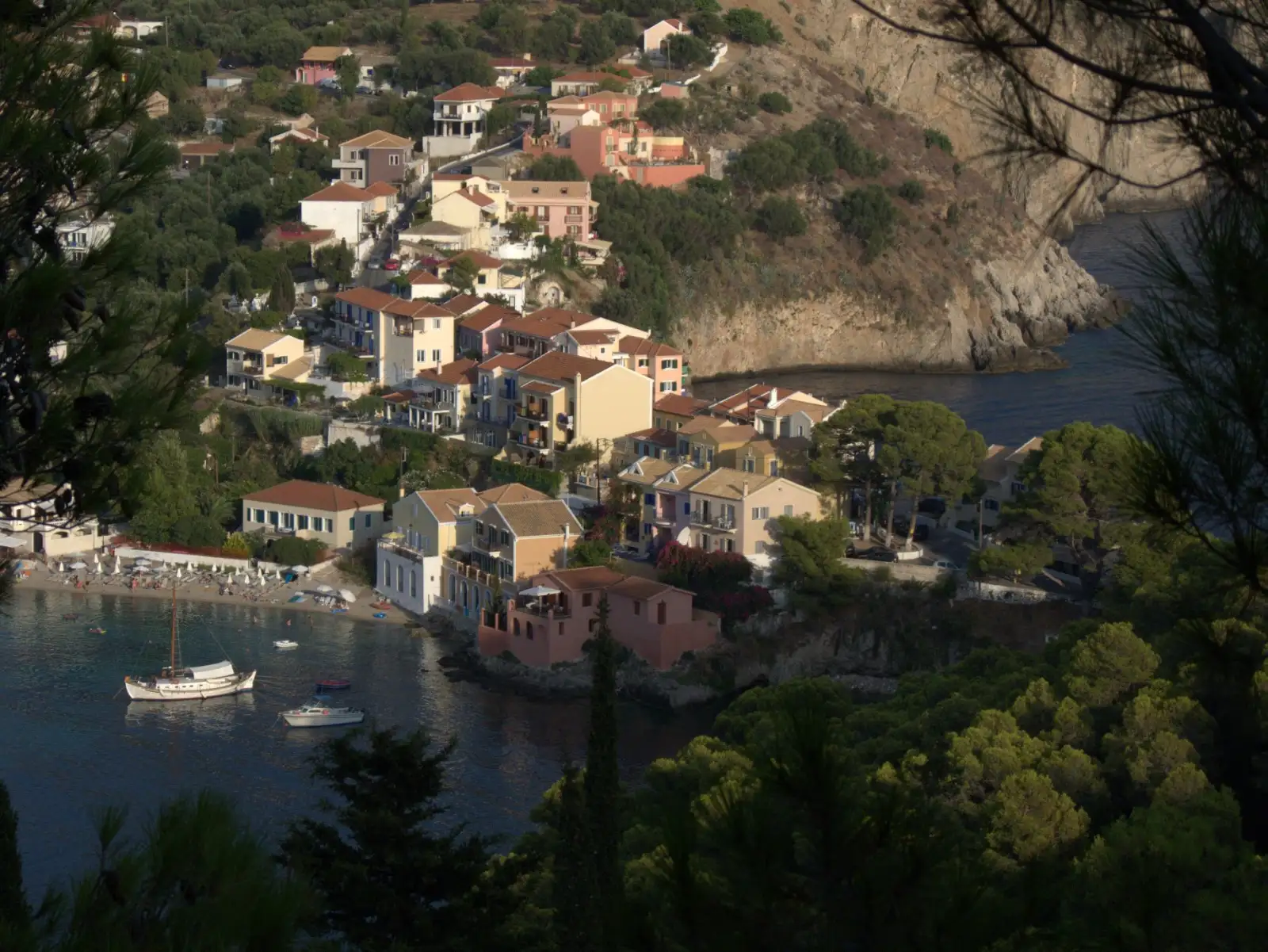
Fiskardo is the Venetian survivor and looks the part: 18th-century harbour houses, boutique rooms, yachts stern-to on the quay. It is the island’s couples and honeymoon base, and the honest caveats are the prices, rooms that sell out well ahead in peak season, and the hour of winding road between you and everything south. Assos, down the coast on the Fiskardo road, is the tiny romantic alternative - a handful of rooms below a Venetian castle and very little else, which is the point.
Whichever you pick, book the car with it. On this island, the two decisions are one decision.
How many days Kefalonia needs
Four to five days is the honest minimum for Kefalonia: enough for Myrtos, the Sami caves, Assos and Fiskardo with real beach time in between, provided you have a car. A week is the comfortable norm. Three days works, but only with early starts and no lie-ins.
| Days | What fits | Suggested base |
|---|---|---|
| 3 | The big four sights, with a car and early starts | Argostoli or Sami |
| 4-5 | The full loop plus proper beach days | Any single base, with a car |
| 7 | The loop, the Ithaca day trip and the Paliki peninsula | One base, or split west and east |
The reason the tiers run long is the map. The headline sights sit on three different coasts, so every “quick” day trip is two hours of driving door to door, and three-day plans quietly turn into a driving holiday with swims attached. Give the island four or five days and the same loop becomes unhurried, one region per day, a beach at the end of each leg.
A day trip over from Zakynthos exists in summer, but treat it as a taster - one viewpoint, one swim - rather than a visit; the boats land at remote ports on both ends, covered below. For how a Kefalonia week fits into a longer route, start with our Greece itineraries.
Getting there: seasonal directs, or Athens plus a short ferry
Kefalonia International Airport “Anna Pollatou” (EFL) sits about 8 km south of Argostoli and is run by Fraport Greece. From roughly May to October it takes direct flights from the UK and a spread of European cities; the rest of the year the link is Athens, about an hour. Which airlines fly which routes changes from season to season, so take the current list from the airport rather than from a guide. Most visitors collect the rental at the airport and start the loop from there.
By sea, look west rather than to Piraeus. Kefalonia’s mainland ferries leave from Greece’s west coast - Kyllini to Poros, the fastest crossing at roughly an hour and a half, and Patras or Astakos to Sami. From Athens without a flight, that means crossing the country to Kyllini first, a bus of about four hours, which turns arrival day into a full day of travel.
| Route | Arrives at | Duration | Season | Choose it if |
|---|---|---|---|---|
| Kyllini - Poros | Poros, southeast coast | ~1.5 h, the fastest | Year-round | You are basing in Skala or the south |
| Patras - Sami | Sami, east coast | Longer; check current timetables | Check current season | You are coming from Patras or the north |
| Astakos - Sami | Sami, east coast | Check current timetables | Check current season | You are driving the western mainland |
No timetable, frequency or fare on this page: take those from the operators for your date.
Pick the port by your base. Poros lands you roughly three quarters of an hour’s drive from Argostoli and close to Skala; Sami puts you next to the caves and the east coast. In season there are also island-to-island links - Ithaca from Sami, Lefkada from Fiskardo, Zakynthos from Pesada - covered in the Ionian loop below.
For fares and booking mechanics, see flights to Greece and Greek island ferries.
The big four, honestly: Myrtos, the caves, Assos and Fiskardo
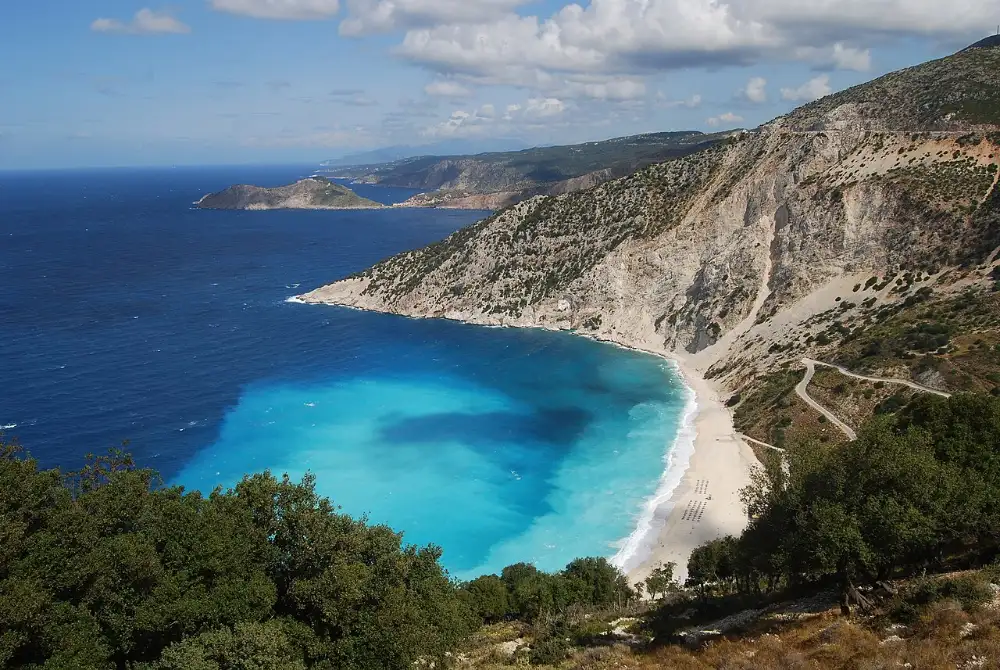
Myrtos first, with both halves of the truth. The white-pebble sweep under sheer cliffs is the island’s postcard, and the viewpoint on the road above is the guaranteed win: a five-minute stop, no effort, the full picture. The swim is a separate decision. The access road is a steep run of switchbacks, the pebbles want water shoes, the waves can be rough, and rockfall is a real feature of those cliffs - a landslide sent debris onto the shore in July 2026 and the beach was temporarily closed. Check the current status locally before you build a swim day around it, and treat the warning signs as instructions.
Melissani, just outside Sami, is the sunlit lake inside a collapsed cave, toured by rowing boat in ten to twenty minutes. Go around midday, when the sun drops through the open roof and lights the water from below; in peak season expect a queue, sometimes a long one. Tickets are sold at the entrance, and hours shorten sharply outside summer.
Drogarati, nearby, is the other half of the pairing: a chamber roughly 150 million years old, a constant ~18C whatever August is doing outside, and acoustics good enough that concerts have been staged inside. It keeps seasonal hours and its own entrance fee too, so check before making the detour. Together, the two caves are why Sami makes such a strong base.
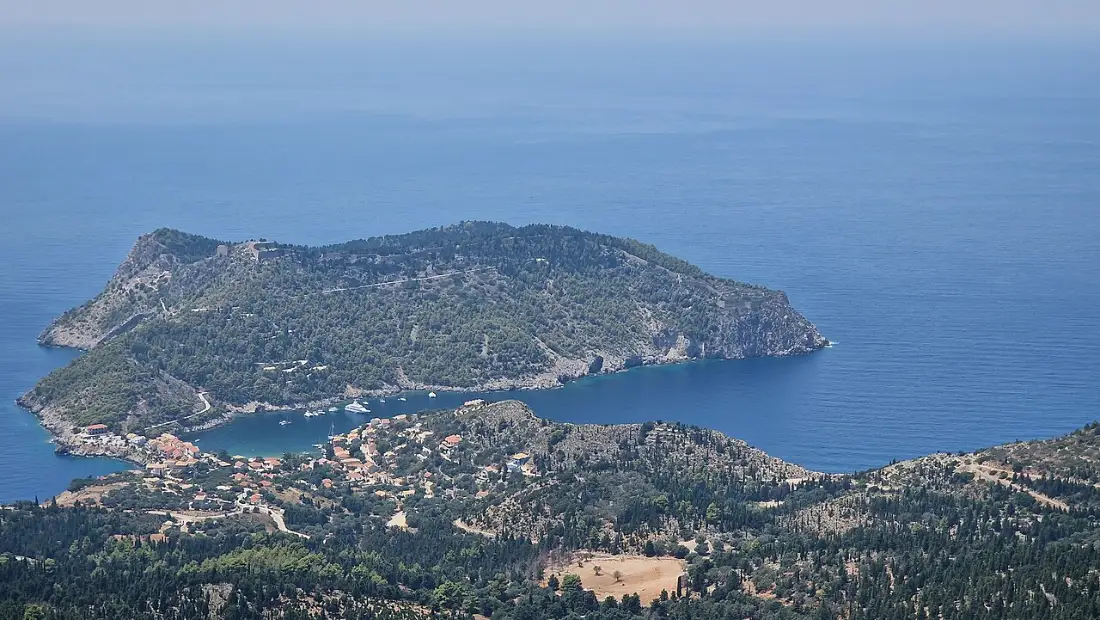
On the west road north, Assos is the pastel village on its own mini-peninsula below a Venetian castle, reached by a 30-40 minute walk up; an hour or two here is time well spent. Fiskardo, at the island’s tip, is the 1953 survivor - 18th-century harbour houses, good boutique tavernas, a yacht crowd that knows exactly how photogenic it all is. It is worth the drive; just budget for the lunch prices.
Round out the loop with the quieter hits. Mount Ainos national park has the summit forest and, on clear days, views across half the Ionian; the Robola wineries on its slopes - Gentilini, Sclavos, the Robola cooperative - pour the island’s signature white; and Argostoli itself earns an hour, for the stone De Bosset bridge across the lagoon and the caretta turtles working the harbour in the mornings.
For the swimming side of the island, the depth lives in the best beaches in Kefalonia.
Beaches: pebble drama in the north, sand in the south
One rule sorts Kefalonia’s beaches, and it should drive your booking: the drama is pebble, the comfort is sand. The famous north and west - Myrtos, Petani, boat-access Fteri - is white-pebble country under cliffs, while the easy sand sits south, around Skala, Lassi and the Paliki’s red-sand Xi.
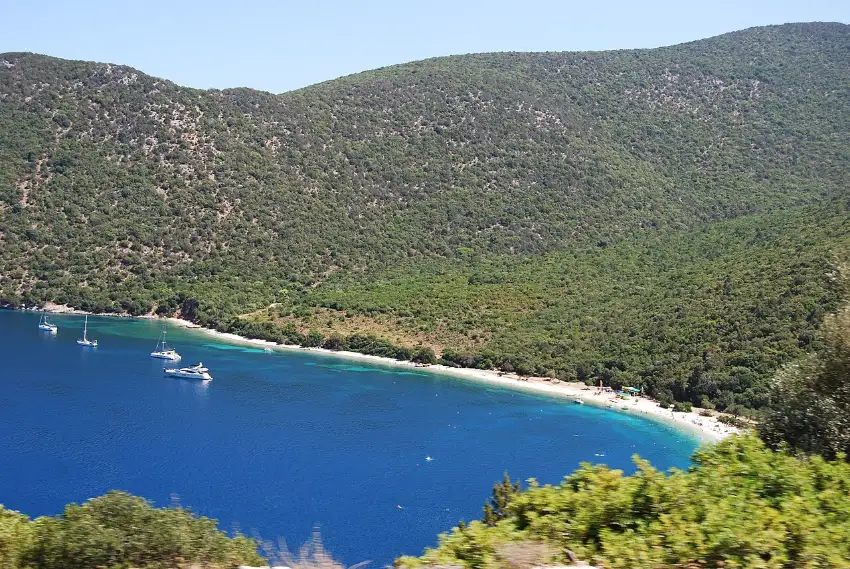
Antisamos, the Captain Corelli filming beach, is the east’s best swim: white pebbles, water that turns deep green against steep wooded hills, and only ten minutes from Sami. It is the natural end to a caves morning.
The Paliki peninsula is the quiet win. The short ferry from Argostoli to Lixouri works as a shortcut across the gulf, and beyond it wait Xi’s shallow red sand and the pale cliffs of Petani, a Myrtos in miniature with fewer coaches. Most guides skip the Paliki entirely, which is exactly why it stays calm in August.
- Sand: Skala, Makris Gialos and Platis Gialos (Lassi), Xi
- Pebble: Myrtos, Antisamos, Petani, Fteri
Access notes, sunbed reality and the full ranking live in the Kefalonia beaches guide.
When to come, and what shuts outside season
The best time to visit Kefalonia is late May to June and September to early October: warm settled days, a sea still comfortable for swimming, the big beaches uncrowded and rooms at sane prices. July and August are the peak, when Myrtos and Melissani queue and Fiskardo’s few rooms vanish.
The deeper truth is that this is a seasonal island. Direct international flights and the island-to-island ferries to Zakynthos and Lefkada run roughly May to October, and the resort bases - Skala, Lassi - go quiet once the last charter leaves, while Argostoli lives year-round. Outside summer, base in the capital and treat the island as a driving trip.
| Season | Crowds | What runs | Note |
|---|---|---|---|
| May-Jun | Moderate | Directs ramping up; island ferries starting | The island at its greenest |
| Jul-Aug | Peak | Everything | Queues at Melissani; book Fiskardo months ahead |
| Sep-early Oct | Moderate | Directs and island ferries still running | Warm sea, thinning crowds |
| Late Oct-Apr | Light | Athens flights and mainland ferries | Resorts shut; Argostoli carries on |
Micro-timing does the rest. Myrtos is best before 10am or in late afternoon, Melissani around midday for the light shaft, and Ainos in spring or autumn if you plan to walk. For the wider calendar, see best time to visit Greece and the month-by-month weather guide.
Kefalonia or Zakynthos, and the rest of the Ionian loop
The short verdict: pick Kefalonia for space, mountain-and-cove scenery, quieter beaches and generally better value; pick Zakynthos for the famous shipwreck beach, stronger nightlife and easier package connectivity. The full case for the other side lives in our Zakynthos guide.
If you plan to combine them, know the catch nobody prints. The seasonal ferry runs from Pesada, in Kefalonia’s rural south, to Agios Nikolaos on Zakynthos’ remote northern tip - about an hour and a half with Ionion Pelagos, roughly mid-June to late September. Both ports sit in the middle of nowhere with thin bus service, so the crossing only works with pre-arranged transport or a rental on each side. Otherwise, connect the two islands via Kyllini.
Ithaca is the easy add. The short crossing from Sami makes it a genuine day trip - out in the morning, back in the evening - with time for Vathy’s harbour front and a swim on the way. Sailings shift by season, so check the current timetable locally before you commit the day. Homer’s island earns a longer look in the Ithaca guide.
| Neighbour | From which port | Crossing | Season |
|---|---|---|---|
| Ithaca | Sami | Short; a realistic day trip | Check current timetable |
| Zakynthos | Pesada, to Agios Nikolaos | ~1.5 h | Summer only, roughly mid-June to late September |
| Lefkada | Fiskardo | Seasonal link northward | Summer |
The loop keeps going if you let it: Fiskardo links north to Lefkada in season, Corfu anchors the group’s north, and the Ionian islands overview maps the whole chain. For the money side there is what a Greece trip costs, and for stitching a route together, island hopping in Greece.
And that is the whole method for this island. Pick the base, book the car with it, and Kefalonia’s size stops being the problem and becomes the point.
Kefalonia FAQ
Where is Kefalonia?
Kefalonia, also spelled Cephalonia, is the largest of the Ionian islands, off mainland Greece’s west coast between Zakynthos and Lefkada. The capital is Argostoli, the island has its own international airport (EFL), and ferries connect it to the western mainland ports, not Piraeus. It anchors the southern half of the Ionian islands.
How many days do you need in Kefalonia?
Four to five days is the honest minimum: Myrtos, the Sami caves, Assos and Fiskardo, plus real beach time, with a car. A week is the comfortable norm, adding the Ithaca day trip and the Paliki peninsula. Three days works only with early starts and a tolerance for driving.
Where should you stay in Kefalonia?
Base in Argostoli or Lassi for practicality, sand and the car-free fallback; Sami to sleep next to Melissani, Drogarati and the Ithaca ferry; Skala for the island’s longest sandy beach; Fiskardo for the Venetian harbour if the budget stretches. Match the base to your beach type - the north is pebble. Fiskardo suits a couples trip best.
Do you need a car in Kefalonia?
Effectively yes. The island is the largest in the Ionian, its sights sit on three different coasts an hour of winding road apart, and buses are thin and shaped around package schedules. The exception: base in Argostoli or Lassi, take organized excursions and accept a shorter list. See getting around Greece.
How do you get to Kefalonia?
Fly direct in season, roughly May to October, from UK and European cities to Kefalonia airport (EFL), or via Athens in about an hour year-round. By sea, the ferries are western-mainland ones rather than Piraeus ones: Kyllini to Poros in roughly an hour and a half, Patras or Astakos to Sami. Details in Greek island ferries and flights to Greece.
Kefalonia or Zakynthos - which should you pick?
Pick Kefalonia for space, mountain-and-cove scenery, quieter beaches and generally better value; pick Zakynthos for the shipwreck beach, livelier nightlife and easier package connectivity. A seasonal ferry of roughly an hour and a half connects them in summer, but it lands at remote ports on both ends, so arrange onward transport before you sail. Start with the Zakynthos guide.
What is Kefalonia famous for?
Myrtos Beach’s white-pebble amphitheatre, the sunlit underground lake at Melissani, the Venetian harbour village of Fiskardo that survived the 1953 earthquake, and Robola wine from the slopes of Mount Ainos. Its dated claim to fame is Captain Corelli’s Mandolin, filmed around Sami and Antisamos in 2001. The swimming is ranked in the best beaches in Kefalonia.
Can you visit Ithaca from Kefalonia?
Yes. The short ferry from Sami makes Ithaca a genuine day trip: out in the morning, back in the evening, with time for Vathy’s harbour front and a swim. Sailings shift by season, so check the current timetable locally before you commit the day. The island gets its own depth in the Ithaca guide.
Plan by category
The Kefalonia guides
5 guides, each scoped to a decision you actually have to make.
 Attractions
Things to do
See the attractions → Hotels
Where to stay
Compare the areas → Beaches
The beaches
See the beaches → Itinerary
Day by day
See the itinerary →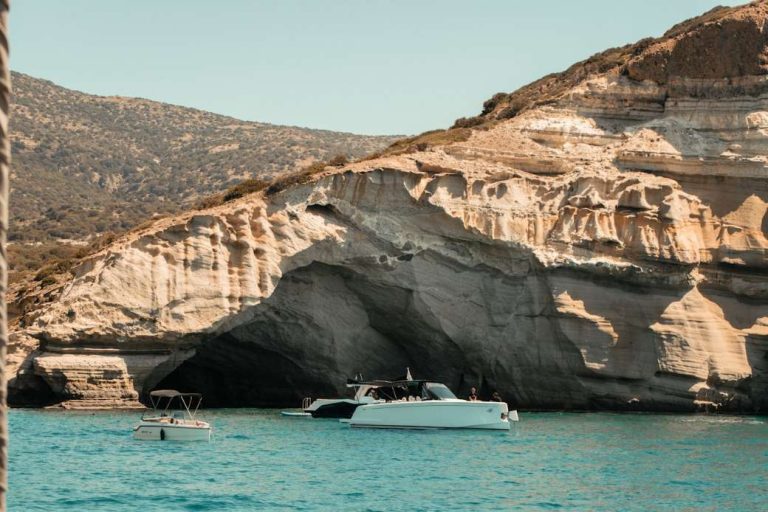 Day trips
Day trips
See the day trips →
Booking
We sell nothing and book nothing for you. Every guide on this page tells you how to arrange each piece yourself - which ferry operator, when to book, what to prebook and what to leave loose.