The short answer
Corfu vs Kefalonia comes down to what your trip is for. Choose Corfu for a historic town, an easy arrival and buses instead of a rental car; choose Kefalonia for the Ionian’s most dramatic beaches, mountain scenery and quiet, car-based days. Cost lands close, so neither is the obvious budget pick.
This page settles it axis by axis - beaches, landscape, old town, nightlife, romance, getting there and around, and cost - then names who each island suits and gives you an honest answer on whether you can see both.
Choose Corfu for a UNESCO old town, easier flights, no-car travel and a nightlife strip if you want one. Choose Kefalonia for Myrtos and Antisamos, mountains and dramatic scenery, and slow, quiet evenings. How to decide by asking whether you want a town and easy logistics or a landscape and a car.
Corfu vs Kefalonia at a glance
Here is the whole decision in one view. Read it top to bottom: most rows fall cleanly to one island, and they split along a single line - Corfu takes the town rows, Kefalonia takes the landscape rows.
| What you’re deciding | Corfu | Kefalonia | Verdict |
|---|---|---|---|
| Best for | Town, culture, easy no-car trips | Beaches, scenery, quiet couples | Depends on the trip |
| Character | Developed, historic, well-connected | Dramatic, nature-first, spread out | Tie, opposite moods |
| Beaches | Sandy family bays, pebbly west coast | Cliff-backed Myrtos, Antisamos, Petani | Kefalonia for drama, Corfu for easy |
| Scenery | Soft, green, cultivated | Mountainous, dramatic, big | Kefalonia |
| Old town and culture | UNESCO old town, fortresses, layers | Post-earthquake rebuilds, Fiskardo | Corfu |
| Nightlife | A party strip plus town bars | Tavernas and quiet drinks | Corfu |
| Romance and quiet | Romance with a pulse | Quiet, scenic, secluded | Kefalonia |
| Getting there | More direct flights, mainland ferries | Fewer flights, longer haul | Corfu, easier |
| Getting around | Compact, extensive buses, no car needed | Large and spread out, rent a car | Corfu, easier |
| Cost | Mid-range, budget resorts to pricier | Mid-range, can edge cheaper | Roughly comparable |
| Ideal length | 5 to 7 days | 5 to 7 days, more if you drive it all | Kefalonia needs a touch longer |
Those verdicts are ours, not a scoreboard, so a reader who cares most about beaches will read the table differently from one who cares most about the old town. On our reading: Corfu takes the old town, the connectivity and the no-car ease; Kefalonia takes the beaches, the scenery and the quiet; and cost is roughly a wash.
This page compares the two at a decision level only. For every beach, hotel, attraction and village, go deep on the Corfu guide and the Kefalonia guide.
Beaches: Myrtos drama or a sandy family swim
If the trip is really about the beach itself, Kefalonia owns the spectacle and Corfu owns the easy swim. These two are not chasing the same beach day.
Kefalonia has the Ionian’s headline beaches. Myrtos and Antisamos are cliff-backed crescents of white pebble over impossibly blue water, and Petani on the west coast belongs in the same company. They are as much a view from the clifftop as a swim: the access is steep, the shade is thin, and you reach the best of them by car. Plan them as a dramatic swim day you drive to, not a step-off-the-sunbed morning.
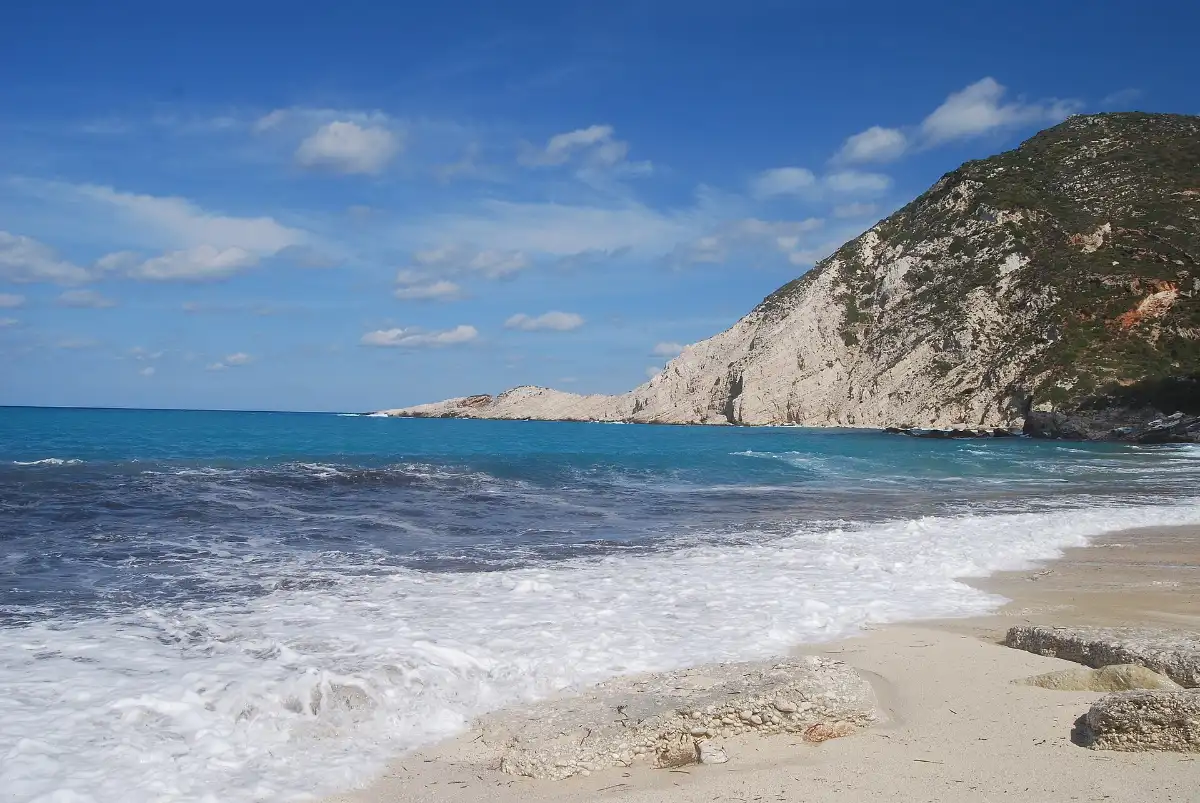
Corfu trades the spectacle for variety and ease. The north and north-east coast hold genuinely sandy, shallow bays that suit small children, Sidari and the resort beaches come with facilities close by, and the west-coast Paleokastritsa is scenic but pebbly, with a sea that runs cooler than the sandy east. This is the island of the easy, sandy, close-to-your-base swim.
The split is about purpose. Kefalonia’s beaches are the postcard and the reason you rented the car; Corfu’s are for kids in the shallows a short walk from lunch.
Pick Kefalonia if the single most beautiful beach of the trip is the point and you will drive to reach it. Pick Corfu if you want sandy, shallow, easy-access swimming with facilities nearby. For the full lists, see Kefalonia beaches and Corfu beaches.
Landscape: soft green or dramatic mountains
Both islands are green, so this is not the green-versus-bare choice you make in the Cyclades. It is a choice between soft and dramatic.
Corfu is the soft one. Olive groves, cypress and a lush, cultivated interior earned it the Emerald Isle reputation, and the land rolls rather than towers. You can enjoy most of it without long drives, because the island packs its variety into a compact space.
Kefalonia is the dramatic one. It is a bigger island built around Mount Ainos, the highest peak in the Ionian, with steep coasts, pine forest and long stretches of open road between the sights. Here the scenery is the activity: you cover ground by car, and the drive between Argostoli, Sami, Assos and Fiskardo is part of the point rather than dead time.
That scale is the planning fact hiding under the scenery. Corfu gives you variety within easy reach; Kefalonia gives you grandeur you earn behind the wheel.
Pick Kefalonia if you want mountains, distance and a road-trip feel. Pick Corfu if you want green, gentle country you can enjoy without a long drive. For where these two sit in the wider group, see the Ionian islands.
Old town and culture: where Corfu wins outright
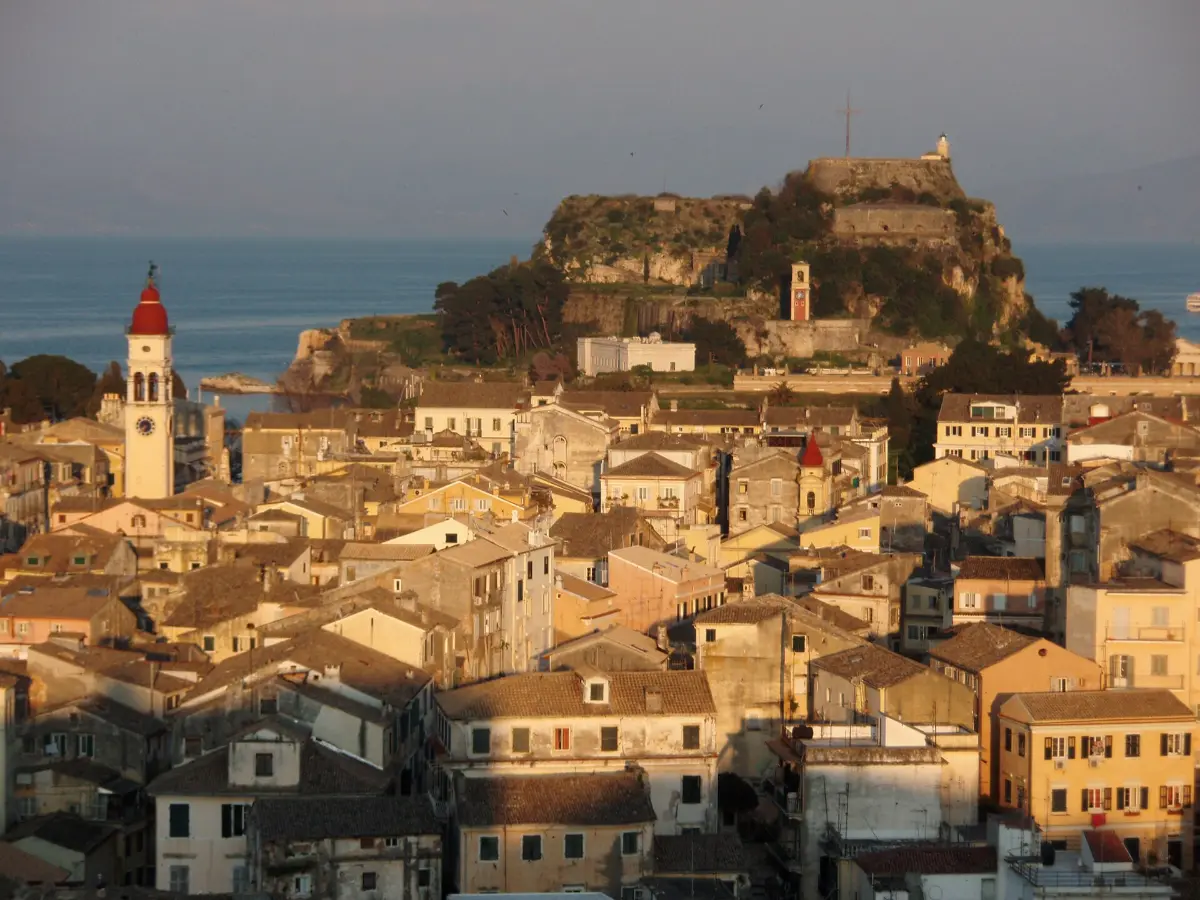
This is the one axis where Corfu wins outright, and a single fact anchors it. Corfu Old Town is a UNESCO World Heritage Site, a dense and walkable warren of Venetian, French and British layers with two fortresses guarding it and the arcaded Liston to sit under in the evening. It is a proper town, the kind you spend nights in rather than pass through.
Kefalonia’s story is different, and told honestly it is about an earthquake rather than a lack of character. The 1953 Ionian earthquake flattened most of the island’s old villages, so much of what you see today, Argostoli included, is careful mid-century rebuild: pleasant and walkable, modern rather than historic. Its one great survivor is Fiskardo, the Venetian harbour village in the north that came through largely intact and now carries the old-Kefalonia look almost single-handedly.
So the culture question answers itself by what you want your evenings to be. Corfu gives you a layered town, museums and centuries of history on foot; Kefalonia gives you a landscape and lets a single preserved harbour do the historic talking.
Pick Corfu if a historic town and layered history matter to the trip. Pick Kefalonia if you would rather the scenery did the talking. Go deep on Corfu Old Town and things to do in Corfu, or on things to do in Kefalonia for Fiskardo, Assos and the caves.
Nightlife: a party strip or quiet dinners
If a night out is a reason for the trip, Corfu can give you one and Kefalonia mostly will not try. Corfu has a purpose-built party strip at Kavos on its southern tip, aimed squarely at a young crowd, plus livelier bars in Corfu Town and the busier resorts. It is a self-contained scene you can walk straight into, or avoid entirely by basing yourself in the north or the town.
Kefalonia runs quiet in the evenings by design. The nights out are long taverna dinners, a handful of bars around Lassi and Argostoli, and waterfront tables in Fiskardo and Assos: a relaxed drink rather than a dance floor. That is the island working as intended, not a gap in it.
Pick Corfu if you want the option of a big night. Pick Kefalonia if your idea of a night out is a slow dinner by the harbour. For the strip and the town bars, see Corfu nightlife, and for the cross-island picture, nightlife and party trips.
Romance and quiet: Kefalonia for a slower couple’s trip
For a quiet, romantic Ionian trip, Kefalonia is the stronger pick, and the specifics back it up. The Fiskardo and Assos harbours, the clifftop view down over Myrtos, the boutique and adult-only hotels and the simple fact of fewer crowds all point the same way: this is a natural island for a slow couple’s trip or a quiet honeymoon.
Corfu can be romantic too. Paleokastritsa and the green north-east coast have the setting for it. But Corfu is busier and more developed, so the romance comes with a pulse: a town to dress up for, dining variety, and something to do when it rains, rather than seclusion and silence.
So the split is clean. Kefalonia for calm, scenic romance where the evenings are yours. Corfu for a couple who wants romance plus a town, more restaurants and more to do.
Romance verdict: Kefalonia for quiet romance, Corfu for romance with a town attached.
Neither island has its own honeymoon page here, so plan the trip on the Greece honeymoon guide, or the couples guide if a wedding is not the occasion.
Getting there and getting around
Corfu is the easier island to reach and the easier one to explore without a car. Kefalonia asks more of you at both ends.
Getting there, both islands have airports, but Corfu holds the stronger hand: more direct European flights, a longer season, and a position close to the mainland that adds a short ferry from Igoumenitsa and international sailings from Italy on top of the flights. Kefalonia’s flight options are thinner and it is the longer, less convenient haul. Treat that as a durable comparison rather than a timetable, and take the specifics from flights to Greece and which islands have an airport.
Getting around is the input travellers underrate. Corfu is compact with an extensive bus network, so a good trip there needs no rental car at all. Kefalonia is large and genuinely spread out, its beaches and villages sit far apart, and you will want a rental car or organised tours to see it properly. That is a real line in the budget, not a footnote, and it is corroborated across the independent guides and the traveller forums. Plan it on renting a car in Greece.
Pick Corfu if an easy arrival and no-car travel matter. Choose Kefalonia if you are happy to fly less conveniently and drive once you land. For the boats between islands, the Greek island ferries guide has the routes.
Cost: both mid-range, with a slight Kefalonia edge
Neither island is Santorini-priced, and asking which is cheaper gives you a closer answer than the internet suggests. Both are mid-range Ionian islands, cheaper than the headline Cyclades, and daily costs land broadly comparable. Where Kefalonia can edge cheaper is at the local end: it is less package-saturated, so food and rooms away from the resorts can run a touch lower. Corfu spreads wider, from budget package resorts to pricier boutique stays, which is its own kind of value if you book the cheaper end.
The catch that decides it is the car. On Kefalonia you should budget for a rental because you need one; on Corfu you can delete that cost by living on the buses. So the cheaper island depends partly on whether a car is in the plan at all.
Pick on where your money goes, not a headline number. Kefalonia if you want lower local prices and will absorb the car. Corfu if bus travel and package-resort options keep the total down. For the plannable breakdown in euros, see what a Greece trip costs.
Which should you pick? By traveller type
The same two islands score differently depending on who is going, so match the island to the traveller rather than to a leaderboard. Here is the quick router:
- Family with young kids and no car: Corfu. Sandy, shallow bays, resorts with facilities close by, buses instead of a rental, and more to do when it rains. Plan it on the family trips page.
- Active family happy to drive: Kefalonia, for calm days and dramatic swimming, as long as everyone accepts time in the car.
- Honeymooners and couples wanting quiet: Kefalonia, for Fiskardo, Assos and the Myrtos view. Start with honeymoon planning or Greece for couples.
- Couple wanting a town and some buzz: Corfu, for the old town, the dining and a night out within reach.
- Culture and history traveller: Corfu, every time - the UNESCO old town, the fortresses and the layered history are the whole appeal. Begin on the Corfu guide.
- Beach-and-scenery seeker: Kefalonia, for Myrtos, Antisamos and the mountain drives. The Kefalonia guide sets it up.
- First-timer who wants an easy arrival and no car: Corfu, the simpler landing and the simpler week.
- Party group: Corfu, for the Kavos strip and the town bars. See nightlife and party trips.
- Seclusion and fewer crowds: Kefalonia, and if quiet is the whole brief, weigh it against the quietest Greek islands.
The rule underneath all of it: match the island to the trip you actually want, and the pick names itself.
Two Ionian islands, or just one?
Here is the honest answer the comparison blogs skip: unlike the Cyclades, Corfu and Kefalonia do not pair on a quick ferry, so combining them is closer to an either/or than a two-stop trip.
The geography is the reason. Corfu sits in the far north Ionian, up near the mainland gateway of Igoumenitsa, while Kefalonia sits in the centre, opposite the gateway of Kyllini. The direct crossing between them is slow and runs rarely, nothing like the fast, frequent hops that stitch the Cyclades together, so most people who want both route through the mainland, fly, or simply choose one.
The better move is to pair each island with its natural neighbour instead of with each other. Corfu goes with nearby Paxos just to its south; Kefalonia goes with Ithaca just across the strait. That is the realistic second island most travellers actually want.
On length, five to seven days is plenty for either island, a little more for Kefalonia because you drive between the sights. Forcing both into one trip usually costs more transit time than it is worth. For how island-hopping actually works out here, see the island-hopping guide.
Our pick, if you make us choose
Forced to one island, book Corfu. For a first Ionian trip, and for most travellers who want an easy arrival, a historic town and no rental car, it is the one that gives you the most with the least effort. Choose Kefalonia instead when Myrtos, Antisamos and the dramatic scenery are the actual reason for the trip and you are ready to rent a car and drive it. Couples chasing quiet lean Kefalonia; families chasing easy lean Corfu.
The logic under every verdict here is the same: Corfu is a town, Kefalonia is a landscape, so pick the trip you want and the island stops being a toss-up.
From here, go deep on the Corfu guide or the Kefalonia guide. If your shortlist is really a different pairing, the same decision spine runs through Santorini vs Mykonos and Naxos vs Paros, and the wider group is on the Ionian islands hub.
Quick answers
Which is better, Corfu or Kefalonia?
Neither is better outright. Corfu vs Kefalonia splits by what you want: Corfu wins for a historic old town, an easy arrival and no-car travel, with a nightlife strip if you want one, while Kefalonia wins for dramatic beaches, mountain scenery and quiet. Cost is close, so pick the island that matches your trip. In short, Corfu is a town with easy logistics; Kefalonia is a landscape you drive.
Is Corfu or Kefalonia better for families?
Corfu is the easier family island. Sandy, shallow bays, resorts with facilities close by and a bus network mean you can travel without a car and keep small children happy. Kefalonia works for families who will rent a car and want calm days and dramatic swimming, but its headline beaches take real effort to reach. Plan either on the family trips page.
Is Corfu or Kefalonia better for a honeymoon or couples?
Kefalonia, for most couples wanting quiet. The Fiskardo and Assos harbours, the Myrtos viewpoint, boutique and adult-only hotels and fewer crowds make it a natural quiet-honeymoon island. Choose Corfu only if you want romance plus a historic town, more dining and more to do on a rainy day. Plan it on the honeymoon or couples page.
Which has better beaches, Corfu or Kefalonia?
It depends on the beach day you want. Kefalonia has the more spectacular beaches - Myrtos, Antisamos and Petani, cliff-backed and dramatic - but they take a drive and offer little shade. Corfu has more variety and easier sandy, shallow family bays, while its west-coast Paleokastritsa is scenic but pebbly with a cooler sea. See Kefalonia beaches and Corfu beaches.
Do you need a car in Corfu or Kefalonia?
You can skip a car on Corfu, which is compact and covered by an extensive bus network. On Kefalonia you really want one: the island is large and spread out, and the best beaches and villages sit far apart. Budget for a rental if you choose Kefalonia, and see renting a car in Greece for the how.
Can you visit both Corfu and Kefalonia in one trip?
It is awkward, unlike the Cyclades pairings. Corfu is in the far north Ionian and Kefalonia in the centre, and the direct crossing between them is slow and infrequent, so most people route via the mainland, fly, or simply pick one. If you want a second island, pair Corfu with Paxos and Kefalonia with Ithaca instead.
Is Corfu or Kefalonia cheaper?
Both are mid-range Ionian islands and daily costs land close, so neither is a clear budget winner. Kefalonia can edge cheaper because it is more local and less package-saturated, but you should budget for a rental car there, while on Corfu the buses keep costs down. Which is cheaper depends on whether a car is in the plan. See what a Greece trip costs.