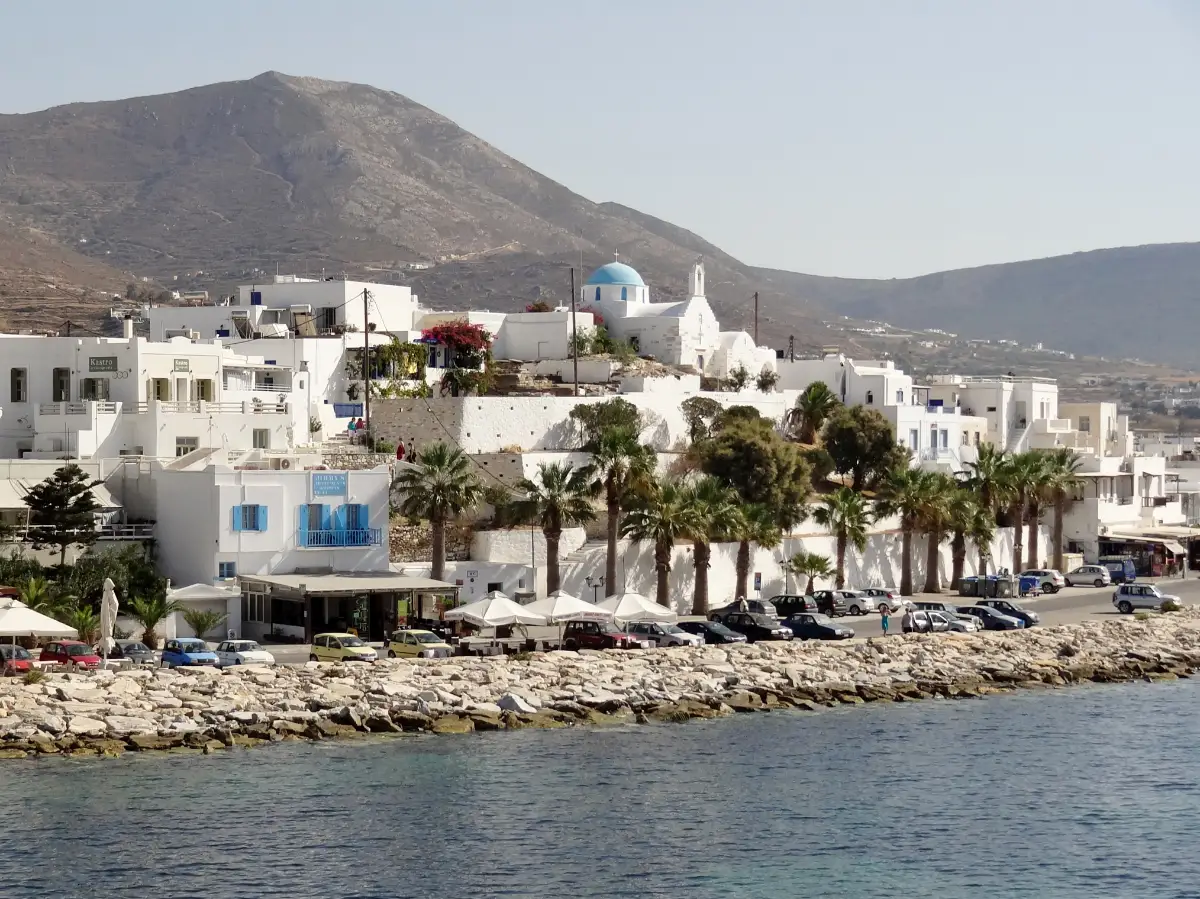
Greek island hopping is a design problem, not a bucket list. A good hop is not a set of islands you collect one by one; it is a route you build from two fixed points - the flight in and the flight out - and a few rules that turn Greek island travel from a guess into a plan. Pick one ferry system, set a realistic pace, order the stops so every boat carries you forward, and fly out the far end: do that and the route almost draws itself. This page teaches the rules. For how the ferries work - ports, boats, booking and cancellations - it sends you to the ferries guide; for a route you can copy, to an itinerary. Naming what we hand off is the point, not the gap.
Start with the ferry system, not the island
The first decision, and the one that makes every other decision possible, is which ferry system you are travelling in. Greek island hopping runs on four broadly separate networks, and they barely connect to each other, so choosing one is what turns a map of hundreds of islands into a route you can actually sail.
The four are the Cyclades, the Dodecanese, the Ionian and the Saronic. The Cyclades sit in the central Aegean, sail out of Piraeus and Rafina, and are the classic choice for a first trip - Santorini, Naxos, Paros, Mykonos, Milos. The Dodecanese run down the Turkish coast in the eastern Aegean - Rhodes, Kos, Symi, Patmos. The Ionian are a different sea altogether on the west side of the country - Corfu, Kefalonia, Zakynthos - reached from western-mainland ports, not from Athens. The Saronic sit right off Athens - Aegina, Poros, Hydra, Spetses - the easy long-weekend system you can dip into without committing a whole trip.
They are separate for concrete reasons: different seas, different home ports, different operators, and genuinely thin links across the gaps. The tells are on the map once you know to look. Milos is a Cyclades island, but it rides the western-Cyclades line out of Piraeus - Serifos, Sifnos, Kimolos - a separate corridor from the Mykonos to Naxos to Santorini spine, so you reach it from Athens rather than side-stepping across from Santorini. Rhodes sits a long way east: the direct boat from Piraeus is an overnight conventional ferry with no high-speed on the run, which is why most people fly. Crete is its own region about 120 km south of Santorini, big enough to carry two airports of its own. None of these are quirks; they are what “separate system” means in practice.
So the rule writes itself: pick one system per trip, unless you have two weeks or a flight to spare, and the exception has its own section below. For a first hop that system is almost always the Cyclades, where the boats are frequent, the hops are short, and Athens is the front door. If you are still weighing which islands to visit in Greece at all, start from the group, not the island - the full island groups index lays them side by side.
| System | Home ports | Character | Best for | Group page |
|---|---|---|---|---|
| Cyclades | Piraeus, Rafina | Frequent boats, short hops, the postcard islands | A first hop, and most second ones | Cyclades |
| Dodecanese | Piraeus, or fly in | Eastern Aegean, close to Turkey, big single islands | Rhodes, Kos and their neighbours | Dodecanese |
| Ionian | Western-mainland ports | A greener, calmer sea, no Athens ferry | Corfu and the west coast | Ionian |
| Saronic | Piraeus | Day-trip close to Athens | A long weekend without a flight | Saronic |
One distinction worth drawing once: island hopping is not a cruise. A cruise carries your bed with you and chooses the ports; a hop is independent ferry travel, where you pick the islands and sleep a few nights on each. If a floating hotel is what you actually want, take a cruise instead. Otherwise, how ferries and ports actually work is the mechanics behind everything above.
Match the number of islands to your nights
As a rule of thumb, plan about one island per three nights, treat two nights as the floor, and never book a single night anywhere. In a week that means Athens plus two islands; in ten days, three done properly. It is guidance drawn from what experienced hoppers report, not a measured law, but the mechanism under it is real.
A ferry day costs you a half-day at each end - checkout, the trip to the port, the crossing, the ride to the next room, check-in - so a one-night stay is spent almost entirely in transit. That is why one night is a trap and two is the practical minimum.

Diagram by Greece Trips. Free to reuse with credit - CC BY 4.0.
The method behind the number is to design backwards from the two things you cannot move: the flight in and the flight out. Start from your total nights, give Athens its share - most first trips want two or three - subtract any travel-heavy days, and divide what is left by three. The whole shape of a Greek island trip falls out of that sum.
In practice, a week buys Athens plus two Cyclades islands; ten days buys three done properly, or the same two slowed right down; two weeks buys three or four at an easy pace, with room to fold in a quieter, less touristy island like Milos or Amorgos. Treat those as ranges, not promises - your own flights and ferry days bend them.
The trade-off is worth saying plainly: two or three islands done well beats five half-seen. Every extra island is another packing morning, another port and a little less of each place - and when people come home wishing they had moved slower, this is almost always why.
None of this needs a timetable. A hop costs a half-day whatever the exact crossing time, so for what a ferry day actually involves the mechanics are one click down. For a pace you can copy rather than calculate, a seven-day plan and a ten-day plan do the sum for you.
Order the stops so every ferry moves you forward
Once you have a system and a number, the order is what separates a smooth trip from a wasted day. The best way to travel between the Greek islands within a group is almost always the ferry, so the corridor you choose is really a chain of ferry links - and the trick is to plan the route to the links that exist, not the map you wish existed.
Inside the Cyclades the central spine - Mykonos, Paros, Naxos, Santorini - is densely linked, so you can hop straight down the line in one direction without ever doubling back. The western-Cyclades line, Milos and its neighbours, is a separate corridor you usually join and leave from Piraeus, not a stepping stone you reach sideways from Santorini.
That gives you two route shapes, and the right one depends on your islands. A linear route moves one way down a corridor and flies out the far end - the better shape for seven nights or more, and the one that pays off an open-jaw ticket. A hub-and-spoke route bases you on one well-connected island, Naxos or Paros especially, and day-trips out and back - the better shape when the boats to your extra islands are thin or seasonal, so you keep one room and let the day-trips flex.
The thing to design out is the backtrack. Any leg that sends you back to Piraeus to reach the next island is usually a lost day, and you can see it coming on the map before you ever book. Corridors shift by season and operator, so confirm the direct connections you are counting on - which islands actually connect, and how - before you lock the order. Mykonos and Santorini anchor the ends of the classic line, and a ready-sequenced Cyclades route rides it for you.

Diagram by Greece Trips. Free to reuse with credit - CC BY 4.0.
Open-jaw beats round-trip: fly in one end, out the other
The single move that saves the most time is a flight, not a ferry. Book an open-jaw ticket - multi-city, into one end of your corridor and home out of the other - so you never sail back to where you started. Fly into Athens or straight into Mykonos, ride the line south, and fly home from Santorini; it usually costs little more than a round-trip and saves a whole travel day. The one requirement is to end on an island with an airport - in the Cyclades that means Santorini, Mykonos, Naxos or Paros - so you can lift off instead of backtracking. Flying into and out of the islands covers the logistics, and an Athens-Santorini-Crete backbone is built to end on a flight rather than a return sail.

Diagram by Greece Trips. Free to reuse with credit - CC BY 4.0.
What a bad route looks like
Most ruined hops fail in the same few ways, and each one is a design error you can catch on the ferry map before you book, not a stroke of bad luck. Here are the five that recur, with the fix for each.
- Two systems in one week. Santorini plus Corfu, or Mykonos plus Rhodes - different seas, no useful direct boat, so the “hop” quietly becomes a flight or an all-day haul. Fix: one system per week, or add a flight and the time to use it, as the exception section below explains.
- One night per island. You spend the trip in transit, packing at dawn and checking in at dusk. Fix: a two-night floor, roughly one island per three nights.
- The fragile connection. A can’t-miss ferry-to-flight, or a non-refundable first night, stacked on an exposed high-speed leg at the meltemi’s peak - exactly when the light fast boats are the first to be pulled. Fix: leave a day of slack and take a conventional ferry on any leg you cannot miss.
- Travelling around mid-August. The single busiest stretch of the year, when Greeks travel en masse and the popular sailings sell out weeks ahead. Fix: shift to the shoulder season, or book the hard legs far in advance - the meltemi and the month to avoid has the calendar.
- Too many islands. Five in ten days looks ambitious on paper and feels like packing every morning in practice. Fix: cut it to three and give them room.
None of these needs a timetable to diagnose. Each is visible in the shape of the route - the gap between two groups, the single night, the exposed leg, the sold-out date, the overstuffed line - and each has a fix you can apply before you pay for anything.
Let the season set the pace
The calendar is a design input, not a footnote. The same route is a different trip in May than in August, and the difference is mostly the boats.
May, September and early October are the hopper’s sweet spot. The ferries still run at close to full frequency, so you can chain islands without building the whole trip around a timetable, but the high-summer crowds have either not arrived or already gone. You give up a small amount of certainty on the weather and gain a lot on space and calm - which is why the shoulder months, not high summer, are where a hop is easiest to design.
High summer, July and August, is hottest, busiest and the peak of the meltemi - the strong northerly that runs hardest from July into September and grounds the light high-speed catamarans well before the big conventional ferries even slow down. It is still a fine time to hop; it just demands slack. Leave a buffer day before any flight or non-refundable night, and put a conventional boat on any leg you truly cannot miss. Mid-August is the one stretch to sidestep outright, when the whole country is on the move and sailings sell out weeks ahead.
Winter, roughly November to March, is a different exercise. The network drops to a skeleton: the big islands and the mainland keep sailing, but many small-island and inter-island links simply stop, so a crossing that is routine in July may have to route back through Piraeus, take a third island, or become a flight. A winter Cyclades hop is possible, but it is thinner and slower, and worth planning as such rather than assuming the summer map still holds.
The detail lives elsewhere: when to go, month by month makes the seasonal call, and the meltemi and the weather calendar tracks the wind.
When it is worth breaking the one-group rule
Sticking to one system is the default, not a law. With two weeks, or a willingness to fly, you can pair groups - as long as you pay for the pairing in a flight or a long haul, rather than pretending a cross-group ferry exists that does not. Framed as a deliberate trade it works; framed as a free hop it wrecks the route.
To add the Dodecanese, fly to Rhodes from Athens and hop within the group from there - Rhodes to Symi is a short high-speed run - instead of trying to sail east across the open Aegean. The direct Piraeus to Rhodes boat is an overnight conventional ferry with no high-speed on the run, which is why the flight, not the ferry, is the sane way in. There is a one-week Rhodes and Dodecanese plan built on exactly that.
To add Crete to a Cyclades trip, use the in-season high-speed link between the Cyclades and Heraklion rather than treating Crete as just another hop - it is its own region, about 120 km south of Santorini, and a trip in its own right. To add the Ionian, do not try at all from the Cyclades: it is a different sea reached from the western mainland, and it belongs to a separate trip.
The rule of thumb keeps the exception honest. Budget a full transfer day - usually a flight - for every group you add, and do not attempt two systems in under about two weeks. How the ferry systems connect, and where they do not is the page to check a specific pairing against.
Plan the trip in the right order
Do the decisions in order and the booking turns from a guess into a checklist. A Greek islands trip planner works best as a sequence, not a spreadsheet, and the sequence mirrors this page:
- Pick one ferry system - for a first trip, the Cyclades.
- Set the pace from your nights: about one island per three, two the minimum.
- Sketch a one-direction corridor so every ferry moves you forward.
- Lock the scarce pieces first - the open-jaw flights and the hardest-to-change ferry legs, meaning peak dates, cabins and any car.
- Leave the flexible hops loose and confirm their times close to travel.
The order is not arbitrary. The flights and the peak-date sailings are the pieces that sell out, so they have to anchor everything else; the flexible mid-trip hops can wait, because a spare seat on a Tuesday in June is never the problem. The risk in summer is not price - it is a sold-out boat that quietly breaks the route you built.
From there this page hands off, because it books nothing itself. Booking ferries, ports and tickets covers the sea legs; flights and open-jaw tickets cover the air; and what the whole trip costs puts numbers to the plan. If you would rather start from a finished route than a blank corridor, a ready Cyclades hopping route and all our routes are the place to begin.
From plan to route
That is the whole method: one system, one island per three nights, one direction, fly out the far end, and let the season set the slack. Hold those five and the hundreds of islands stop being a decision and start being a route.
The next step is not a timetable - it is that route. Pick up a ready Cyclades route, get the ferry mechanics right, and use the full island map to see how your corridor fits the whole. Then the only thing left is to book it.
Common questions about Greek island hopping
How many Greek islands can you visit in a week?
In a week, plan Athens plus two islands in one group - about one island per three nights, with two nights the minimum. Three islands in seven days is possible, but you will spend it packing and catching boats; two done well is the better trip. To size it yourself, subtract Athens and your travel days, then divide the rest by three - a seven-day plan shows the pace.
How do you choose which Greek islands to visit?
Choose the ferry system before the islands - for a first hop that is almost always the Cyclades - then pick islands that sit on one corridor, so each ferry carries you forward instead of back. Match the count to your nights rather than to a wish list. The island groups and which Cyclades islands connect help you shape the shortlist.
Can you island hop between different Greek island groups?
Within a group, easily; across groups, rarely by ferry. The Cyclades, Dodecanese, Ionian and Saronic are largely separate systems, so combining them usually means a flight or a long haul - workable with two-plus weeks, awkward in one. Add the Dodecanese by flying Athens to Rhodes, and Crete by an in-season fast link off the Cyclades. How the systems connect has the detail.
Which Greek island should I visit first?
Start in the Cyclades - the boats are frequent, the hops are short, and Athens is the natural gateway. Naxos or Paros make relaxed, well-connected first bases; add Santorini for the caldera and fly home from there. Treat it as a design step, not a ranking: the best first island is the one that sits on an easy corridor. A Cyclades hopping route sequences one for you.
When is the best time for Greek island hopping?
May, September and early October are the sweet spot - the boats are still frequent but the crowds have thinned. July and August are hottest, busiest and the meltemi’s peak, so build in slack; mid-August is the one stretch to avoid outright. The best time to visit, in detail makes the month-by-month call.
Should you island hop by ferry or fly between the Greek islands?
Within a group, ferries are the default - frequent, scenic and direct, and the best way to travel the Greek islands short of your own boat. Flying earns its keep on the long jumps a ferry handles badly: reaching another group, like Athens to Rhodes, or saving a day by flying home from your last island instead of sailing back to Piraeus. Ferry basics and flights and open-jaw tickets cover each.