Corfu
Things to do in Corfu
Corfu does not look like the Greece on the poster, and the sooner you accept that the better the island reads. No white cubes, no blue domes. A walled town of tall shuttered buildings and arcades, olive and cypress running down to the water, and a mountain in the north with Albania across the strait.
So read this page as four Corfus rather than as a ranked list. They want different days, and two of them want a car.
The walled town. Corfu Old Town is the one entry below with a page of its own, and it is the strongest single argument for leaving a resort. It sits between two Venetian fortresses: the Old Fortress out on its promontory east of the centre, the New Fortress on the rise behind the town. Between them run the kantounia, lanes so narrow that many will not take a vehicle, and the Liston, the French-built arcade along the Spianada. Saint Spyridon, which holds the relics of the island’s patron saint, is a working church at the middle of it rather than a monument on a list. Give it a day, not an afternoon.
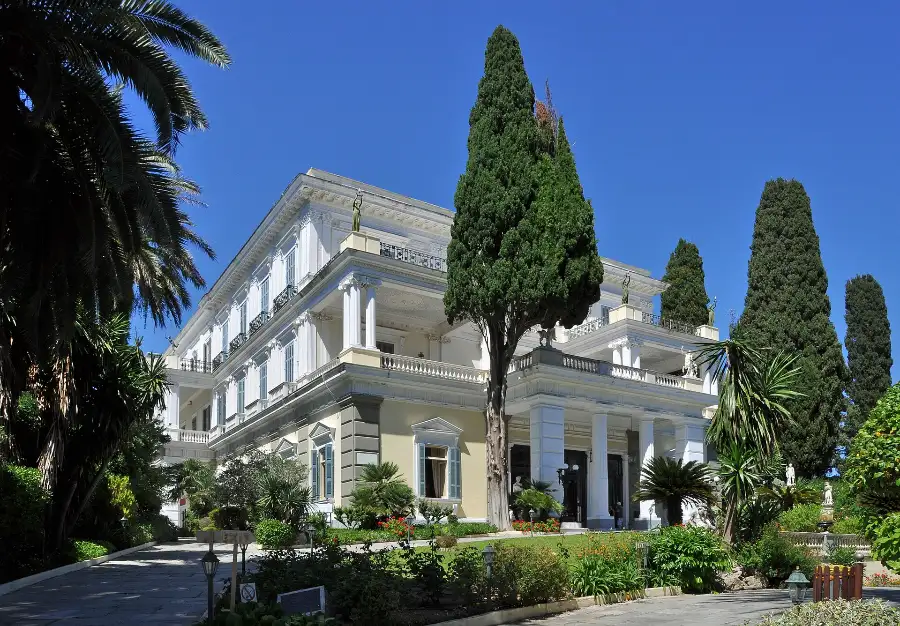
The palace and the postcard. At Gastouri, a short drive south of town, the Achilleion was built for Empress Elisabeth of Austria and later owned by Kaiser Wilhelm II. It has been under a long restoration and its visiting arrangements have moved with the works, so take the current position from the palace’s own publisher rather than from any travel page, this one included. Nearer town, the Kanoni peninsula looks down on the Vlacherna monastery and Mouse Island, which is the view that ends up on most of the postcards and takes roughly as long to see as that sentence suggests.
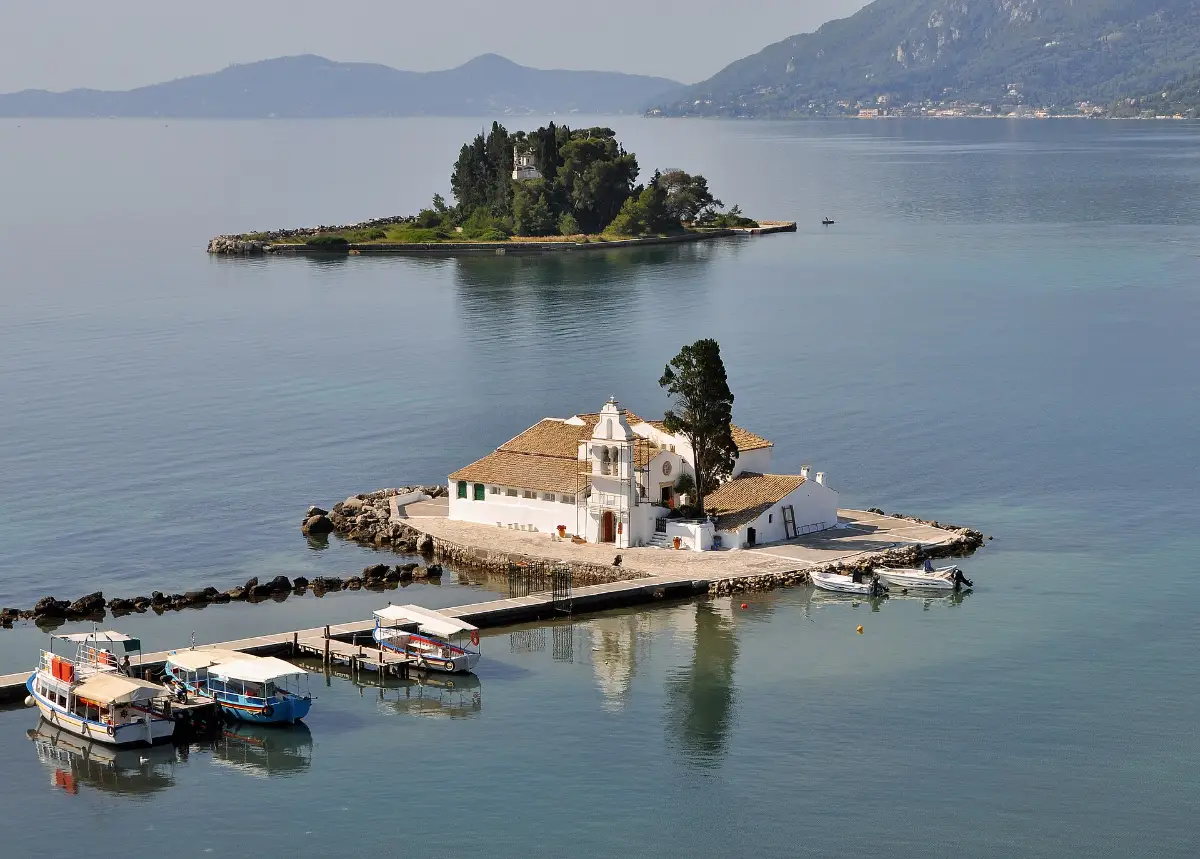
The coast that counts as sightseeing. Paleokastritsa, on the northwest, stacks green headlands over a run of coves, with a clifftop monastery above the bays and the Byzantine castle of Angelokastro higher again. This is scenery rather than a site, and it is the half of the island people describe afterwards. Which of those coves deserves your swim is a beach question and gets a different answer.
The mountain. Mt Pantokrator tops the island at 906 m and is reached by road or on waymarked trails. From the summit the strait to Albania reads as landscape rather than as a border, which is a fair summary of where Corfu actually sits.
Two practicalities decide how much of this you get. The first is wheels: buses cover Corfu Town and the east-coast resorts well, and the northwest, the capes and Pantokrator are where the network thins. The second is the cruise rhythm. The Old Town is close enough to the berths to walk from, so the lanes fill through the middle of a season day and empty by evening. Look at what is tied up in the port rather than at any schedule, because that is the forecast that is right on the day.
We print no opening hours, no ticket prices and no closed days for anything named here. They belong to the ministries, municipalities and trusts that run each place, they are revised by season, and a printed hour is the fastest thing on a travel page to go quietly wrong.
If you are still choosing an island, Corfu against Kefalonia is the comparison people actually make. The Corfu guide plans the days and the bases, and where the island goes out is a separate question with a separate answer.