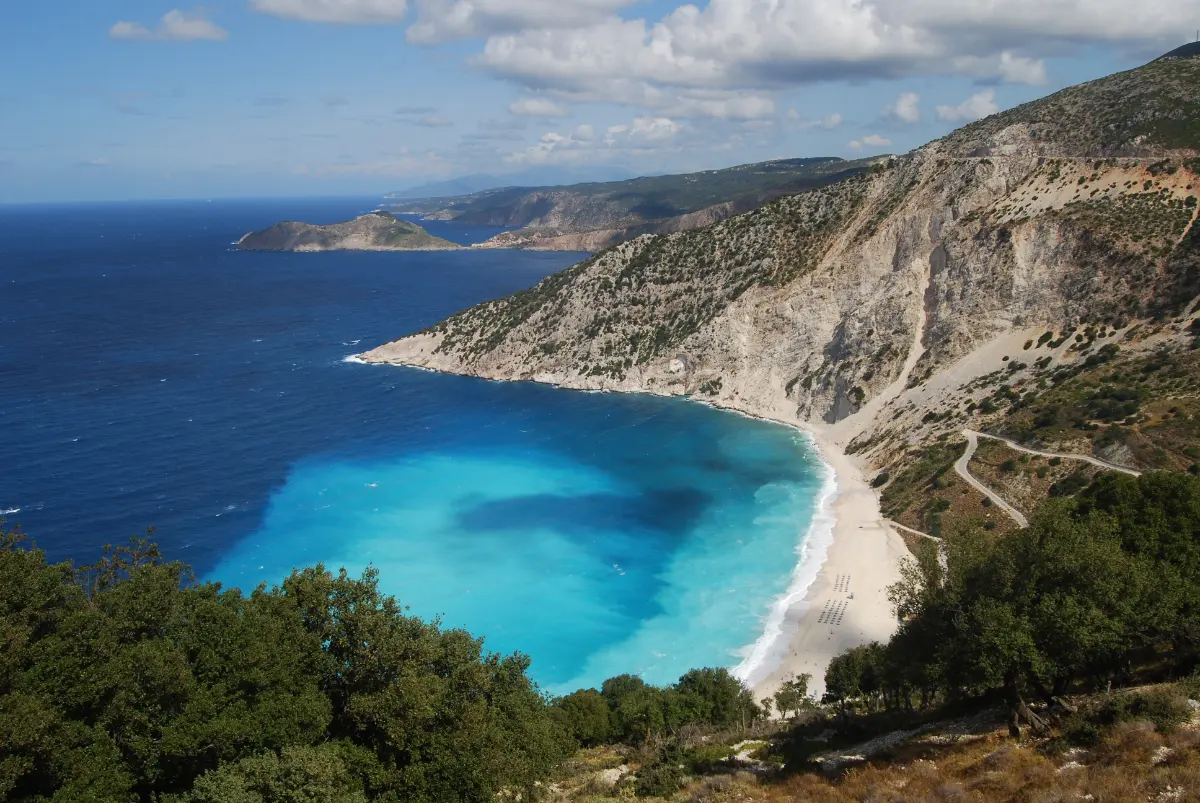
The famous view of it is the one from that road, high above the water. Standing at the viewpoint and standing on the stones are two different visits.
What connects them is a single process. The colour of the sea, the size of the stones underfoot and the way the water moves at Myrtos beach Kefalonia are not three facts, they are one, and once you can see the mechanism you can decide for yourself which visit you want. The island guide covers how a week here fits together.

Diagram by Greece Trips. Free to reuse with credit - CC BY 4.0.
Why the water is that colour, and why the stones get smaller as you walk in
The rock around Myrtos is marble, which is limestone recrystallised by heat and pressure. The cliffs are made of it, and so is the beach: the cobbles are that same rock, broken off, rolled and rounded white and smooth. That comes from Wikipedia’s geology section for the beach, the only page in the search results that explains this cove rather than admiring it.
Walk down the bank towards the water and the stones get smaller. The shore has an abrupt drop close to the waterline, so the waves arrive with high energy and sort what they land on, grading the bank from cobbles at the back to pebbles at the front. Longshore drift has shaped the curve.
Then the colour. As the waves curve along the bay they pick up the finest of that marble, and the sediment plumes follow the curve in the direction the waves are travelling. The turquoise is powdered white rock suspended in clear water.
Which is why the bay never looks the same twice: the colour is strongest along the curve and after the sea has been working, so a still day photographs differently from a rough one.
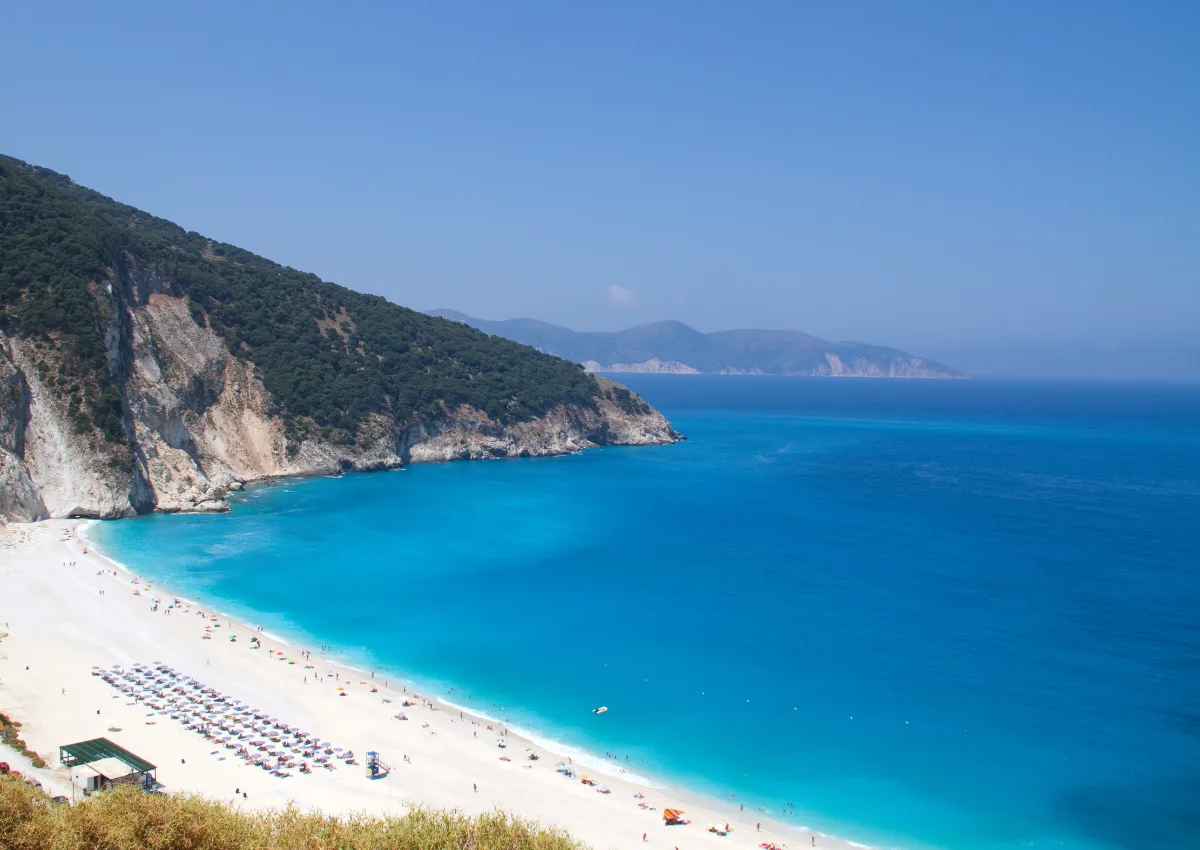
The viewpoint above, and the hairpins below it
You can have the photograph without driving down. There is more than one lookout on the road above the cove, which the local guides describe as almost never empty. Our island guide calls that stop the guaranteed win: five minutes, no effort, the whole picture.
The turn is at Divarata, on the north-west coast road, with tavernas at the top. From there a steep asphalt road of hairpins descends to the shore, about 2 km of it by Wikipedia’s account, narrow near the bottom.
Parking at the base is free and finite. One first-hand account found the lot almost full by mid-morning in early June, and once it fills, cars park along the narrow road above. Arriving late does not only cost you a space, it puts your car on the hairpins and turns the walk back into a climb.
Wikipedia also reports a seasonal bus run by the Municipality of Pylaros from the harbour area at Agia Efimia, with timetables held at the tourist information office there. The island network out of Argostoli is another matter and is not built around this beach.
What the descent asks of a given driver in a given hire car is not ours to answer. Driving in Greece covers the general case.
The cobbles underfoot, the drop at the waterline, and the flag
The ground is hard. Round marble cobbles, large at the back of the bank and smaller as you go down, awkward barefoot and more awkward where you step into and out of the sea. Our island guide says the pebbles want water shoes, and the first-hand accounts agree.
Where the stones meet the water the shore drops away abruptly. That is the same drop that grades the bank and raises the wave energy: one fact doing two jobs.
The guides and the first-hand accounts are consistent that the water here moves, from undercurrents on breezy days to waves that vary with the wind. This page reports that. It does not grade it.
What does have standing is a named system. Myrtos is on the 2026 Greek Blue Flag list, and the scheme’s criteria require lifeguards on duty through the swimming season at beaches the competent committee designates high-traffic. Whether this beach carries that designation we could not confirm, so read the mechanism and not a promise: where a lifeguard is posted, a flag is flown, and on the day you are standing there the flag and the lifeguard are the authority. Not this page, and not the award.
The cliffs, and who actually knows the current position
These cliffs shed rock. That is a property of the cliff rather than of a particular week, and the island guide carries the dated events that are on record.
To Vima reported on 13 July 2026 that landslides had come off a steep cliff section above the cove days earlier, that Greece’s Civil Protection Risk Assessment Committee had adopted emergency recommendations, that guidance would go to the Civil Protection services of the Ionian Islands region and the responsible municipalities, and that warning signs were already in place around the area.
So the current position belongs to Civil Protection and to the municipality, and it is posted on site. This page cannot track it. Check it locally on the day.
What you carry down, and when to come
The sources cannot agree on what is on this beach. One portal describes umbrellas, sundecks and a snack bar; another adds toilets, showers and changing rooms; a local site hedges to sometimes; two independent visitors in June found nothing open at all. They are probably all telling the truth about different weeks.
A seasonal set-up is put up and taken down, so August is not May or October. Carry water down and assume nothing else.
The first-hand accounts agree there is little natural shade on the open pebble, and our Corfu comparison already calls the shade on Kefalonia’s beaches thin. The umbrellas are a seasonal rental, not a fixture. Water shoes for the cobbles, and something to lie on.
Our island guide puts Myrtos before 10am or in late afternoon, and the car park is the reason. For months, late May into June and September into early October: warm days, a sea still worth swimming in, thinner coach traffic. When to come to Greece takes the wider view.
What the award record actually says
The most repeated claim about this beach does not survive a check. Wikipedia says Myrtos has been voted the best Greek beach twelve times, citing a personal travel site whose page returns a 404 today. An aggregator guide says eleven times, crediting a Greek website. A large portal says only that it has been awarded many times, naming nobody. Two counts, two attributions, one dead link, and no count on this page.
One award here does have a named body and a public list: the Blue Flag, run in Greece by the Hellenic Society for the Protection of Nature for the Foundation for Environmental Education, annually and against published criteria. Myrtos appears on its 2026 Greek list under the Municipality of Sami, and it has to be earned again every season.
The beach also appears in Captain Corelli’s Mandolin, a dated claim to fame.
Stop at the top, then decide
Two things are worth carrying away. The picture is from the road and costs five minutes, and the beach below it is a bank of white marble cobbles that drops away where the water starts. Both are worth having, and they are not the same visit.
The rest of the coast is ranked in the Kefalonia beaches guide. Antisamos is the pebble bay ten minutes from Sami, and Petani is the quieter set of cliffs on the west side.
The booking that decides a Myrtos morning is not made at the beach: it is the base you drive from and the car you drive it in.
Common questions about Myrtos Beach
Is Myrtos Beach sand or pebbles?
Pebbles, not sand. Myrtos is a bank of round white cobbles eroded from the marble cliffs around it, large at the back and smaller as you approach the water, hard underfoot and awkward to walk over without shoes. The grading is the work of the waves, which land hard because the shore drops away close to the waterline.
Why is the water at Myrtos Beach so blue?
Because there is white rock suspended in it. Wikipedia’s geology of the beach explains that the surrounding sediment is marble, a metamorphosed limestone, and that as the waves curve along the bay they pick up the finest marble particles. Those plumes follow the curve of the beach and give the water its turquoise. The colour is suspended rock, so it shifts with the sea and with the angle you look from.
Can you drive down to Myrtos Beach, and where do you park?
Yes. The turn is at Divarata on the north-west coast road, and from there a steep asphalt road of hairpin turns descends to the shore, about 2 km of it by Wikipedia’s account. Parking at the base is free and finite: one first-hand account found it almost full by mid-morning in early June, and once it is full cars park along the narrow road above, which turns the return into a climb. A seasonal local bus is reported from Agia Efimia, its timetable held at the tourist office there.
Does Myrtos Beach have sunbeds, a canteen and shade?
Seasonally, and the sources disagree about the detail. Portals describe umbrellas, sundecks and a snack bar, a local guide hedges to sometimes, and two independent June visits found nothing open. The set-up goes up and comes down with the season, so August is not May or October. Natural shade on the open pebble is consistently reported as little to none, and the umbrellas are a rental rather than a fixture. Carry water and assume nothing.
Has Myrtos Beach really been voted the best beach in Greece?
The claim circulates everywhere and does not survive being checked. Wikipedia says twelve times and cites a personal travel site, one of whose pages is now dead; a large guide says eleven times, crediting a Greek website; a major portal says awarded many times and names nobody. One award here does have a body and a public list: the Blue Flag, run in Greece by the Hellenic Society for the Protection of Nature, whose 2026 Greek list carries Myrtos under the Municipality of Sami, renewed each season.
Last checked 23 July 2026. No price, fare, timetable, sea temperature or distance in minutes appears on this page by design.