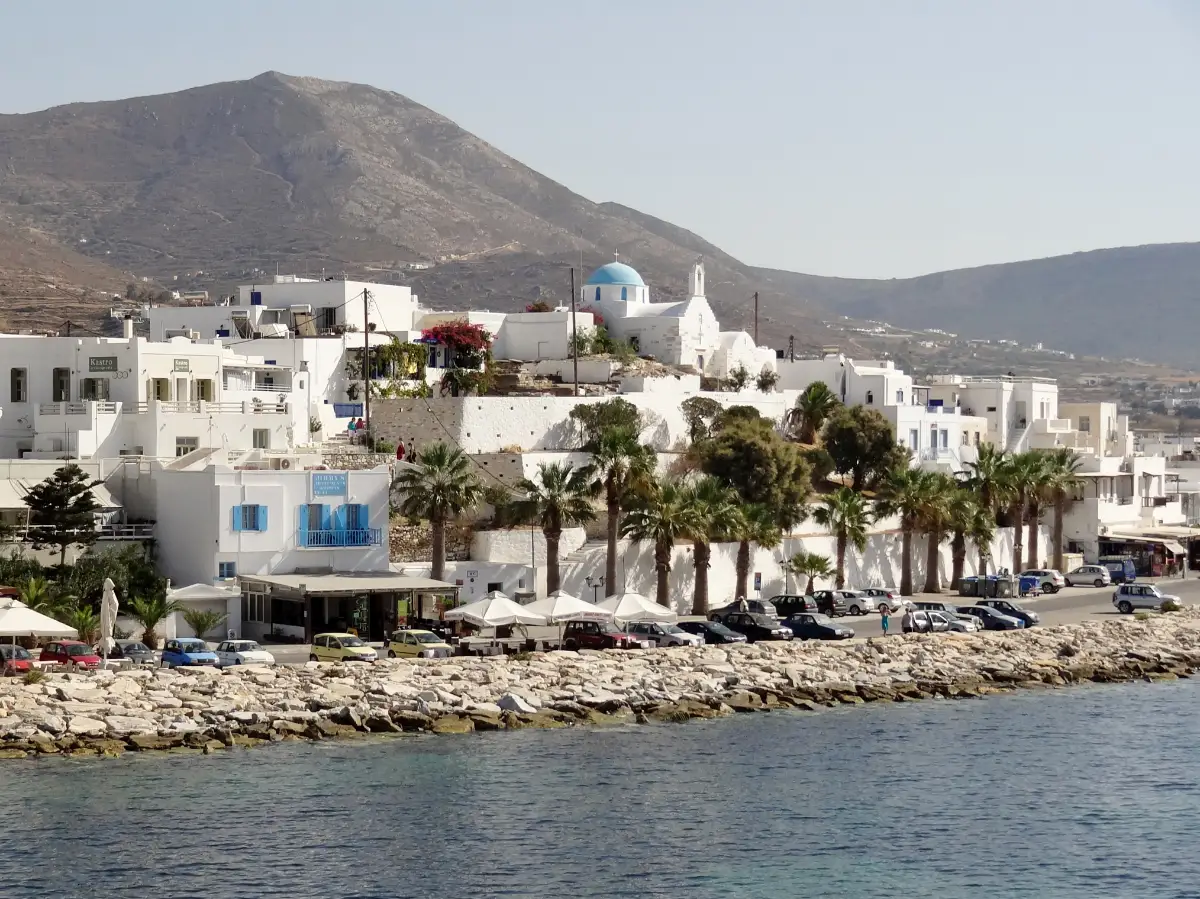
The Cyclades are the Greece most people picture: white cubic villages, bare rock, deep blue water. They are also the easiest group to travel, because they carry the densest ferry network in the country, which is why almost every island-hopping route in Greece runs through them.
They come with one condition. The meltemi, the dry north wind, blows hardest here from June into September, and it is the single thing most likely to rearrange your plans: it grounds the light fast boats first. Plan a buffer day in high summer and you will barely notice it. Plan a tight connection and you will.
Which Cycladic island
Santorini is the icon: the caldera, the sunset, the highest prices in Greece. Worth seeing, and worth fewer nights than people give it.
Mykonos is the other icon: sandy beaches, beach clubs and a nightlife machine that runs from mid-afternoon to sunrise. Glossy and expensive, and honest about it.
Naxos is the big, green, easy one: the best sandy coast in the group, a farmed mountain interior, and the island we send families to first.
Paros is the crossroads: the best-connected island in the Cyclades, balanced between a working port, a pretty harbour town, and beaches on both sides of the wind.
Milos is the volcanic one: a coastline of white rock and coloured cliffs, where the good beaches are often reached by boat rather than by road.
How to hop them
Two islands in a week is a holiday. Four is a series of ferry terminals. The rule that saves most trips is to move one way down the chain and fly home from the far end rather than sailing back to where you started.
The island-hopping guide covers how to order the stops so every boat moves you forward, the ferries guide covers how the boats actually work, and our Cyclades route gives you a sequence that already holds together.
When to come
Late May to late June, and September, are the sweet spots: the sea is warm, the boats are frequent, and the crowds are thinner than the July and August peak. When to go has the month-by-month verdict.
Every island in the group
Each one has its own guide. The line after the name is the reason to pick it.
- santorini - The caldera, and the one everybody pictures
- mykonos - The town, the beach clubs and Delos offshore
- naxos - The biggest, with mountains and a real farming interior
- paros - The balanced one: ferries, beaches and two good towns
- milos - A drowned volcano ringed with more beaches than its neighbours
- ios - A hilltop chora that holds all of the nightlife
- syros - The administrative capital, and a working neoclassical city
- sifnos - The island the rest of Greece rates for its cooking
- serifos - A chora stacked up a rock, over an old mining coast
- kythnos - Thermal springs running into the sea, and a sandbar
- kea - The closest to Athens, and barely visited for it
- andros - Green, watered and walkable, with a serious art museum
- tinos - A pilgrimage island of dovecotes and marble villages
- amorgos - A cliff monastery and the far end of the chain
- folegandros - A chora on a cliff edge, and very little else
- antiparos - A short hop from Paros, with a cave and a quiet chora
- koufonisia - Low, sandy, and walkable end to end
- schinoussa - One ridge village and a coast made of coves
- iraklia - The quietest of the Small Cyclades
- donousa - The most isolated, where the ferry decides your stay
- kimolos - Ten minutes from Milos, a fraction of the people
- sikinos - One road, two villages, and a Roman tomb turned church
- delos - Uninhabited, and the sacred centre of the whole group