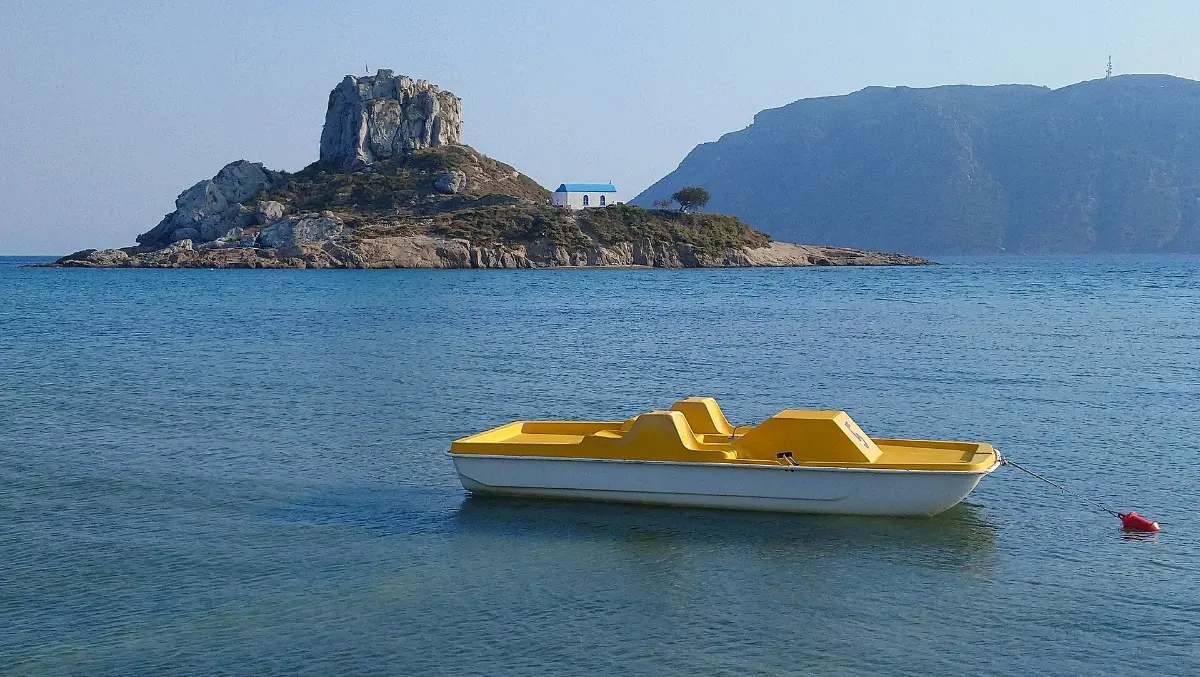
The Dodecanese lie along the Turkish coast, at the far south-eastern edge of the country, and they are the group where the history is loudest. Successive occupiers left the buildings standing: crusader knights, Ottomans and Italians all governed here, and the islands still look it.
They sit further south than the Cyclades, which buys you a longer, warmer season. It is the group where the sea stays swimmable latest into the autumn.
They are also further from Athens. That changes how you use them: people usually fly in and stay, rather than hop. If your plan is to move island to island every two nights, the Cyclades will serve you better.
Rhodes and Kos
Rhodes is the big one, built around a walled medieval Old Town you can still walk through, with a long east coast made for a beach week.
Kos is the flat, cycleable one: Hippocrates’ island, with an ancient healing sanctuary above the town, a layered old quarter, and resort beaches on both coasts. It is also the easiest jumping-off point for a day in Turkey or on the Nisyros volcano.
Getting there and around
Both have their own airports with seasonal direct flights, which is usually the sane way in. Ferries run down from Athens, but they are long. Flights to Greece covers the airport choice, and the ferries guide covers the sea legs.
Every island in the group
Each one has its own guide. The line after the name is the reason to pick it.
- rhodes - A walled medieval city, and a large island behind it
- kos - Flat, cyclable, with the Asklepion and a Roman town
- patmos - The cave of the Apocalypse and a fortified monastery
- symi - One neoclassical harbour, stacked in colour
- karpathos - Wind, remote villages and a long empty west coast
- kalymnos - Sponge divers, and now world-class sport climbing
- nisyros - An active volcano you can walk down into
- astypalaia - Two lobes, one isthmus, and a Cycladic-looking chora
- kasos - The southernmost, with a story rather than sights