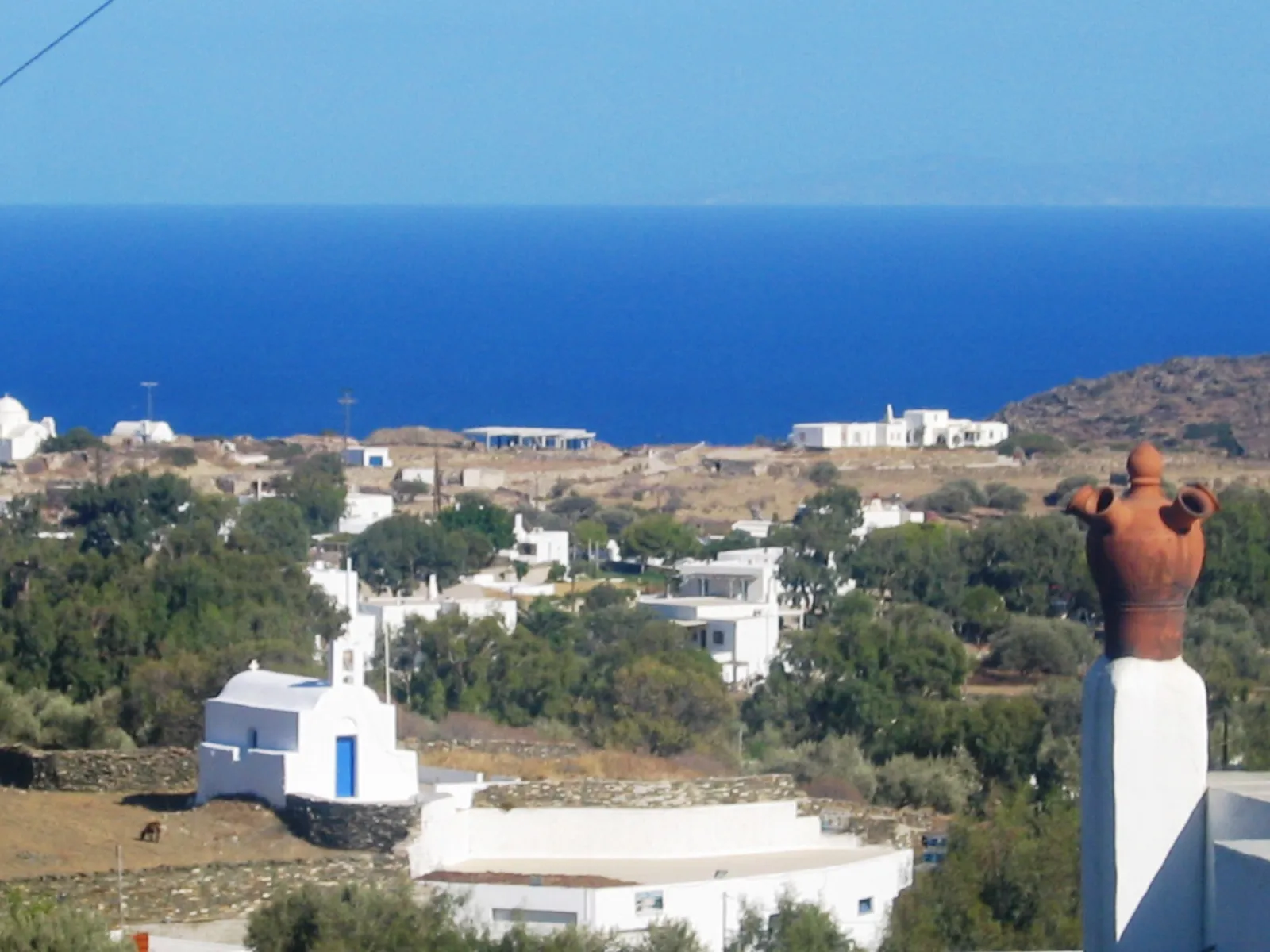
Sifnos has a reputation in Greece that it does not have abroad, and it is a reputation for food. The island produced Nikolaos Tselementes, whose cookbook was so dominant that his surname became the Greek word for a recipe book, and the cooking here is still taken seriously enough to be a reason for the trip.

Diagram by Greece Trips. Free to reuse with credit - CC BY 4.0.
The rest of it is a compact, walkable Cycladic island of white villages on a spine of hills, with a coast of small bays rather than long beaches.
The villages
- Apollonia, the capital, sits in the middle of the island: a knot of whitewashed lanes with the bars and tavernas along a stepped street everyone calls the Steno.
- Kastro, on the east coast, is the old capital and the most striking place on Sifnos: a fortified village built as a continuous ring of houses on a headland, with Venetian coats of arms still set in the walls and a whitewashed church on a rock below it.
- Artemonas, next to Apollonia, is the handsome one, with neoclassical houses and a slower pace.
Pottery, and the paths
Sifnos has made pots for centuries, and the workshops along the coast at Vathi and elsewhere are still working. The island’s cooking pots are the practical end of the same tradition.
The other thing Sifnos has, unusually, is a marked network of old stone footpaths, restored and signed, linking villages, monasteries and bays. On an island this size that turns walking into a proper way of getting about rather than an excursion.
The coast
Small and sheltered rather than dramatic:
- Platys Gialos, a long sandy bay with tavernas, the busiest.
- Vathi, a calm bay with a monastery on the sand.
- Chrissopigi, the monastery on a rock spur that appears on every photograph of Sifnos, with swimming off the rocks either side.
- Kamares, the port, which has its own decent beach.
Getting there and how long
Ferries run from Piraeus and connect across the western Cyclades towards Milos and Serifos. There is no airport.
Three or four nights suits it: enough to eat properly, walk one or two of the paths, and see Kastro at both ends of a day.
Last checked August 2026. Ferry schedules and seasonal openings change - see our editorial policy.
Common questions
What is Sifnos known for?
Its food above all, along with a long pottery tradition and a restored network of stone footpaths across the island.
Is Sifnos a good island for walking?
Yes. It has a marked and maintained path network linking villages, monasteries and bays, which is unusual in the Cyclades.
What is Kastro on Sifnos?
The old capital on the east coast: a fortified village built as a continuous ring of houses on a headland, with Venetian coats of arms still visible in the walls.
Does Sifnos have an airport?
No. It is reached by ferry from Piraeus and by connections across the western Cyclades.
How long should you stay on Sifnos?
Three or four nights is the usual answer: time to eat well, walk a path or two, and see Kastro properly.
For a day by day plan see the Sifnos itinerary, and for what is reachable in a day from here see day trips from Sifnos.
Next
Read Milos, Serifos, or the Greek island ferries guide.