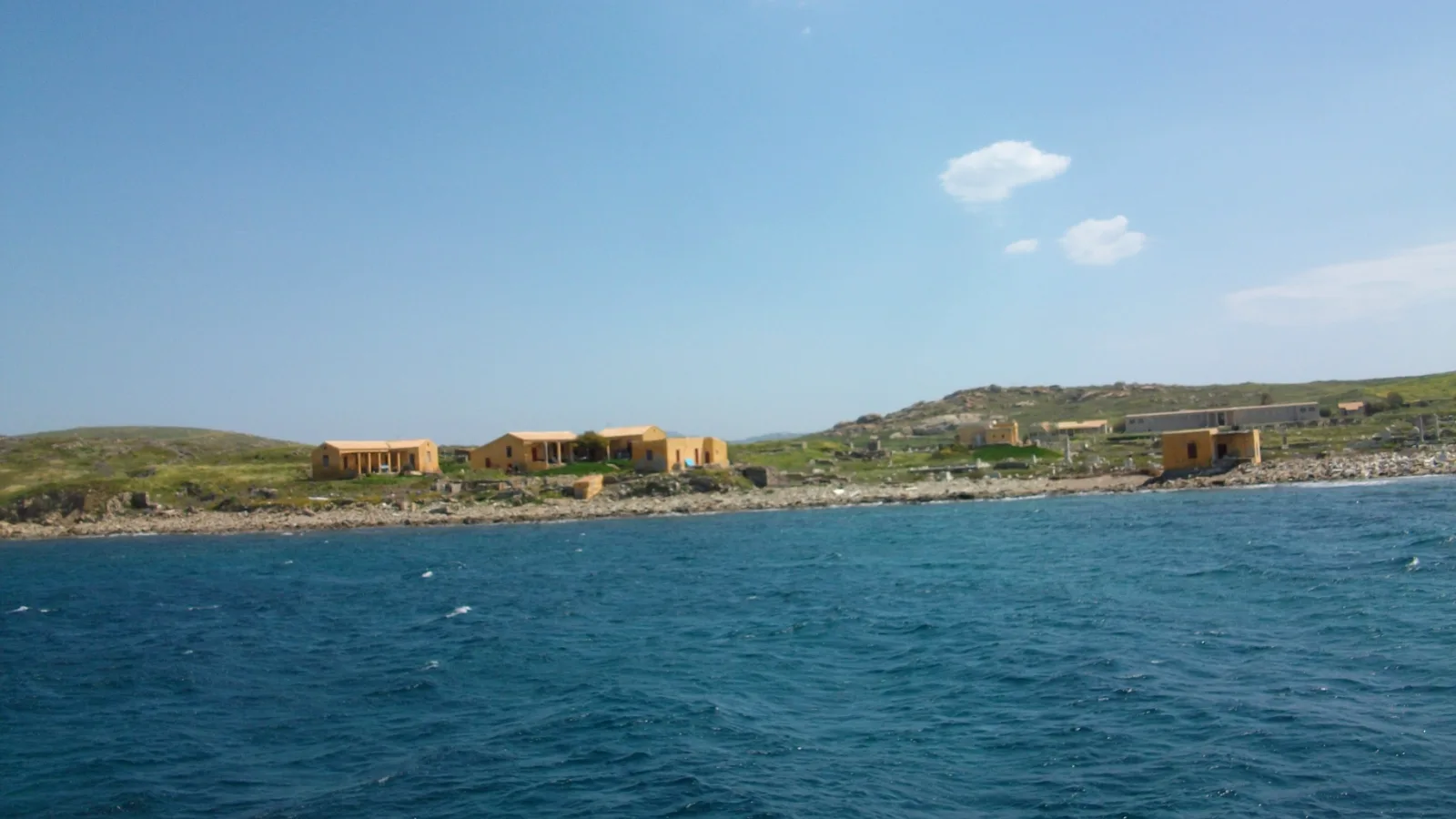
Island group
Cyclades - a small island just west of Mykonos, uninhabited, UNESCO World Heritage (inscribed 1990)
Getting there
Excursion boat from Mykonos’s Old Port (not the New Port at Tourlos), roughly 30 to 45 minutes each way, day return only; summer day excursions also from Naxos and Paros
Site + museum ticket
One ticket covers the archaeological site and the Archaeological Museum, bought at the ticket office on Delos; separate from the boat fare
Best months
Roughly April to November (the warm-season opening window); closed 1 December to 31 March, visits by prior written request only; no weekly closing day is published
Stay and eat
None on the island - it is uninhabited, with no accommodation and no real food; sleep and eat on Mykonos
Travel details last checked July 2026.
Two things decide whether that half day goes to plan: catching the right boat from the right port in Mykonos, and being back at the landing in time for the last one out. Everything below is arranged around those two facts.
Why an empty island was the holiest place in the Aegean
Delos mattered because myth made it the birthplace of the twin gods Apollo and Artemis, and history made it the religious and trading heart of the Aegean for close to a thousand years. It was a Panhellenic sanctuary and, later, a cosmopolitan free port, and in 1990 UNESCO inscribed the whole island as a World Heritage Site.
The story is specific. Leto, pregnant by Zeus and hunted across the earth by a jealous Hera, could find no place willing to shelter her, until a small barren island floating loose in the sea took her in. In return it was anchored to the seabed and made solid ground, and there, the myth goes, Leto gave birth to Artemis and then to Apollo. The spot was later marked by the Sacred Lake, a round pool the site keeps drained today. That birth is why the island of Delos became sacred: not a city that grew a temple, but a temple that a whole island grew around.
For centuries the island of Delos was a sanctuary that Greek city-states treated as neutral holy ground, sending envoys and offerings across the Aegean. By the Roman period it had turned into something busier: a duty-free trading port where merchants, bankers and dealers from across the Mediterranean built houses, shrines and warehouses, and the population swelled into the tens of thousands. Then it was sacked twice in a generation, in 88 BC and again in 69 BC, and it never recovered. The port silted, the people left, and the island has stood empty ever since. The only people on it today are the site staff and the archaeologists who look after the ruins.
One modern footnote worth knowing before you go: Delos is low, and slowly losing ground to the sea. The French archaeological mission that has worked the island for well over a century, and a monitoring programme set up to track the water around it, have both reported that rising sea level and a sinking coastline together are eating at the lowest parts of the site, with sea water reaching ancient walls in winter. Take that as reported research rather than as a settled forecast, but it is one more reason the excavation feels like something you are fortunate to be able to walk across at all.
Getting there: the boat leaves from the Old Port, not the ferry port
You reach Delos on a small excursion boat from Mykonos’s Old Port, on the town waterfront, not the New Port at Tourlos where the large ferries and cruise ships dock. The crossing takes about half an hour each way, and it runs as a day return only: the boat that brought you is, in effect, the boat that takes you back.
Get the port right and the rest of the day follows. Mykonos has two. The Old Port sits right in Mykonos Town, a short walk from Little Venice, and the Delos excursion boats leave from its pier. The New Port at Tourlos, roughly 2 km north of town, is the commercial harbour where scheduled island ferries and cruise-ship tenders arrive. The classic mistake is to land on Mykonos by ferry or off a cruise ship, see a sign for the port, and assume that is where the Delos boat goes. It is not. If you are staying on Mykonos, head for the Old Port in town; if you are arriving by sea that same morning, budget the time and the taxi to get across town to it.

Diagram by Greece Trips. Free to reuse with credit - CC BY 4.0.
The crossing itself is short, roughly 30 to 45 minutes depending on the boat and the sea, so plan on about half an hour rather than a fixed number. The boats are small and, in high season, they fill. Buy your tickets early in the day or book ahead rather than turning up for the last sailing and hoping for a seat.
Mykonos is the main gateway, but it is not the only one. In summer, day excursions run from Naxos and from Paros as well, usually pairing a few hours on Delos with a few hours in Mykonos Town on the way back, so a base elsewhere in the Cyclades does not rule the trip out.
Exact departure times and fares change by operator and by season, so check the current schedule with the boat operator, such as delostours.gr, close to your date rather than trusting a timetable printed months earlier. For everything else about basing yourself there, see the Mykonos travel guide; Delos is the headline entry on the list of day trips from Mykonos.
Open by day, in season, and no place to sleep
Delos runs on the site’s opening hours and the year’s calendar, not on yours. The archaeological site is open for daytime visits through the warm-season months, roughly April to November, and shuts from December to the end of March, when it can be visited only by prior written arrangement. Hours shift with the season, running longer in high summer than in November, so check the current opening times at the official Ministry of Culture listing before you commit the day.
One thing to confirm rather than assume: you will read in places that the site shuts one day a week, usually named as Monday. The Ministry’s published hours for Delos set out a summer and a November timetable and a winter closure, and they do not list a weekly closing day at all, so we are not repeating one. What does close the island on a given morning is the weather, because the boat has to run. Check the official hours, and check the forecast.
There is nowhere to stay, and no reason to try. Delos is uninhabited: no hotels, no rooms, no houses that take guests. The only buildings standing are ruins and the small museum, so a day trip is the only kind of visit there is. The site keeps daytime hours and empties with the last boat, and there is no bed to sleep in and no shelter to sleep under. Sleep on Mykonos and treat Delos as a half-day out. Where to base yourself is covered under Mykonos hotels.
This is why the return boat is the most important thing on the island’s clock. The boats back run to a fixed schedule, and when you land you should note your last departure and pace the whole visit to it. Miss it, and you are on an uninhabited island after the last boat has gone, which is exactly the situation the day is arranged to avoid. On an inhabited island a missed sailing is an inconvenience; here it has no easy fix.
Admission to the site is separate from the boat fare. A plain crossing ticket does not get you through the gate; the site charges its own entry, paid at the ticket office when you land, so budget for two costs rather than one. Guided packages sold from Mykonos often bundle the two, which is worth checking before you pay twice. Rates are set by the Ministry and are repriced from time to time, so confirm the current one rather than working from a figure you read months earlier.
What to see: a whole ancient city, not one temple
What to see on Delos, roughly in the order you meet it walking up from the boat: the Sanctuary of Apollo, the Terrace of the Lions, the drained Sacred Lake, the Theatre and its quarter of mosaic houses, and the summit of Mount Kynthos, with the Archaeological Museum near the landing.
What makes the boat ride worth it is that Delos is not one monument but a whole city. A typical ancient site gives you a temple, maybe two, and a lot of imagination. Delos gives you the sacred precinct, the merchants’ houses with their mosaics still down, the theatre, and the mountain the god was born under, excavated and walkable street by street. That is the honest answer to whether it is worth it: yes, if a whole ancient city interests you more than a single ruin.

Diagram by Greece Trips. Free to reuse with credit - CC BY 4.0.
The Sanctuary of Apollo and the Terrace of the Lions
The heart of the island is the Sanctuary of Apollo, the sacred precinct the whole place was built around. Here stood several temples to the god, along with the scattered pieces of a colossal marble statue of Apollo, the Colossus of the Naxians, which still lie where they fell, too big to have been carried off.
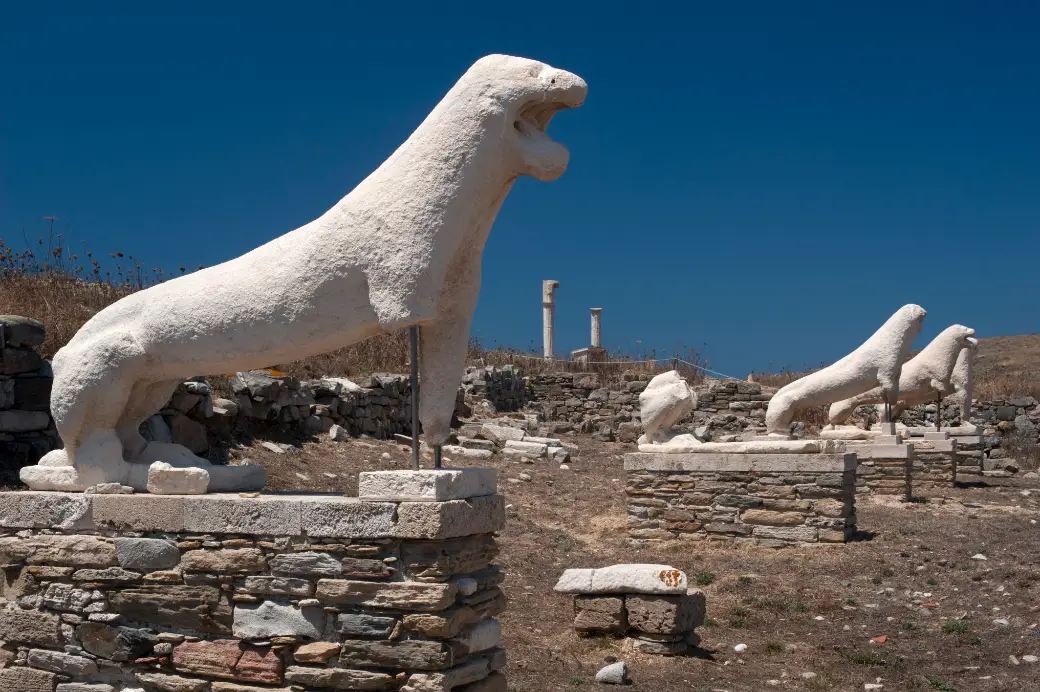
The image everyone recognises sits just north of it: the Terrace of the Lions, a row of lean archaic marble lions that the island of Naxos dedicated around 600 BC. They crouched like sentinels along the processional route toward the Sacred Lake. Not all of the original row survives, and the counts you will read differ, both for how many were carved and for how many are left; one of them was carried off to Venice centuries ago and stands there still. What most visitors do not realise is that the ones on the terrace today are replicas; the surviving originals, weathered and extraordinary, are kept indoors in the site museum. Skip the museum, and you skip the real lions.
The Theatre Quarter and its mosaic houses
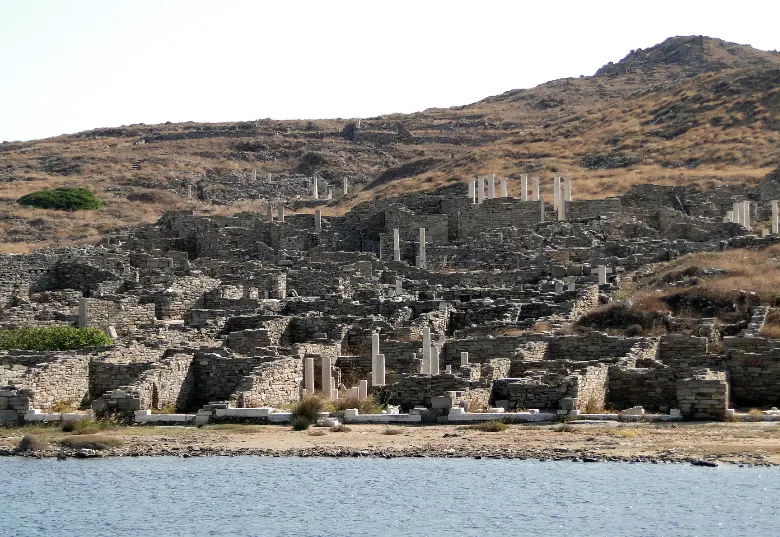
Walk south and Delos stops being a sanctuary and becomes a town. The Theatre Quarter is a district of merchants’ houses climbing the slope below a large stone theatre, and it is where the whole-city claim earns itself. These were private homes, some of them grand, and several are known by the mosaics still set into their floors: the House of Dionysos, the House of the Dolphins, the House of Cleopatra. The colour and detail that survive in them, a god riding a panther, dolphins ridden by small figures, are the kind of domestic, lived-in ancient world the great monumental sites cannot show you. This is the part of Delos that the Acropolis, for all its grandeur, has no answer to.
Delos and Naxos are threaded together here, too: the same island that gave Delos its lions raised its own great gateway to Apollo, the Portara on Naxos, still standing on its islet.
Mount Kynthos, the Sacred Lake and the museum
Between the sanctuary and the mountain lies the Sacred Lake, the round basin where the myth places Apollo’s birth. It is kept deliberately dry today, a ring of stone around an empty centre with a palm at the middle. From near it, a stepped path climbs Mount Kynthos, the island’s high point at about 112 metres, for the best view over Delos and the surrounding Cyclades. It is a short climb but an exposed one, and it adds time, so skip it if your last boat is close.
Finish at the Archaeological Museum by the landing. One ticket covers both the site and the museum, and the museum holds what the open air cannot keep: the original lions, statues and mosaics lifted from the houses. It is a small museum on an excavation, so rooms can be shut for conservation work at any given time; ask at the ticket office when you land rather than assuming every gallery is open.
A guide, an audio guide, or on your own
The real question at Delos is not whether you enjoy guided tours; it is whether you arrive with any context at all. The site has very little interpretive signage, and unlabelled, a Roman merchant’s house and a sanctuary treasury can look like the same field of knee-high walls. Read up first or bring a guide, and the rubble resolves into a city. Turn up cold, and a lot of it stays anonymous.
There are three honest ways to solve that. A live guided walk, run in English and other languages, gives you the most and answers your questions, but it moves at the group’s pace and to a fixed length, which can rush a short window. An audio guide is the cheaper middle path: context in your ear, at your own speed, without a group to keep up with. Self-guided works perfectly well if you do the reading beforehand and start at the museum, which orients you before you walk into the ruins.
One practical note on timing ties this back to the boat. A live tour runs to its own clock, so if it lands near your last sailing you can end up hurried at the end; going self-guided lets you pace the day to the return boat instead. Whichever you pick, the choice is about context, not about whether tours are your thing.
What Delos is not, and what to pack
It helps to be clear about what Delos is not, because the island refuses four things most Greek-island days take for granted, and each refusal has a plain reason.
It is not a place to stay. The island is uninhabited and has no accommodation of any kind, so you sleep on Mykonos and come over for the day; the Mykonos travel guide covers where.
It is not really a place to eat. There is no taverna and no village. A small kiosk or cafe by the landing turns up in visitor reports, described as expensive and not always open, and the Mykonos operator tells passengers they can buy cold bottled water on the boats. Carry your own water and food, and treat anything you can buy on the island as a bonus.
It is not a beach or a swim stop. Delos is a protected, fenced archaeological site, and the visit runs from the landing through the ruins and back to the boat; there is no beach scene here and no swimming built into the day. Come for the ruins, and do your swimming off Mykonos.
It is not an evening out. The site keeps daytime hours and clears out with the last boat, so there is no dinner, no bar and no nightlife on the island; by the time Mykonos gets going, Delos has been empty for hours.
For the kit, treat it as an open-air excavation with almost no shelter. The sun is relentless and the shade is minimal, because the island is bare and low; the ground is uneven ancient stone; and water is not reliably sold on the site. Bring a hat, sunscreen, more water than you think you need, and sturdy shoes you can walk uneven ground in.
And the one discipline that outranks all of it: note your return-boat time the moment you step off the boat, and keep half an eye on it all day.
Common questions about visiting Delos
Can you stay overnight on Delos?
No. Delos is an uninhabited archaeological island with no hotels or accommodation of any kind, and overnight stays are not part of a visit; everyone leaves on the last return boat. Plan it strictly as a day trip and sleep on Mykonos, or on whichever island you sailed from.
How do you get to Delos from Mykonos?
By a short excursion boat from Mykonos’s Old Port, in the town itself, not the New Port at Tourlos where the big ferries and cruise ships arrive. The crossing is about half an hour each way and runs through the warm-season months. Buy tickets early in high season, because the boats are small.
How long do you need on Delos?
Plan on two to three hours for the main site and the museum, or four to five if you climb Mount Kynthos. Your real limit, though, is the return-boat schedule rather than the clock, so check your last boat when you land and pace the visit to it.
Is Delos worth visiting?
Yes, if you care about ancient history. Delos is not a single ruin but a whole excavated city, from the Sanctuary of Apollo to mosaic-floored mansions and a theatre, on the island myth calls the birthplace of Apollo and Artemis. If all you want is a beach day, skip it.
Do you need a guide for Delos?
Not strictly, but most visitors get far more with one. Delos has little signage, so without a guide, an audio guide or some reading beforehand, much of the site reads as anonymous rubble. Self-guided works if you start at the museum first to get your bearings.
When is Delos open, and is it open in winter?
Delos opens for daytime visits through the warm-season months, roughly April to November, and closes from December to the end of March, when it can be visited only by prior written arrangement. Hours are longer in high summer than in November. Confirm the current hours at the official listing before you go, and check the forecast, because the crossing is what actually cancels a visit.
Fitting Delos into a Cyclades trip
Delos is a half-day, not a holiday, and it belongs inside a bigger island trip rather than at the centre of one. The neatest way to do it is a morning or afternoon out of a Mykonos base, before or after the town, the beaches and the rest of the island. On a longer Cyclades hop it slots in wherever your boat touches Mykonos, Naxos or Paros. For the trip around it, see the other day trips from Mykonos, the Cyclades island-hopping route, and the wider Cyclades islands.
Booking
We sell nothing and book nothing for you. Every guide on this page tells you how to arrange each piece yourself - which ferry operator, when to book, what to prebook and what to leave loose.