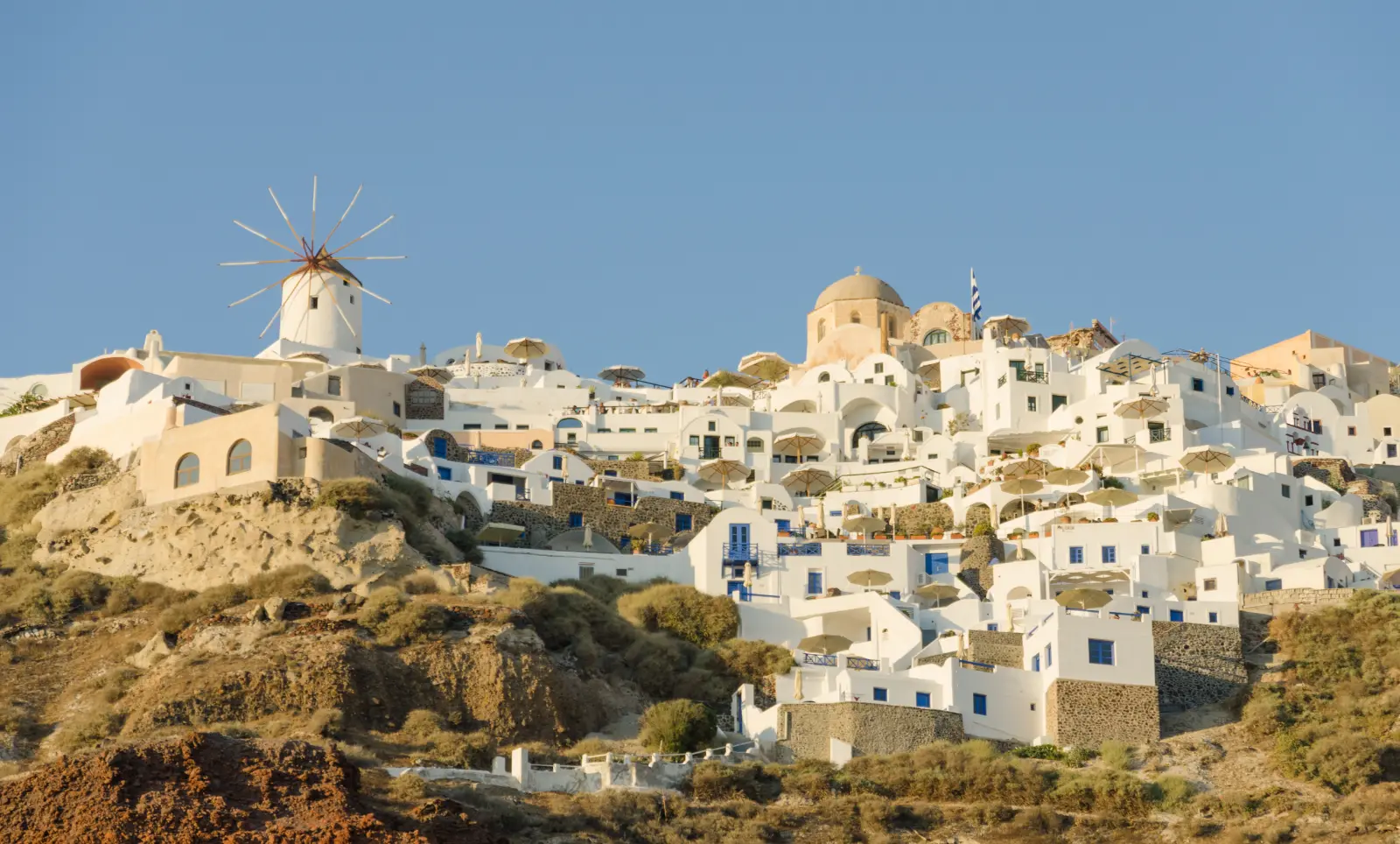
The short answer
Choose Santorini if the caldera view, the cliff villages and the iconic sunset are the reason for the trip, because Milos does not have them. Choose Milos for the other kind of volcanic drama, the lunar white rock of Sarakiniko, the sea caves of Kleftiko and dozens of beaches in every mineral colour, on an island that is far quieter and cheaper. On a longer Cyclades trip, do both, with Milos as the longer half.
That is the honest answer to Santorini or Milos, and it is more interesting than most island pairs because both are volcanic. They are two volcanoes on the same Aegean arc, telling two different stories: one built a caldera you look down into, the other built a coast you swim along. This page settles the axes you actually weigh: the two kinds of drama, beaches, cost, crowds, getting around, and who each suits.
Choose Santorini for the caldera view, the cliff villages and the sunset. Choose Milos for the coloured coast, the moonscape, the sea caves and quiet, better value. Do both on a longer trip, with Milos as the longer half.
Santorini vs Milos at a glance
Here is the whole decision in one view. Both are volcanic; the difference is where the volcano shows itself and what it costs you.
| What you’re deciding | Santorini | Milos | Verdict |
|---|---|---|---|
| Best for | The view, the icon, a short bright trip | The coast, the colour, quiet and value | Different trips |
| The drama | A caldera you look into | A coast you swim along | Depends what you came for |
| The signature sight | The rim villages and the sunset | Sarakiniko’s white moonscape | Neither replaces the other |
| Beaches | Black and red volcanic shore | Dozens, every mineral colour | Milos, and it is not close |
| Boat trips | Some, the volcano islets | The main event: Kleftiko and coves | Milos |
| Villages | Cliff villages, one famous register | Plaka hilltop, painted fishing coves | Both, different |
| Cost and value | Higher, view-driven | Lower, quieter island | Milos |
| Crowds | Big cruise ships; midday crush | Far quieter, no mega-ships | Milos |
| Nightlife | Rim bars in Fira, low-key | Quiet; dinners and a drink | Neither is a party island |
| Getting around | Small, buses and feet, but steps | A car or quad, plus a boat day | Both want wheels |
| Ideal length | A short leg | A longer stay | Milos the longer half |
The read-out: Santorini takes the view, the sunset and the icon; Milos takes the coast, the colour, the quiet and the value. The Verdict column is our editorial call rather than a score.
This page compares the two at a decision level only. For every beach, base, attraction and season, go deep on the Santorini guide and the Milos guide.
What only Santorini has: the caldera view
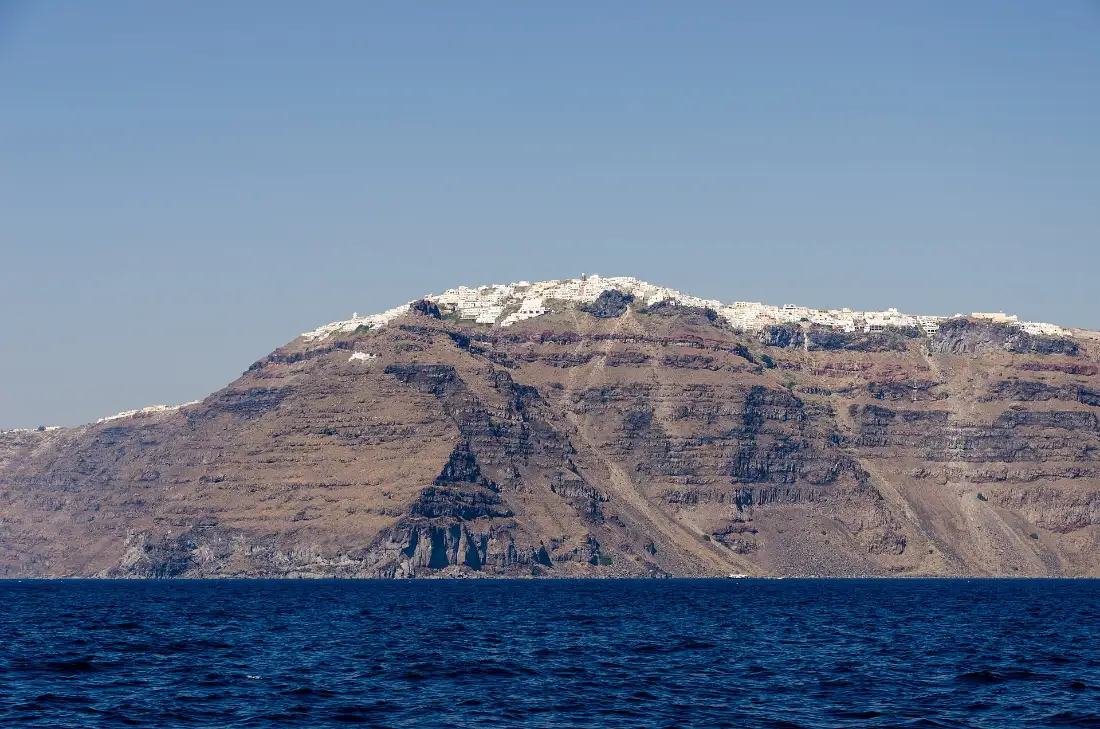
Choose Santorini if the caldera view is a reason for the trip rather than a bonus, because this is the one thing Milos, for all its volcanic drama, does not have. Santorini is the rim of a flooded volcano, so the villages of Fira, Firostefani, Imerovigli and Oia sit along a cliff a couple of hundred metres above the water, facing the crater and the sunset. That view, and the cliff-village world built on it, is the icon, and the geology behind it belongs to the Santorini guide.
Here is the honest part, because Milos is often sold as a cheaper Santorini and it is only half true. Milos is genuinely volcanic and genuinely dramatic, but its volcano did not leave a flooded caldera with villages on the rim, so it cannot give you Santorini’s specific view or its sunset amphitheatre. What Milos gives you instead is a different and arguably richer volcanic landscape at ground and sea level, which is the next section.
The trade-offs on Santorini are the flip side of that same geology: the cliff is why the island is stairs and steep cobbles, why the rim rooms cost what they cost, and why the sunset viewpoints stand shoulder to shoulder in high summer. None of that means there is only a view, the Bronze Age town at Akrotiri, the interior villages and the wineries are a second Santorini most people skip, and things to do in Santorini starts there.
Choose Santorini if the caldera view and the sunset are the reason you are going, and accept the cost, the steps and the crowds.

Diagram by Greece Trips. Free to reuse with credit - CC BY 4.0.
What only Milos has: the coloured coast
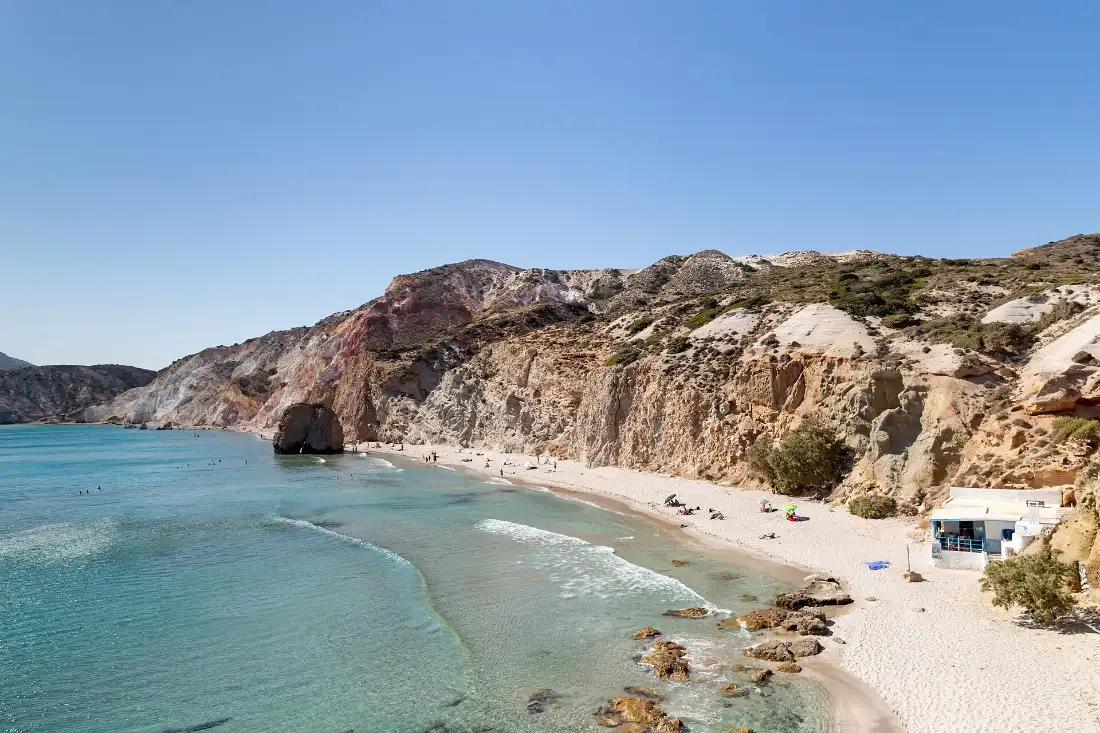
Choose Milos if you want the volcano at sea level rather than the volcano as a view. Milos is ringed with more beaches than almost any island its size, in a range of mineral colours from white to rust to grey, because the volcanic and mineral geology paints the coast, and much of the best of it is reached by boat. Sarakiniko, the stretch of white volcanic rock the wind and sea have carved into something that genuinely looks like the surface of the moon, is the island’s signature, and Kleftiko, a maze of white sea cliffs, arches and caves with no road to it, is the classic boat day.
That is the whole difference in one line: Santorini’s volcano is a view you look at, and Milos’s is a coast you move through. A Milos trip is organised around the water, the boat trip round the island, the coloured coves you drive to, the moonscape at dusk, in a way a Santorini trip is organised around the rim. Above the coast, the hilltop town of Plaka and the painted fishing-village syrmata give the island a quiet, lived-in centre. Start with the Milos itinerary and Milos beaches.
Choose Milos if the coloured coast, the moonscape and the boat-trip coves beat a famous view, and you would rather have quiet and value than the icon.
Beaches: black volcanic shore, or a coast of every colour
If beach days are a real reason for the trip, Milos wins the water outright, and it is not close. Both islands are volcanic, but Milos turned that into a coast of extraordinary variety while Santorini turned it into a short, dramatic, dark shore.
Santorini has no soft golden sand. Its volcanic origin gives it black and red pebble and coarse dark sand along the east and south coasts at Kamari, Perissa and Perivolos, with the much-photographed Red Beach under its rust cliff near Akrotiri, whose access path has seen repeated closures for rockfall and is often roped off. It is a shore for the look more than the swim.
Milos, by contrast, is effectively a tour of what a volcano can do to a coastline: white lunar rock at Sarakiniko, the sea-cave arches of Kleftiko, and dozens of other coves in sand and pebble and every mineral shade, some reached by car and the best by boat. If the beaches are the reason for the trip, this is the more rewarding island by a wide margin.
What the sea does on any given day is weather, not a fixed property of a beach, so read the ground and check the conditions rather than trusting a rating, what the sea is like covers that.
Cost, crowds and quiet
Milos is the cheaper and the quieter island, and both differences are structural rather than seasonal. Santorini’s premium is the view: a finite length of caldera-edge frontage meeting permanent cruise-and-honeymoon demand, on an island that desalinates its water and imports most of what it serves, so the rim room is the biggest line in most budgets. Milos has no equivalent scarcity to price against and nothing like the same demand, so rooms, tavernas and car hire all sit lower.
The crowd difference is just as clear. Santorini takes big cruise ships most mornings and its famous spots fill at midday and sunset; Milos is a genuinely quieter island where the pace stays slow and the coves rarely feel crowded outside peak August. That quiet is much of what people who choose Milos are choosing. Most of the Santorini premium is a view premium you can decline by staying off the rim and using the buses, but on Milos there is no such toll to begin with.
Every plannable figure lives on what a Greece trip costs; this page carries the mechanism and no numbers. If a quieter, cheaper Cyclades is the goal, the shoulder months thin even Santorini, per shoulder season in Greece.
Getting there and around
Both islands are reached on the Cyclades ferry network out of Piraeus and both have airports, though Santorini takes international summer flights while Milos’s is domestic, so an overseas trip to Milos usually connects through Athens. They sit in different corners of the Cyclades, Santorini in the south, Milos in the west, so they are connected but not adjacent, and pairing them takes a little more planning than the central-Cyclades islands. Take the times for your dates from the Greek island ferries guide.
On the ground, Santorini is small enough for buses and feet, though the caldera villages are stepped and steep and taxis are scarce. Milos wants a car, quad or scooter to reach its scattered coloured beaches, plus a boat day for Kleftiko and the coves without a road, which our Milos day trips and itinerary cover. Sort the vehicle question on which islands need a car, and place the pair with the Cyclades.
Which should you pick? By traveller type
Match the island to the traveller:
- First-timer who wants the icon: Santorini, for the caldera and the sunset that are the reason many people book Greece at all.
- Beach travellers: Milos, every time, for the coloured coast and the boat-trip coves.
- Couples wanting quiet and value: Milos for a relaxed, better-value week; Santorini for a short, iconic, off-peak stay, the call Greece for couples frames.
- Honeymooners after the postcard: Santorini, for the icon; plan it on Greece honeymoons or a Santorini honeymoon.
- Photographers and landscape travellers: either, for opposite reasons, Santorini for the caldera view, Milos for Sarakiniko and the sea caves.
- Anyone who wants a quieter, cheaper Cyclades: Milos, decisively.
- Short-trip travellers with one big sight in mind: Santorini, since its icon is a single unmissable view; Milos rewards a slower, longer stay.
Read it top to bottom and it splits by what you came for: Santorini for the view and the icon, Milos for the coast, the colour and the quiet.
Can’t choose? Here’s how to do both
On a longer Cyclades trip, doing both gives you the full range of what a volcano can build, the caldera view on one island and the coloured coast on the other. They are not adjacent, so pairing them takes a little more ferry planning than the central islands, but it is a rewarding combination precisely because the two dramas are so different.
Give Milos the longer half, because it rewards settling in, a land day for Sarakiniko and the villages, a boat day for Kleftiko, and a day for the coloured beaches, and treat Santorini as a short, high-impact stop of three or four nights for the view and the sunset. Take those as a shape, not a timetable, and let your flights and the sailings decide the order, with the Cyclades island-hopping itinerary and the island-hopping guide covering how to string them.
Our pick, if you make us choose
Forced to one island, it depends on the one thing you most want to see. Book Santorini when the caldera view and the sunset are the specific reason for the trip, keep it short, and go off-peak if you can. Book Milos when beaches, the coloured coast and a quieter, better-value island are the point, and you would rather move through a volcanic landscape than photograph one from a cliff.
Neither choice is a mistake; they are two volcanoes on one arc, answering different questions. One built a view you look into; the other built a coast you swim along. And on a longer trip, the honest move is to take both, with Milos as the longer half.
From here, go deep on the Milos guide or the Santorini guide, or step back to the Cyclades. If your shortlist is really a different pairing, the same decision spine runs through Santorini vs Naxos, Santorini vs Paros and the rest of the island comparisons.
Quick answers
Is Santorini or Milos better?
Neither is better outright, and the twist is that both are volcanic islands with different kinds of drama. Santorini has the caldera view, the cliff villages and the iconic sunset, which Milos does not. Milos has the moonscape of Sarakiniko, the sea caves of Kleftiko and dozens of beaches in every mineral colour, on a quieter, cheaper island. Choose Santorini for the view and the icon, Milos for the coast, the colour and the quiet.
Is Milos a good alternative to Santorini?
Partly. Milos is genuinely volcanic, quieter and cheaper, and it has a far more rewarding coast of coloured beaches and sea caves, so if beaches, landscape and value are what you want, it beats Santorini. But it is not a like-for-like substitute for the caldera view, the cliff villages and the sunset, which are Santorini’s specific icons and which Milos does not have. So it is a great alternative if the view is not the point, and not one if it is.
Is Milos cheaper than Santorini?
Yes, and clearly. Santorini’s cost base is set by a finite length of caldera-edge frontage meeting permanent cruise-and-honeymoon demand, on an island that desalinates its water and imports most of what it serves. Milos has no equivalent scarcity or demand, so rooms, tavernas and car hire all run lower. Much of the Santorini premium is a view premium you can decline by staying off the rim; on Milos there is no such toll. The plannable breakdown sits on what a Greece trip costs.
Which has better beaches, Santorini or Milos?
Milos, by a wide margin. Both are volcanic, but Milos turned that into a coast of dozens of beaches in every mineral colour, from the white moonscape of Sarakiniko to the sea-cave coves of Kleftiko, many reached by boat. Santorini’s volcanic shore is short, dark and dramatic, black and red pebble and sand that is more for the look than the swim. If beaches are the reason for the trip, Milos is the far more rewarding island.
Is Milos quieter than Santorini?
Yes, considerably. Santorini takes big cruise ships most mornings and its famous spots crowd at midday and sunset, while Milos is a genuinely quieter island where the pace stays slow and the coves rarely feel crowded outside peak August. That quiet, along with the lower prices, is much of what people who choose Milos are choosing.
Can you visit both Santorini and Milos in one trip?
Yes, on a longer Cyclades trip, and it gives you the full range of what a volcano can build. They sit in different corners of the Cyclades, Santorini in the south and Milos in the west, so they are connected by ferry but not adjacent, and pairing them takes a little more planning than the central islands. Give Milos the longer half and treat Santorini as a short, high-impact stop; the Cyclades island-hopping itinerary covers stringing them.
What is Sarakiniko on Milos?
Sarakiniko is a stretch of white volcanic rock on the north coast of Milos, carved smooth by wind and sea into a bare, curving landscape that looks strikingly like the surface of the moon. It is the island’s most famous and photographed place, best seen in the soft light of late afternoon or early morning, and it is a place to walk over rather than a beach with facilities. It is the clearest example of the different, ground-level volcanic drama Milos offers in place of Santorini’s caldera view.