Three places answer to the name. The archaeological site on the island’s southwest coast, which is this page. The modern village of Akrotiri up the road, with its beach and its lighthouse below it. And if you search akrotiri greece you will also turn up the peninsula outside Chania on Crete, where that island’s airport sits.
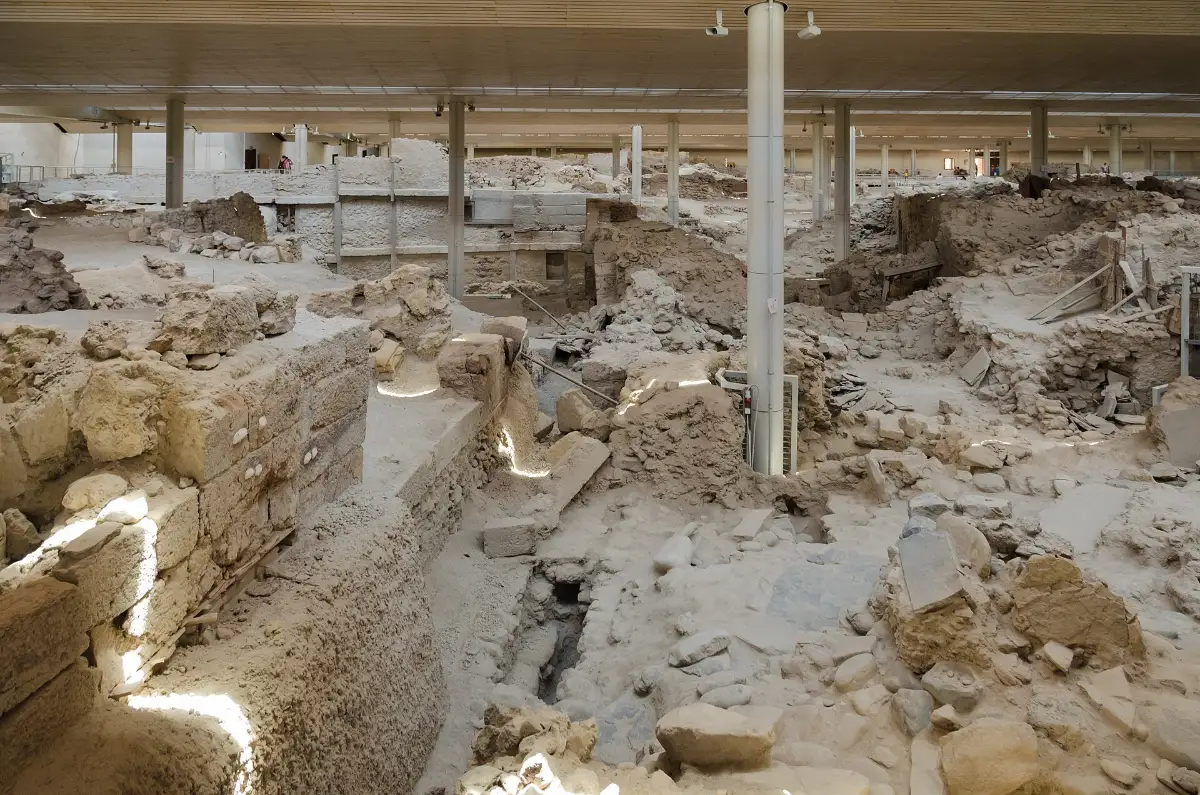
The site is a prehistoric town of about 20 hectares, with an elaborate drainage system and multi-storeyed buildings, buried by the eruption that shaped Santorini and preserved by it, in the Ministry of Culture’s own words, “just like in Pompei”. You walk it on raised walkways, under a roof.
Two facts decide your day. It is closed one day a week. And the frescoes are not here.

Diagram by Greece Trips. Free to reuse with credit - CC BY 4.0.
This is a town, not a ruin field
Walls stand two and three storeys high, with window openings still in them. Streets run between the buildings, and drains run beneath the streets. Furniture and vessels were found where their owners left them. That is the difference between an archaeological site and a place, and it is why people who came to look at knee-high stones stop short on the walkway.
The Ministry of Culture’s record calls Akrotiri one of the most important prehistoric settlements of the Aegean: about 20 hectares, a main urban centre and port of its world, trading with Crete, the Greek mainland, the Dodecanese, Cyprus, Syria and Egypt. A town with plumbing and an export trade is a bigger claim than any adjective.
The order of the ending matters, and most pages get it backwards. Severe earthquakes forced the inhabitants out. The eruption came afterwards. The volcanic material then buried island and town together, and it is that material which protected the buildings and their contents, the record says, “just like in Pompei”.
The end of the town’s life is conventionally dated to the last quarter of the 17th century BC. The absolute date is contested among archaeologists and this page does not settle it.
So the Pompeii comparison is the Ministry’s own rather than a marketing line, and it holds in one direction: same mechanism, smaller scale. This is a town centre, not a city. Santorini, end to end sets it in the island it belongs to.
The roof is the reason you can visit in July, and the reason they can close it
Akrotiri is covered. The excavation sits under a large bioclimatic shelter, and you walk it on raised walkways in shade and moving air. On a July afternoon on Santorini it is the coolest hour of your day, and that is an argument for going at midday rather than at nine in the morning.
Most people front-load the island’s outdoor sights and hide from the sun at lunchtime. Akrotiri inverts that. Put it in the middle of the day and put the caldera at either end of it, which is the one piece of sequencing worth taking from this page. The rest of the Cycladic calendar is in when to visit Greece.
The same structure is the site’s point of failure. Because the town sits under an engineered building, it is the building that must be checked when the ground moves. After the Cycladic earthquake swarm of early 2025 the site closed, and it was the last of the island’s major sites to reopen, because the shelter over it needed the most demanding inspection of any of them. Local reporting gives the reopening as 11 April 2025, and that date belongs to the reporting, not to the Ministry.
The Ministry’s own record still carries an undated line saying its hours apply after “the reopening of the temporarily closed area due to seismic activity”. We cannot tell you whether that clause is current, so we are not going to tell you the whole site is open. Check the record before you build a day around Akrotiri, and check it again after any Cycladic earthquake reaches the news. We publish no live opening status, and a page that claims to is out of date by the time you read it.
You walk on raised metal walkways above the excavation, with the buildings standing beside you and below you. We will describe the ground and stop there. Whether it suits you is not a judgement we are in a position to make, and the Ministry’s own access information is a better place to settle it than we are.
The frescoes are in Fira and in Athens, so ask what your ticket covers
The wall paintings are not on the walls. They were lifted out for conservation, and they are displayed in the Museum of Prehistoric Thera in Fira and in the National Archaeological Museum in Athens. That is the most consequential thing to know before you arrive, because the frescoes are the reason most people have heard of Akrotiri at all, and finding out at the exit is a small and entirely avoidable disappointment.
Now the detail almost nobody prints. The Ministry’s record for the site lists a package covering three places: Akrotiri of Thera, Ancient Thera, and the Prehistoric Thera Museum. Its current price list, though, prices each place separately. If the package holds on your date, the museum in Fira that holds the paintings is already on the ticket you bought at the gate, so ask at the ticket desk what yours covers before you buy a second ticket.
That turns a one-hour stop into a coherent half-day. Do the site, drive back into Fira, and look at the paintings that came out of the rooms you have just walked past. You are probably eating or sleeping in Fira anyway.
Ancient Thera is the third place on that package, and it is a different proposition: a Hellenistic and Roman city on a high ridge at the other end of the island. It is a separate expedition rather than an add-on to this one.
We print no ticket price. The Ministry’s record carries the current one, and a price on a travel page is wrong within a season. We also name no individual fresco: those names belong to the museums that hold them, and a confidently wrong fresco name is exactly the mistake this page exists not to make.
The closed day is the fact that wastes a morning
Akrotiri closes one day a week, and the field does not agree on which.
The Hellenic Ministry of Culture’s record for Akrotiri of Thera is reported to give Tuesday. The most prominent independent Santorini site in our research says Monday. We could not open the Ministry’s record ourselves: the host serves plain HTTP and refuses our connection, so all we have are accounts of what it says. We are not going to settle it from here, and you should not let us.
We are telling you this rather than picking a day, because the closed day is the one fact on this page that costs a whole morning, a car hire and a bus fare. And it shows what is true of every travel page including this one: it is a copy of a copy unless somebody opened the record. We did not manage to, and we would rather say so than pass a rumour off as a check.
So open the record yourself. The Ministry’s entry for Akrotiri of Thera is where the closed day lives. Check it for your date before you drive out, and take the day from it rather than from us or from anybody else.
The hours are a separate tangle and we are not printing those either. They differ between summer and winter, and the summer timetable runs a short day on some weekdays. That is more than one line can hold honestly, and it is reissued. How Greek opening hours work in general is in siesta and opening hours, and which days sites shut for the calendar is in public holidays and what closes.
An opening hour is a number that rots. We would rather send you to the source than be confidently wrong in August, and our editorial policy explains how we date what we do print.
Getting there, and how long it takes
The site is on the southwest coast, roughly 10 km from Fira, just below the modern village that shares its name. A KTEL bus runs from Fira, the stop is at the entrance, and there is parking opposite.
We print no bus times. Not the frequency, not the fare, not the journey time. None of it sits in a primary we read, all of it moves with the season, and a wrong last bus is a long walk. Check the current KTEL Santorini timetable on the day you go. Moving around the country in general is covered in getting around Greece.
Allow an hour to ninety minutes inside. No primary publishes a visit duration, so treat that as what visitors consistently report rather than as a rule, and it is enough for the site itself.
The sequencing is the part people get wrong. Akrotiri sits at the southern end of the island, on the same headland as the Red Beach, and Oia is at the far northern tip. Treating it as a stop on the way to a sunset in Oia is how a Bronze Age town ends up getting forty minutes. Pair it with the south, or pair it with Fira and the museum, and give it the middle of the day.
Go at midday, and finish in Fira
Two things are worth carrying off this page.
Akrotiri is indoors, which makes it the one thing on Santorini that is better at noon than at nine, and the only sight on the island that improves as the day gets hotter. And the frescoes are in Fira, which makes the museum the second half of this visit rather than a different outing on a different day. Ask at the ticket desk whether your ticket covers it before you buy a second one.
Before you drive out there, open the Ministry’s record and check the closed day. It is the only fact here that can cost you a morning, and the pages that rank do not agree on it.
From here: Santorini, end to end.
Last checked September 2026. What gets re-checked on this page: the closed day, the hours mechanism, what the ticket covers and the Ministry’s seismic caveat.
The Ministry sells Akrotiri of Thera through its own e-ticketing service. Its record for the site lists a package with Ancient Thera and the museum in Fira, but its current price list prices each place separately, so ask at the ticket desk what yours covers before you buy a second ticket.
Everything on this page is arrangeable by yourself in an afternoon, and the Ministry’s record is the one page to open before you go.
Common questions about Akrotiri
What is Akrotiri in Santorini?
Akrotiri is a prehistoric town on Santorini’s southwest coast, buried by the volcanic eruption that shaped the island and preserved beneath the ash. Buildings survive to two and three storeys, with streets and a drainage system between them. You walk it on raised walkways, under a shelter. It is not the modern village of the same name a few hundred metres up the road, and it is not the beach. The Hellenic Ministry of Culture’s record calls it one of the most important prehistoric settlements of the Aegean.
Is Akrotiri covered, or is it in the sun?
It is covered. The excavation sits under a large bioclimatic shelter and you walk it on raised walkways in shade and moving air. That is why Akrotiri is the sensible thing to do in the middle of a July day on Santorini, when the caldera path and the beaches are in full sun. We are describing the structure rather than promising you comfort, and the shelter is the reason the site can also be closed for inspection when the ground moves.
Which day is Akrotiri closed?
We are not going to name the day, because we could not confirm it. The Hellenic Ministry of Culture’s record for Akrotiri of Thera is reported to give Tuesday; at least one prominent independent guide prints Monday. We could not open the Ministry’s record ourselves, so we have only accounts of it, and a closed day taken from an account is exactly how a reader loses a morning. Open the record for your own date before you drive out.
Where are the Akrotiri frescoes?
Not at the site. The wall paintings were removed for conservation and are displayed in the Museum of Prehistoric Thera in Fira and in the National Archaeological Museum in Athens. The useful half: the Ministry’s record for the site lists a package valid for Akrotiri of Thera, Ancient Thera and the Prehistoric Thera Museum, though its current price list prices each place separately, so ask at the ticket desk what yours covers before you buy a second ticket. Do the site, then do the museum.
Is Akrotiri open after the earthquakes?
After the Cycladic seismic activity of early 2025 the site closed for a precautionary inspection, and it was the last of the island’s major sites to reopen because its protective shelter needed the most demanding check. Local reporting gives the reopening as 11 April 2025. But the Ministry’s own record still refers to its hours applying after “the reopening of the temporarily closed area”, and we cannot establish whether that clause is current, so we will not tell you the entire site is open. Check the Ministry’s record. We publish no live status here.
How long do you need at Akrotiri?
An hour to ninety minutes is what visitors consistently report, and it is enough for the site itself. No primary publishes a visit duration, so that is a consensus rather than a rule. The planning consequence is the useful part: the Museum of Prehistoric Thera in Fira is a second, shorter visit, possibly on the same ticket, and the two together make a coherent half-day rather than two separate errands.
How do you get to Akrotiri from Fira?
A KTEL bus runs from Fira to Akrotiri, the stop is at the site entrance, and there is parking opposite. The site is roughly 10 km from Fira on the southwest coast. We print no timetable, no fare and no journey time, because none of that is in a primary and all of it changes with the season: check the current KTEL Santorini timetable. One planning note, since it catches people out: Akrotiri is at the opposite end of the island from Oia, so pair it with the south rather than with a sunset.
Booking
We sell nothing and book nothing for you. Every guide on this page tells you how to arrange each piece yourself - which ferry operator, when to book, what to prebook and what to leave loose.