Where
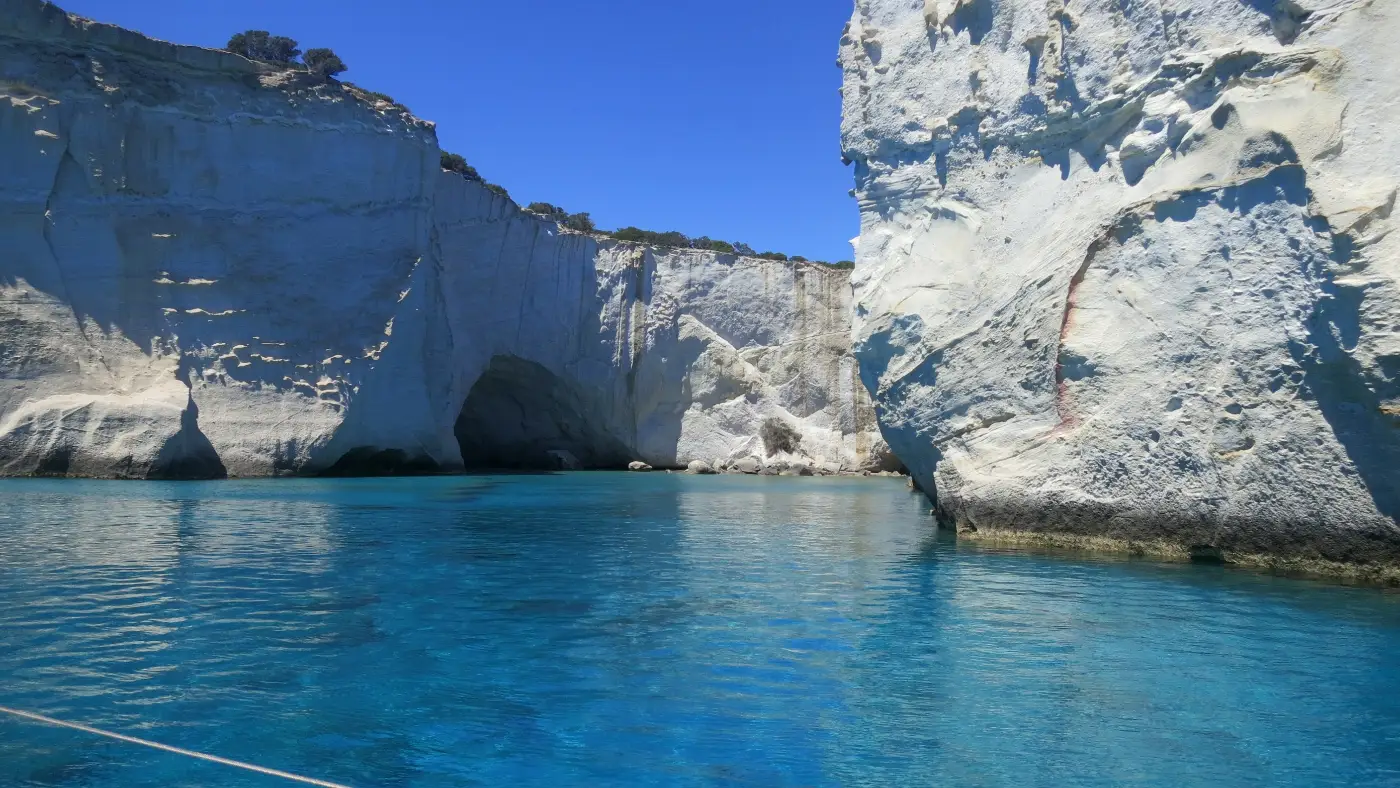
The roadless southwest tip of Milos, in the Cyclades
Access
By boat only, from Adamas. No road and no path reaches the formations, which are entered from the water
What it is
White volcanic rock stacks rising from deep water, with arches, caves and swim-through passages
Trip shapes
Half-day, about 3 to 4 hours, focused on Kleftiko. Full-day, 6 to 10 hours, several swim stops. Confirm with the operator
Season
Roughly May to October
What cancels it
The meltemi, the north wind of the Aegean summer. Book early in your trip and keep a spare day
The name
From kleftis, thief. The pirate account is the standard explanation, not a documented history, and no centuries are printed
Facilities
None reach it, because no road does. Water, shade and a mask come out on the boat
Travel details last checked July 2026.
That last clause is the whole planning problem, so take it literally. You do not drive to Kleftiko, and you do not walk in. The coast there is roadless, the caves are entered from the water, and the only way you see the place is from a boat that carried you round to it.
Which means the day is not really yours to schedule. It belongs to the wind.
Why the wind, not the calendar, decides this
Milos in summer sits under the meltemi, the dry north wind of the Aegean, and on this island the meltemi does more than ruffle a hat. Our Milos guide puts it plainly: it is the single thing most likely to cancel a Kleftiko trip.
So the planning rule is simple and almost nobody follows it. Do not book the boat for your last full day.
Treat Kleftiko as the fixed point of a Milos trip and build the rest around it, with at least one spare day behind it. Boats run roughly May to October, and within that window a blown-out morning is an ordinary event rather than bad luck. People who allow a second chance usually get out. People who allow one slot sometimes fly home having seen the island’s headline from a photograph.
The mechanics of Greek summer winds, if you want to understand what you are reading in a forecast, are in what the sea is like in Greece.
What the trip actually is
Boats leave from Adamas, the port town, and the market has settled into two shapes.
A half-day trip goes to Kleftiko and back, focused on it, running about three to four hours. A full-day sailing runs somewhere between six and ten hours, works its way round more of the coast, and stops several times to swim. Both carry the same figures on our Milos guide, and both should be confirmed with whoever you book, because durations and seasons move.
We name no boat and print no fare. Operators rebrand and re-price between seasons, and a page built on their names is out of date before the next summer.
What we can tell you is what to ask, because the questions are durable even when the answers are not. Ask how long the boat spends at Kleftiko itself rather than how long the trip is, because that is the number that varies most between products with similar names. Ask whether the boat is a sailing yacht, a motor cruiser or a small open boat, because that decides how much of the day is transit and how much shade you get. Ask what happens if the wind cancels, and get the answer before you pay rather than after.
And ask what the trip does at the caves, because that varies too. Some boats go in. Some hold off and let people swim across. On the day, that is the skipper’s call and not the brochure’s, which is the correct place for it to sit.
The rock, and the swim
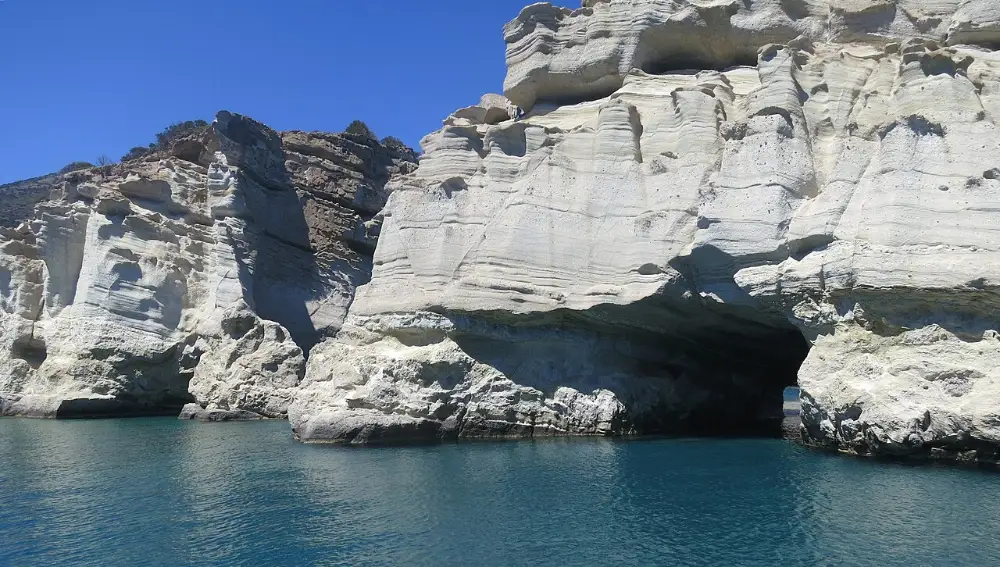
The stacks are white volcanic rock, part of the same volcanic island that produced Sarakiniko on the opposite coast, and the pattern is the same one: rock laid down by an ancient volcanic system, then carved back over a very long time by sea and weather. Here the sea has worked from below and from the side rather than from above, so instead of a rolling white plateau you get columns, arches, roofed passages and hollows.
We are not going to describe the petrology any further than that. The Sarakiniko page declined to adjudicate what exactly the island’s white rock is called, on the reasonable grounds that we would be doing it in swimming shorts, and we found no scientific description of Kleftiko specifically to improve on it.
The swimming is the point of the visit. The water inside and around the formations is clear and deep, and boats stop long enough for people to get in, snorkel around the stacks, and swim through the passages that connect them.
This page rates no cave, names no swim-through and recommends no route. Not one of those is a judgement we can make from here: the water moves, the swell inside a rock passage is not the swell outside it, and the only people with a view of the day are the crew and you. What we will say is that a mask makes a large difference to this stop, and that boats vary in whether they carry them, so pack one. Practical packing for a Greek trip generally is in what to pack for Greece.
The pirates, and what is actually known
Kleftiko takes its name from kleftis, the Greek word for thief. The account attached to it everywhere is that pirates used the caves as a base, sheltering their boats inside the rock and coming out at passing shipping.
That story is repeated identically across every page selling a trip there, and we could not find a historical source behind it. So we are giving it to you as the standard explanation rather than as documented history, and we are printing no dates for it, because the centuries in circulation are as unsourced as the story.
The geography makes it plausible in a way that is more interesting than the anecdote. This is a roadless coast with deep water, hidden inlets and roofed passages, facing the open sea on a shipping route through the Cyclades. It is exactly the kind of coast that shelters whoever does not want to be seen, and that has been true for as long as there have been boats.
Fitting Kleftiko into the island
Milos sorts its beaches by how you reach them rather than by how they look, which our Milos guide sets out as the island’s organising idea, and Kleftiko is the far end of that scale.
The same boat-only coast holds Gerakas and the Sykia sea cave, and most full-day trips take in at least one of them. Across the water, Polyaigos, the uninhabited island beyond Kimolos, is reached on the same kind of sailing and governed by the same wind, so a wind day that cancels one usually cancels the other.
Boat trips here are booked directly with the operators, in Adamas or online, and in July and August the good ones fill well ahead. Book the boat before you book anything else about your Milos week, and leave a spare day behind it.
Two things to bring onto the boat, since nothing reaches Kleftiko except boats. Water and shade are whatever you and the crew carried out; there is nowhere to buy either at the rock, because no road runs to it. And your own mask, for the reason above.
Then the honest expectation. Kleftiko is not a beach. There is nowhere to lie down, nothing to walk on and nothing to buy. It is a swim stop at a rock formation, and the people who come away happiest are the ones who wanted a day on the water with a spectacular stop in the middle of it. If what you want is sand and a taverna, the island’s road-served beaches do that, and the Milos guide sorts them.
What to take away
Kleftiko is the best hour on Milos and it is the one you cannot arrange by yourself. Book the boat early, book it early in your trip, ask how long it actually stops there, bring a mask and water, and accept that the meltemi has a vote you do not.
Last checked July 2026. What gets re-checked on this page: the boat season and trip durations, which are carried from our Milos guide and were last confirmed there in July 2026. No operator, fare or price appears here by design. How we date and correct facts is in our editorial policy.
Common questions
How do you get to Kleftiko in Milos?
By boat, from Adamas, and only by boat. Kleftiko is at the roadless southwest tip of the island: no road reaches that coast, and the caves and passages are entered from the water. Trips come in two shapes, a half-day focused on Kleftiko at about three to four hours, and a full-day sailing of six to ten hours taking in more of the coast with several swim stops. Confirm durations and season with whoever you book. We name no operator and print no fare, because both change between seasons.
Can you drive or walk to Kleftiko?
No. There is a coastal walking route on the clifftops in that part of the island, and whatever it shows you, it does not put you in the caves: the formations rise out of deep water and are entered from the sea. Anybody planning to reach Kleftiko on foot or by car has misread a map. Milos sorts its beaches by access mode, and Kleftiko sits in the boat-only class along with Gerakas and the Sykia cave.
When do the Kleftiko boats run, and what cancels them?
Roughly May to October, and the meltemi cancels them. The meltemi is the dry north wind of the Aegean summer, and our Milos guide names it as the single thing most likely to take this trip away from you. The practical consequence matters more than the season: do not book the boat for your last full day. Put it early in the week and keep a spare day behind it, and a blown-out morning becomes an inconvenience rather than a missed trip.
Can you swim at Kleftiko?
The swim is the reason the boats stop. The water around and inside the formations is clear and deep, people snorkel around the stacks and swim through the connecting passages, and boats allow time for it. This page rates no cave, names no passage and recommends no route, because the swell inside a rock passage is not the swell outside it and no page can see your day. What the boat does at the caves on the day is the skipper’s call. Bring a mask; boats vary in whether they carry them.
Why is Kleftiko called Kleftiko?
From kleftis, the Greek word for thief. The account attached to the name everywhere is that pirates sheltered in the caves and raided passing shipping from them. We attribute that as the standard explanation rather than as documented history, because we could not find a historical source behind it, and we print no centuries for the same reason. The geography is the persuasive part: a roadless coast with deep water, hidden inlets and roofed passages, on a shipping route through the Cyclades.
Are there facilities at Kleftiko, and what should you bring?
No road reaches Kleftiko, so whatever you want at the rock is what came out on the boat with you. Bring water, bring shade in whatever form the boat allows, bring sun cover, and bring your own mask. There is nowhere to lie down and nothing to walk on: Kleftiko is a swim stop at a rock formation rather than a beach, and treating it as a beach day is how visitors end up disappointed by one of the best things on the island.
Booking
We sell nothing and book nothing for you. Every guide on this page tells you how to arrange each piece yourself - which ferry operator, when to book, what to prebook and what to leave loose.