Why this route runs north to south, and never back
Island-hop the Cyclades as one southbound line, not a loop. Fly into Mykonos at the top of the chain, hop down the spine through Paros, Naxos and, if you want it, Ios, and fly out of Santorini at the bottom. Booked in that order, every ferry moves you forward, and this greek island hopping itinerary never costs you a backtracking day.
The geography makes the decision for you. The central Cyclades run as a single ferry corridor: Piraeus down through Paros and Naxos in the middle to Ios and Santorini at the southern end, with Mykonos hanging off the north of the chain and connected by short hops. Two of those islands, Mykonos and Santorini, have their own airports. A one-way line therefore has an airport at each end, which is the whole reason it points south rather than looping back to where you started.
Run it in reverse and you pay for the mistake. Starting at Santorini means reaching the far end first, then working north against the flow before doubling back to fly home, and it stacks the route’s most cancellable boat against your flight out. The Athens-first seven-day route warns against the same reversal for the same reason. Keep the order southbound and the problem disappears.
What this page is not is a lesson in how ferries work, or how to design a hop from scratch. Those live one click up: how Greek island ferries actually work covers ports, boat types and cancellations, and how to design an island-hop covers pace and ordering in general. This page owns one named route with the specific boats. Here it is.
The Greek island hopping itinerary at a glance: Mykonos to Santorini
Here is the whole route in one block, before any of the day-by-day. Mykonos two nights, Paros two, Naxos three, Ios one if you take it, Santorini three - roughly ten to eleven nights, flown in at Mykonos and out at Santorini. That is the whole greece island hopping itinerary on a single line. We recommend it as the best greek islands itinerary for a first independent hop, and the shorter and longer versions come later on the same spine.
The map shows why the order holds: it is a straight run south, not a tour.
| Ferry leg | Boat type | Approx time | Book-ahead note |
|---|---|---|---|
| Mykonos → Paros | High-speed | ~45 min | Mostly fast boats; meltemi-sensitive, book early |
| Paros → Naxos | Conventional or high-speed | Short hop, the line’s shortest leg | Very frequent; the low-risk middle |
| Naxos → Santorini (direct) | Conventional or high-speed | ~2h conventional, 1–1.5h fast | The core southbound leg |
| Naxos → Ios (optional) | High-speed | ~40 min–1h | Mostly fast boats; fragile |
| Ios → Santorini (optional) | High-speed | ~35–40 min | Mostly fast boats; fragile |

Diagram by Greece Trips. Free to reuse with credit - CC BY 4.0.
To actually buy these and read the season’s sailings, use how Greek island ferries work; this page gives you the route, that one gives you the timetable.
This page is the plan - lock the ferry chain and the two anchor rooms, Mykonos and Santorini, yourself and in this order.
Mykonos: two nights at the top of the chain
Two nights on Mykonos, and no more, unless beach clubs and nightlife are the actual reason you came. It is the trip’s front door: one night to shake off the flight and see the town, one for a beach or a boat, then a short hop south onto the spine. Give it a third night only if the scene is the point.
You arrive one of two ways. Fly straight into Mykonos (JMK), which takes direct summer flights from across Europe, or ferry across from Athens - from Piraeus, about 2h40m to 3.5 hours on a high-speed catamaran, or from Rafina, which sits nearer the Athens airport and is often the faster connection off an incoming flight.
Keep the island itself to a short list: the whitewashed maze of Chora with its windmills and Little Venice, the sheltered south-coast beach strip, and sacred Delos a half-day boat ride across the water. Which beach, which club, which night out is all on the Mykonos guide, the best Mykonos beaches and Mykonos nightlife - this page keeps moving.
Then the first leg, and the first warning. Mykonos to Paros is a short high-speed hop of about 45 minutes, run mostly by fast catamarans, with only a thin conventional Blue Star sailing as a fallback. That makes it one of the route’s weather-sensitive links, the kind the meltemi cancels first, and the slower boat may not run on the day you need it. Hold that thought for the failure-modes section below.
One honest steer before you commit. Mykonos is the priciest and busiest stop on the whole line, and plenty of hoppers skip it, flying instead into the spine and starting at Paros or Naxos. If the party is not your draw, that is a defensible cut, not a compromise.
Paros: two nights on the connector island
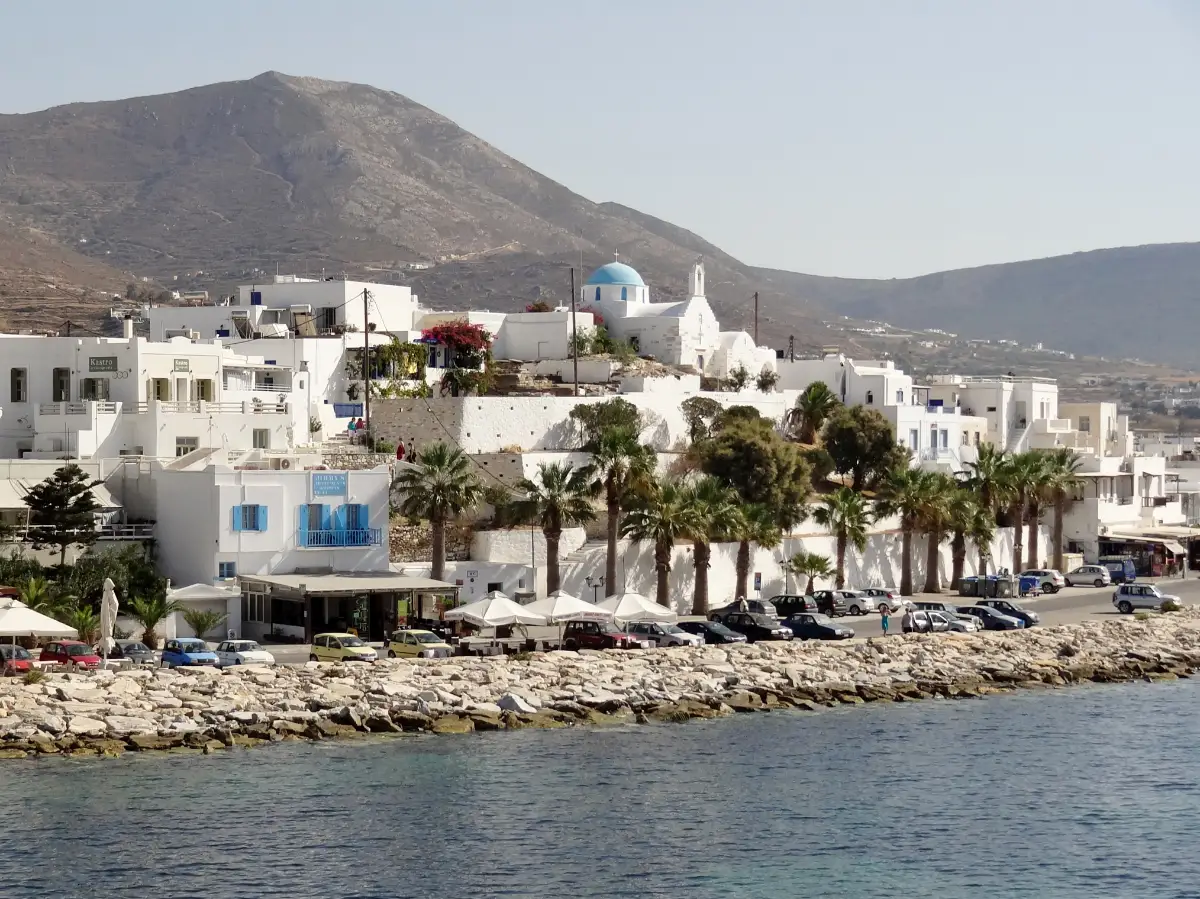
Paros is the switchboard of the Cyclades, and that is the reason it earns two nights in the middle of this greek island itinerary. More boats call at Parikia, its main port, than at almost anywhere else in the group, so Paros is the low-risk heart of the route: whatever the weather does to a single sailing, you can nearly always get somewhere from here.
Two nights buys the island and the connection both. Wander Parikia’s old quarter behind the harbour, spend an afternoon at Naoussa - the fishing town turned stylish, with Kolymbithres and its wind-sculpted rocks a short hop around the bay - and, if you have a spare morning, take the short channel ferry across to little Antiparos. The fuller version is on the Paros guide and the best Paros beaches page; here it is a two-night island, not a week.
Then the easiest leg on the whole line. Paros to Naxos is the shortest hop of the route and one of the most frequent in the Cyclades, run through the day on Blue Star conventional ferries and high-speed catamarans alike. It is short enough that the boat choice barely matters and frequent enough that a missed or cancelled sailing rarely costs you more than an hour.
That frequency is worth planning around, not just enjoying. If a later leg falls through - a grounded fast boat between Naxos and Ios, say - Paros is the fallback hub you route back to, because something is almost always sailing out of Parikia. Keep it in your back pocket as the route’s insurance island.
Naxos: three nights for the calm middle
Naxos is the one island on the line that earns a third night. It is the largest of the Cyclades, the cheapest of these five stops, and the least frantic, which makes it the right place to slow down before Santorini’s crowds close in. Two nights would work; three is what turns it from a stopover into the calm middle of the trip.
The island backs up the extra night. Its west coast holds the best sandy beaches in the Cyclades - Agios Prokopios and Plaka, long, shallow and reachable by local bus - while the old town climbs under the Portara, the giant marble doorway of an unfinished temple on the islet off the harbour, best walked out to as the sun drops through it. Inland, the mountain villages are the part most hoppers miss: Halki with its old market and citron distillery, marble-laned Apiranthos an hour’s drive up. If you do one thing beyond the beach, rent a car for a day and take the mountains. The Naxos guide and the best Naxos beaches go deeper than three days can.
From Naxos the route reaches its one real fork. You can sail straight to Santorini, the core southbound leg, or slot in a single night on Ios between the two. That is a genuine decision with a weather cost attached, so it gets its own section next rather than a throwaway line here.
Pack the night before either way. Whichever leg you take out of Naxos tends to sail early or mid-afternoon, and a slow morning over the bags is a poor use of your last hours on the best-value island of the line.
The Ios question: one night, or sail straight through
Add Ios for one night if you want a young beach-and-bar stop between Naxos and Santorini and you do not mind a pair of fast-boat-only hops. Skip it, and sail Naxos to Santorini direct, if you would rather keep the calm you found on Naxos, or you are travelling in shoulder season when the fast boats thin out.
The legs tell you why it is optional. Naxos to Ios is about 40 minutes to an hour, and Ios to Santorini about 35 to 40 minutes, both run mainly by high-speed catamarans; a slower Blue Star conventional does serve each leg (around 1 hour 20 minutes) but only a few times a week. The direct alternative, Naxos straight to Santorini, runs about two hours on a conventional boat or one to one and a half on a high-speed, and crucially the conventional option is a boat that sails when the fast ones are grounded.
Here is the honest risk. The fast catamarans on both Ios legs are the first the meltemi cancels, and the conventional fallback is infrequent, and a single-night stop has no slack to absorb a cancellation. A pulled sailing can cost you the Ios night, or worse, bleed into your Santorini arrival. That fragility is the whole reason Ios is an option and not a fixture on this line. What to do on Ios makes the case for taking it; how ferry cancellations work makes the case for reading the forecast first.
Santorini: three nights, then fly out
Three nights on Santorini, based on the caldera rim but away from Oia’s evening crush - Imerovigli or Firostefani, both on the same clifftop view with a fraction of the crowd - then a flight home from the island’s own airport. This is the end of the line by design, and the design is the point: you finish the trip without a single backtracking mile.
Keep the three days uncomplicated. Walk the caldera path along the rim from Fira through Firostefani to Imerovigli, take a boat trip out to the volcanic islets and their warm springs, and go to Oia for the quality of the light rather than the scrum at sunset. Where to sleep across the caldera villages is a real decision with a real price attached, laid out on the Santorini hotels guide; for a rim base built around two people, the Santorini honeymoon page makes the case; the Santorini guide fills the days.
One arrival warning, said once. Ferries dock at Athinios, at the foot of the caldera cliffs, where the taxis are few and instantly mobbed when a boat unloads. Do not plan to find a cab there. Pre-book a transfer or take the bus up to Fira. The detailed version lives in how the ferries and ports work; this route just flags it so it does not catch you.
Then fly out. Santorini’s airport sits on the island’s east side, with flights home or a short hop back to Athens, and it is the entire reason the route pointed south in the first place. No ferry back to Piraeus, no lost day retracing water you have already crossed. Leave a real buffer for an early flight - the airport is small and its security backs up - and end the trip looking at the caldera, not at a boarding screen.
Where Milos fits, and where it does not
Milos is worth a trip, but it is not on this one, and it is honest to say so before the route tempts you off course. Milos belongs to the western Cyclades, grouped with Serifos, Sifnos and Kimolos on a separate ferry line out of Piraeus. It does not sit on the Mykonos-Paros-Naxos-Ios-Santorini spine, however often a blog drops it in beside Santorini as if it did.
There are two honest ways to add it. The first is at the south end, on the seasonal high-speed link between Santorini and Milos - a SeaJets catamaran of roughly one hour and fifty-five minutes, running up to about twice a day at the height of summer and thinning to as little as one or two sailings a week off-season. It is a fast-boat-only connection, which means the meltemi grounds it first, and it disappears fast outside July and August, so treat it as a bonus, not a booking you build the trip around.
The second is cleaner: do Milos as its own western-line trip from Piraeus, stringing Sifnos, Serifos and Milos together instead of forcing it onto this spine. The island-hopping guide works through that western-line logic.
What does not work is the middle. Trying to slot Milos between Naxos and Santorini means leaving the spine, crossing to a different line, and coming back - the classic backtrack, and one that can cost a full day of ferries for a single island. If Milos and the moonscape of Sarakiniko are calling, add them at the end or give them their own trip. Do not bend the line to reach them.
Shorter and longer: the same line at seven or fourteen nights
The line does not change shape when you change its length. Drop the soft stops to shorten it, add them back to stretch it, but the southbound spine stays the same, which keeps every version copyable.
For a seven-night trip, compress to the three anchors: Mykonos two nights, Naxos two, Santorini three, dropping Paros and Ios. That is a pure-island 7 day greek island itinerary, all on the water - distinct from our Athens-inclusive one-week route, which trades an island for two nights in the capital. Pick this one if you never want to leave the Cyclades.
The core ten to eleven nights is the full route above, and it is the 10 day greek island itinerary most hoppers should copy. To reach fourteen, add the Ios night and then either a western-line Milos leg off the south end, as the Milos section describes, or a few slow days in the Small Cyclades - Koufonisia and its neighbours - reached by day-boat off Naxos.
| Trip length | The same line |
|---|---|
| 7 nights | Mykonos 2, Naxos 2, Santorini 3 |
| 10–11 nights | Mykonos 2, Paros 2, Naxos 3, Ios 1, Santorini 3 |
| 14 nights | Add Ios, plus a Milos or Small Cyclades leg |
Want the mainland in the mix, and it is a different shape: ten days with Athens added puts the ancient core before the islands, and adding Crete at the south end is the two-week version with a bigger island to finish. This page stays on the water; those two step onto land.
What breaks this route
Every route breaks somewhere, and this one breaks in a handful of predictable places. Naming them is the plan, not a disclaimer - each has a fix, and knowing the failure before it happens is what keeps a cancelled boat from becoming a ruined week.
The mid-August sell-out. Mid-August is the single stretch to avoid. Greeks travel en masse around the 15th, and the popular sailings sell out weeks ahead, so a chain of ferries booked late will not assemble. Book those legs the moment schedules open, or travel either side of the 15th and sidestep the crush entirely.
The meltemi on the fast hops. The meltemi, the dry north wind that blows hardest from July into September, cancels high-speed boats before conventional ones. On this line the fragile legs are the fast-catamaran hops - Mykonos to Paros, and both Ios legs - where the conventional fallback runs only a few times a week. Where a frequent conventional ferry exists, as it does on Paros-Naxos and Naxos-Santorini, prefer it on a windy forecast, and leave a day of slack on the legs that matter.
The reversed route. Starting at Santorini and working north stacks the most cancellable boat against your flight home. Keep the order southbound and the riskiest sailing sits early in the trip, where a lost day costs a beach afternoon and not a plane.
The off-season collapse. Outside summer the short inter-island hops thin right out, and a rigid night-by-night split can strand you between islands when there is simply no boat on your day. Travelling October to April, take a slower shape with fewer connections.
The single-sailing Ios trap. A one-night stop on a fast-boat-only pair has no slack at all; one cancellation eats the night. That is the price of the Ios insert, and the reason the direct Naxos-Santorini leg is the safer default.
How cancellations are actually handled - rebooking, refunds, the day-of status - is in the ferries guide; when to go to dodge the worst of the crowds and wind is in when to visit Greece.
What to book before you leave, and what to keep loose
Four things lock this route; the rest rewards staying loose. Get that split right and the line runs on rails instead of nerves.
Book before you leave:
- Both flights - into Mykonos, out of Santorini. They are the fixed ends the whole one-way line hangs on.
- Every ferry leg on peak-summer dates, and the high-speed hops first, since those sell out and cancel before the conventional boats do.
- A Mykonos room and a Santorini caldera room, in peak season - the two priciest, most limited nights on the trip, and the ones that book out earliest.
Leave loose:
- Restaurants - follow whichever taverna is full of locals, not a reservation.
- Beach days, which the wind decides for you anyway.
- The Ios decision, made on the forecast a day or two out.
- The Naxos day - mountain villages or a Small Cyclades boat.
- Sunset spots, chosen on the evening.
On cost, skip the headline figure and watch three levers instead: the season you travel, whether you take high-speed or conventional ferries, and the Santorini caldera-view premium. A shoulder-season hop on conventional boats with a non-view room is a different trip, financially, from an August caldera suite, so budget by those levers rather than a single number.
For the booking-window mechanics - when next summer’s sailings appear, and why July fills up - go to the ferries guide. This page tells you what to lock; that one tells you when the window opens.
Plan the ferries, and the islands fall into line
That is the whole trip in one move: lock the southbound ferry chain and the two anchor rooms, in order, and the islands take care of themselves. This greek island hopping itinerary is one line, not a wishlist - booked north to south, flown out of Santorini at the far end, with never a mile retraced.
The next step is not a packing list. It is a plan: how to design your own island-hop if you want to adapt the line, and the map of Greece and its islands to see how the pieces sit. Start with the ferries, and the rest falls into place.
Quick answers
How many days do you need to island hop the Cyclades?
About seven days buys two or three islands at a real pace; ten to eleven is the comfortable sweet spot for the full Mykonos-to-Santorini line; two weeks lets you add Ios and a western-line stop. A useful rule that travelers repeat is one island every three to five days. Rush below that and the trip becomes a run of ferry queues rather than a holiday.
Which Cyclades island should you start with?
Start at Mykonos, or at Paros if you skip the party, at the north end of the chain, and finish at Santorini in the south. That way every ferry moves you forward and you fly home from Santorini’s own airport instead of backtracking to Athens. Starting at Santorini reverses the flow and stacks the most cancellable boat against your flight out. How to sequence a hop covers the logic.
Can you island hop the Cyclades without a car?
Yes. The whole route runs on scheduled ferries, and every island has local buses to its main town and beaches, so no car is needed to travel the line. Rent a scooter or car only for a day on the bigger islands, Naxos or Paros, if you want the mountain villages or the remote beaches. You generally return the rental and re-rent on the next island rather than ferry it across, which the ferries guide explains.
Is Milos part of a Cyclades island-hopping route?
Not on this one. Milos sits on the western Cyclades line, with Sifnos and Serifos, not the Mykonos-to-Santorini spine. You can add it via the seasonal Santorini-Milos high-speed at the south end, or do the western islands as their own trip, but slotting it mid-spine forces a backtrack that can cost a day.
What is the best time of year for Cyclades island hopping?
Late May to June and September into early October are the sweet spot: warm days, a sea still swimmable, ferries still frequent, and thinner crowds than midsummer. July and August are the hottest and busiest, and mid-August is the one stretch to avoid outright, when Greeks travel en masse and boats sell out. When to visit Greece and the weather month by month go deeper.
Do you need to book Cyclades ferries in advance?
Off-peak, no - you can often buy a day or two ahead. In July and August, and especially around mid-August, book the popular hops weeks ahead, because one sold-out sailing breaks the whole chain. Lock the high-speed legs and any fixed peak date first, since those are the ones that sell out and cancel earliest. The ferries guide covers the booking window in detail.