Why the route runs one way south, and why you fly home from Crete
Visit Athens first, then Santorini, then Crete last, and fly home from Crete rather than doubling back to Athens. That order runs one way because Heraklion, Crete’s main port, sits about 120 km south of Santorini - so the whole trip points south down a single line: the mainland at the top, the caldera in the middle, the big island at the bottom.
Run that way, an Athens, Santorini and Crete itinerary connects the country’s big three without a single backtrack, which is the promise this route is built to keep. You join the three with one short flight and one seasonal boat, and instead of returning to Athens for the flight home, you finish on Crete and leave from there.
The move that makes it work is the open-jaw ticket. Book a multi-city flight - into Athens, out of Heraklion (HER) or Chania (CHQ) - as a single fare, and you never sail or fly back up the chain you just came down. This is the most valuable decision on the page, and it is the one most itineraries skip: nearly all of them send you back to Athens for the flight home, spending a travel day to undo the trip.
There is a real catch, and it is worth knowing before you book. Nonstop long-haul flights, especially from North America, mostly land only in Athens. Flying home from Crete usually means a European connection - through Athens, Rome or Frankfurt - rather than a single nonstop. So the open-jaw saves you an internal Greek travel day and can add a connection on the way home. If a cheaper or nonstop round trip into Athens beats that trade for you, take it, and treat the last leg differently. For how flights and open-jaw tickets into Greece work, see flights to Greece.
Some experienced travellers argue the reverse, islands first and Athens last, so the capital’s museums and late dinners cushion the jet lag at the end. It is a fair case. This route still puts Athens first, because that keeps the line running continuously south and ends the trip on Crete, the country-sized island you settle into after the fast early legs rather than rush at the start. And Crete is a base decision, not a stop, which is exactly the kind of place you want at the end.
How many nights, and how to stretch or shrink it
Ten nights is the comfortable version of this route: Athens 2, Santorini 3, Crete 5, or about eleven days door to door. Each number earns its place. Two nights in Athens is an arrival buffer plus one well-timed Acropolis morning; three on Santorini is the caldera without rushing; five on Crete is the floor that buys two of the island’s four regions rather than one hotel and a lot of driving.
The Crete leg is the elastic one, which is what lets the same line stretch from a short trip into a full two-week trip.
| Total nights | Athens | Santorini | Crete | What the Crete leg buys |
|---|---|---|---|---|
| 8 (the floor) | 2 | 3 | 3 | One region, seen quickly - Chania or Heraklion |
| 10 (the sweet spot) | 2 | 3 | 5 | One region properly, or a light two |
| 14 (the long version) | 2 | 3 | 9 | Two regions in depth, or the full west-to-east road trip |
Stretch it to a fortnight and Crete gets the room to be a road trip rather than a stop. If a full two-week trip is what you are planning, the dedicated 14 days in Greece route plans that version in its own right - four Cyclades islands, or the big three with a whole second region - so send the longer trip there rather than stretching this one to fill it. Give Crete a seventh night and this same line simply relaxes into the length between. At the top end you can also spread a night or two onto Athens and Santorini instead of piling them all onto Crete - the split is yours, the shape is fixed.
Draw the lines with the siblings so you land on the right plan. For the Cyclades in a week with no Crete at all, that is the seven-day Athens-Naxos-Santorini route. For more island time without Crete’s scale, ten days in the Cyclades stays north. For islands only, no mainland, island-hop the Cyclades. This page is the one that commits to all three of the big three and the two connections between them.
One deliberate omission: this page decides the connections and the Crete base, then hands the Crete day-by-day to the island’s own pages. For how to spend those five-plus nights on the ground, the Crete itinerary has the days; here we keep to the route.
Athens: two nights at the top of the line
Athens earns two nights on this route as the gateway, not the destination. The first day is mostly a write-off - you land off a long-haul flight, jet-lagged and in no state to climb a marble hill. From the airport, Metro Line 3 runs straight into the centre in about 40 minutes for EUR 9 a single ticket, so drop your bags in Plaka or Monastiraki, eat an unambitious first dinner, and go to bed early.
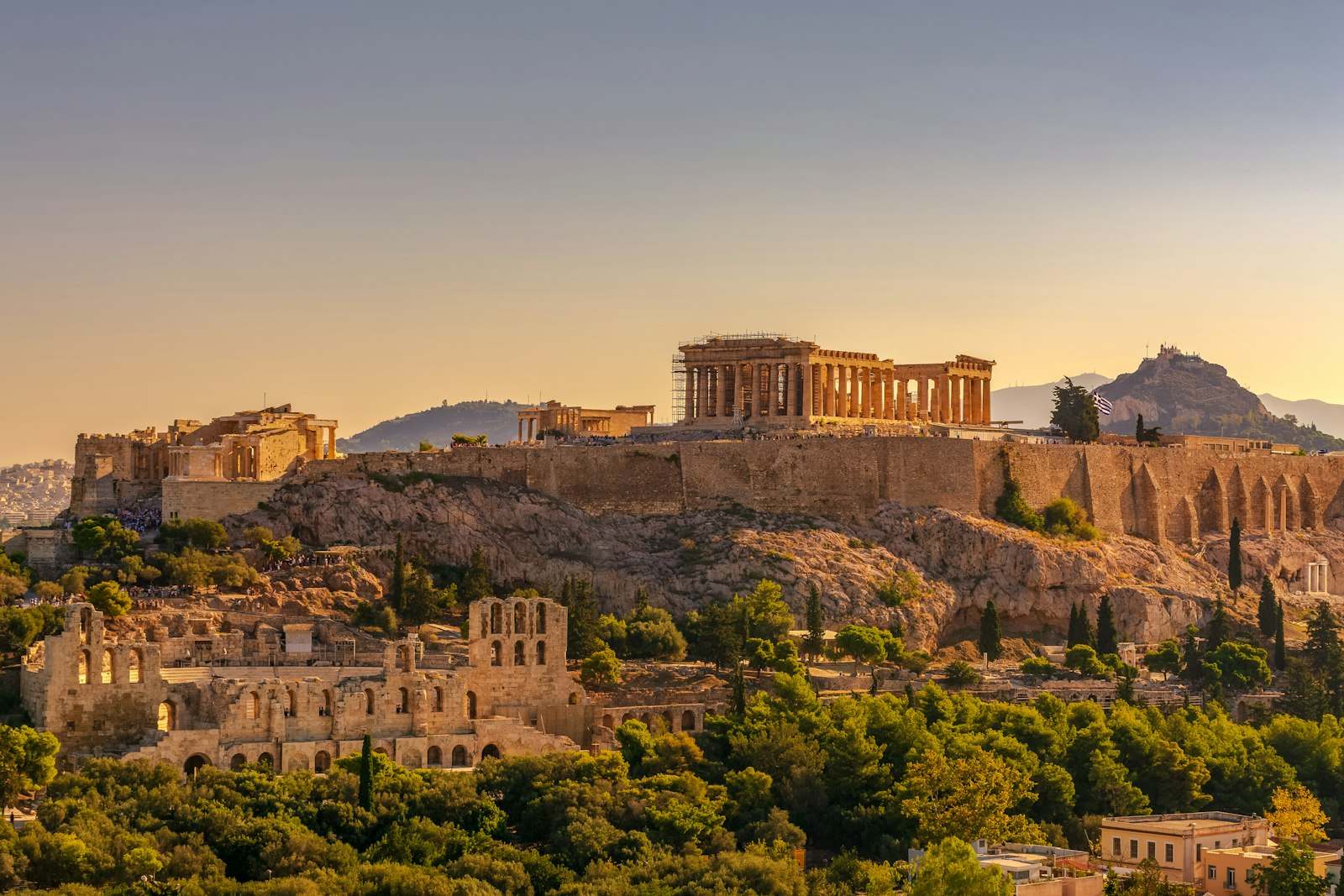
Give the second morning to the Acropolis at opening. The rock has almost no shade, and by mid-morning it both bakes and fills with cruise-ship groups, so the first entry slot is cooler, quieter and better for photographs. Book a timed ticket, and check the current price and hours, which shift by season. Spend the afternoon on the Ancient Agora below or in the Acropolis Museum, and end on a Monastiraki rooftop looking back at the hill.
Why two nights and not one, when some itineraries give Athens a single night before the islands: the extra evening is your buffer. A late inbound flight, a lost bag or plain exhaustion all eat into a one-night stop, and once the island legs begin the ferry and flight timetables start running your clock. Two nights buy a soft landing before that starts. The depth - what to actually do with the days - lives on the Athens guide, and booking and timing the Acropolis is worth getting right before you go.
Leg 1: Athens to Santorini - fly the 45 minutes, or take the boat
The first connection is the easy one to decide: fly. Athens (ATH) to Santorini (JTR) is about 45-50 minutes in the air on Aegean, Sky Express and others, several times a day in season. On a trip where the point is your Santorini time, not a half-day at sea, the flight wins for most people.

Diagram by Greece Trips. Free to reuse with credit - CC BY 4.0.
Take the boat only if you want the sea day or the flights are full. A high-speed catamaran from Piraeus runs the crossing in about 5 hours; a conventional car ferry takes roughly 7.5-8 hours. It is genuinely scenic, and an overnight sailing saves a hotel night, but it costs you half a day either way.
The honest trade is not only time. The ferry drops you at Athinios, the port at the foot of the caldera cliffs, where taxis are scarce and instantly mobbed, so arrange a transfer or know the bus up to Fira. The flight lands at Santorini airport on the east side, small, single-runway and described by more than one traveller as organised chaos. Neither arrival is smooth; the flight is just faster to recover from. Both durations sit in the shared legs table below, alongside the second connection. For what three nights on the caldera actually look like, see the Santorini guide.
Santorini: three nights on the caldera before you turn south
Three nights is enough to do Santorini without rushing, and on this line the island is the middle, not the finale: you arrive from Athens and leave south for Crete, so base for the view and plan an afternoon exit.
Base on the caldera rim, in Fira or quieter Imerovigli, for the view you came for. Walk the paved caldera path between the villages, take a caldera boat out to the volcanic islets or a black-sand beach day, and give one evening to a sunset. On Oia’s sunset, the honest line is that it is genuinely spectacular and genuinely mobbed, with the castle walls packed out an hour before the sun drops. See it if you want the postcard, but for elbow room take the view from Imerovigli and Skaros Rock, or simply your own terrace. Room and tour prices swing hard by season. Where to sleep on the rim is its own decision - caldera-view rooms compared lays out the villages, and Oia and its sunset, honestly covers the crowds.
Then plan the exit south, because it sets the rhythm of your last day. The boat to Crete almost always leaves in the afternoon, so your final Santorini morning is free - a last caldera coffee, a swim - but you want to be packed and heading for the port with time to spare, not scrambling. Athinios is the same awkward port you may have arrived at, so build in the transfer. The full Santorini guide fills the three days; the point here is that the island is a pivot, and the pivot turns in the afternoon.
Leg 2: Santorini to Crete - the afternoon boat to Heraklion, and only in season
This is the leg the whole route hangs on. A high-speed ferry runs south from Santorini across roughly 120 km of open sea to Heraklion, Crete’s main port, in about 1 hour 45 minutes to 2.5 hours in season on SeaJets and others; a slower conventional Blue Star sailing takes longer, around 4h30. It almost always departs Santorini in the afternoon, typically somewhere between about 3 and 6 pm, the reverse of the morning boat that runs Crete to Santorini.
Two things about this boat decide the shape of your trip. First, the fast link is seasonal. The high-speed catamaran runs busy and daily from roughly early April through October, then largely stops for winter; a conventional Blue Star ferry keeps the Santorini-Heraklion route open year-round, but only about twice a week in the off-season, too thin to hang a fixed itinerary on. That winter gap is the single biggest thing that can break the route. Second, it lands you at Heraklion, in the centre of the island - not at a resort, not near the western beaches, but dead in the middle. That arrival point is the start of your Crete base decision, not the end of the journey.
One honesty note the operators bury: high-speed catamarans bounce in the meltemi, the summer north wind, and get cancelled outright in a strong blow, worse in autumn. On a fixed route with no spare day, one cancelled sailing costs a Crete night. Here are both connecting legs in one place:
| Leg | Mode | Rough duration | When it runs |
|---|---|---|---|
| Athens - Santorini | Flight (ATH-JTR) | 45-50 min | Year-round, several daily |
| Athens - Santorini | High-speed ferry (Piraeus) | about 5 h | Mainly Apr-Oct |
| Athens - Santorini | Conventional ferry (Piraeus) | 7.5-8 h | Year-round, thinner in winter |
| Santorini - Heraklion | High-speed ferry | 1h45-2.5h | ~mid-Apr to Oct, afternoons |
| Santorini - Heraklion | Conventional ferry | around 4h30 | Year-round, about twice a week in winter |
For how Greek ferries, operators, tickets and cancellations actually work, read Greek island ferries before you book either leg.
On Crete you choose a base, not a hotel
Crete is not one stop with one hotel. It runs about 250 km end to end across four regions and has two airports, so the trip-defining decision is which base you sleep in - and because the ferry drops you at Heraklion in the centre, that same choice picks the airport you fly home from. For a first trip on this route, base central or west and fly home from Heraklion (HER) or Chania (CHQ) to match.
| Base | Region and vibe | Best for | Fly home from |
|---|---|---|---|
| Heraklion | Central; Knossos and the archaeological museum, a working port city | Least driving after the ferry, ancient history | HER |
| Rethymno | Centre-west; Venetian old town plus a long town beach | All-rounders and families, the undecided | HER or CHQ |
| Chania | West; the prettiest old town and the famous beaches (Balos, Elafonisi) | Couples, food, scenery | CHQ |
| The east (Elounda, Agios Nikolaos) | Lasithi; quiet, resort-led, the boat to Spinalonga | A slower, settled end to the trip | HER |
Read the table by where you want to be, then let it pick your flight home. Land at Heraklion, base central or east, and fly out of HER for the least driving, since the ferry has already put you near the airport. Base west in Chania and you fly out of CHQ instead. West-basers should weigh the drive: Heraklion to Chania is close to a three-hour run, about 200 km along the north coast, so you do not want to do it twice.
Which is where the advanced move comes in, the nested open-jaw inside Crete. Arrive at Heraklion port, drive the island’s 250 km spine once heading west, drop a one-way rental car in Chania, and fly home from CHQ. You never double back inside Crete either, and the long drive becomes the trip rather than a return leg. If that is more driving than you want, take the simple version: stay central, see Knossos and the museum, and fly home from Heraklion. Either way the base is the decision - pick your Crete base breaks down all four in depth, Chania and the west makes the western case, where to stay in Crete sorts the hotels by base, and Knossos is the reason to weight Heraklion if ancient history is your thing. This page forces the choice; those pages furnish it.
What breaks this route
This exact line fails in a few predictable ways, and it is fairer to know them before you book than after. The big one is the boat.
The Santorini-to-Heraklion high-speed link is seasonal, running busy and daily from roughly early April through October and then stopping for winter, when only a twice-weekly conventional Blue Star sailing remains. Out of season the no-backtrack promise effectively breaks: on most winter days there is no boat that suits, and you are left with two ugly options. You either backtrack north to Piraeus and take the overnight ferry down to Heraklion or Souda, the port for Chania - about nine hours, leaving around 9 pm - or you fly Santorini to Athens to Heraklion. Both undo the clean southbound line. If you are travelling November to March, this is not the route; plan a different shape.
Three more failure modes, in order of how often they bite.
A single cancelled sailing. High-speed catamarans get pulled in a strong meltemi, and it is worse in autumn. On a fixed ten-night route with no spare day, one missed boat eats a Crete night or, at the wrong end, threatens a flight. Keep your Crete nights flexible and do not stack a tight connection against the sailing.
Under-booking Crete. Trying to do a 250 km, four-region island in two or three nights is the classic mistake, and you spend the time in the car instead of anywhere worth being. Crete is the leg to protect: give it five nights or more, or cut it from this trip and save it for its own.
Santorini in winter. Many caldera hotels and restaurants close from early November until around Greek Easter, so an off-season version of this route loses half of what frames the view.
On timing, the sweet spots are May-June and September-October: warm days, a sea still swimmable, the boat still running frequently, and fewer crowds than the July-August peak. For the month-by-month picture see best time to visit Greece; for how cancellations and rebookings really work, Greek island ferries has the mechanics.
What to book ahead
Four things lock this route or sell out, so book them before you leave. Everything else rewards staying loose.
Book ahead:
- The open-jaw flight. The multi-city ticket - into Athens, out of Heraklion or Chania - is the reservation the whole trip is built on. Book it as one fare, early, because it also fixes your dates at both ends.
- The Santorini-to-Crete sailing. It is seasonal and it sells out in July and August, so reserve it well ahead - a couple of months for peak dates is the usual advice. A full boat on a fixed route can cost you a night.
- A caldera-view room on Santorini. The rim rooms are limited, book out first and cost the most, so decide early whether you are paying for the view or skipping it on purpose.
- A one-way Crete rental car, if you are driving Heraklion to Chania. One-way hires need arranging ahead, and the drop fee is worth pricing in.
Leave loose: restaurants everywhere, following the tables full of locals rather than a reservation; beach days, weather-dependent anyway; the Crete day trips; and the Santorini boat-versus-beach choice. Decide those on the day.
On cost, resist a single headline figure, because it will be wrong for your trip. Four levers move the total more than anything else: the season you travel, the ferry class you take, the caldera-view premium on Santorini, and whether you add a one-way car on Crete. Budget around those, not a number someone else invented. What a Greece trip like this costs works through them, and caldera-view rooms compared shows the single biggest line.
This page is the plan - lock the open-jaw ticket and the Santorini-Crete boat first, in that order, and the rest falls into place. Plan this trip.
Quick answers
Should you visit Athens, Santorini or Crete first?
Athens first, then Santorini, then Crete last. Crete sits south of Santorini and has its own airports, so that order runs one way south and lets you fly home from Crete instead of backtracking to Athens. Some travellers flip it, islands first and Athens last to cushion the jet lag, but starting in Athens keeps the line unbroken.
How many days do you need for Athens, Santorini and Crete?
About ten nights is comfortable: Athens 2, Santorini 3, Crete 5. Eight is the floor for one Crete region; fourteen is the two-week ceiling, with Crete stretched to seven-plus nights across two regions. The Crete leg is the one you lengthen or shorten, because a 250 km island is where extra days pay off.
How do you get from Santorini to Crete?
A high-speed ferry runs south from Santorini to Heraklion in roughly 1 hour 45 minutes to 2.5 hours in season, usually leaving in the afternoon; a slower conventional boat takes longer. It is seasonal, busy from about early April to October and thin in winter, and the catamarans get cancelled in a strong wind, worse in autumn.
Can you fly home from Crete instead of returning to Athens?
Yes, and it is the point of this route. Book an open-jaw (multi-city) ticket into Athens and out of Heraklion (HER) or Chania (CHQ), so you never double back. The catch: long-haul nonstops, especially from North America, usually run only through Athens, so flying home from Crete often means a European connection. If a nonstop or cheaper round trip into Athens beats that for you, take it.
Which Crete airport should you fly home from, Heraklion or Chania?
Fly home from Heraklion (HER) if you base central or east - Heraklion, Rethymno or Elounda - since it is where the ferry lands and means the least driving. Fly home from Chania (CHQ) if you base west, and consider a one-way drive across the island so you never backtrack inside Crete either.
What time of year does this route work?
Roughly early April to October, while the Santorini-Crete boat runs frequently. The sweet spots are May-June and September-October: warm days, a swimmable sea, the boat still regular and fewer crowds. In winter the boat thins out and the one-way line breaks, so an off-season trip means backtracking through Piraeus or flying via Athens.