The short answer
Kos vs Rhodes comes down to whether you want an easy island or a big one. Choose Kos for a flat, cyclable beach week at a slightly lower cost; choose Rhodes for the walled Old Town, Lindos and enough history and variety for a longer trip. Undecided, with a week or more, do both.
This page decides it axis by axis - history, beaches, getting around, nightlife, families, cost and who each island suits - then routes you to the right island hub and shows how to pair the two.
Choose Kos for a flat, easy, cyclable beach week at a slightly smaller bill. Choose Rhodes for the walled Old Town, Lindos and more history and variety to fill a longer trip. Do both if you have roughly 8 to 10 days and want the full Dodecanese contrast.
Kos vs Rhodes at a glance
Here is the whole decision in one view. The pattern reads quickly: Kos wins on ease, Rhodes wins on scope, and only a couple of rows are genuinely close.
| What you’re deciding | Kos | Rhodes | Verdict |
|---|---|---|---|
| Best for | Easy flat beach week, young families, cyclists | History, variety, a fuller trip | Depends on the trip |
| Character | Flat, compact, relaxed | Big, varied, historic | Tie, different holidays |
| History and ancient sites | The Asklepion, Hippocrates heritage | UNESCO Old Town, Lindos acropolis | Rhodes |
| Beaches | Long flat sand, gentle entries | More coast, more variety, dramatic coves | Ease vs choice |
| Getting around | Flat, cyclable, bus-served | Large, spread out, a car helps | Kos, easier |
| Nightlife | Kos Town Bar Street, Kardamena | Faliraki, New Town bars | Both, real strips |
| Families | Low-stress for young kids | Richer for older kids | Depends on ages |
| Cost | Edges a little cheaper | A little pricier | Kos, slightly |
| Size and length of stay | Compact, about 3 to 5 days | Roughly 5x larger; 3 to 4 days for the highlights, 5 to 7 for the whole island | Kos shorter, Rhodes longer |
| Getting there | Own airport, near Bodrum | Own airport, direct flights | Tie, both direct |
Those verdicts are ours rather than a scoreboard, so a reader who cares most about ruins will weigh the table differently from one who cares most about an easy swim. On our reading, Kos takes ease, flat cycling, gentle family beaches and a slightly lower bill; Rhodes takes history, variety and a longer trip; and nightlife is a real contest rather than a walkover, because both islands run genuine resort strips.
This page compares the two at a decision level only. For every beach, hotel, restaurant and attraction, go deep on the Kos guide and the Rhodes guide - both sit in the Dodecanese, the island chain hugging Turkey’s southwest coast.
History and ancient sites: Rhodes runs deeper
For history, Rhodes runs deeper, and it is not close. The medieval Old Town is a living, inhabited UNESCO World Heritage site, walled and cobbled, with the Street of the Knights running up to the Palace of the Grand Master. Above the bay to the south, the acropolis at Lindos stacks an ancient temple over a Knights’ castle on one cliff. Between them, Rhodes layers ancient Greece, the Knights of St John and the Ottomans in a way you can spend days walking.
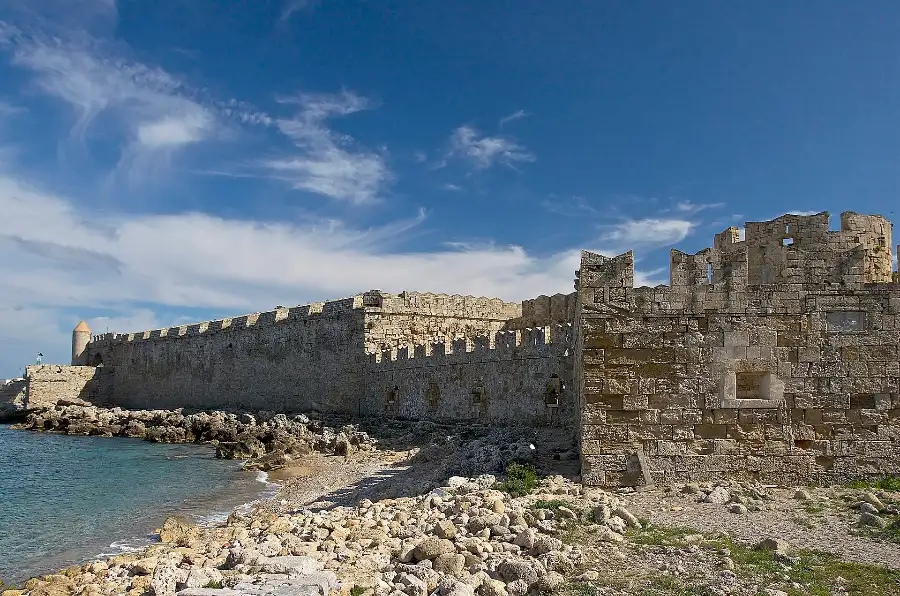
Kos answers with real antiquity of its own, walkable and genuine, just smaller in scale. Its headline site is the Asklepion, the ancient healing sanctuary tied to Hippocrates, set on terraced slopes above Kos Town. In the town itself sit the ancient agora and Roman remains, and the old plane tree associated with Hippocrates still stands by the harbour. It is a strong afternoon of history rather than a week of it.
That difference is the whole verdict. Choose Rhodes if ancient sites and a lived-in historic city are a reason for the trip on their own. Choose Kos if you want one strong headline site beside an easy beach holiday, not a full itinerary of ruins.
For the depth, start with Rhodes Old Town and the Lindos acropolis; the Kos side lives on the Asklepion page.
Beaches: easy sand or dramatic variety
If a beach day means long flat sand and a gentle walk-in, Kos has the edge. Its north coast runs to wide, shallow, sandy stretches around Tigaki, Marmari and Mastichari, and the town beaches at Lambi and Psalidi are close to base. The entries are soft and gradual, which is why families with small swimmers keep landing on Kos.
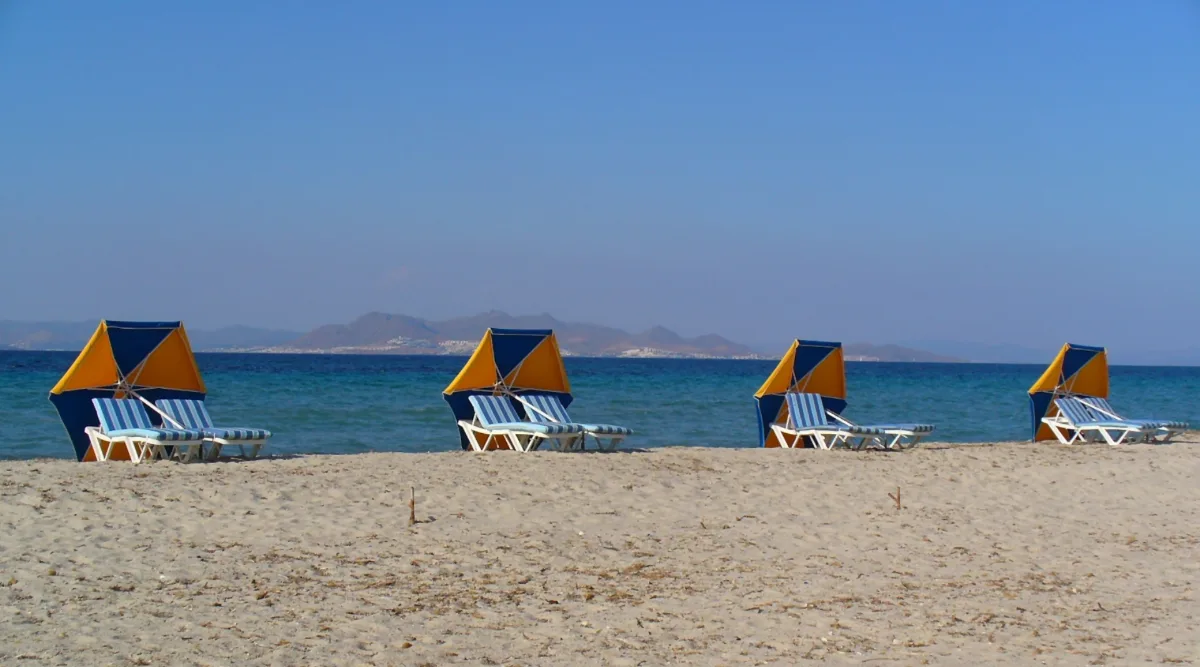
Rhodes trades ease for choice, and it has far more coast to spread out on. The sheltered east side holds the organised resort beaches, while the standouts reward a drive: the cliff-ringed cove at Anthony Quinn Bay, the long sweep below Tsambika, and the twin-sea sandspit at Prasonisi where the wind draws windsurfers. The west coast runs windier and emptier. You get scenery and range, but the best of it is scattered.
So the split is about purpose. Kos beaches are for a reliable swim-and-sand day within reach of your resort; Rhodes beaches are for exploring, and they pay off if you are willing to move around for them.
Choose Kos if you want easy, flat, swimmable sand near where you sleep. Choose Rhodes if you want variety and dramatic bays and are happy to drive to reach the best ones. Compare the Kos beaches for the flat family sand, and the Rhodes beaches and Anthony Quinn Bay for the coves and the range.
Getting around: flat and cyclable, or big and mountainous
Here is where the common advice gets Kos wrong. Kos is famously flat and compact, with dedicated cycle lanes running from Kos Town out to the nearer beaches, short distances between resorts, and a bus network linking the main zone. For the core of the island you can cycle, walk or take a scooter and skip a car entirely; a car earns its keep mainly for the far west around Kefalos. So the honest reading is the opposite of “Kos needs a car” - it is the easier island to enjoy without one.
Rhodes is a different scale of problem. It is roughly five times the size of Kos and more mountainous, so the good beaches, Lindos and the inland villages are spread across a big island. Buses do connect Rhodes Town with the airport, Faliraki and Lindos, so a car is not mandatory, but a car or a planned bus route is what unlocks the whole island rather than a slice of it.
Choose Kos if you want to cycle, walk and take short hops and leave the car behind. Choose Rhodes if you are happy to drive for the payoff of a bigger, more varied island. For the general rule on which islands reward a hire car, see which islands need a car.
Nightlife: two real party strips, not one
This is not the one-sided contest that Santorini versus Mykonos is. Both islands have genuine resort nightlife, so the question is not whether but which kind of strip you want. Rhodes has Faliraki, one of the best-known package-holiday party strips in the Mediterranean, backed by the bars of Rhodes New Town. Kos has its own concentrated scene: the Bar Street in Kos Town and the resort of Kardamena, both drawing a young, sociable crowd through the summer.
We name the strips and the areas, not individual clubs. Bars and clubs on these strips rebrand and change hands every season, so a list of venue names would be wrong by August; the strips themselves do not move. Away from them, both islands keep quieter towns and villages, so neither is only a party island.
Choose Rhodes if you want the biggest single resort-strip name, Faliraki, with a large varied island wrapped around it. Choose Kos if you want a lively but more compact scene you can walk or cycle home from. For each in detail, see Rhodes nightlife and Kos nightlife, or the cross-island picture on nightlife and party islands.
Families: which island is the easier week
For families the split is about effort, not fun. Kos is the lower-stress week for younger children: flat and compact, with short distances, a walkable town, easy cycling and gentle shallow beaches at Tigaki, Marmari and Mastichari. You can build a whole holiday inside a small radius and barely touch a car. That ease is the point.
Rhodes suits older kids who want more going on. It has the beaches, the Old Town to explore, Lindos to climb, a water park and boat day trips, so there is enough variety to fill a fortnight of energetic ages. The trade is more driving and bigger distances between the good things.
Parents say much the same across the traveller forums. On Tripadvisor and Mumsnet threads the pattern is consistent: families with young children repeatedly land on Kos as the calmer, easier base, and praise Kos Town as compact and friendly, while families who want more to do lean to Rhodes. That is a consensus across many posts rather than a single review.
Choose Kos for an easy week with young kids. Choose Rhodes for older kids and a family trip that mixes beaches with sights and day trips. Plan either on the Greece with kids page, and check the shallow bays on the Kos beaches page.
Cost and how long you need
Both are relatively affordable package-holiday islands, and the daily totals sit close. Where the sources agree is direction, not a precise gap: Kos tends to come in modestly cheaper, on the order of 15 to 25 percent in the comparison data, with the saving concentrated in accommodation and car hire while dining runs roughly level. That read is corroborated across a cost aggregator and independent comparisons rather than pulled from one site.
Length of stay tracks size the same way. Kos is compact and works well in roughly 3 to 5 days, long enough for the beaches, the town and the Asklepion. Rhodes is about five times larger, so it stretches to fit the time you give it: the Old Town and Lindos alone reward a focused 3 to 4 days, while a spread of beaches and the inland villages fill a roomier 5 to 7 without rushing. Treat both as editorial recommendations, not measurements.
Choose Kos if you want a shorter, cheaper, lower-effort week. Choose Rhodes if you have the days and the budget for a bigger island and intend to use them. For the plannable breakdown in euros, see what a Greece trip costs; the gap between the two is small enough that the deal you find matters more than which island you pick.
Getting there and doing both
Both islands make an easy arrival. Kos and Rhodes each have an international airport served by direct and seasonal charter flights from the UK and much of Europe, and both sit a long way south of Athens, so most international visitors fly straight in rather than routing through the capital. Kos has one extra card: it sits within easy reach of Bodrum on the Turkish coast, a crossing Rhodes cannot match as directly. The airports are the durable fact here; the crossing times and fares belong on the ferries page, not baked into this one.
You do not have to choose at all on a longer trip. Kos and Rhodes are close Dodecanese neighbours linked by frequent fast ferries through the summer, so basing a few nights on each over roughly 8 to 10 days is comfortable, and a day trip from one to the other is possible but tight. Picture the hop as a short direct crossing of a few hours that runs more often in high season, and take the exact timing from the ferries page.
Choose either as a single base without worrying about the other. But if you have the days, split them and let the ferry link the two. For how the boats run, see Greek island ferries; to pair Rhodes with a smaller neighbour, look at the Symi day trip and the wider Rhodes day trips; and to turn any of this into a route, start on the itineraries hub or borrow the day-by-day from one week in Rhodes.
Which should you pick? By traveller type
The same two islands score differently depending on who is going, so match the island to the traveller rather than to a leaderboard. Here is the quick router:
- First-timer with room for one island: Rhodes. It gives the fullest Greek-island trip in a single place - the Old Town, Lindos and enough variety that you never run short. Sense-check it against the best island for first-timers.
- Family with young kids: Kos, for the flat, compact, gentle-beach ease that keeps a young-family week low-stress. Plan it on Greece with kids.
- Family with older kids: Rhodes, for beaches plus sights, a water park and day trips to keep energetic ages busy.
- Couple wanting quiet and relaxed: Kos is the calmer, more low-key of the two; switch to Rhodes if the couple wants more to see and do. If genuine quiet is the real priority, neither package island is truly it - see the quietest Greek islands or plan a couples trip on Greece for couples.
- History and sightseeing lover: Rhodes, every time, for the walled city, Lindos and the layered past.
- Cyclist or easy-mover who wants a car-free week: Kos, for the flat lanes, short distances and bus-served beaches.
- Resort-strip nightlife group: either works - Faliraki on Rhodes for the bigger name, or Kos Town and Kardamena for a more compact scene you can walk home from. Compare both on nightlife and party islands.
- Budget or short-break traveller: Kos, for the slightly cheaper, shorter, lower-effort week.
The read-out underneath the list: Rhodes for the fullest trip and for history, Kos for ease, young families, cyclists and a smaller bill. Go deep on the Kos guide or the Rhodes guide once you have your pick.
Our pick, if you make us choose
Forced to one island, book Rhodes for a first Dodecanese trip and for anyone who wants history, variety and enough to fill a proper week; it is the one that leaves you with the most to see. Choose Kos instead when the trip is really about an easy, flat, relaxed and slightly cheaper beach week, especially with young kids or a bike under you. And if you have 8 to 10 days, stop choosing: base a few nights on each and let the ferry settle it.
The logic under every verdict on this page is the same one. Decide whether you want an easy island or a big one, and the two stop looking like rivals and start looking like two answers to different questions.
From here, go deep on the Kos guide or the Rhodes guide. If your shortlist is really a different pairing, the same decision spine runs through Crete vs Rhodes, Corfu vs Kefalonia and Naxos vs Paros, and the full map is on the Greek islands hub.
Quick answers
Is Kos or Rhodes better?
Neither is better outright. Kos wins for a flat, easy, cyclable beach week at a slightly lower cost, while Rhodes wins for the UNESCO Old Town, Lindos and enough history and variety to fill a longer trip. Pick the island that matches whether you want an easy week or a big one. Kos leans to ease, gentle beaches and a smaller bill; Rhodes leans to history, scope and a fuller trip.
Is Kos or Rhodes cheaper?
Kos tends to come in modestly cheaper - on the order of 15 to 25 percent in the comparison data - though both are relatively affordable package-holiday islands and daily costs sit close. The gap concentrates in accommodation and car hire, while dining runs roughly level. It is small enough that the deal you find matters more than the island; see the trip-cost page for the breakdown.
Is Kos or Rhodes better for families?
Kos is the easier week for families with young children: flat, compact, short distances and gentle shallow sandy beaches like Tigaki, with a walkable town and easy cycling. Rhodes suits families with older kids who want beaches plus the Old Town, Lindos and day trips, at the cost of more driving and bigger distances. Plan either on the family page.
How many days do you need in Kos and in Rhodes?
Kos is compact and works well in roughly 3 to 5 days, enough for the beaches, the town and the Asklepion. Rhodes stretches to fit the trip: the Old Town and Lindos fit a focused 3 to 4 days, while the whole island rewards 5 to 7. The length difference tracks the size difference; slot the days on the itineraries hub.
Can you visit both Kos and Rhodes in one trip?
Yes, and on a longer trip you probably should. They are close Dodecanese neighbours linked by frequent summer ferries, so a two-base trip over roughly 8 to 10 days is comfortable, with a few nights on each. A day trip from one to the other is possible but tight. Route the plan through the ferries and itineraries pages.
Which island has better beaches, Kos or Rhodes?
Kos has the easier flat sandy family beaches with gentle entries - Tigaki, Marmari and Mastichari - while Rhodes has more coastline and more variety, including dramatic coves like Anthony Quinn Bay and the windsurfing spit at Prasonisi. Kos wins for an easy swim day close to base; Rhodes wins for choice and scenery. Compare the Kos beaches and Rhodes beaches pages.
Do you need a car on Kos or Rhodes?
Not for the main zone of Kos: it is flat, compact and cyclable, with cycle lanes and buses to the main beaches, so a car helps mainly for the far west around Kefalos. Rhodes is about five times bigger and more spread out, so a car - or a planned bus route - is what unlocks the island rather than a slice of it. See which islands need a car for the wider rule.