What it is
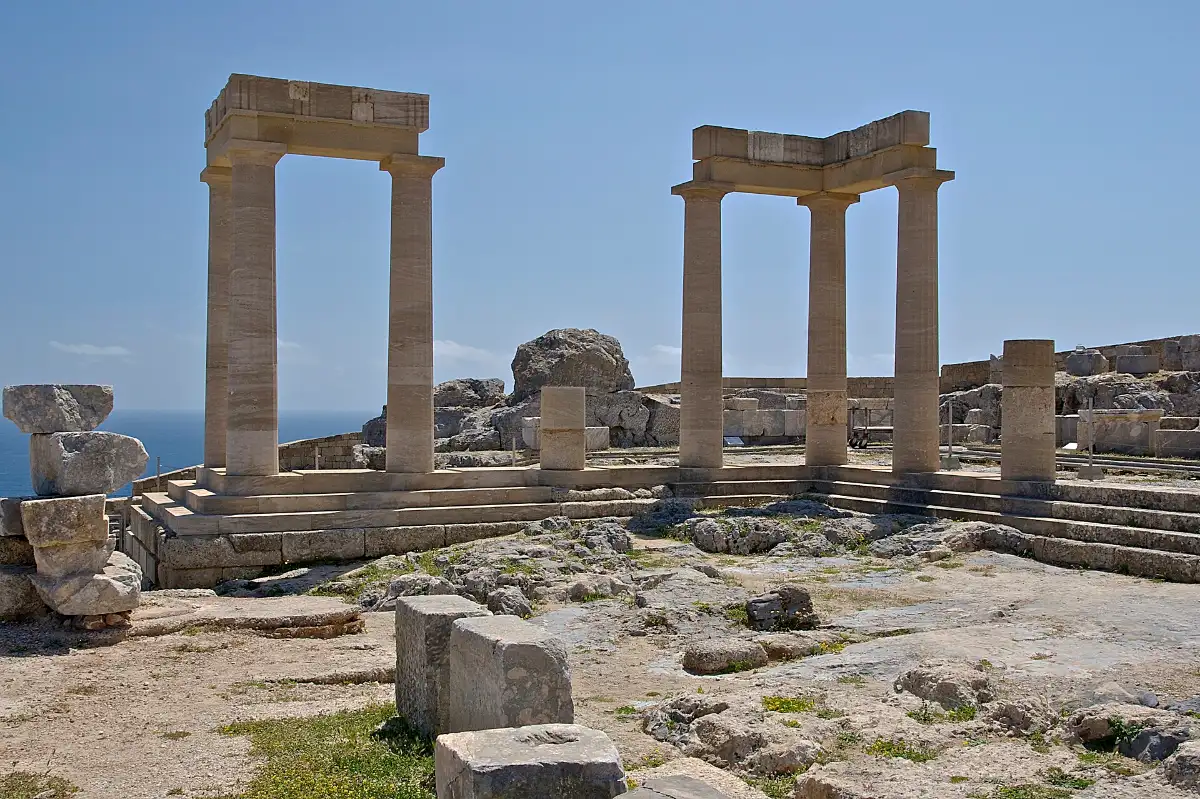
A clifftop acropolis above Lindos village, fortified in turn by Greeks, Romans, Byzantines, the Knights of St John and the Ottomans
The ancient buildings
Doric Temple of Athena Lindia, about 300 BC; Hellenistic stoa about 87 m long with 42 columns; Hellenistic staircase of the 2nd century BC; a rock-cut relief of a Rhodian trireme, about 180 BC
The medieval layer
Castle of the Knights of St John, built some time before 1317; a Greek Orthodox church of the 13th or 14th century
Getting there
Roughly 47 km south of Rhodes Town, about a 45 to 50 minute drive, or about 1 hour 40 minutes each way by KTEL bus. Access to the top is on foot up a steep stepped path
Donkeys
Rides up the path are offered. Welfare concerns are documented; the inspecting organisation’s findings are mixed and are set out on this page. No recommendation is made either way
Tickets and hours
Ticketed Ministry of Culture site, seasonal schedule, last admission before closing. No price or hours are printed here; take them from the Ministry’s listing for your date
Travel details last checked July 2026.
The official Rhodes destination site puts it plainly: the rock was fortified successively by the Greeks, the Romans, the Byzantines, the Knights of St John and the Ottomans. So what you walk into at the top is a Doric Greek sanctuary sitting inside a medieval crusader castle, with a Byzantine-era church in the middle of it and Ottoman work over the top. Nobody demolished the last occupant’s building. They kept adding.
It stands above Lindos village on the sheltered east coast of Rhodes, roughly 47 km south of Rhodes Town, about a 45 to 50 minute drive. You reach the top on foot, up a steep stepped path through the village.
What is actually up there
Take them in the order you meet them, because the site reads as a sequence rather than a plan.
The way up into the ancient sanctuary is a Hellenistic staircase of the second century BC. Above it stands the Hellenistic stoa, a colonnaded hall about 87 metres long with 42 columns, which is the row of standing pillars in every photograph of the place. And at the highest point, the Doric Temple of Athena Lindia, dating from about 300 BC. This was a working sanctuary of real standing in the Greek world, not a provincial shrine.
Wrapped around all of that is the Castle of the Knights of St John, built some time before 1317. The official site’s dating is deliberately loose and we have kept it loose. The knights fortified the headland because it is a headland: sheer on the seaward sides, commanding two harbours, and impossible to approach unseen. The same logic that made it a sanctuary made it a fortress.
Inside the walls there is also a Greek Orthodox church of the thirteenth or fourteenth century, which is the piece most visitors walk past on their way to the columns.
Then the detail worth the whole climb, and almost nobody prints it. Cut into the living rock on the way up is a relief of a Rhodian trireme, a warship, dating to around 180 BC. Rhodes was a naval power, and here is its navy carved into the approach to its sanctuary, twenty-two centuries old and still in the open air. Look for it rather than at your phone on the way up.
From the walls you look down on St Paul’s Bay, the near-enclosed cove on the south side, and out over the main harbour. That view is why the coaches come, and it is genuinely worth the ticket on its own.
Why anyone built anything here
The site makes far more sense once you understand it as a piece of geography rather than a piece of architecture.
Lindos sits on a headland with a harbour on each side of it. The main harbour lies to the north, where the village and the beach are; the near-enclosed cove of St Paul’s Bay lies to the south. A ship working the eastern Mediterranean could put in on one side or the other depending on which way the wind was blowing, which on this coast is not a minor convenience. That is a rare and valuable thing, and it is the reason there has been something important on this rock for two and a half thousand years.
Then the rock itself. It is sheer on its seaward faces and it commands both harbours and the sea approaches to them. A sanctuary here was visible to every ship coming in, which is exactly what a sanctuary is for. A fortress here could see anything coming, which is exactly what a fortress is for. The Greeks, the Romans, the Byzantines, the Knights and the Ottomans all worked out the same thing in turn and each one built on what the last had left.
Which is also why the trireme is carved where it is. A warship cut into the rock on the approach to the sanctuary, on a headland between two harbours, is not decoration. It is a maritime state advertising what it was, to everyone walking up.
Which is worth carrying up the steps with you. The view from the walls is the thing everyone photographs, and it is also the entire explanation of the site. You are standing where you are standing because somebody wanted to see what was coming.
The climb, and the hour that decides it
You get to the top on foot, up stepped lanes through the village and then up the rock.
The path is steep, it is stone worn smooth by an enormous number of feet over an enormous number of years, and there is essentially nothing over your head between the village and the walls. Our Rhodes guide says the same thing about it, and it is the one piece of advice everyone who has done it repeats. Whether that surface and that gradient suit any particular person on any particular day is not a judgement this page is in a position to make. What we can tell you is what is underfoot and what is overhead, which is worn stone and open sky.
So the hour is the whole game, and it is not complicated. Go early, before the heat and before the tour coaches come down from the resort strips. Or go late in the day, when the light on the stoa is at its best and the crowd has gone back up the coast. The middle of a July day on that rock is the version people remember badly.
Carry water up with you. Wear something you can climb worn stone in rather than something you can look good in, which is a real tension in Lindos, where the village below is all whitewashed lanes and dinner terraces.
One structural point about the day: the village and the acropolis are one trip, not two. The stepped lanes of Lindos are pedestrian, and you park or get dropped at the edge and walk in. The KTEL bus from Rhodes Town takes about 1 hour 40 minutes each way, which is why a Lindos day off a bus is a whole day and a Lindos day by car is a comfortable half of one.
The donkeys
Donkey rides up to the acropolis are offered from the village, and they have been for a long time. You will be asked. So here is the position, reported rather than preached.
The welfare of the Lindos donkeys has been the subject of documented concern, and the most useful account we found is from Animal Action Greece, an animal welfare organisation that has actually inspected them rather than campaigned from a distance. Its findings are mixed, and the mixture is the point.
On the positive side, its team examined 67 donkeys and reported most of them in good condition and at ideal body weight, with no wounds, no injuries and no lameness. On the other side, it reported eye sores from fly irritation, hoof problems from constantly wet floors, dental issues needing attention, insufficient shade at some locations, and two stables with serious hygiene problems.
The working regime, as that organisation describes it, is more structured than most visitors assume. The animals work between eight in the morning and five in the afternoon, with a maximum of six permitted routes of ten minutes each, giving a maximum of about an hour of actual work in a day. They work in pairs and on alternate days so they get rest between shifts. A weight limit applies and is supervised, and the organisation’s own conclusion is that it needs to be respected without exception by every owner, which is a fairly clear statement that at present it is not. We print no weight figure, because press reports give conflicting numbers attached to different instruments and we did not read any regulation text.
We are not going to tell you to take the ride and we are not going to tell you to boycott it. What we will do is give you the facts that a decision actually turns on: the option exists, welfare concerns have been raised and documented by a named organisation, that organisation found real problems and also found most of the animals in good condition, and the work is limited and supervised rather than unregulated. If you do take one, your own weight is the variable you control, and the limit exists for a reason.
The one thing worth saying without hedging: the ride goes up the path, not into the archaeological site. Whatever you decide, the walking starts again at the top.
Tickets, hours, and the two numbers we will not print
The site is a Hellenic Ministry of Culture archaeological site, and it is ticketed.
We print no price and no opening hours, and that is a deliberate refusal rather than laziness. Rhodes’s ministry sites were repriced in April 2025, the summer and winter schedules differ substantially, and last admission falls before closing. A travel page that prints a grid is publishing something that quietly goes stale, and here the cost of being wrong is a 45-minute drive or a 1 hour 40 minute bus ride to a closed gate.
What is durable: it is ticketed, the schedule is seasonal, winter hours are considerably shorter than summer ones, and Greek archaeological sites close on certain public holidays, which our guide to public holidays and what closes sets out. Take the actual hours and the actual price from the Ministry’s own listing for the date you are going, rather than from whichever official-looking domain ranks highest that week.
Entry is sold by the Hellenic Ministry of Culture. We sell nothing and take no commission here, and the wider budget picture is in what a Greece trip costs.
Where it fits in a Rhodes trip
Lindos is a set piece, and it deserves its own half day rather than a slot squeezed between two beaches.
The practical shape most people land on: drive or bus down in the morning, do the acropolis before the heat, come down into the village for lunch, and swim at St Paul’s Bay or one of the east-coast beaches in the afternoon. That works because the east coast is the sheltered, sandy side of the island, so a beach afternoon here is reliable in a way the west coast is not.
The other shape, and the better one if your route allows it, is to sleep in Lindos rather than visit it. The village empties in the evening when the day traffic goes back up the coast, and the acropolis is floodlit above it. A one-week Rhodes route does exactly that as a split stay, and the case for it is set out in our Rhodes guide, which also covers the island’s other headline site, the medieval Old Town.
Last checked July 2026. What gets re-checked on this page: the Ministry’s listing for the site, and the welfare reporting on the Lindos donkeys. No ticket price and no opening hour appears here by design. How we date and correct facts is in our editorial policy.
Common questions
What is at the top of the Lindos acropolis?
A Doric Temple of Athena Lindia dating from about 300 BC, a Hellenistic stoa around 87 metres long with 42 columns, a Hellenistic staircase of the second century BC leading up into the sanctuary, a Greek Orthodox church of the thirteenth or fourteenth century, and all of it enclosed by the Castle of the Knights of St John, built some time before 1317. The rock was fortified in turn by Greeks, Romans, Byzantines, the Knights and the Ottomans, which is why it reads as layers rather than as a single ruin.
How do you get up to the Lindos acropolis?
On foot, up stepped lanes through the pedestrian village and then up the rock. There is no vehicle route into the site. Donkey rides are offered from the village and go up the path, not into the archaeological area, so the walking resumes at the top either way. The path is steep, the stone is worn smooth, and there is almost no shade between the village and the walls.
Should you take a donkey up to Lindos acropolis?
That is your call, and here is what it turns on. The rides exist and are offered from the village. Welfare concerns have been documented, and Animal Action Greece, which has inspected the animals, reported mixed findings: 67 donkeys examined, most in good condition and at ideal body weight with no wounds or lameness, but also fly-related eye sores, hoof problems from wet floors, dental issues, insufficient shade in places and two stables with serious hygiene problems. It describes a regulated regime of roughly an hour of actual work a day across six ten-minute routes, in pairs and on alternate days, with a supervised weight limit that it says is not respected by every owner. We report that and do not tell you what to do with it.
How long do you need at the Lindos acropolis?
An hour to an hour and a half at the top covers it comfortably, plus the climb from the village at each end. Build the visit into a half day and the whole Lindos trip into a full one, especially if you are coming by bus from Rhodes Town, which takes about 1 hour 40 minutes each way. Photographers and anybody who wants the stoa in low light will want longer and should come late rather than early.
What time should you visit the Lindos acropolis?
Early morning or late afternoon. The path and the site are open and shadeless, and the tour coaches come down from the resort strips through the middle of the day, so the middle of a July day is both the hottest and the most crowded version of the visit. Late in the day has the additional advantage of the light on the columns.
How far is Lindos from Rhodes Town?
Roughly 47 km south, about a 45 to 50 minute drive on the coast road, or about 1 hour 40 minutes each way on the KTEL bus. That difference is what turns Lindos from a comfortable half day into a whole day if you are not driving, and it is worth planning around rather than discovering at the bus stop.
How much does the Lindos acropolis cost, and when is it open?
It is a Hellenic Ministry of Culture site and it is ticketed, with different summer and winter schedules and a last admission before closing. We deliberately print no price and no hours here: Rhodes’s ministry sites were repriced in April 2025, and a stale grid on a travel page is worse than none when the alternative is a long drive to a closed gate. Take both from the Ministry’s own listing for your date.
Booking
We sell nothing and book nothing for you. Every guide on this page tells you how to arrange each piece yourself - which ferry operator, when to book, what to prebook and what to leave loose.