Where
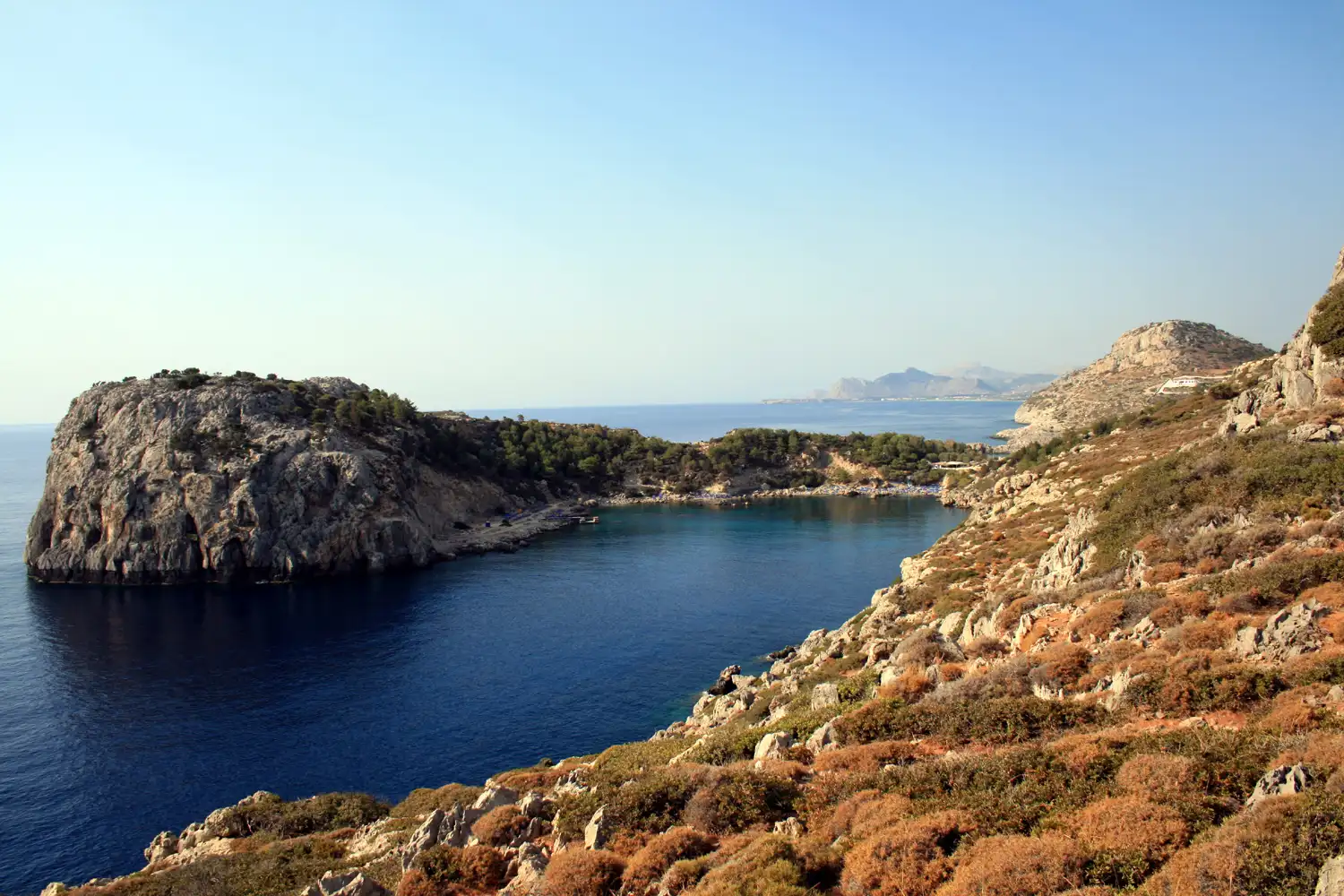
East coast of Rhodes, a few kilometres south of Faliraki, beside Ladiko
The shore
Pebble, shingle and flat rock with rock slabs into the water. Very little sand. Pines behind giving real shade
The name
For the actor Anthony Quinn, whose connection to Rhodes began with The Guns of Navarone, released 1961. Filming year not printed: sources disagree
Ownership
Disputed. To Vima reports a 1961 purchase of 117 stremmata in the Ladiko area and a later dispute between his widow and children and the Greek state over land classified as shoreline. Other accounts conflict. No court record opened. The bay is public
What it is for
Snorkelling over a rocky bottom in clear water, and shade under the pines. Not a sunbathing beach
Facilities
Rented sunbeds and umbrellas and a canteen in season. No prices printed
Best hours
Early morning or late afternoon. The middle of a summer day is when the coaches, cars and boats converge on a very small cove
Travel details last checked July 2026.
It is named for the actor Anthony Quinn, and that is where the straightforward part of the history stops.
The name, and why the ownership story is disputed
Quinn came to Rhodes for The Guns of Navarone, released in 1961, in which he played the Greek resistance fighter Andrea Stavrou. The film was shot on the island, he became attached to it, and the cove has carried his name ever since. That much every account agrees on, and it is the only part of the story this page is going to assert.
What happened next is told at least four different ways, and they contradict each other.
The Greek national newspaper To Vima reports that Quinn bought a property of 117 stremmata, about 29 acres, in the Ladiko area of Rhodes in 1961, and that decades later his third wife and children were in a legal dispute with the Greek state, which contested ownership of the land having classified it as part of the shoreline. To Vima names no seller, gives no court dates and states no outcome.
Elsewhere you will read that the government of the day agreed to sell him a beach in return for publicising Greece; that the sale was annulled and the land instead granted to him for a token sum; that the deeds were never issued and he was bitter about it for the rest of his life; and that the courts eventually settled the land in public hands. Those versions are widely repeated and they are not compatible with each other. We opened no court record, no land registry entry and no legal reference for any of them, so we are not going to pick one, and neither should the pages that do.
Here is what actually matters to a visitor, and it is not in dispute anywhere: the bay is public and you can walk into it. Whatever the history was, this is not private property with a gate on it.
The honest version of the story is more interesting than the tidy one. A famous actor’s attachment to a Greek cove turned into a decades-long argument about who owns a shoreline, the argument outlived him, and his name stuck to the place regardless. That is the tale worth telling, and it does not need a resolution it has never had.
What the cove is actually like
Set the beach-day expectation before you drive out, because this is the thing that surprises people.
There is very little sand. The shore is pebble, shingle and flat rock, with rock slabs running into the water at the sides, and getting in and out is done over stone. Water shoes make a real difference here and most visitors wish they had brought some.
The trade-off is the water. A rocky bottom means clarity and it means things to look at, which is why the cove has a reputation for snorkelling out of all proportion to its size. Our Rhodes guide calls it a snorkelling cove and that is the right label: bring a mask and the visit doubles in value.
We are not going to rate the entry, the rocks or the water for you. Rock shelves and swell are a combination that changes hour to hour, no page can see the day you are standing in, and that is not a certificate we are in a position to issue. Look at what the water is doing when you arrive, and take your time getting in and out over the stone.
The pines are the other half of the appeal, and they are the reason this cove is more pleasant in midsummer than the open beaches along the same coast. There is real shade under them, which on a Dodecanese August afternoon is worth more than a sunbed.
Speaking of which: sunbeds and umbrellas are rented in season and there is a canteen for snacks and drinks. We print no prices and name no business, because a beach concession is a seasonal trade and any figure would be wrong within a year.
The problem with a small famous place
The cove is small and its name is large, and the arithmetic of that is the main practical issue with visiting.
Coaches, hire cars and boat trips all include it, and through the middle of the day the shore is full, the shade under the pines is taken and the water has a good deal of company in it. Parking exists at the top and it fills; whatever you have read about there being plenty of it, this is a narrow access on a coast road in high season.
So the whole strategy for Anthony Quinn Bay is a time of day. Early morning is a genuinely different place: quiet water, empty rock, the pines to yourself. Late afternoon works too, once the excursion traffic has moved on. The middle of the day in July and August is when almost everybody sees it and it is the worst version of it.
If you arrive and it is full, Ladiko is next door and the long sandy beaches of the east coast are a few minutes up or down the road.
Where it fits on the east coast
The east coast is the sheltered, swimmable side of Rhodes, and it holds most of the island’s beach days, which is the frame our Rhodes guide sets out.
Anthony Quinn Bay is the small, rocky, snorkelling one in that set, and it is the odd one out. Tsambika is the long golden beach under its clifftop monastery. Kalithea Springs pairs a swim with restored Italian-era spa architecture. Agathi, Afandou and Faliraki fill out the rest, and Faliraki is the resort strip a few kilometres north of the cove.
The useful way to plan it is as half a day rather than a whole one. Come early to the bay, swim and snorkel, then move on to a longer beach or into Rhodes Town for the afternoon. Rhodes Old Town is close enough to do in the same day, and our one week in Rhodes itinerary fits the coast and the town together.
Nothing at the cove is booked in advance. The hire car is what makes this coast work, and renting a car in Greece covers what those agreements involve.
Getting there
The bay lies off the road south of Faliraki, on the stretch that runs down towards Ladiko, and the turning drops down to a small parking area above the cove with a walk down to the water.
A car or a scooter is the straightforward way. Excursion boats along the east coast also stop off the bay in season, which is a pleasant way to see it and a poor way to spend time at it. We name no operator and print no fare.
If you are staying in Faliraki you are a few kilometres away, which makes the early-morning visit trivial and is the single best reason to be based on that stretch of coast. The Rhodes guide sorts the bases.
The short verdict
Anthony Quinn Bay is worth an hour and worth a mask, and it is not a beach-day beach. Come early, wear something on your feet, bring snorkelling gear, sit under the pines, and treat the ownership story as the unresolved argument it is rather than the tidy anecdote every other page prints. The cove is public, it is beautiful, and it is small.
Last checked July 2026. What gets re-checked on this page: nothing about the cove, which does not change, and the ownership question, which would change only if a court record or a land registry entry ever surfaced. No price, fare or business name appears here by design. How we date and correct facts is in our editorial policy.
Common questions
Did Anthony Quinn own Anthony Quinn Bay?
The accounts disagree, and this page will not settle them. The Greek national newspaper To Vima reports that Quinn bought a property of 117 stremmata, about 29 acres, in the Ladiko area in 1961, and that decades later his third wife and children were in a legal dispute with the Greek state, which contested ownership having classified the land as shoreline. Other widely repeated versions say the sale was annulled, that the land was granted for a token sum, that the deeds were never issued, or that the courts settled it in public hands. We opened no court record for any of them. What is not disputed is that the bay is public today.
Why is it called Anthony Quinn Bay?
Because the actor Anthony Quinn became attached to the cove while working on Rhodes for The Guns of Navarone, released in 1961, in which he played the resistance fighter Andrea Stavrou. The film was shot on the island and the name has stuck to the bay since. That is the part of the story every account agrees on, and it is the only part this page asserts. We do not print the year of filming, because sources give both 1960 and 1961.
Is Anthony Quinn Bay sandy?
No. The shore is pebble, shingle and flat rock, with rock slabs running into the water at the sides, and you get in and out over stone. Water shoes are the single most useful thing to bring. The payoff is the water: a rocky bottom means clarity and things to look at, which is why the cove is known for snorkelling well out of proportion to its size. Bring a mask.
Is Anthony Quinn Bay good for snorkelling?
It is the cove’s main draw and our Rhodes guide labels it that way. The bottom is rock rather than sand, the water is clear, and there is structure along the sides to look at. We rate no entry point and no route, because rock shelves and swell change hour to hour and no page can see the day you are in. Look at the water when you arrive, take your time over the stone, and bring your own mask, because relying on finding one is how people end up snorkelling without one.
How crowded does Anthony Quinn Bay get?
Very, in the middle of a summer day. It is a small cove with a large name, and coaches, hire cars and boat trips all include it. The shore fills, the shade under the pines is taken early, and the parking above is limited. Come at the beginning or the end of the day and it is a different place: quiet water, empty rock and the pines to yourself. If you arrive at noon in August and it is full, Ladiko is next door and the long east-coast beaches are minutes away.
How do you get to Anthony Quinn Bay from Faliraki?
It is a few kilometres south of Faliraki on the road towards Ladiko, and the turning drops to a small parking area above the cove with a short walk down to the water. A car or a scooter is the practical way, which is why a base on this stretch of coast makes the early visit easy. Excursion boats along the east coast also stop off the bay in season, which shows you the cove but gives you little time in it. We name no operator and print no fare.
Plan by category
The מטאורה guides
4 guides, each scoped to a decision you actually have to make.
 Attractions
Things to do
See the attractions → Hotels
Where to stay
Compare the areas → Itinerary
Day by day
See the itinerary →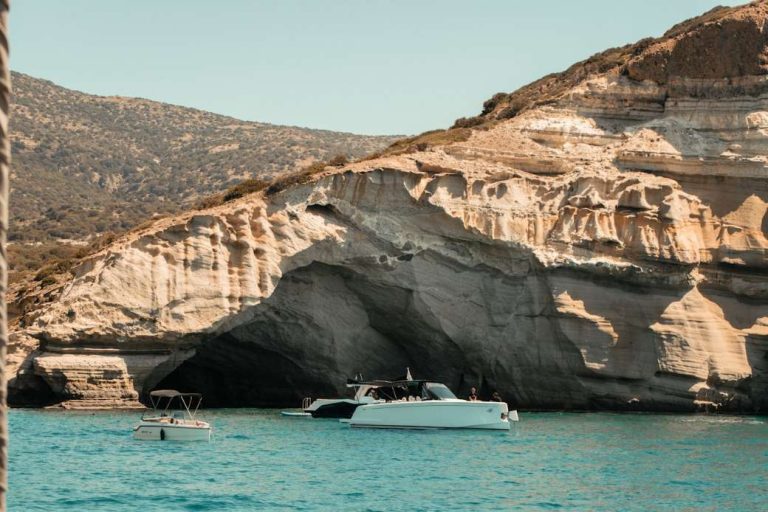 Day trips
Day trips
See the day trips →
Booking
We sell nothing and book nothing for you. Every guide on this page tells you how to arrange each piece yourself - which ferry operator, when to book, what to prebook and what to leave loose.