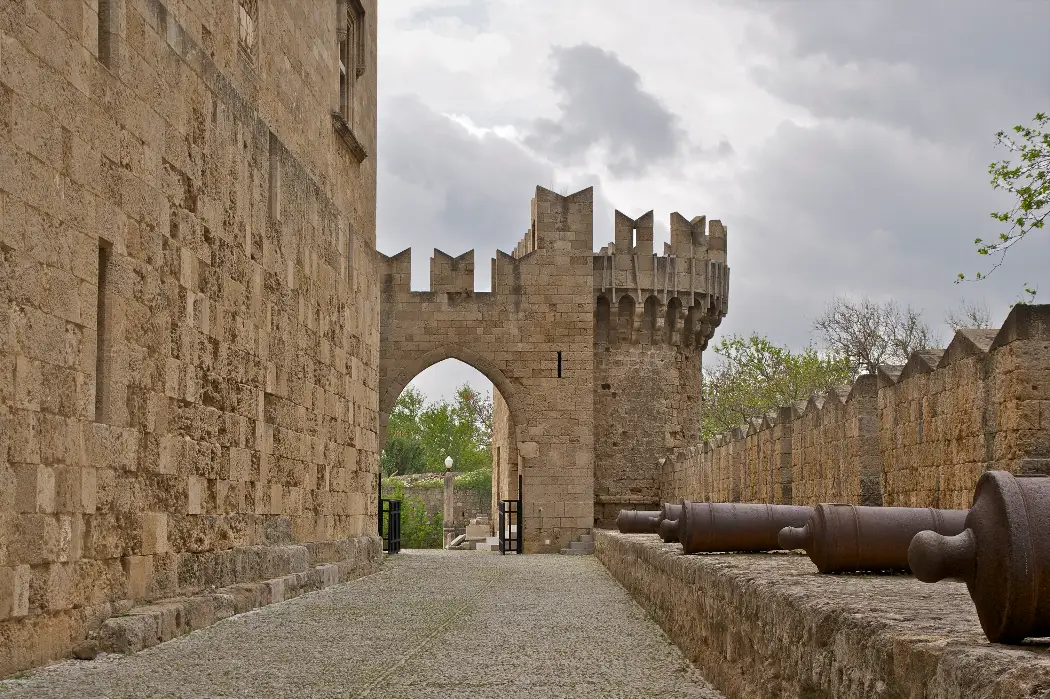
What costs money is a short list of specific buildings inside the walls, and the Ministry’s own sources disagree on whether they come as one package or one at a time, so ask at the ticket desk what yours covers before you buy a second ticket.
The town also has a shape that most visitors never notice. The Knights split it in two with a wall and a moat, their own quarter above and everybody else’s below, and that division is still the difference between the half that gets photographed and the half where the washing is hanging out.

Diagram by Greece Trips. Free to reuse with credit - CC BY 4.0.
A lived-in town, not a site
There is a second thing worth knowing before you go through the gate, and it is what the free access actually means. The Medieval City of Rhodes is on the UNESCO World Heritage List. We print no inscription year, no criteria and no reference number, because UNESCO’s own page has refused our requests and we do not print citation details we have not read. The paperwork is not the useful part anyway: what is listed here is a whole inhabited town rather than a monument, and you are about to walk around in it.
So what you find inside the wall is houses, laundry, delivery trolleys, schoolchildren and a great many cats. No opening hours are posted for the Medieval Town, and that is not an oversight: people live here, and their streets do not keep a timetable.
The scale of the maze is the thing that catches people out. The lanes run to something like two hundred, many of them unnamed, and that figure is what the local sources report rather than anything anyone has measured for us. The one street you can reliably navigate by is Sokratous, which is as close as the medieval city comes to a high street.
On the question every driver asks, the answer is six words long: by car to the gates, then on foot. That is the whole rule, and the rest of Rhodes is on the Rhodes hub and across the Dodecanese.
The Ministry’s tickets, and the hours trap inside the Palace
Walking into Rhodes Old Town is free. The buildings inside it are not, and the Hellenic Ministry of Culture’s record for the Palace lists them on one package: the Palace of the Grand Masters, the Archaeological Museum of Rhodes, the Decorative Arts Collection, and Our Lady of the Castle, also called Panayia tou Kastrou. The Ministry’s current price list, though, prices each place separately, so ask at the ticket desk what yours covers before you buy a second ticket.
Now the honest gap, because it is more useful to you than a confident guess. A fifth line, “Medieval Town of Rhodes”, has been listed on that same package, and we could not establish what it admits you to, given that walking into the town itself costs nothing. It must refer to something specific inside the walls. We are not going to invent what. Ask at the ticket desk.
We print no price either. The Palace was repriced in 2025, and a figure typed here today is a figure that will be wrong for somebody. Buy at the desk, or check the current price on the official heritage ticketing portal and on the Ministry’s record for the Palace. What a Greek trip costs overall is in the trip cost guide.
Then the trap, which is the most useful sentence on this page. The Palace keeps one set of opening hours and the exhibitions inside it keep another, shorter one, and some of those exhibitions have run on alternating days of the week. So on a long summer afternoon you can walk into the Palace and find its contents shut. We give you the mechanism and not the timetable, because the timetable rots and the mechanism does not: check the Palace’s hours and the exhibitions’ hours as two different things, and check them for your date.
Of the four, the Archaeological Museum is the one to give real time to. It is housed in the Knights’ Hospital on the Street of the Knights, which means the building is half the exhibit. How a week on the island is sequenced around it is in the one-week Rhodes route.
The Collachio and the borgo: the town has two halves
A fortress protected the population here in the 7th century AD. After the Knights of St John established themselves on Rhodes in 1309, they expanded the defences to four times their Byzantine size, enclosing a crescent of 42 hectares around the main harbour, and the walls were then gradually adapted to meet the needs of gunpowder warfare as the technology changed under them.
Then they divided what they had enclosed, and this is the part nobody prints. The fortifications split the town in two. Above sat the Collachio, the upper town, holding the Knights’ dwellings, most of their administrative buildings and the fortified Palace of the Grand Master as the last line of defence. Below it lay the borgo, the lower town, where most civilians lived. A wall and a moat ran between them.
The Street of the Knights is the Collachio’s main artery, running from the Palace down to the Latin cathedral, lined on both sides with the inns of the various tongues of the Order, the conventual church, the hospital and the chapel of St Michael. That is why it looks and feels the way it does. It was an administrative avenue rather than a commercial one, it never became a shopping street, and it is the quietest famous street in the town for a reason that is 700 years old.
The borgo is where the rest of the town happened and still happens: the lanes, the shops, the mosques, the hammam and the Jewish quarter with its synagogue. The Ottoman layer arrived with the Knights’ surrender in 1522 and never left the map.
Whichever gate you come through, the borgo is where you will spend most of the day, because it is where everything is. The Collachio is where you go when you want the town to be quiet. The rest of the island’s monuments are on the things to do in Rhodes page.
Where the car stops, and which gate you walk through
The rule is plain enough: by car to the gates of the town, then on foot. The two gates a driver actually aims for are the Amboise Gate and the Liberty Gate. Leave the car outside the wall.
That is as far as we will go, and the limit is deliberate. We are not going to name a car park, quote a parking fee, or tell you about a traffic restriction or a resident permit, because we confirmed none of them. In Greece an administrative act that has not been published in Diavgeia, the public registry of municipal decisions, is not in force, and we did not check Diavgeia for this town. So: park outside the walls, walk in, and ask locally on the day if the arrangements matter to your plan.
The gates are worth treating as orientation rather than as a list. Which one you walk through decides which half of the town you land in and how long it takes you to find the other. The Amboise Gate is the one the Ministry names for the Palace, so it is the gate that puts you closest to the Collachio; a gate on the harbour side drops you straight into the borgo and its lanes.
If you arrive by sea you have no decision to make at all. The commercial port sits minutes from the walls, which the Rhodes hub sets out along with the overnight crossing from Piraeus, and how the boats and the ports work is in the ferries guide.
The day-trip tide, and when the lanes are yours
The cruise berth is a few minutes outside the medieval wall. That single fact explains the day. Ship passengers here are not coached in from an airport an hour away, they walk in through a gate, which is why the Old Town fills and empties like a tide rather than trickling all day. Coach groups from the resort strips arrive at the gates on top of them.
So do not look for a timetable. Look at the port. The ships are visible from the walls, and what is tied up out there is a better forecast of your afternoon than any schedule we could print, which would be wrong by next week anyway.
Two ways to use that. If you are sleeping on the island, walk the town early in the morning or in the evening, and the one-week Rhodes route is built around exactly that. If you are off a ship, you are the tide, and the way to escape yourself is to climb into the Collachio and walk the Street of the Knights while everyone else is in the lanes below.
How long you need is our judgment and not a published figure: a full day walks the town and gets you into one or two of the buildings, and half a day does the Collachio, the Street of the Knights and one museum. Lindos, the other thing everyone drives to, wants a day of its own. Where the island actually goes out at night is a separate question with a separate answer, and it is on the Rhodes nightlife page.
Walk in free, and buy the buildings
Two things are worth carrying through the gate. The Ministry’s own record says the Medieval Town has free access, so you are not buying entry to a site, you are walking into a town. And the buildings that do charge are ticketed by the Ministry, so the only real decision is whether you want the buildings as well as the town. Ask at the desk what your ticket covers before you buy a second one.
From here: Rhodes end to end, and a week on the island.
Sleeping inside the walls is the decision that buys you the empty evening, and it is the one to make early rather than late. The one-week Rhodes route explains why the Old Town comes first in a split stay.
Last checked September 2026. The free access, what each ticket covers, the different opening hours of the Palace and its exhibitions, and the gates named by the Ministry are re-checked on this page before every update. How we date and correct facts is in our editorial policy.
Common questions
Is Rhodes Old Town free to enter?
Yes. The Hellenic Ministry of Culture’s own record for the Medieval Town of Rhodes lists it, under its opening information, as free access. You walk in through a gate in the wall. It is an inhabited town rather than a fenced archaeological site, and the record publishes no opening hours for it because its streets are where people live. The buildings inside the walls are a separate question, and they are ticketed.
Is there a combined ticket for Rhodes Old Town?
Possibly. The Ministry’s record for the Palace of the Grand Masters names a special ticket package covering the Palace, the Archaeological Museum of Rhodes, the Decorative Arts Collection and Our Lady of the Castle (Panayia tou Kastrou), but the Ministry’s current price list prices each place separately. The record lists a fifth item on the same package, “Medieval Town of Rhodes”, and we could not establish what that item admits you to, given that the town itself is free to walk into. Ask at the ticket desk what yours covers before you buy a second ticket. We print no price: the Palace was repriced in 2025, so check the current figure on the official ticketing portal.
How long do you need in Rhodes Old Town?
A full day walks the town properly and lets you into one or two of the ticketed buildings. Half a day does the Collachio, the Street of the Knights and one museum, and no more. That is our judgment and not a published figure, and the reason it takes longer than people expect is scale: this is a whole walled town of lanes, and a great many of them look the same. Come early or come in the evening. The middle of the day belongs to the ships.
Can you drive into Rhodes Old Town?
The Ministry’s own answer is the one to use: by car to the gates of the town, then on foot. Its record for the Palace names the Amboise Gate and the Liberty Gate as the two a driver aims for. We do not print a car park, a fee, a permit rule or a traffic restriction, because we confirmed none of them, and in Greece a municipal decision that is not published in Diavgeia is not in force. Leave the car outside the walls and check locally on the day.
Is Rhodes Old Town a UNESCO World Heritage Site?
Yes. The Medieval City of Rhodes is on the World Heritage List. We deliberately print no inscription year, no criteria and no reference number, because UNESCO’s own page has refused our requests and we do not print citation details we have not read ourselves. Read them on the World Heritage Centre’s own listing if you want them exactly. What we can tell you is why it qualifies as one of the most complete surviving fortified medieval towns: the Knights kept adapting the walls as gunpowder changed what a wall had to do, and the town inside them never stopped being lived in.
What is the Street of the Knights?
It was the principal street of the Collachio, the Knights’ upper town, running from the Palace of the Grand Master to the Latin cathedral. The Ministry’s history records that its sides were lined with the inns of the various tongues of the Order, the conventual church, the hospital and the chapel of St Michael. It was an administrative avenue rather than a commercial one, which is exactly why it stayed quiet, and why it feels nothing like the lanes below it.
When is Rhodes Old Town least crowded?
Early morning and evening. The mechanism is the thing to hold on to: the cruise berth is minutes outside the walls, so day visitors walk in rather than arriving by coach from far away, and the town fills and empties like a tide. We print no arrival time and no ship count, because those change every week. Look at the port instead, which you can see from the walls, and go up into the Collachio when the lanes below are full.
Booking
We sell nothing and book nothing for you. Every guide on this page tells you how to arrange each piece yourself - which ferry operator, when to book, what to prebook and what to leave loose.