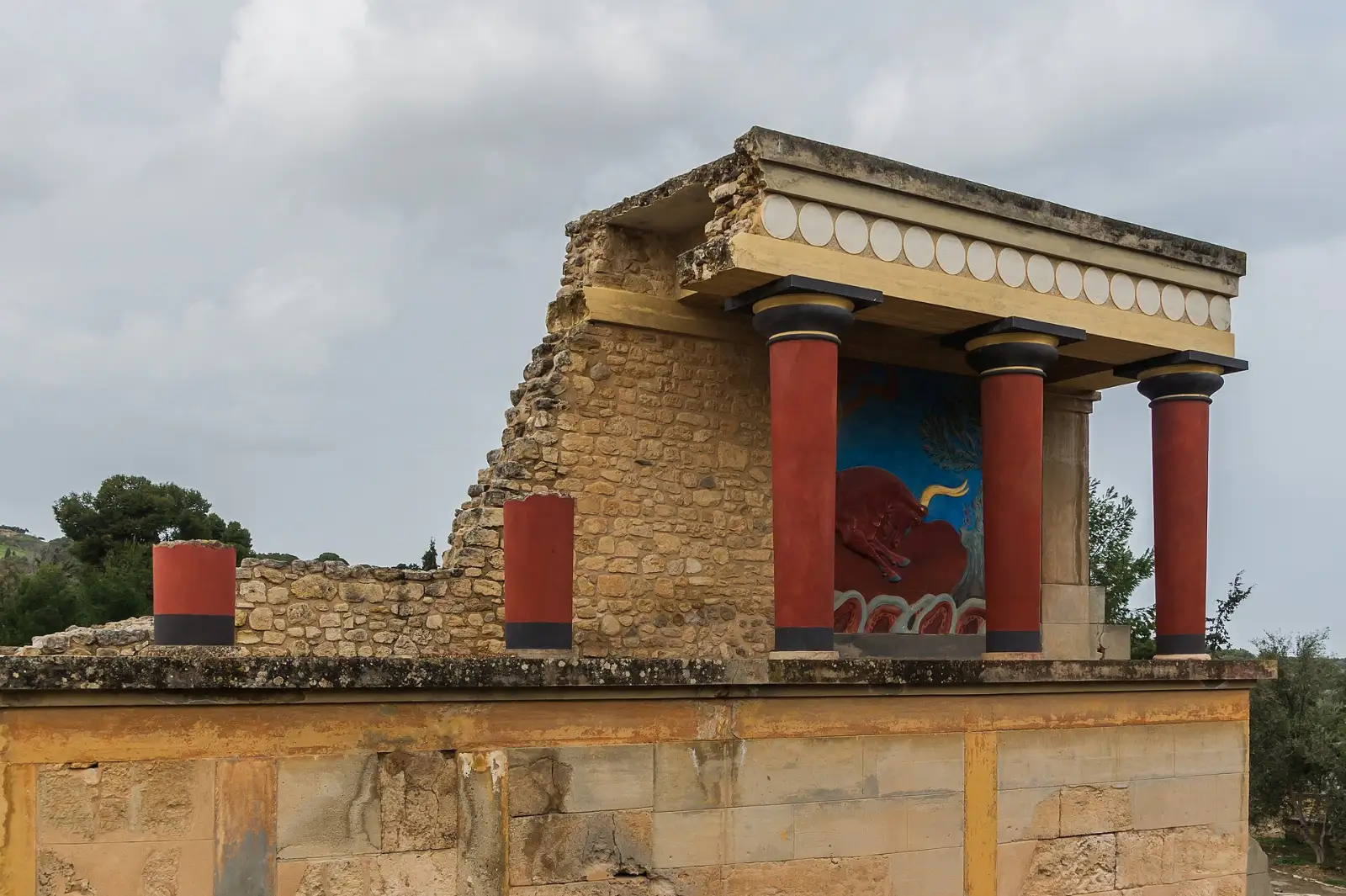
The frescoes on its walls are reproductions. The originals, the pottery and the Linear B tablets from the building are in the Heraklion Archaeological Museum, and the two are ticketed separately: the Ministry’s own record for the museum says the old combined ticket for the museum and Knossos “isn’t valid any more”. Plan on two tickets, which also means the two halves do not have to be the same day.
The site joined the UNESCO World Heritage List in July 2025, as one of six Minoan Palatial Centres.
One thing before you buy anything. Several of the top search results for Knossos tickets are resellers, not the Ministry, and a domain that looks official is not evidence. Take the hours and the ticket from the Ministry’s own record for the site.

Diagram by Greece Trips. Free to reuse with credit - CC BY 4.0.
A World Heritage Site since 2025, and the myth that got there first
UNESCO inscribed the Minoan Palatial Centres on the World Heritage List in July 2025, a serial property of six component sites, Knossos among them. The others are reported as Phaistos, Malia, Zakros, Zominthos and Kydonia, and Kydonia lies under the modern city of Chania, which turns a heritage list into a trip decision if you are based in the west. That listing is taken from the news coverage of the Committee session rather than from UNESCO’s own page for the property, which we have not read. UNESCO’s list of Greek properties does name the Minoan Palatial Centres (2025), and the link above goes to the register so you can check the six names yourself. Most pages about Knossos predate the inscription and say nothing about it.
The myth got there first, and it is why many people come. The palace plan is famously complicated, the bull runs all through its imagery, and the Greeks told a story about a labyrinth and the thing at the centre of it. The Labyrinth belongs to the story rather than to the floor plan. Come for the myth, then let the building be a building. It is the better half.
It is a serious building: the largest of the preserved Minoan palatial centres, four wings arranged around a central court, holding royal quarters, workshops, shrines, storerooms and a throne room. The Ashmolean Museum in Oxford, which holds Arthur Evans’s archive, dates its use from around 1900 to 1350 BC. Monuments stand beyond the palace too, among them the Royal Villa and the House of the Frescoes. Where Knossos sits on the island, and how far it is from your base, is in our Crete guide.
The frescoes on the walls are copies, and the originals are in Heraklion
The frescoes you see on the walls at Knossos are reproductions. The originals were lifted and taken to the Heraklion Archaeological Museum, where they are shown with the pottery and the Linear B tablets from the palace. The two places are ticketed separately, so plan on two tickets.
The museum’s list of highlights is, to a striking degree, a list of things from Knossos. The Bull-Leaping Fresco, the Prince of the Lilies, the Cup-Bearer and a piece of a relief bull, all from the palace. The Snake Goddesses, from its temple repositories. The faience Town Mosaic. The Blue Bird fresco, which came from the House of the Frescoes at the site. The Minoan frescoes have a room to themselves on the first floor, and the Linear B tablets from Knossos and the polychrome Kamares ware are downstairs in the Minoan collection.
So the site gives you the plan, the scale and the ground. The museum gives you the things that were standing on it. Do only the site and you have seen the box.
That decides the shape of your day. The palace is an open excavation and it gets hot from the middle of the morning; the museum is indoors and does not. Palace early, museum after lunch. Or put them on different days. The two are ticketed separately, and the Ministry’s own record for the museum states that the combined ticket for the museum and Knossos is no longer valid, so buy each ticket for the day you want it on tickets.hh.gr. Our Crete guide says the same. Two dates are what rescue a hot afternoon.
How much of this did Arthur Evans build?
Sir Arthur Evans began excavating at Knossos in 1900 and worked there until 1931, and he did not only dig it: he rebuilt parts of it in reinforced concrete, and he had a word for that, reconstitution. His architect from the 1920s, Piet de Jong, raised structures over the excavation, replaced excavated wooden columns in concrete, and had artists complete the frescoes on the walls from the fragments found in place.
The plan is the excavation. The central court, the four wings around it, the storerooms and their great jars are the building that was found. What stands above them in places, the upper floors, the tapering red columns, the bright painted panels everyone photographs, is Evans’s argument about what the palace looked like, cast in a twentieth-century material.
Where exactly that line runs, this page will not settle. Nor do the people who hold his archive: the Ashmolean Museum, which sets all of this out, says plainly that “it can be difficult for archaeologists and visitors alike to disentangle the 20th-century reconstitutions from the 2nd millennium BCE building.” Some archaeologists regard the concrete as an overwrite of the evidence; others as the only reason anybody can read the site at all. We are not going to adjudicate that, and we will not put a percentage on it, because no source we opened gives one.
The payoff is practical. A visitor who knows which is which spends the morning reading the building instead of quietly wondering whether they are being had. It is also the strongest argument for a guide or an audio guide here, more than at most Greek sites. Knossos does not explain itself.
Go at opening, because the coaches do not
Knossos is the standard excursion out of the Heraklion cruise berth and off the north-coast resort strip, and visitors report, consistently and for years, that the coach groups land through the middle of the morning. That is a reported pattern, not a published timetable, so we are not going to invent an arrival time for it. What it implies is simple. Be at the gate when it opens.
The gate opens early in summer and a good deal later in winter, and last admission falls well before closing in either season. We print no hour here: it is the Ministry’s to set, it steps down through the autumn, and a stale opening time is what puts somebody outside a locked gate. Take the hour for your date from the Ministry’s record for Knossos, not from a page that is selling you a ticket.
Then the sun. This is an open excavation on a low hill, walked on raised walkways and worn ground, and the light is on it from the moment the gate opens. Hat, water, and shoes you can cross uneven ground in. Which month you come decides how hard the heat works, and our month-by-month weather guide is the honest version of that. The shoulder months do for the temperature roughly what an eight o’clock start does for the coaches.
We publish no live opening status for this site, and no travel page should. On a day of severe weather, check the Ministry’s record before you set out. Which days Greek sites close for holidays is covered in our guide to public holidays and what closes.
Getting there without a coach
A city bus goes to Knossos. The Ministry’s own record for the site gives the access in four words, Bus Nr. 2 “Knossos” from Herakleion, and Heraklion Urban Bus, which runs the city network, lists line 2 with Knossos on it. Every page that ranks would rather sell you a transfer.
Now the limit, stated rather than fudged. We do not print the frequency, the fare, the journey time or the last bus back. None of that is in the Ministry’s record, all of it changes, and a wrong last bus is an expensive taxi. Take those four numbers from the operator’s own timetable on the day you travel, which is why we linked it.
By car it is a short run south out of the city. We have not confirmed the parking arrangements at a primary source, so we do not describe them. If the car is a rental, renting a car in Greece and getting around Greece cover the rest of the driving.
If you are on a cruise excursion, the coach owns your clock and this page cannot change that. What it can do is tell you what you are looking at while you stand there, and where the frescoes went.
Do the palace first and the museum second, on two tickets
Two things are worth carrying off this page. The frescoes on the walls are copies, and the originals are in the museum in Heraklion. And the two are ticketed separately, so the palace and the museum do not have to be the same hot afternoon.
Palace at opening, when it is cool and quiet. Museum later, or tomorrow. That is the whole plan, and two separate tickets let you make it.
From here, Crete end to end puts the site back into the island, and our Crete itinerary sequences a week with room for both.
Buy from the portal the Ministry’s own record links to, and plan on two tickets, one for the site and one for the museum: the old combined ticket for the pair is no longer valid.
Last checked September 2026. What gets re-checked on this page: the seasonal hours mechanism, how the site and the museum are ticketed, the bus route, and the ticketing portal the Ministry names. How we check and date facts is set out in our editorial policy.
Common questions
Are the frescoes at Knossos real?
The frescoes on the walls at Knossos are reproductions. The surviving originals were removed to the Heraklion Archaeological Museum, where they are displayed with the palace’s pottery and its Linear B tablets. The site and the museum are ticketed separately, so plan on two tickets to see both.
This is not a scandal, it is a preservation decision, and it goes further than swapping a copy for an original: the walls those reproductions sit on were themselves rebuilt by Arthur Evans. The museum’s own highlights name the Bull-Leaping Fresco, the Prince of the Lilies, the Cup-Bearer and the Blue Bird among the pieces it holds from Knossos.
Is Knossos a UNESCO World Heritage Site?
Yes, since 2025. Knossos is one of the six component sites of the Minoan Palatial Centres, inscribed on the World Heritage List in July 2025 (UNESCO ref 1733). The other five are reported as Phaistos, Malia, Zakros, Zominthos and Kydonia.
UNESCO’s own list of Greek properties now names the Minoan Palatial Centres (2025). The six component names here come from the news coverage of the Committee session rather than from UNESCO’s page for the property, which we have not read, so check them against the register. Most pages about Knossos predate the inscription and either say it is not listed or say nothing at all. Kydonia, incidentally, lies under the modern city of Chania.
Is Knossos worth visiting, or should I just go to the museum?
We refuse that choice. The site and the museum are ticketed separately, so plan on two tickets, and do both, on separate days if the heat argues for it.
What each gives you is different. The site gives you the plan, the scale, the central court and the storerooms. The museum gives you the objects that were in them, which is where the Minoan world stops being a floor plan. A visitor who does only the site has seen the box and left the contents behind.
How much of Knossos did Arthur Evans rebuild?
Substantial parts of what stands up at Knossos are Evans’s reconstitution, made in reinforced concrete from 1900 onwards, with the frescoes on the rebuilt surfaces completed by artists working for him. The plan of the palace, the central court, the wings, the storerooms, is the excavated Bronze Age building.
We do not put a percentage on it, because no source we opened gives one, and the Ashmolean, which holds his archive, notes that even archaeologists find the two hard to disentangle. Some regard the concrete as an unforgivable overwrite and some as the only thing that made the site legible. We describe the argument. We do not settle it.
How do you get to Knossos from Heraklion without a tour?
A city bus goes there. The Hellenic Ministry of Culture’s own record for the site gives the access as Bus Nr. 2 “Knossos” from Herakleion, and Heraklion Urban Bus lists line 2 with Knossos on it.
We do not print a frequency, a fare or a journey time, because none of those is in the Ministry’s record and all of them change. Take them from the operator’s timetable on the day. A taxi or a rental car does the same run south out of the city in a fraction of the time, at a price we are not going to guess at either.
What time should you get to Knossos?
Be there when it opens. Knossos is the standard cruise and coach excursion out of Heraklion, and visitors consistently report the groups arriving through the middle of the morning, so the first hour of the day is the quietest one you will get. It is also the coolest, which matters more than people expect on an open excavation.
Take the actual opening hour for your date from the Ministry’s record for the site. It changes with the season, it steps down through the autumn, and it is not a number any travel page should be your source for.
How long do you need at Knossos?
Allow roughly an hour and a half to two hours for the site. That range is what visitors and guides consistently report rather than anything the Ministry publishes, and it will stretch if you take a guide, which at this site is time well spent.
Then plan a second visit of comparable length for the Heraklion Archaeological Museum, because that is where the frescoes, the pottery and the tablets are. They are ticketed separately, so you can buy each for its own day, which is the argument for not cramming them into one.
Booking
We sell nothing and book nothing for you. Every guide on this page tells you how to arrange each piece yourself - which ferry operator, when to book, what to prebook and what to leave loose.