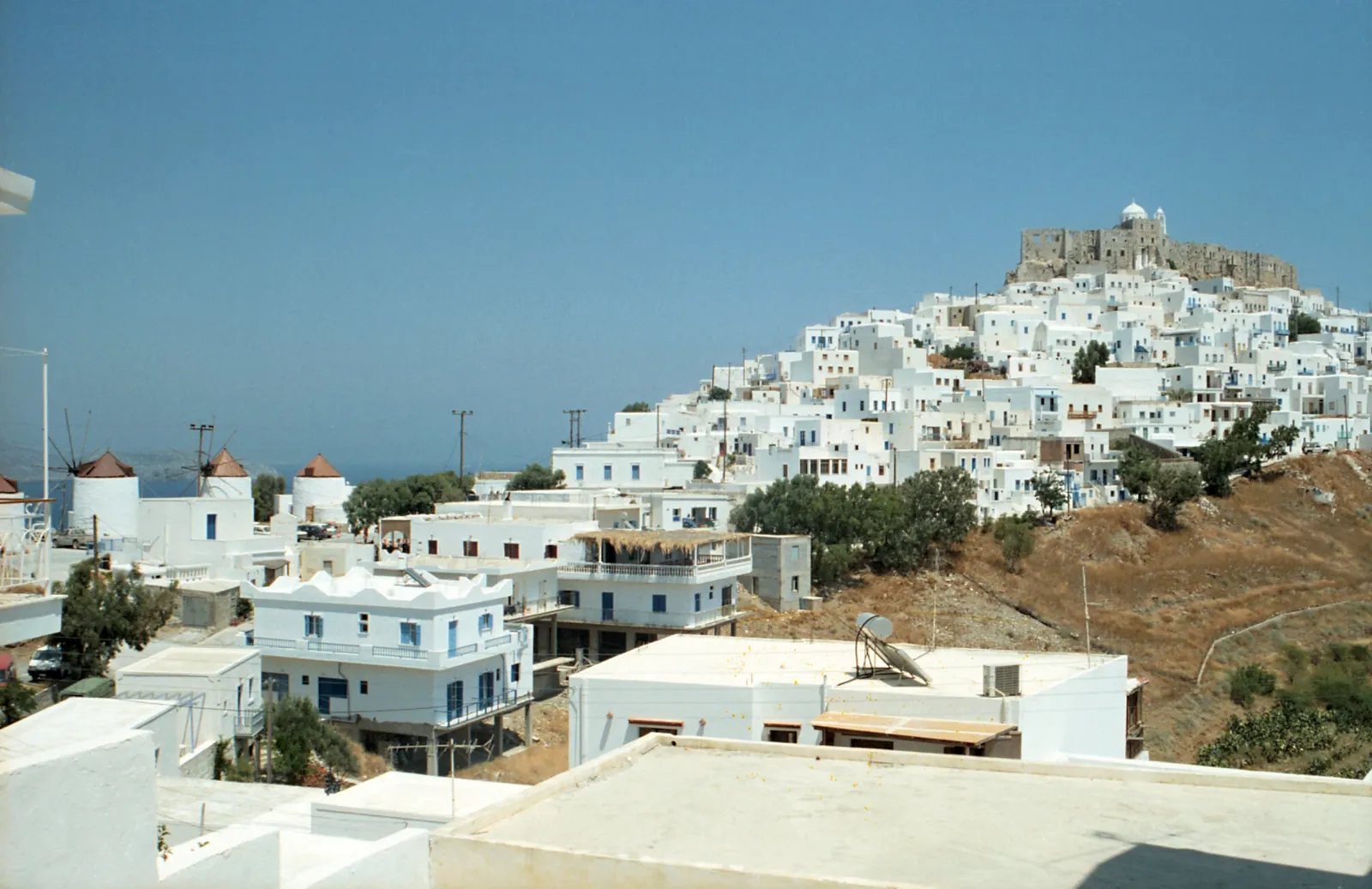
Astypalaia sits between the Cyclades and the Dodecanese and looks like the wrong group. Administratively it is Dodecanese; visually it is Cycladic, with a white cubic chora climbing to a Venetian castle on a ridge above the sea.

Diagram by Greece Trips. Free to reuse with credit - CC BY 4.0.
Its other distinguishing feature is its shape. The island is two lobes joined by an isthmus barely a hundred metres wide, which you drive across with sea on both sides.
The Chora and the castle
The chora is the reason most people come. Whitewashed houses stack up the hillside to the Querini castle, built by the Venetian family that held the island, with a church built into the gatehouse. Below it a row of restored windmills stands along the ridge.
It is one of the best-preserved castle villages in the Aegean and, unusually, it is still lived in.
The two halves
- The west lobe holds the chora, the port at Pera Gialos, and the accessible beaches.
- The isthmus at Steno is the pinch point, with a beach on each side so you can choose your wind.
- The east lobe is emptier: rough roads, the beaches at Vatses and Kaminakia reached down dirt tracks, and the long run out to Mesa Vathy, a near-landlocked inlet.
What else
There is a small archaeological museum, a much-photographed set of windmills, and a serious excavation history: a Bronze Age and later cemetery on the island has produced significant finds, including an unusual infant burial ground.
Beaches are pebble and small-sand coves rather than long strands, and several need a car with clearance.
Getting there and how long
There is a small airport with domestic flights, and ferries on the long Dodecanese and Cyclades routes. Astypalaia is genuinely awkward to reach, which is why it stays quiet.
Three nights. The chora is a day, the east lobe another, and the connections make a short stop impractical anyway.
Last checked August 2026. Flight and ferry schedules change - see our editorial policy.
Common questions
Is Astypalaia Cycladic or Dodecanese?
Administratively Dodecanese, visually Cycladic. Its whitewashed hilltop chora looks like the Cyclades rather than the rest of its own group.
What is the castle on Astypalaia?
The Querini castle above the chora, built by the Venetian family that held the island, with a church built into its gatehouse and restored windmills on the ridge below.
Why is Astypalaia called the butterfly island?
Because of its shape: two lobes joined by an isthmus barely a hundred metres across, with sea visible on both sides as you cross it.
How do you get to Astypalaia?
By domestic flight to its small airport, or by ferry on the long Dodecanese and Cyclades routes. It is not a convenient hop.
Do you need a car on Astypalaia?
For the eastern half, yes, and preferably one with clearance. The best beaches there are down dirt tracks.