Island group
Dodecanese (South Aegean, Greece) - the largest island of the group
Airport
Rhodes International “Diagoras” (IATA: RHO), about 14 km southwest of Rhodes Town, operated by Fraport Greece
Ferry from Piraeus
Blue Star Ferries overnight, roughly 13–17 hours; no high-speed catamaran on the direct route
Best months
May–June and September–October (shoulder sweet spot); long season roughly April–November, swimmable into October; July–August hottest and busiest
Travel details last checked July 2026.
Rhodes is the Dodecanese’s big, sunny anchor, not a Cyclades island
The island of Rhodes sits at the far southeast of the Aegean, closer to the Turkish coast on the horizon than to mainland Greece, and it is the largest island of the Dodecanese. Its capital, Rhodes Town, holds the northern tip, and the land runs a long way south from there to a windswept point where two seas meet.
That geography is why Rhodes reads nothing like the Cyclades most people picture. There is no blue-domed, whitewashed caldera cliche here. What you get instead is a walled medieval city the Crusader knights built, and ancient Greek and Roman ruins on the hills above town. On top of that sits an Italian layer from the 1912–1943 occupation that gave whole avenues their arcades, plus Ottoman-era mosques and hammams folded into the old quarter. The Greek island of Rhodes has been fought over and rebuilt by more powers than almost anywhere else in the country, and it wears all of them at once.
It also sells itself as the sunshine island, with a reputation for something close to 300 days of sun a year. That long, dry season is real, and it shapes the whole trip, but the detail belongs further down. Start with the four decisions that actually build a Rhodes week: how many days, how you arrive, where you base, and when you come.
How many days Rhodes actually needs
Five days is the sweet spot. It gives you two unhurried passes at the Old Town, a full day on Lindos and the east-coast beaches, a day for the west coast or the green interior, and a Dodecanese boat trip, without any of it feeling like a race. Three days only skims the island.
Here is what each length actually buys.
Three days covers the walled Old Town and a Lindos day, plus one beach afternoon if you keep moving. It is enough to say you have seen the headline Rhodes, and it works when the island is one leg of a longer Dodecanese hop rather than the whole trip.
Five days is where Rhodes opens up. You keep the Old Town and Lindos, add a swim day on the sheltered east coast, a driving day for the wineries and ruins inland, and a catamaran across to Symi with room to spare.
Seven days or more suits slow travellers, hikers and anyone who wants to fan out across the wider Dodecanese - a night on a neighbouring island, the mountain villages, and the beaches nobody photographs.
One honest warning aimed at package and charter travellers: it is easy to book a week on an all-inclusive strip and never leave the sunbed. Those extra days pay off far more on the Old Town after dark, the climb at Lindos and a day on Symi than on a fourth identical afternoon by the pool. For the hour-by-hour version, the one-week Rhodes route lays out the days.
Getting to Rhodes: fly, or take the overnight ferry
Rhodes is a plane island, and this is the single most useful correction on the page. From Athens it is about an hour by air to Rhodes International Airport, named Diagoras and coded RHO. The alternative from Piraeus is an overnight haul: Blue Star Ferries runs the direct crossing in something like 13 to 17 hours, an evening departure that lands you the next day, and there is no high-speed catamaran on that route to shorten it.
So unless the sea passage is genuinely the point, you fly.
Plenty of visitors skip Athens altogether. Through the April-to-November season, charter and budget airlines fly into Diagoras direct from cities across Europe, which is how most of the resort-strip crowd arrives.
| Mode | Roughly | Arrives at | Choose it if |
|---|---|---|---|
| Flight (ATH→RHO) | ~55 min | Diagoras (RHO), ~14 km SW of Rhodes Town | Almost everyone; time matters |
| Overnight ferry (Piraeus) | ~13–17 h, overnight, Blue Star | Rhodes Town commercial port, beside the Old Town | You want the sea crossing or the lowest fare |

Diagram by Greece Trips. Free to reuse with credit - CC BY 4.0.
Where you land shapes the first hour. Diagoras sits about 14 km southwest of Rhodes Town, a 20-to-30-minute run by airport bus or taxi. The ferry, by contrast, docks right at Rhodes Town’s commercial port, a few minutes’ walk from the walls - one of the rare Greek arrivals that leaves you in the middle of things rather than on a switchback road below them. The mechanics of both are in the Greek island ferries and flights to Greece guides.
Getting around: a car for the south, buses for the east
Here is the rule: you do not need a car for an Old-Town-and-east-coast trip, but you rent one the moment you want the west. The KTEL buses out of Rhodes Town run the east coast reliably - to Faliraki, Kalithea, Kolymbia and all the way south to Lindos - which covers most of what a first visit wants to see.
The catch is time. The KTEL bus down to Lindos takes about 1 hour 40 minutes each way, so a car pays for itself the day you want the south end on your own clock. The west coast, the mountain wineries and the inland villages have little or no bus service; that is car country.
One thing not to do: drive into the Old Town. It is walled, car-free and walkable end to end, and the gates are for people, not vehicles. Park outside and walk in. For the wider picture, see getting around Greece.
Where to base: the Old Town, the resort strips, or Lindos
Before you book a bed, make this decision, because it defines the trip more than any other. Rhodes gives you three very different bases, and they are not interchangeable.
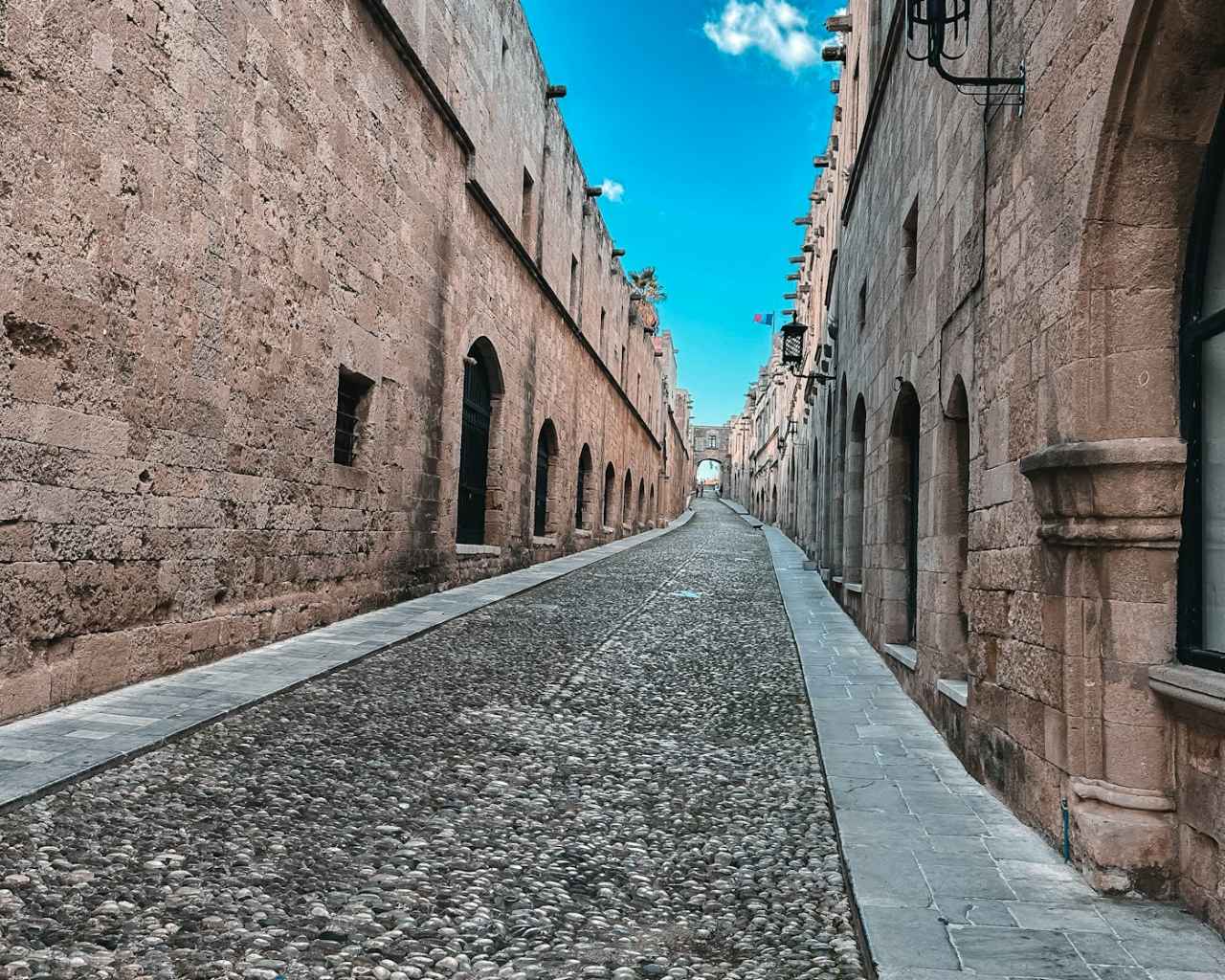
Inside the Old Town walls you wake up in a living medieval city. The reward is atmosphere and history and, once the day-trippers leave, real quiet in the lanes; the trade-off is that these are mostly small guesthouses and boutique conversions rather than big-pool resorts, and the cobbles are hard work with a wheeled suitcase. It is the pick for first-timers who came for the city, and for anyone who wants Rhodes Town on their doorstep. The adjacent New Town adds modern hotels and Elli beach a short walk away if you want a foot in both.
The resort strips spread north and south of the capital - Ixia, Ialyssos, Kalithea, Faliraki and Kolymbia - and this is package-holiday Rhodes: all-inclusive hotels, a beach on the doorstep, pools and kids’ clubs and a shuttle culture. It is the honest answer for families who want the sea and the buffet handled and do not plan to move much. It is also the Rhodes that is easiest to never leave, which the how-many-days section warned about.
Lindos, about 45 minutes south, is the postcard: a whitewashed pedestrian village under a floodlit acropolis, boutique stays, sunset terraces and prices to match. It is the romantic pick, better for couples than for anyone hauling luggage up its stepped lanes, and it is a real drive from both the airport and the Old Town - the trade you make for the setting.
| Base | Vibe | Best for | Trade-off |
|---|---|---|---|
| Old Town | Medieval, atmospheric | City-first travellers, history | Few big-hotel comforts, cobbles |
| New Town | Modern, convenient | Beach-plus-city, easy logistics | Less character than the walls |
| Resort strips | All-inclusive, beachfront | Families, package holidays | Generic; easy to never leave |
| Lindos | Postcard village | Couples, a romantic stay | Pricey, far from town and airport |
Which specific hotel, in which of these, is the decision that comes after this one - we break it down in where to stay in Rhodes. Rhodes nightlife does the same for the night, including how you get back from each.
The walled Old Town, and why you stay past sunset
The Old Town of Rhodes is the living medieval city the Knights of St John left behind, and it is a UNESCO World Heritage Site for good reason. The Knights Hospitaller ran the island for two centuries and built to last: the Palace of the Grand Master at the top, the cobbled Street of the Knights running down from it, and roughly 4 km of walls with a dry moat wrapped around the whole thing. Layered over that are the Ottoman centuries - mosques, a hammam, minarets above the rooftops - and the old Jewish quarter to the east, so the city reads as several empires at once.
Here is the honest rhythm of the place. By late morning the main spine, Sokratous, fills with cruise passengers and day-tour groups funnelled off the buses, and the souvenir lanes get shoulder to shoulder. By early evening they drain out, the last coaches leave, and the Old Town becomes the quiet, lamp-lit medieval city you came for. The move is simple: see the headline sights early, or stay inside the walls so the place is yours after the crowds have gone.
The Palace of the Grand Master is ticketed, and its price and opening hours are worth checking against the Hellenic Ministry of Culture’s own site before you go, rather than trusting a figure that drifts. The full walk-through, and the wider list of what stands inside the walls, sit on the Rhodes Old Town and things to do in Rhodes pages.
Lindos and the sheltered east coast
The east coast is the sheltered, sandy, swimmable side of Rhodes, and Lindos is its set piece. The village is a car-free tangle of whitewashed houses below a dramatic acropolis, and the climb is the thing: the Doric Temple of Athena Lindia at the top, a Byzantine chapel and a Hellenistic stoa on the way up, and the blue horseshoe of St Paul’s Bay far below. The path is shadeless and worn slick by generations of donkeys, so go before 10am, ahead of the heat and the tour groups, and wear real shoes rather than sandals.
Lindos is roughly 47 km south of Rhodes Town, about a 45-to-50-minute drive, which is why it reads as a day out rather than a quick errand.
The same coast holds the beaches built for a swim day. Tsambika is the long golden one under its clifftop monastery; Anthony Quinn Bay is a small, rocky snorkelling cove named for the Hollywood actor who filmed on Rhodes and grew attached to the spot; Kalithea Springs pairs a swim with restored Italian-era spa architecture; and Agathi, Afandou and Faliraki fill out the choices. All of them are more sheltered and more sand-than-pebble than anything on the west. The acropolis gets its own detail on the Lindos acropolis page, and the full ranking is in the best beaches in Rhodes.
The windward west, Prasonisi and the green interior
Flip to the west coast and Rhodes changes character. This side is pebblier and open to the prevailing summer wind, which is bad news for a lazy float and very good news for anyone on a board. It builds to Prasonisi at the island’s southern tip - roughly 90 km down, a genuine drive, where the Aegean and the Mediterranean meet across a sandbar and kitesurfers and windsurfers gather for some of the most dependable wind in Greece.
The interior is the other reason to keep the car. The Valley of the Butterflies is a shaded, stream-cut park - around 600 acres of it - where Jersey tiger moths cluster on the tree trunks in their thousands, though only in high summer; come outside roughly June to September and you get the walk without the spectacle. Nearby are the ancient sites of Kamiros and Ialyssos, the wineries under Mt Attavyros, the ornamental springs and tunnel at Seven Springs, and mountain villages like Embonas that see a fraction of the coast’s traffic.
This is a driving day, not a beach-club day, and that is the point. It rewards travellers who would rather have olive groves, ruins and a winery lunch than another afternoon on a sunbed.
When to go: Rhodes’ unusually long season
The short answer: come in May–June or September–October. Those shoulder months give you warm days, a sea that is still swimmable, thinner crowds than the peak, and lower rates - and on Rhodes the window stretches further than almost anywhere in the Cyclades. The season runs roughly April to November, and the sea holds enough summer warmth to swim into October, which makes it the smartest month of all to come.
July and August are the trade-off. They are the hottest stretch, with highs commonly in the low thirties Celsius, the busiest, packed with charter arrivals, and the time the meltemi wind is most likely to pick up and chop the exposed west coast. If that is when you can travel, base on the sheltered east and book rooms early.
Winter is where Rhodes quietly separates itself from the caldera islands. The resorts close and the strips go dark, but Rhodes Town and its Old Town stay lived-in year-round - shops open, tavernas serving locals, a working city rather than a shuttered stage set - so an off-season city break here actually holds up.
| Season | Crowds | Prices | Weather |
|---|---|---|---|
| April | Light | Low | Mild, sea still cool |
| May–Jun | Moderate | Mid | Warm, sea warming |
| Jul–Aug | Heavy | Highest | Hot, windy spells on the west |
| Sep–Oct | Moderate | Mid | Warm, sea swimmable into October |
| Nov–Mar | Light | Lowest | Cool and wetter; resorts closed, Rhodes Town open |
The same shoulder-season logic runs across the country in the best time to visit Greece and the month-by-month weather guides.
Day-hopping the Dodecanese, and where Rhodes fits a bigger trip
Rhodes is the hub of the Dodecanese, not a dead end, and the day-hops are half the reason to come. Symi is the standout: a high-speed catamaran gets you there in about 50 minutes, and it is the best day you will spend off the island - a horseshoe harbour stacked with pastel neoclassical mansions, and the great Panormitis monastery at the southern end. The rhythm is a morning boat out and a late-afternoon boat back. Beyond it lie quiet Halki and Tilos, the bigger island of Kos to the north, and far-flung Kastellorizo out toward Turkey; the whole chain is mapped in the Dodecanese islands guide.
What Rhodes is not is a quick hop from the famous Cyclades. Travellers often try to line up Santorini, Mykonos and Rhodes in one trip and find they sit on entirely different ferry networks - you connect them by flying via Athens, not by a short crossing. Lesbos, up in the North Aegean, is not a neighbour either. Rhodes pairs with its Dodecanese siblings, and that is its own kind of trip.
So plan Rhodes as a week of its own or as the anchor of a Dodecanese leg. If you are weighing it against the other big southern island, Crete vs Rhodes settles that head to head.
Get the base, the days and the season right, and the rest of Rhodes falls into place around them. The one-week Rhodes route turns the plan into actual days; when you are ready to build the wider trip Rhodes belongs to, browse all our Greece destinations.
Rhodes FAQ
How many days do you need in Rhodes?
Five days is the sweet spot - two passes at the Old Town, a Lindos-and-beaches day on the east coast, a day for the west or the interior, and a catamaran across to Symi. Three days covers the Old Town and Lindos but rushes everything else; a week suits slow travellers and hikers. The one-week Rhodes route has the day-by-day.
What is the best time to visit Rhodes?
May–June and September–October are the sweet spot: warm, swimmable and far quieter than the July–August charter peak. Rhodes has one of Greece’s longest seasons, so the sea stays swimmable into October. In winter the resorts close but Rhodes Town stays open, unlike many Cyclades towns. More in best time to visit Greece.
How do you get to Rhodes from Athens?
Fly - it is about a 55-minute flight from Athens to Diagoras airport (RHO). The only alternative is an overnight Blue Star ferry from Piraeus of roughly 13 to 17 hours, with no high-speed option on the direct route, so most people fly unless the sea passage is the point. The Greek island ferries guide has the detail.
What is Rhodes famous for?
The medieval Old Town the Knights of St John built, now a UNESCO site; the whitewashed village and acropolis of Lindos; the ancient Colossus of Rhodes that once stood over Mandraki harbour as one of the Seven Wonders; long sandy beaches; and one of the sunniest, longest seasons in Greece. The things to do in Rhodes page has the full list.
Do you need a car in Rhodes?
Not for an Old-Town-and-east-coast trip - KTEL buses reach Faliraki, Kolymbia and Lindos on their own. Rent a car when you want the west coast, the mountain wineries and the inland villages, which have little bus service and are better on your own schedule. The Old Town itself is walled and car-free. See getting around Greece.
Rhodes or Crete - which is better?
Crete is far larger, with more landscapes, more to drive to and its own long season; Rhodes is more compact, with a denser medieval core and easier Dodecanese day-hops. Choose Crete for range and road-tripping, Rhodes for the walled Old Town and a walkable base. The full head-to-head is in Crete vs Rhodes.
Can you take a day trip to Symi from Rhodes?
Yes - a high-speed catamaran reaches Symi in about 50 minutes, and it is the standout day trip: a harbour ringed by pastel neoclassical houses and, at the island’s south end, the Panormitis monastery. Take a morning boat out and a late-afternoon boat back. More on the island at Symi.
Plan by category
The Rhodes guides
6 guides, each scoped to a decision you actually have to make.
 Attractions
Things to do
See the attractions → Hotels
Where to stay
Compare the areas → Beaches
The beaches
See the beaches → Restaurants
Where to eat
See where to eat → Itinerary
Day by day
See the itinerary → Day trips
Day trips
See the day trips →
Booking
We sell nothing and book nothing for you. Every guide on this page tells you how to arrange each piece yourself - which ferry operator, when to book, what to prebook and what to leave loose.