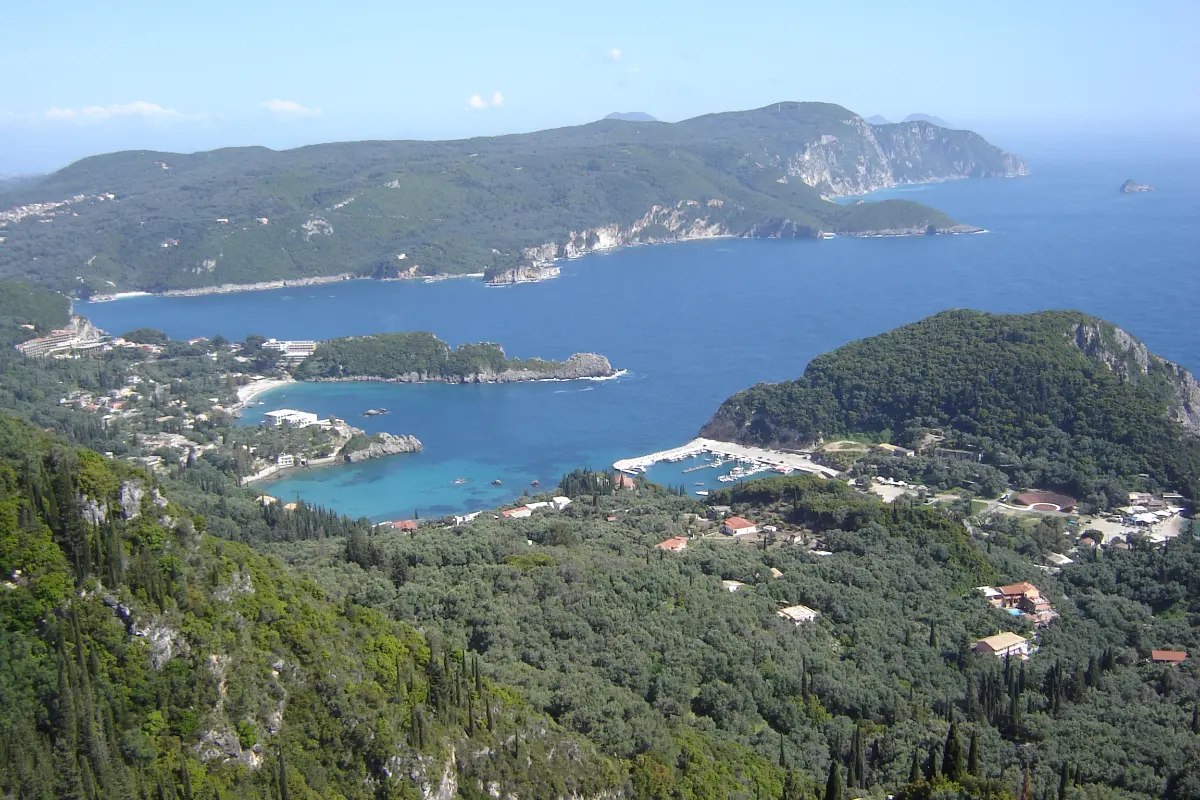
That is where the photograph misleads. Most people arrive with one image of Paleokastritsa, Corfu at its greenest, taken from the hill road above the bay, and from up there it reads as one wide sweep of turquoise. At sea level it is a run of small coves with a resort round them.
Taken as it is, it is one of the better half-days on Corfu: pick a cove rather than a beach, go up to the monastery or out round the headland by boat, and time the day against the coaches.

Diagram by Greece Trips. Free to reuse with credit - CC BY 4.0.
Which cove you stop at decides the day
Agios Spiridon is the one most people mean: the largest, with the car park across the road behind it and the jetty at its far end, and where the facilities and the crowd collect. Agios Petros sits immediately beside it, with Ampelaki tucked in behind: both small, and both where the space is once the main cove fills. Alipa is the working harbour end. Agia Triada, at the far end of the resort, is the second big cove and gets busy in its own right.
How many there are is not settled. Most guides count six, one counts seven, and the seventh is an area whose name is also a business name, which is the easiest way to get this bay wrong. Call it five or six depending on who is counting, and choose one rather than trying to see them all.
Two names other lists put here do not belong. Liapades is the next bay south, and Paradise is reached by boat rather than by road. How the island’s beaches rank against each other is the beaches page’s argument, and Canal d’Amour at Sidari is a different day entirely.
Shingle underfoot, and a sea that runs cold
The ground is shingle and pebble more than sand. The main cove is the sandiest, and several of the others have stones in the water as well as on the beach, which is why reviewers keep recommending water shoes. Our comparison with Kefalonia calls this coast scenic but pebbly.
The water is the other thing people notice: it reads colder here than on the island’s sheltered east side, and the bay has a reputation for being bracing even in August. Why is a question we leave open. Three of the biggest pages on the subject blame Adriatic currents, freshwater springs and underground sources respectively, and not one of them cites anything. We print no temperature either: the only figure going is review text with no month attached.
The clarity is what everyone agrees on, including reviewers who liked nothing else. More on what Greek sea conditions are like.
The monastery on the headland is a working house, not an exhibit
The Monastery of the Holy Theotokos stands on the headland above the main cove, founded in the thirteenth century: sources give 1225 and 1228, so the century is what we print. The church and cells you walk through are eighteenth-century.
Modest dress is expected, shoulders and knees covered, and coverings are lent at the entrance to anyone arriving from the beach without them, so beachwear is a delay rather than a wasted trip. Voices stay down in the courtyard and the church; people pray here.
We print no hours and no admission arrangement. It is a working house: it keeps its own hours, shuts for part of the middle of the day, and can close for a service, so treat any hours you find online as provisional and aim at the morning. No ecclesiastical source was reachable, so we make no claim about cost either.
The road up is a steep, narrow lane through cypress and olive, worked one way on a traffic light because two vehicles cannot pass in places. You can walk it. Inside, an old olive press sits on the lower level, and the exhibit people remember is a whale skeleton, killed by a fisherman in the nineteenth century by local account.
The boats go where the road does not
Past the headland the cliffs carry on and the road does not follow. The coves along that stretch are reached from the water, which is what the boats are for.
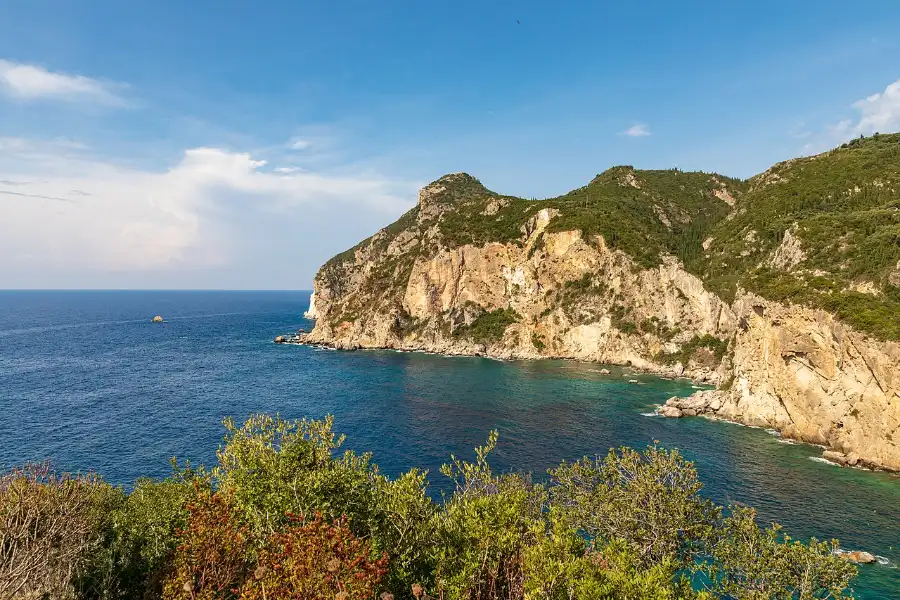
They go from two points: the jetty at the main cove, where small taxi boats sell tickets from a kiosk on the day, and the harbour at Alipa. Trips come in two shapes: a short circuit along the cliffs into the sea caves, named for Nausicaa, St Nicholas and the Blue Eye, and a longer run out to the coves, among them Rovinia, Limni and Paradise, a Corfu cove, not the Mykonos beach of the same name. Neither is an itinerary: which stops a boat makes is the boatman’s decision and the sea’s.
The trips depend on the water, and on windy days with rough seas the boats may not run, so it is bought on the day rather than pinned into a plan weeks out. The boats are small and open.
The Nausicaa name is a story, not a record: Corfu has been proposed as Homer’s Phaeacia and this bay as where Odysseus met her, with a rock offshore pointed out locally as his ship turned to stone.
The coaches arrive late morning and the bay empties by evening
The bay fills through the late morning as coaches and boat trips arrive, holds through the early afternoon and thins from mid-afternoon; by evening, with the day-trippers gone, the resort is quiet. One guide puts the coach window at roughly 11am to 3pm and suggests arriving before 9am or after 4pm, which is a reading of the pattern rather than a timetable we vouch for. Organised day trips run on schedules that put them here in the middle of the day.
Come before the coaches or come after them: same coves, same water, a different day. July, August and into September are the crowded months, one more argument for the shoulder season.
The car park behind the main cove fills early in season, and the roads in are narrow: two of the commonest complaints across several thousand Tripadvisor reviews.
Getting here, the climb between the coves, and the ramp on the main beach
It is a cross-island drive from Corfu Town on roads that narrow as they close in. We print no distance and no driving time; our sources give four different answers.
There is a bus. KTEL Kerkyras, the island’s intercity operator, publishes a Corfu Town to Palaiokastritsa route, the A9, from the green-bus station on Eptanisou Avenue, and publishes the timetable itself. We read no departure times, so we print none, and no fare. The bus reaches the resort; the car is for what is around it, which is the line our Corfu guide takes.
The ground is vertical: a hilly resort with steps and climbs between the coves, and pavement along only part of it, so the far end is walked on the road.
Greek Travel Pages reported in July 2025 that the Municipality of Central Corfu and the Diapontia Islands had installed SEATRAC sea-access systems at six Corfu beaches including this one, under an equipment lease signed that June. That is trade press; we could not check it against the municipality’s own record. Lease is the operative word: leased equipment is a decision taken again each season, so anyone planning around it asks the municipality first.
Go early, take the boat, stay past four
Three things to take away. It is coves rather than a beach and the ground is stony, so pick one and bring the right shoes. The boat is how the coast past the headland is reached at all. And the coaches decide what kind of day you get, which is why the first and last hours are the good ones. Where this bay sits among the island’s beaches is a separate argument.
Nothing here is bought in advance through us: the boat sells at the jetty and the bus at the operator’s station. The decision worth making early is where on the island you sleep, and Corfu hotels sets that out area by area.
Last checked July 2026. What gets re-checked here: the sea-access equipment, which is leased for a season, and the monastery’s access arrangements, which come from Corfu portals rather than from the church. No fare, ticket price, parking charge, boat rate, opening hour, sea temperature or distance in minutes appears on this page by design. How we date and correct facts is in our editorial policy.
Common questions
What is Paleokastritsa in Corfu?
Paleokastritsa is a village and bay on Corfu’s north-west coast where steep green headlands drop to the sea. It is not one beach but a run of small coves on a single road, with a monastery on the headland above and boats out to a cliff coast beyond it. The name means old little castle, after the fortress on the ridge rather than the bay.
Is Paleokastritsa sandy or pebbly?
Mostly shingle and pebble. Agios Spiridon, the main cove, is the sandiest of the group, and several of the others carry stones in the water as well as on the beach, which is why visitors keep recommending water shoes. Our comparison with Kefalonia calls the bay scenic but pebbly.
Is the sea cold at Paleokastritsa?
It reads colder than the sheltered east side of Corfu, and the bay has a reputation for being bracing even in August. Why, we cannot tell you: three widely read pages give three incompatible causes and none of them cites a source. We print no temperature.
What should you wear to visit the Paleokastritsa monastery?
Modest dress, with shoulders and knees covered. Coverings are lent at the entrance to visitors who arrive from the beach without them, so beachwear costs you minutes rather than the visit. It is a working religious house: voices stay low, it keeps its own hours, it closes for part of the middle of the day, and it can close for a service, so check on the day.
Are the Paleokastritsa boat trips to the sea caves worth it?
They are access rather than entertainment. The coast past the headland holds coves the road does not reach, and small open boats out of the main cove’s jetty and the harbour at Alipa are how people get to them. The trips depend on the sea, and on windy days with rough water they may not run, so buy on the day.
How do you get to Paleokastritsa from Corfu Town?
You drive across the island to the north-west coast, or you take the bus. KTEL Kerkyras publishes a Corfu Town to Palaiokastritsa route, the A9, from the green-bus station on Eptanisou Avenue, and publishes the timetable itself. We print no departure time, journey time or fare. The bus reaches the resort; a car opens what is around it.
When is Paleokastritsa least crowded?
Early and late. The bay fills as day trips arrive through the late morning and thins from mid-afternoon, and the evening is quiet once the coaches have gone. July, August and into September are the crowded months. The coves are small and the car park is finite, so a crowd fills this bay faster than it fills a long beach.
Is Paleokastritsa worth visiting?
Yes, for the shape of the coast, the monastery above it and the boat out to the coves the road does not reach. Skip it if what you want is a long sweep of sand to walk for an hour, or a bay to yourself in August. Thousands of Tripadvisor reviews split exactly that way, and both readings are true. How it compares with the rest is a separate question.