The governing condition
historic Greek towns are largely stepped stone, cobble and worn marble on slopes, built long before wheeled access was a design consideration. Level ground exists on port promenades, in newer parts of island capitals and in the large mainland cities. Described as terrain, not graded
Hydra
car-free by rule (no cars, motorbikes, scooters or bicycles); the town is steps, slopes and cobbles, and goods move by mule
Lefkada / Delos
Lefkada is reached from the mainland by a bridge, removing ferry boarding entirely; Delos is day-trip-only with no accommodation
Ferries
conventional vessels load through a stern ramp onto the vehicle deck; each operator publishes its own conditions and its own arrangements for reduced mobility, per vessel. Confirm in writing at booking
Seatrac
mechanised rail-and-seat sea access, operated by the user with a remote (left button two seconds in, right button two seconds out, either to stop); described by the operator as a free service for unassisted sea access; operator states over 240 locations in Greece; free account gives email/SMS status notifications per unit; phone line published for beaches without on-site information
Seatrac caveat
installed is not working. Ikaria’s Agia Eleni unit read Out of Order at our last check - one unit, one date, not a verdict on the beach. Check the named unit close to your dates
Acropolis
the Ministry of Culture publishes a lift to the plateau arriving north of the Erechtheion, entry and exit at the Thissio Square entrance on the Apostolos Pavlos walkway, two onward routes, and a restroom for visitors with mobility impairments; the North Slope is described as wheelchair accessible via a designated entrance north of the main entrance
Athens urban transport
nothing stated here
Accommodation
no property, chain or platform is named and no claim is made about the supply of accessible rooms anywhere. The page supplies the five questions to put to an individual property instead
Travel details last checked July 2026.
This page describes what you are likely to encounter, and then tells you who to ask about your own dates. It does not certify any place as accessible. That is not a claim a website can make on behalf of a municipality, a hotel or a ferry, and where you find one made confidently, it is usually made without checking.
Why this page describes rather than promises
An access guarantee has to be attached to a specific thing on a specific day: this vessel, this ramp, this room, this route.
Nothing about Greek provision makes that stable enough to publish. A beach ramp is a machine, and machines go out of service. A hotel that installed a level entrance may have a step at the side door you actually arrive through. A ferry route swaps vessels between seasons, and the vessel decides how you board. So the useful thing a page can do is tell you what the underlying conditions are, name the body that owns each answer, and be specific about the question to put to them.
That is the shape of everything below. Terrain first, then transport, then water, then rooms, then the calls to make.
The old towns are stone, and they are stepped
Start with the single fact that shapes a Greek itinerary more than any other: the historic centres people travel to see are, very largely, stepped stone.
A Cycladic chora is a hill town of narrow whitewashed lanes with steps cut into them, laid out to break the wind rather than to roll anything up. The old towns of the Dodecanese are cobbled and walled. Mainland stone villages are built into slopes. The surfaces themselves are the issue as much as the gradients: worn marble slabs, sea-polished cobble, and joints wide enough to catch a small castor.
Hydra is the clearest case in the country, because it is the extreme. There are no cars, motorbikes, scooters or bicycles anywhere on the island by rule, so the town is steps, slopes and cobbles from the harbour up, and goods move by mule. That produces a place with no traffic at all and also no wheeled alternative to a stepped lane, which is a combination worth understanding before you book rather than after.
The flat exceptions exist and they are worth planning around. Waterfront promenades in port towns, the newer parts of the big island capitals, and the level ground of the larger mainland cities give you the kind of surface an old town does not. What we will not do is name a town as an easy one on your behalf, because paving is renewed, ramps are added, and a street we walked once is not evidence about the street you will arrive at.
Getting between islands: boarding is the question
Island hopping is where an itinerary either works or quietly stops working, and the deciding factor is not the island. It is how you get onto the boat.
A conventional Greek ferry is a car ferry: it drops a stern ramp onto the quay and everything, vehicles and foot passengers alike, walks up the same slope into the vehicle deck, then goes up through the ship. The ramp’s gradient depends on the quay and the tide, the deck is a working car deck while loading is happening, and the route from there to the passenger decks is the ship’s own arrangement. High-speed craft are different vessels with different arrangements again, and are also the boats most often cancelled in wind, which is its own planning problem covered in when a ferry is cancelled.
Every operator publishes its own conditions of carriage and its own arrangements for passengers with reduced mobility, and those arrangements belong to the vessel on your booking, not to the route in general. So the question to ask, in writing, at the time you book, is about the named vessel on your date: how you board it, whether assistance is arranged in advance, and what the crew needs to know. The general picture of ports, vessel types and how the network fits together is in Greek island ferries.
Two structural facts are worth knowing because they remove the boarding question entirely. Lefkada is reached from the mainland by a bridge, so it is the Ionian island you drive onto. And Delos is the opposite case: a day-trip-only archaeological island with no accommodation, reached by small boat, which makes it a fixed, unbroken round trip whatever your needs. Knowing which islands sit at each end of that spectrum is more useful than a general statement about Greek ferries.
Getting into the sea: Seatrac, and the unit rather than the beach
The most interesting piece of accessible infrastructure in Greece is a machine on a beach called Seatrac, and the way to use it well is to think about the individual unit rather than the country.
It is a fixed rail track running down the sand and into the water with a seat on it, and the operator describes it as “a free service that offers unassisted sea access to people with disabilities and mobility issues”. You work it yourself with a remote: press the left button for two seconds to go into the sea, the right button for two seconds to come back, and either button to stop. The operator says there are over 240 locations across Greece.
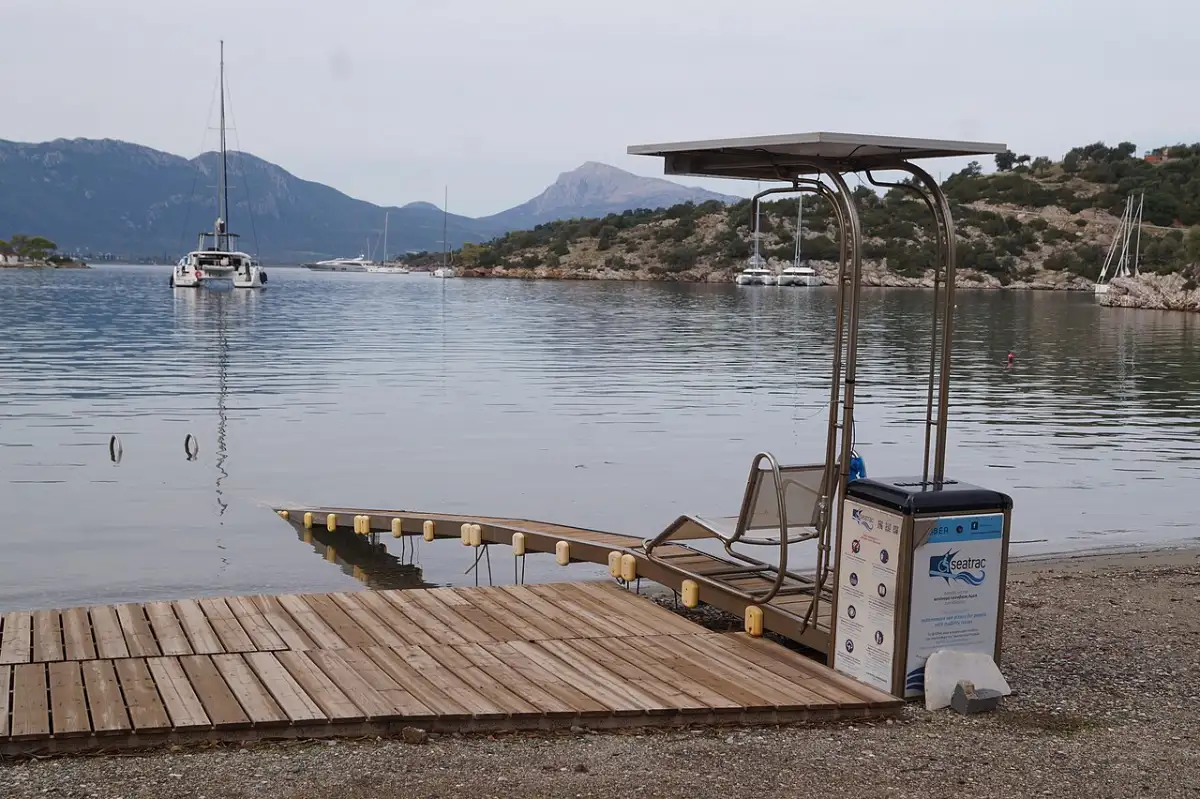
Now the part that matters more than the count. A number of installed units is not a number of working units on the day you turn up, and the operator effectively concedes this by offering the exact feature you need: a free account that sends email or SMS notifications about the status of the units you have marked as favourites. Set that up before the trip and you are watching the machine you plan to use, not reading a map of dots.
We have seen this from the other side. On Ikaria, the Seatrac at Agia Eleni was showing Out of Order when we last checked it, which is a statement about one unit on one date and not a verdict on the beach. That is exactly how to hold every one of these: the ramp at a named beach, checked close to your dates, with a second beach in mind. Where a beach page carries no remote or no further information, the operator publishes a phone number to call and ask.
Athens, and the site that publishes its route
Athens is where you find the most documented access arrangement in Greece, and it is worth reading the actual wording rather than the summary.
The Greek Ministry of Culture publishes an access route to the top of the Acropolis by lift. Its description is specific: the lift arrives on the Acropolis plateau in the area north of the Erechtheion, visitors enter and exit via the entrance on Thissio Square on the Apostolos Pavlos pedestrian walkway rather than the main gate, and from the plateau there is a route towards the Propylaea and a route between the Parthenon and the Erechtheion, with a restroom for visitors with mobility impairments at the end of the second. The ministry also describes the North Slope of the Acropolis as wheelchair accessible through a designated entrance north of the main site entrance on the West Slope.
Two things to take from that. The first is that the entrance you use is not the entrance in your guidebook, so arriving at the wrong gate costs you a long detour on the worst possible ground. The second is that a lift on an exposed rock is a machine outdoors: whether it is running on your morning is a question for the site, on the day, and it is the reason this page describes the route rather than promising the ride. The wider city, its transport and its other sites are in Athens.
Rooms: the word in the listing is not a measurement
“Accessible room” is a marketing category in a booking form and a physical fact in a building, and the two are only loosely related.
The failures are rarely the bathroom. They are the step up from the street into reception, the three stairs between the lift lobby and the room corridor, the lift that is a hundred and ten centimetres deep, the terrace with a lip, and the two hundred metres of stepped lane between the taxi drop and the front door, which no listing describes because it is not part of the property.
So write to the property directly and ask about the things a photograph will not show. Ask what the route from a vehicle to the front door is and whether it has steps. Ask the clear width of the room and bathroom doors in centimetres. Ask whether the lift reaches the floor your room is on, and its internal dimensions. Ask about the bathroom layout in specifics, not by category. And ask them to send photographs of the entrance and the bathroom taken today.
A property that answers those five questions precisely has thought about it. A property that answers “yes, we are fully accessible” to all five has not, and that reply is the most useful thing you will get from the exchange.
Who owns which answer
The recurring mistake is asking the right question of the wrong body, and then treating the shrug as information.
Beach ramps belong to the municipality that installed them and to the operator that maintains them. Boarding belongs to the ferry company, and specifically to the vessel. Archaeological sites and museums belong to the ministry and to the individual site’s ephorate. Rooms belong to the property. Airport assistance belongs to the airport and the airline, and is arranged in advance rather than on arrival. Ground transport belongs to whoever you hire it from, and if a hired vehicle is part of the plan, the terms in renting a car in Greece are the ones to read closely.
Put every question in writing, name the date, and keep the reply. A written answer from the operator is worth more than any page on the internet, including this one.
Planning around what you confirmed
Build the trip out of the things that came back confirmed, and give yourself fewer of them.
That usually means fewer islands and longer stays, a base chosen for the ground around it rather than for the view from it, and one confirmed swimming option rather than a list of beaches. It means treating a stepped old town as an afternoon you have decided to spend, with a plan for how you get in and out, rather than as the default route between two points. And it means shoulder season doing quiet work for you: thinner crowds on narrow ground, cooler days, and staff with time to help, which is one more argument for the months set out in the best time to visit Greece.
The country rewards that approach. It just does not hand it to you, and no page should pretend otherwise. Start from our Greece destinations, pick two, and make the calls.
Accessible travel in Greece: FAQ
Is Greece accessible for wheelchair users?
That is not a single answer, and a page that gives you one is guessing. Greece combines documented access work, such as the Acropolis lift and mechanised Seatrac beach ramps, with historic towns of stepped stone and island ferries that load through a vehicle deck. Plan around individually confirmed places rather than a national verdict.
What is Seatrac and how does it work?
Seatrac is a fixed rail track with a seat that carries a user from the beach into the water. The operator calls it a free service offering unassisted sea access, worked by remote control: two seconds on the left button to enter the sea, two on the right to return, either to stop. Register a free account for status notifications on the units you plan to use.
Can I be sure a Seatrac ramp will be working?
No, and this is the practical heart of it. An individual unit can be out of service on any given day, which is why the operator offers per-unit email and SMS status notifications and publishes a phone line for beaches with no on-site information. Check the specific ramp close to your dates, and have a second beach in mind.
Is there a lift at the Acropolis?
The Greek Ministry of Culture publishes a lift route to the Acropolis plateau, arriving north of the Erechtheion, with entry and exit via the Thissio Square entrance on the Apostolos Pavlos walkway rather than the main gate. Whether it is running on a given morning is a question for the site on the day.
How do I board a Greek ferry as a wheelchair user?
Conventional Greek ferries load through a stern ramp onto the vehicle deck, with the gradient set by the quay, and each vessel has its own internal arrangement. Operators publish their own conditions and their own arrangements for passengers with reduced mobility. Ask the operator in writing about the named vessel on your date, at the time you book.
Which Greek islands are easiest to get around?
Rather than rank islands, look at three things for each candidate: how you board the boat, whether the town you will base in is level or stepped, and whether a confirmed swimming option exists nearby. Lefkada removes the boarding question entirely, since it is reached from the mainland by a bridge. Delos is fixed the other way: a day-trip island with no accommodation.
What should I ask a Greek hotel before booking?
Ask five specific things: the route from a vehicle to the front door and whether it has steps, the clear door widths in centimetres, whether the lift serves your floor and its internal size, the bathroom layout in detail, and photographs of the entrance and bathroom taken now. Precise answers indicate a property that has genuinely looked.
Booking
We sell nothing and book nothing for you. Every guide on this page tells you how to arrange each piece yourself - which ferry operator, when to book, what to prebook and what to leave loose.