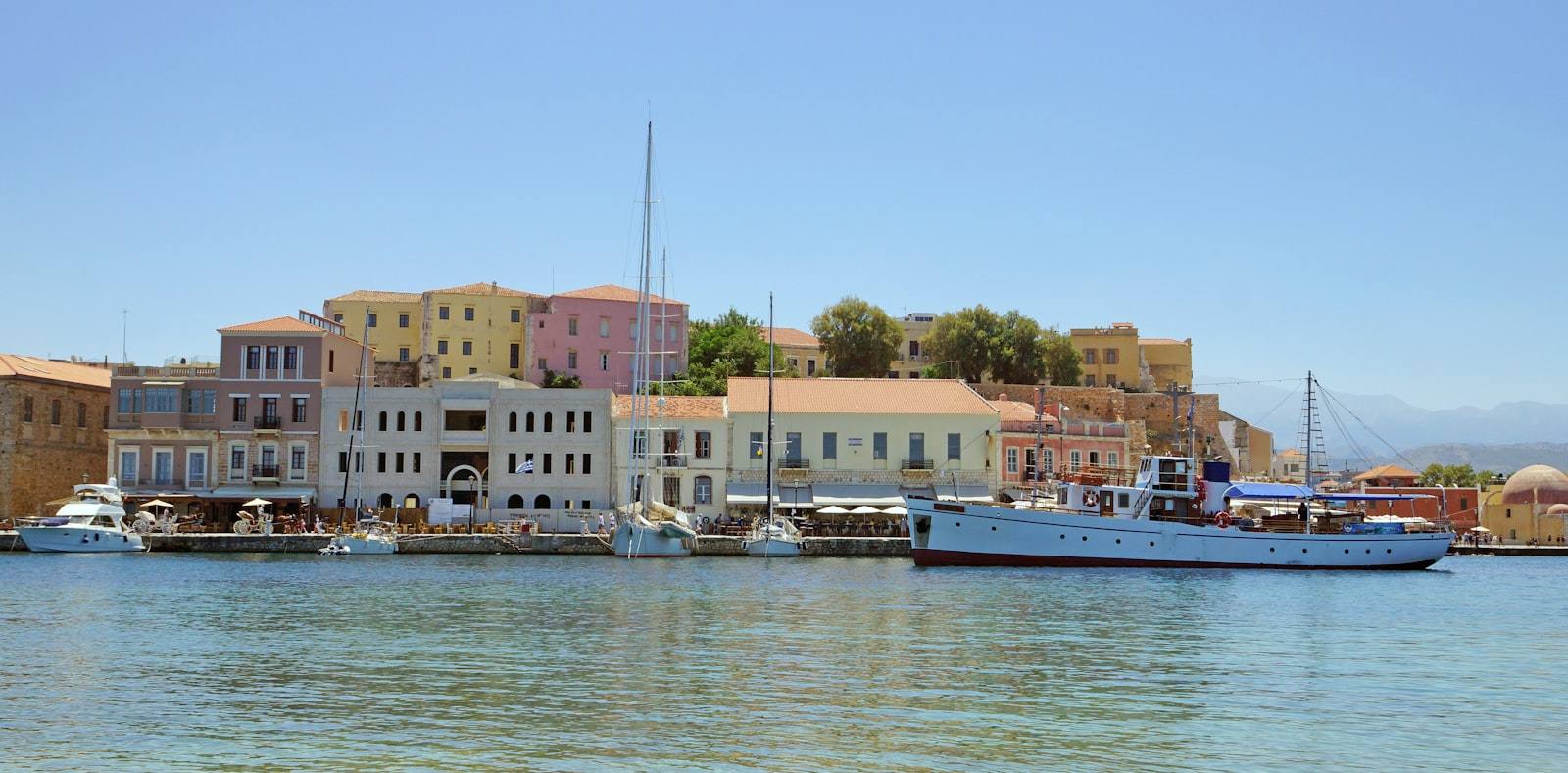
The short answer
Crete or Rhodes comes down to one thing: how long your trip is and how much you want to drive. Choose Crete for a week or more, a proper road trip, Minoan ruins, wild beaches and mountain food; choose Rhodes for a shorter, walkable trip built around one of Europe’s best-preserved medieval old towns.
Short on time, take Rhodes; a week or more and keen to explore, take Crete. This page decides Crete vs Rhodes across size, ancient versus medieval sites, beaches, families, getting there, base towns, season and cost, then names who each suits and whether to do both.
Choose Crete for a longer road trip, ancient Minoan sites, wild beaches and mountain food. Choose Rhodes for a short, walkable week around a medieval old town, with less driving. How long you have decides it: three or four days points to Rhodes, a week or more to Crete.
Crete vs Rhodes at a glance
Here is the whole decision in one view. Read it top to bottom: nearly every row traces back to the same thing, which is that one island is vast and the other is compact.
| What you’re deciding | Crete | Rhodes | Verdict |
|---|---|---|---|
| Best for | Longer trips, road trips, variety, food | Short trips, a walkable week, one base | Depends on trip length |
| Size and scale | Largest Greek island, country-sized | Compact, fourth-largest, easy loop | Crete |
| Days needed | A week or more | Three to four days | Depends on time |
| Headline sights | Minoan Knossos, Bronze Age museum | Medieval Old Town, Lindos | Tie, different eras |
| Beaches | Wild variety, drive-to lagoons | Easy sandy resort bays | Crete for variety, Rhodes for ease |
| Families | Longer varied trip, more driving | Easy compact week, young kids | Depends on ages |
| Getting there from Athens | Two airports, year-round ferry | One airport, longer ferry | Crete, more options |
| Getting around | Car essential, real distances | Buses, taxis, car optional | Rhodes, easier |
| Base towns | Pick a region, often two bases | One base usually covers it | Rhodes, simpler |
| Season length | Effectively year-round | Leans on summer | Crete, longer |
| Cost | A little cheaper off the strip | A touch pricier | Crete, usually |
Those verdicts are ours, not a scoreboard, and the axes carry no weighting beyond our judgement: a traveller who cares most about one row should reach a different answer from one who cares about another. On our reading, Crete takes size, variety, value and food; Rhodes takes compactness, the medieval old town and an easy few days.
This page compares the two at a decision level only. For the full detail, every beach, hotel and ancient site, go deep on the Crete guide and the Rhodes guide.
Size and scale: a big island to drive or a compact one to settle into
Crete is much bigger, and it is not close. It is the largest island in Greece and Rhodes is the country’s fourth-largest, and the gap is wide enough to change the kind of trip each one is rather than merely its length. That is the difference worth holding on to, because it is the one that decides whether you need a week and a car
That scale changes the whole shape of the trip. Crete has a mountain spine running its length, four distinct regions, and long distances between them; it feels less like an island and more like a small country you tour. Rhodes is a fraction of that, a compact island you can loop in short drives, with the main sights clustered in the north and down the east coast.
So size becomes trip length. Crete rewards a week or more, and to reach its best beaches, gorges and mountain villages you effectively need a rental car; the bus network is thin once you leave the north coast. Rhodes works well in three to four days, with buses, taxis and a walkable old town covering most of what people come for, and a car useful rather than essential. For how driving and public transport actually work on each, see getting around Greece.
Pick Crete if you want room to explore and have a week or more to fill. Pick Rhodes if you want less driving and a shorter, simpler trip from one place.
Ancient Crete vs medieval Rhodes: two very different histories
This is where the two islands stop overlapping, and where taste settles the pick. Crete’s headline history is ancient and Bronze Age; Rhodes’s is medieval and walled.
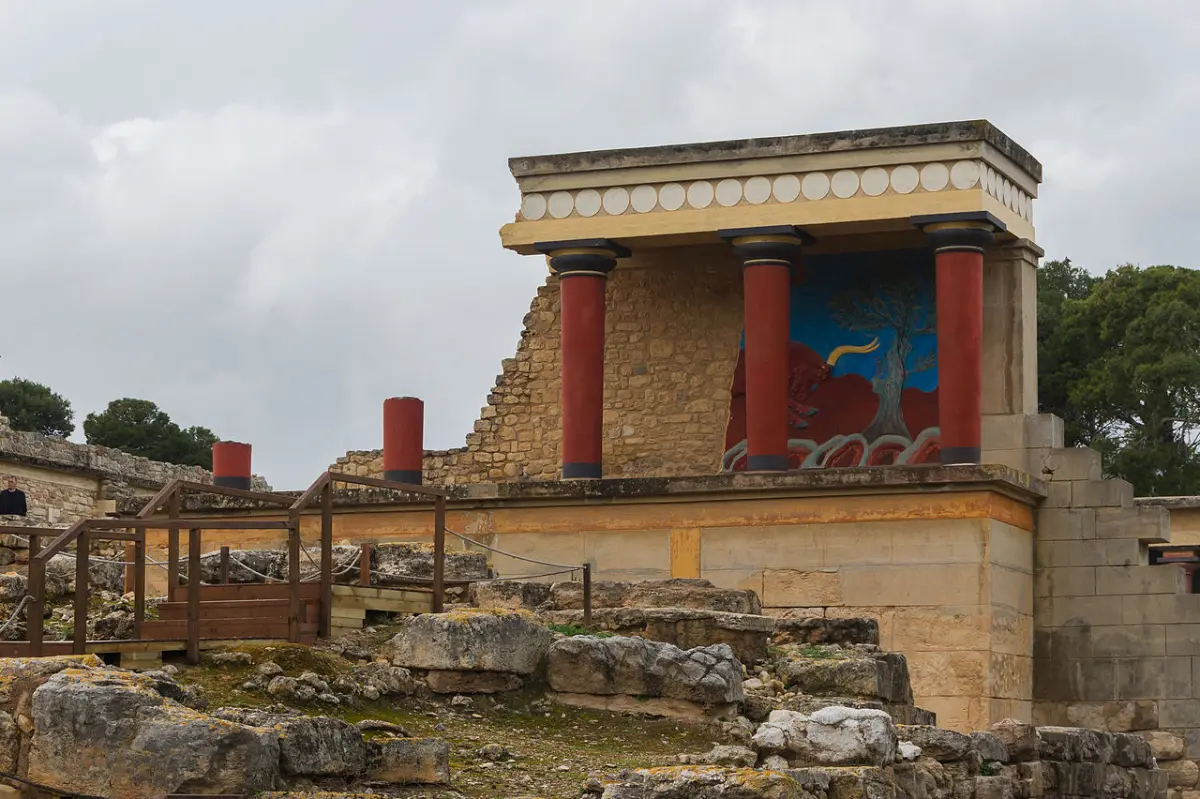
Crete is the home of the Minoans, Europe’s first advanced civilisation. The Palace of Knossos outside Heraklion is the famous set piece, with Phaistos to the south and the Heraklion Archaeological Museum holding the finds that carry the story. These are archaeological sites: ruins and foundations you interpret, with the museum doing much of the storytelling. It is history you read rather than walk into, and it goes back well over three thousand years.
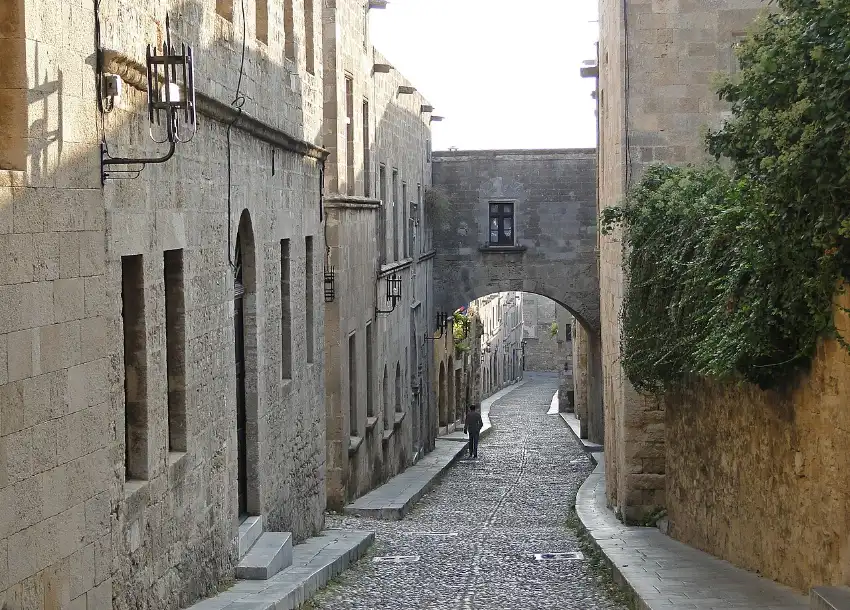
Rhodes offers the opposite experience. Its centrepiece is the medieval walled Rhodes Old Town, a UNESCO World Heritage Site built by the Knights of St John, complete with the Palace of the Grand Master and the cobbled Street of the Knights. Above its bay in the south sits the Acropolis of Lindos, where an ancient temple crowns a village of white houses. The Old Town is not a ruin; it is a living medieval city you walk through, eat in and can sleep inside the walls of.
The practical difference is how you spend the day. At Knossos you work around a site and let the Heraklion museum join the dots; in Rhodes you simply walk the walls, and the Old Town is at its best in the evening, once the cruise crowds have thinned and the lanes belong to the people staying inside them.
Pick Crete for ancient archaeology and the deep Minoan story. Pick Rhodes for one of the best-preserved medieval towns in the Mediterranean, a history you step straight into rather than reconstruct in your head.
Beaches: wild Cretan variety or Rhodes’ easy resort bays
Both islands have excellent beaches, so the split is not quality but effort. Crete’s best are wilder and often earned; Rhodes’s are sandy, close together and easy, which really comes down to whether you will drive for a beach or want one at the end of the street.
Crete’s coastline is long and varied, and its standouts are the ones you make a plan for. Elafonisi’s pink-tinged sand and the Balos lagoon on the northwest tip reach you by rough road or by boat from Kissamos, and the open sweep of Falasarna faces the sunset on the far west coast. All three reward a drive or a crossing, and the payoff is beaches that still feel a little untamed. This is a coast you road-trip, not one you stroll to from the hotel.
Rhodes keeps things closer to hand. Elli sits right below Rhodes Town, while Tsambika, Anthony Quinn Bay and St Paul’s Bay under Lindos are sandy or fine-pebble, sheltered and quick to reach, many backed by resorts, sunbeds and beach bars. The east coast lines them up within short drives of each other, so you can hop between bays without committing a day to the road, and swim somewhere organised without much planning.
Pick Crete if you want variety and will drive to a lagoon for the best of it. Pick Rhodes if you want easy, organised swim beaches close to your base. For the full picture, compare Crete beaches, starting with Elafonisi, against the Rhodes beaches page.
Families: a fortnight of variety or an easy week
Both are strong family islands, and the honest split is again about scale and driving rather than one being better than the other.
Crete gives you more to fill a longer stay. It has sandy, gently shelving beaches plus a stack of things to do with children: water parks, an aquarium near Hersonissos, boat trips, and the freshwater Lake Kournas for a change of pace. The trade-off is the driving, because those attractions are spread across a big island. Rhodes packs family beaches, a walkable old town that reads like a storybook, and short transfers into a compact area, which suits a shorter trip with younger children who want pools and sand more than day trips.
There are honest caveats on each side. The north coast of Crete catches wind, and an exposed beach on a windy day is a different proposition from the same beach on a calm one, so a family beach week benefits from flexibility over where you base and from taking the day’s conditions, the flag and the lifeguard as they come rather than from a page like this one. And our own read, which parents on the forums tend to share, is that Rhodes suits younger children on an easy resort week while Crete gives more back to older ones who will engage with the history and the landscape
Pick Crete for a longer, varied family trip with a car. Pick Rhodes for an easy, compact week with young children. Plan either on the Greece with kids page, or borrow a ready route from the family itinerary.
Getting there, and why combining both is harder than it looks
On their own, both islands are easy. Each has direct flights from Athens, a short hop rather than a journey, plus summer flights from across Europe. Crete has two main airports, at Heraklion and Chania, and a ferry from Piraeus that runs outside the summer season as well; Rhodes has one airport and a longer crossing. Check current timetables on the Greek island ferries and flights to Greece pages.
Combining the two is where the honesty comes in. Crete and Rhodes sit far apart in different island groups, and the direct sea link between them is seasonal and infrequent rather than a service you can build a plan around; the reliable alternative is a short internal flight. That makes doing both a real commitment, not the casual half-day hop that lets you pair the Cyclades. If an easy two-island trip is what you want, the Santorini vs Mykonos pairing is the one that combines without a fuss; Crete and Rhodes do not.
Pick either easily as a standalone trip from Athens, flying in and out of the one island. If you want both, budget for a flight between them and a two-week trip to make the extra distance worthwhile.
Where to base yourself
Rhodes hands you one obvious base; Crete makes you choose a region, and that choice shapes the whole trip.
On Rhodes, most travellers stay in or near Rhodes Town, with the Old Town on one side and the New Town beaches on the other, and day-trip south to Lindos. If beaches come first, you can base in Lindos itself or on a resort strip like Faliraki instead. Either way, one base usually covers the island.
Crete asks a bigger question, because you pick a region rather than a single town. Chania in the west has a pretty Venetian old town and the best west-coast beaches, and is the loveliest base for many; Heraklion in the centre puts you next to Knossos, the archaeological museum and the main transport links; Rethymno splits the difference, and Agios Nikolaos anchors the east. A week often means two bases to avoid backtracking across the island.
Pick Rhodes if you want to unpack once and stay put. Pick Crete if you are happy to move to see more, and start with Chania if you want one base that balances scenery, beaches and an old town. Compare options on the where to stay in Crete and where to stay in Rhodes pages.
Season and cost: Crete stretches further, and comes in cheaper
Both differences point the same way for anyone watching value. Crete works across a longer season and generally costs a little less; Rhodes is a touch pricier and leans harder on summer.
On season, Crete is effectively a year-round island. It has a large permanent population and towns that keep functioning outside the summer, and its position to the south gives it a marginally longer swim season at the shoulders. Rhodes is reliable and sunny in season but quieter and more shuttered in winter. Both get hot and busy at the height of summer, and Rhodes, like parts of the wider southern Mediterranean, has seen wildfire disruption in recent summers, so check current local conditions with the authorities rather than with a travel page before you commit to a specific area. For when-to-go detail, see the best time to visit Greece.
On cost, both are mid-range Greek islands and neither runs Santorini-expensive. Our reading, and it is a reading rather than a finding, is that Crete comes in a little cheaper on food and accommodation, especially away from the resort strips and outside peak summer. It is not unanimous: some travellers find Rhodes cheaper for a packaged pools-and-beaches week, and that dissent is worth more than it looks, because it points at how you travel mattering more than which island you pick. Either can be trimmed by staying off the strip and travelling in the shoulder season. The plannable euro breakdown lives on the what a Greece trip costs page.
Pick Crete for a shoulder-or-off-season trip that still functions and the better everyday value. Pick Rhodes if you are travelling in peak summer anyway and want a concentrated, reliable-sun beach base.
Which should you pick? By traveller type
The same two islands score differently depending on who is going and how long they have, so match the island to the traveller rather than to a leaderboard. Here is the quick router:
- First-timer with a week or less: Rhodes. Compact, walkable, one base and a medieval old town mean less planning and less driving. Start with the Rhodes guide.
- Road-tripper or two-week traveller: Crete, for the distances, the regions and the variety a longer trip can absorb. Build it on the Crete itinerary page.
- History and archaeology lover: Crete for the Minoan, Bronze Age story; choose Rhodes instead only if it is specifically medieval and Crusader history you want.
- Beach-variety seeker willing to drive: Crete, for the lagoons and wilder coast you reach by car or boat.
- Family: an easy week with young children leans Rhodes; a longer, varied trip with older kids leans Crete. Sort it on the Greece with kids page.
- Foodie: Crete, which has a distinct cuisine of its own, from mountain-village tavernas and dakos to raki, and rewards the extra driving.
- Couple after a walkable, romantic old town: Rhodes, for the Old Town lanes and Lindos once the day-trippers have left. Begin with Greece for couples.
- Shoulder- or off-season traveller: Crete, the island most likely to still be open and swimmable, and to reward a shorter drive to a quiet beach.
The rule underneath all of it: name your trip length and your appetite for driving first, and the pick names itself.
Our pick, if you make us choose
Forced to one island, take Crete. If you have a week or more, want to drive, and care about ancient sites, wild beaches, food and value, it is the more complete island and the one to book, and a first Greek road trip that stays in the memory. Choose Rhodes instead when the trip is short, you would rather walk than drive, and a medieval old town is the draw; it delivers a full, easy week from one base. And if you have two weeks and the budget for an internal flight, you can have both: Crete first for the road trip, then Rhodes to slow down.
Whether you frame it as Crete vs Rhodes or Rhodes vs Crete, the deciding factor never changes: how long your trip is and how much you want to drive.
From here, go deep on the Crete guide or the Rhodes guide. If your shortlist is really a different pairing, the same decision spine runs through Santorini vs Mykonos, and the full map is on the Greek islands hub.
Quick answers
Which is better, Crete or Rhodes?
Neither is better outright. Crete wins for size, variety, food and value and rewards a week or more with a car, while Rhodes wins for a compact, walkable medieval old town and an easy few days, so pick the island that matches how long your trip is and how much you want to drive. In short, Crete is the big road-trip island; Rhodes is the compact, walkable week.
Which is bigger, Crete or Rhodes?
Crete, by a wide margin. It is the largest island in Greece and Rhodes is the fourth-largest, and Crete is several times its size. That gap is the reason Crete needs a week and a car while Rhodes fits a few days from one base.
Is Crete or Rhodes cheaper?
Both are mid-range Greek islands and daily costs land close. Our reading is that Crete runs a little cheaper on food and accommodation, especially off the resort strips and outside peak summer, but it is not unanimous and some travellers find Rhodes cheaper for a packaged beach week. Stay off the strip and travel in the shoulder season and either can be trimmed; see the trip-cost page for the breakdown.
Is Crete or Rhodes better for families?
Both are strong. Crete suits a longer, varied family trip, with sandy shelving beaches plus water parks, an aquarium and boat trips, at the cost of more driving. Rhodes suits an easy, compact pools-and-beaches week with younger children. Plan either on the Greece with kids page.
How many days do you need in Crete versus Rhodes?
As an editorial rule of thumb, Crete rewards a week or more, and a rental car helps you reach its regions and best beaches. Rhodes works well in three to four days, stretching to a week if you day-trip to Lindos and the beaches. For a day-by-day plan, use each island’s itinerary page.
Can you visit both Crete and Rhodes in one trip?
Yes, but it is a commitment, not the casual hop that pairs the Cyclades. The two sit far apart in different island groups, linked directly only by a seasonal and infrequent ferry or by a short internal flight, so plan two weeks and most likely a flight between them. See the ferries page for the crossing.
Which has better beaches, Crete or Rhodes?
It depends on how far you will go for one. Crete has the variety and the standout lagoons you often drive or boat to, such as Elafonisi, Balos and Falasarna. Rhodes has easy, sandy, resort-backed bays close to your base, such as Elli, Tsambika and Anthony Quinn Bay. Compare the Crete beaches and Rhodes beaches pages.
Booking
We sell nothing and book nothing for you. Every guide on this page tells you how to arrange each piece yourself - which ferry operator, when to book, what to prebook and what to leave loose.