Chios
Things to do in Chios
Chios is a driving island with two genuinely unusual things on it, and they are unusual in different ways. In the south are medieval villages built as fortresses to protect a crop that grows commercially nowhere else. Inland is a Byzantine monastery whose mosaics are among the finest anywhere. The island holds two UNESCO listings for those two things, and they are not the same kind of listing, which is worth getting straight before you go.
Start with the shrub, because everything in the south follows from it. Mastic is the resin of Pistacia lentiscus var. chia, an evergreen relative of the pistachio. The plant grows around much of the Mediterranean, but it weeps usable resin in commercial quantity only in the south of Chios, where a particular combination of limestone soil, dry summers and mild winters draws the tears out of it. That terroir is the whole story: it is why the resin is Chios-specific, why the villages that harvest it grew up exactly here, and why the product carries an EU Protected Designation of Origin, registered in January 1997 under Commission Regulation (EC) No 123/97 in the category of natural gums and resins. Mastic is not famous-for-Chios by accident of marketing. It is a crop that, commercially, grows in one place.
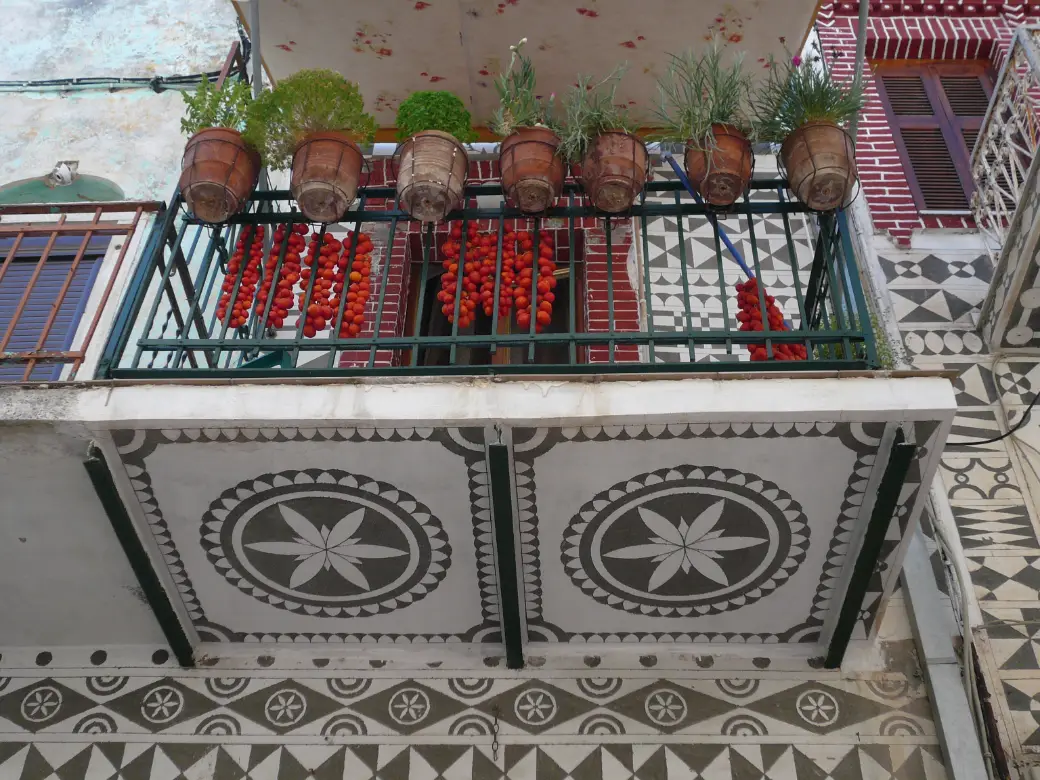
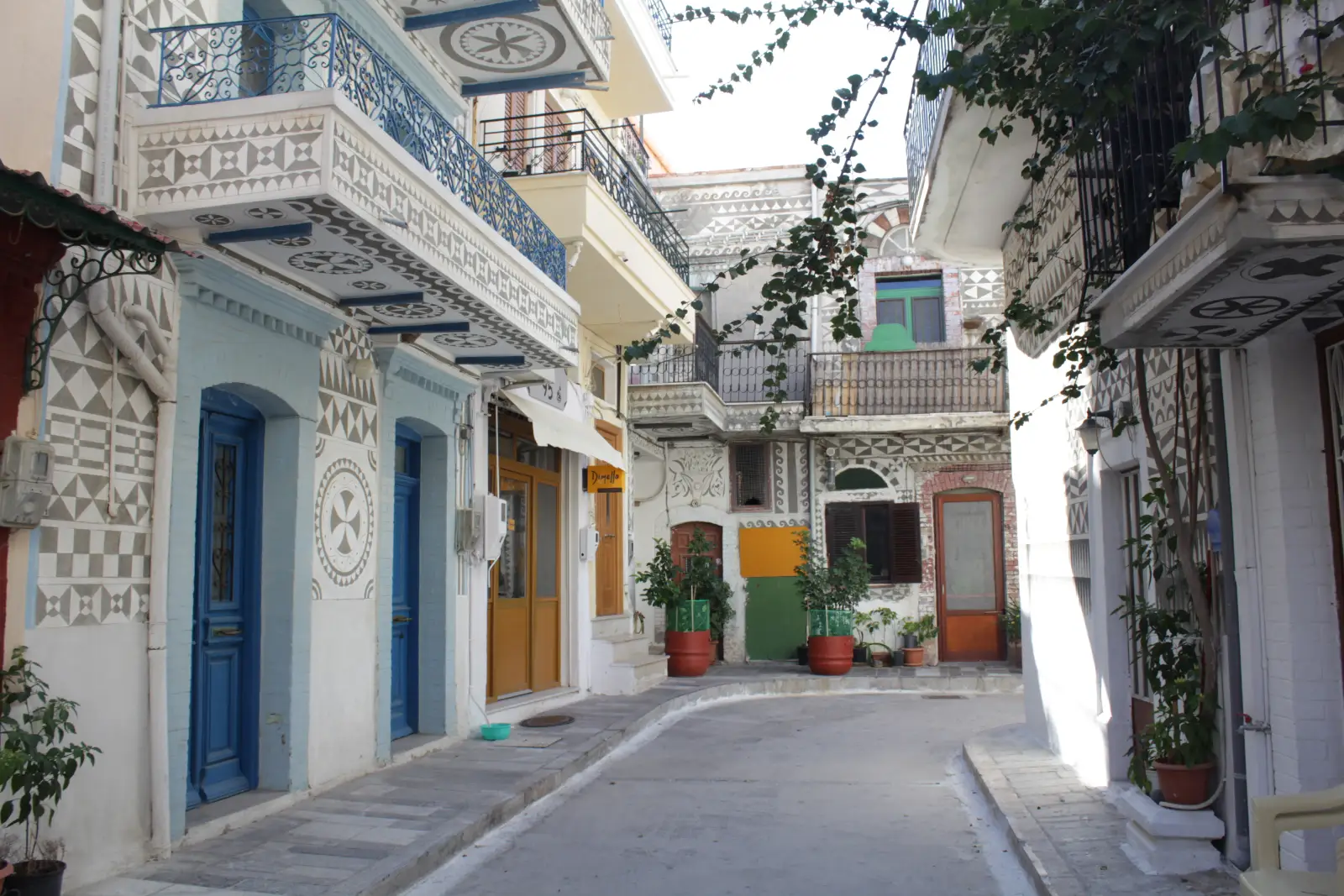
Pyrgi, which is scratched all over. Its houses wear xysta: black-and-white geometric plasterwork made by carving through a dark top coat to the white beneath, so whole facades are covered in a dense grid of triangles, diamonds and stripes. There is nothing else quite like a Pyrgi street in Greece, and the technique is durable in the truest sense, because it is plaster rather than paint and has been redone the same way for generations.
Mesta, which is a fortified maze. It was built as a closed pentagon of houses whose outer walls formed the village’s defensive perimeter, with the alleys inside deliberately narrow, dim and confusing to slow anyone who breached them. Walk it now and you lose your bearings within a minute, which is exactly what it was for. Olympi nearby keeps the same fortified plan, and the mastic villages sit only a short drive apart, roughly twenty minutes from one to the next, which makes them a natural half-day loop by car.
The harvest, and the second UNESCO listing. In late summer growers score the bark so the resin weeps out in tears that harden on the ground, then clean and sort them by hand. That know-how, the cultivation of mastic on Chios, was inscribed in 2014 on the Representative List of the Intangible Cultural Heritage of Humanity, which protects living practices rather than buildings. Keep it separate from the monastery’s listing below: one is about a skill, the other about a place. How the resin reaches the table, in the spoon sweets, the liqueur and the local baking, is part of Greek food and drink.
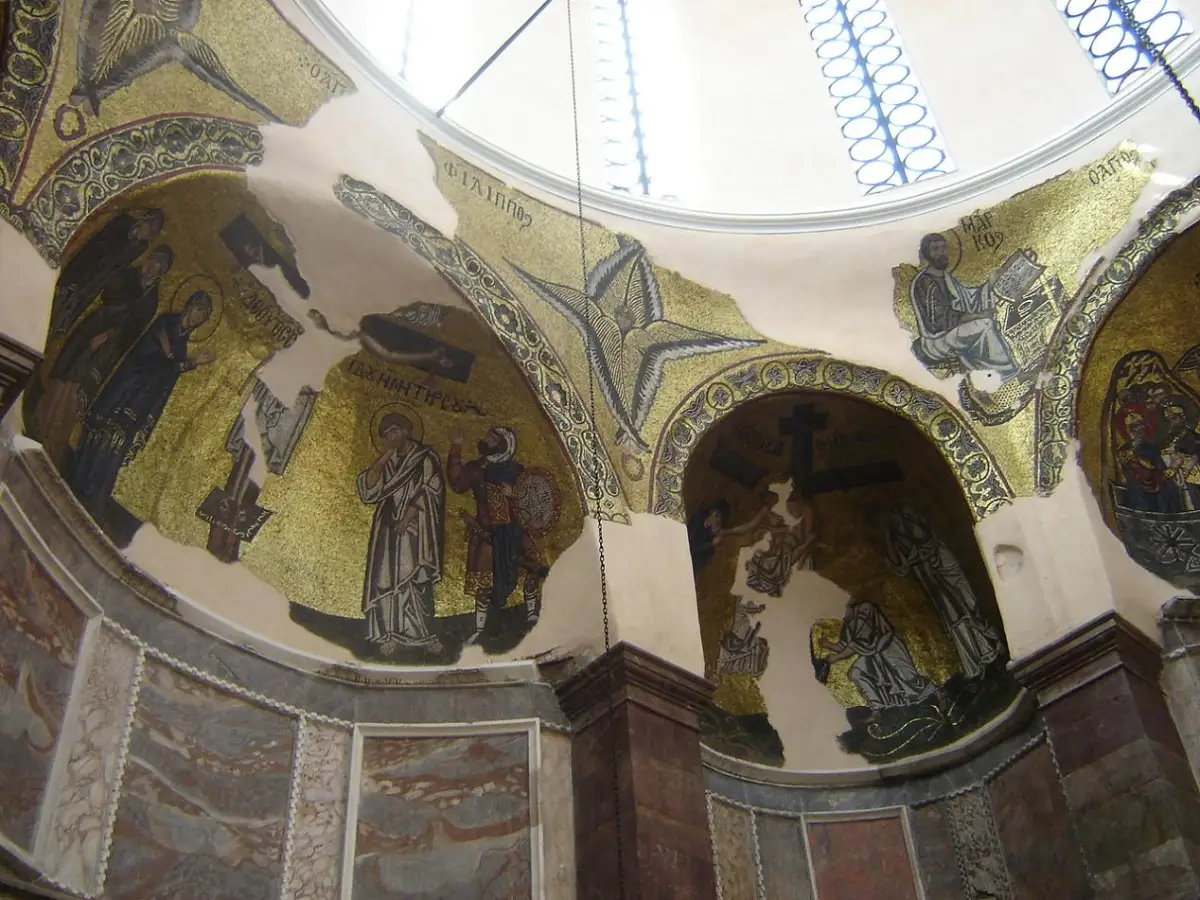
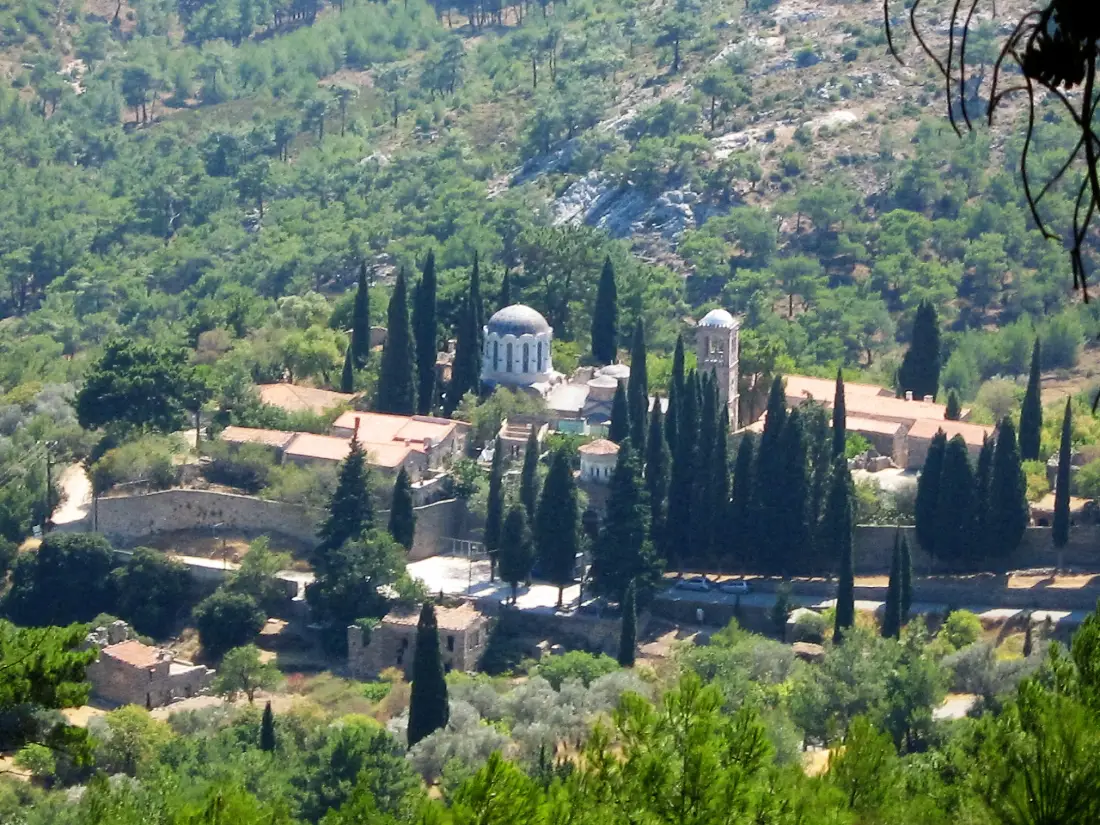
Nea Moni, which is the masterpiece. The monastery was founded in 1042, in the eleventh century, not the fifteenth as some guides still print. Its church holds some of the finest surviving mosaics of what art historians call the second golden age of Byzantine art: gold-ground works, figures set against fields of gold tesserae. They are why the monastery sits on the UNESCO World Heritage list, inscribed together with the mainland monasteries of Daphni and Hosios Loukas as a single property. We print no inscription year or criteria, because we could not read UNESCO’s own page. The monastery stands in the hills inland, a short drive west of Chios Town. Entry is free, it is an active religious site, and modest dress is expected. Go for the mosaics; they are the point. The wider set is in UNESCO sites in Greece.
Anavatos, and the part that does not get tidied away. During the Greek War of Independence, Ottoman forces killed or enslaved much of the island’s population in reprisal in 1822, the event Delacroix painted as The Massacre at Chios, which carried the island’s name across Europe. You feel its aftermath most at Anavatos, a village on a cliff in the interior that was largely abandoned and now stands as a near-empty grey shell above the plain. It is a sombre place and it belongs in any honest account of Chios.
The rocket war at Vrontados. Two rival parish churches near Chios Town stage the rouketopolemos on the night of Orthodox Easter Saturday, each side firing thousands of homemade rockets at the other’s bell tower across the valley. It is a genuine, long-running local event, and timing a spring trip to it puts you in front of something you will not see elsewhere. Its scale and its organisation are settled locally, close to the night itself, and both have changed in recent years, so check what is planned before you build a trip around the date.
Why all of this needs a car. The mastic villages are in the south, Nea Moni is inland, Anavatos is further into the interior and Chios Town is on the east coast. Nothing connects them conveniently, which is the practical fact that shapes a Chios itinerary more than any sight on this page. The rest of the island is in our Chios guide, and the neighbours are in the north Aegean.