That piece of paper is a regulated document. Greece’s market rules tell a restaurant what its price list has to say: whether the fish is sold by weight, whether the dish arrived frozen, what the oil is, what is in the salad, where the wine came from. Learn that short list and the menu starts describing the kitchen to you before you have ordered anything. A menu that leaves all of it out has described the kitchen too.
The rules on this page come from Greece’s codified market rules for the distribution and marketing of products and the provision of services, published by the state. They are not anybody’s opinion about authenticity.
So here is the whole page in one line: order fewer plates than feels right, put them in the middle of the table, and ask what came out of the kitchen this morning.
This is not a list of twenty-five dishes. Those are everywhere, and not one of them helps you in a doorway.
Last checked: 13 July 2026

Diagram by Greece Trips. Free to reuse with credit - CC BY 4.0.
A Greek meal is a table, not a sequence of plates
Order fewer plates than there are people, and share every one of them. Small dishes land in the middle of the table and everybody eats from them. The plates belong to the table rather than to a person, they come out when the kitchen finishes them rather than in courses, and the table fills up faster than you expect.
So compose the order, instead of picking a dish each.
For a table of two, three or four: three or four small plates for the middle. One or two things from the grill or from the tray, to share between everyone rather than one each. A salad. Bread if you want it. Then stop, eat, and order a second round only if you still want it.
That is the whole method, and it is why a Greek table ends up with the right amount of food on it. The most expensive mistake a foreigner makes in Greece is ordering one main course each, and it does not feel like a mistake until all four arrive at once.
The pace follows from the same logic. A meal here is long, and the bill arrives when you ask for it, which is the signal that you are finished rather than a complaint. Do not take that as a promise, though. A two-hundred-cover taverna on a harbour front in August turns tables like any other business, and it may well be brisk with you. The unhurried version of Greece is real, and it is much likelier one street back and later in the evening.
Later is the other half of it. Dinner is late by northern European standards, and a taverna that is empty at half past seven is not a bad taverna, it is an early one. When anything is actually open, and what shuts in the afternoon, is a question of its own: see siesta and opening hours.
Bread and water arrive at the table without being ordered. They are neither a gift nor a trick, and a rule governs both. It is further down this page, in the section it belongs to.
The rest of what happens at the table, from who pours the wine to who insists on paying, is in Greek etiquette and customs.
The words on the menu, and what they are actually telling you
On a Greek menu, the mageirefta are the dishes cooked slowly earlier in the day and held in trays. Tis oras is what is grilled to order. The mageirefta are what the kitchen is proudest of, and they are the food most visitors walk straight past, because nothing about them is sizzling.
That distinction decides your dinner, and it costs nothing to learn. The rest of the menu’s vocabulary is short.
| The word | What it tells you about the food |
|---|---|
| Orektika | The openers. What you eat first, while the rest is still coming |
| Mezedes | Small plates for the middle of the table. Order enough of them and they are the whole meal |
| Salates | The salads. The price list is required to name what is in each one |
| Tis oras | Grilled to order, when you ask for it. Chops, skewers, whole fish |
| Mageirefta | Cooked earlier, slowly, in a tray. The kitchen’s own cooking |
| Tou fournou | From the oven. Usually a mageirefto by another name |
| Ladera | Vegetables cooked in olive oil, served warm or at room temperature |
| Nistisima | The fasting dishes, cooked without meat, and a permanent part of the menu |
The sign outside carries information too, and it is information the menu will not repeat. A taverna cooks broadly. A psistaria is a grill. A psarotaverna is built around fish. A mezedopoleio serves small plates and expects you to make a meal of them. An ouzeri and a tsipouradiko do the same thing around a drink: ouzo in the first, tsipouro in the second, and small plates keep arriving with it. Read the sign and you already know the shape of the evening.
Then the sentence that changes a trip. The printed card is not the whole offer. Ask what came out of the kitchen today, and ask what the mageirefta are. In a kitchen that cooked this morning, the answer is a list, delivered at speed, sometimes with an invitation to come and look at the trays. Where nothing was cooked this morning, the answer is short.
Ask in Greek if you can manage it, and in English if you cannot. A few words go a long way here, and the alphabet is less hostile than it looks: see the Greek alphabet and phrases.
What to order, and the one question to ask before you do
A list of dishes does not survive contact with a real menu, so this page will not print one. What follows is the shape a Greek menu tends to have, so that you can read a menu we have never seen.
In the mezedes column you will meet dips, most often tzatziki, fava and taramosalata; small fried things, from cheese to courgette fritters; grilled octopus; and little pies. Two or three of these feed a table while the rest of the food is cooking.
Under tis oras sit the grilled things: skewers, lamb chops, pork chops, a whole fish. This is where a table of foreigners usually orders one each, and it is exactly where you should order two for four people.
Under the mageirefta are the tray dishes: stuffed vegetables, moussaka and pastitsio, slow-cooked lamb and beef, beans and pulses, and the ladera. This is the food that will be gone by ten in the evening, because Greeks ordered it.
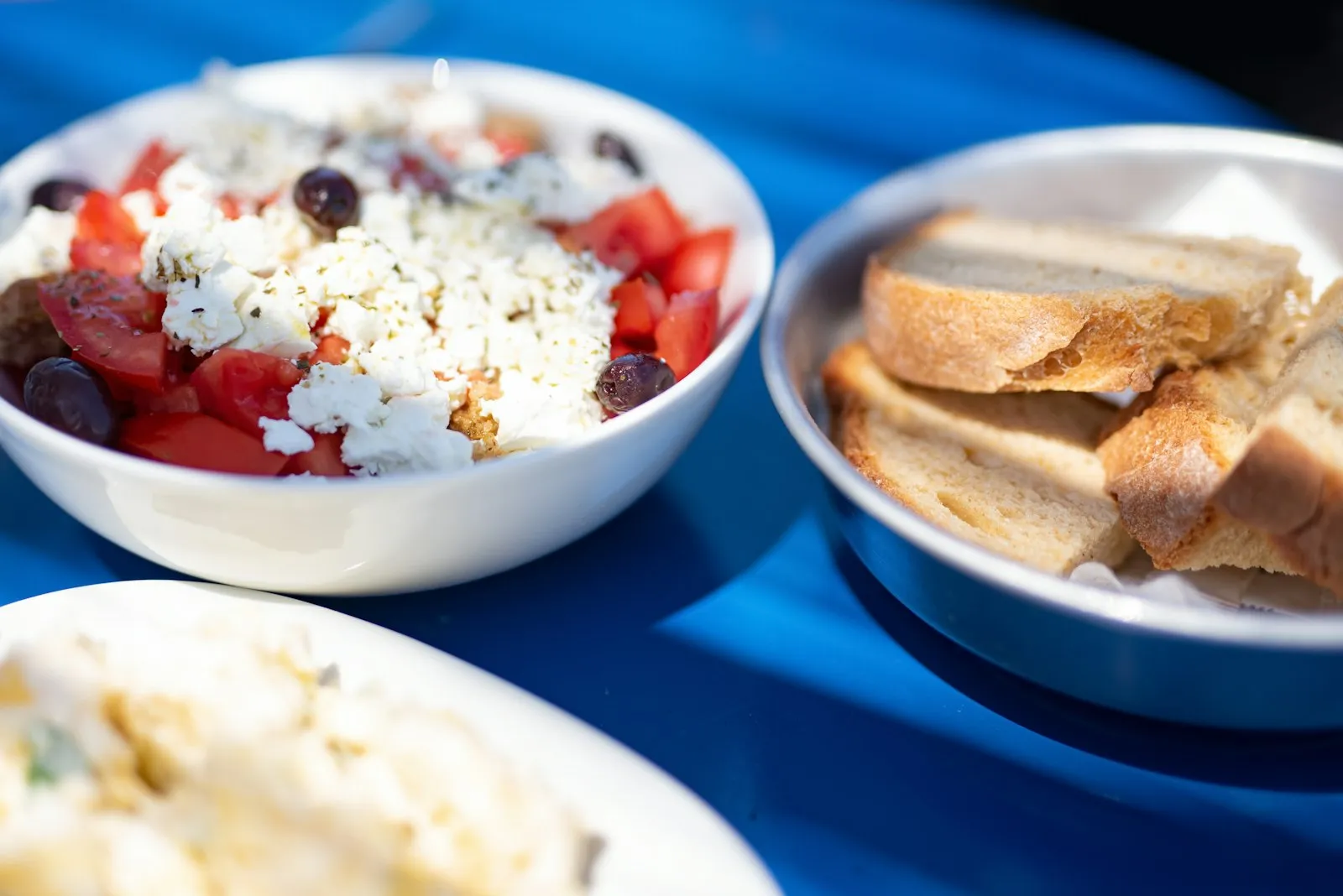
The salads are worth being precise about. Order a horiatiki, the village salad the world calls a Greek salad, and what arrives is tomato, cucumber, onion, pepper, olives and a slab of feta, dressed with oil and oregano. If you want leaves, that is a different salad with a different name. You do not have to take our word for the composition, either, because the price list is required to name the basic ingredients of every salad it sells.
Vegetarians eat better here than they expect, and it is structural rather than lucky. The Orthodox fasting calendar takes meat off a lot of Greek tables for a lot of the year, so the ladera and the nistisima are a permanent part of a kitchen’s repertoire rather than a concession bolted onto the end of the card. Ask for the ladera, and ask what is nistisimo. One caution is worth more than any list: a dish can be meatless and still arrive with feta on it or honey in it, so if that matters to you, ask, and nistisimo is the word to ask with.
Then ask the question, which is the whole section. What is fresh today, and what are the mageirefta. Order that.
Where to eat is a different question, and it is answered by area rather than by name: see restaurants in Athens and restaurants in Crete.
The law is printed on the menu, and it is the best trap detector you have
Greece writes down what a restaurant’s price list must contain, and the list is short enough to check from the pavement.
What a Greek price list is required to carry:
- A price list available to every customer before they order, and one displayed at the entrance where you can see it from outside.
- Greek on the page. A foreign language is an addition to it, not a replacement for it.
- Final prices, with VAT included.
- The word for frozen against a dish that was frozen, and pre-cooked or pre-fried where those apply.
- The mark “by the kilo” beside anything sold by weight.
- The type of oil the kitchen uses, and the basic ingredients of each salad.
- The country of origin and the producer of any wine served without its bottle in view.
- Any minimum charge, printed on the list itself.
Source: Greece’s market rules for trade and services, the DI.E.P.P.Y. rules (Ministerial Decision 91354/2017), catering chapter. Last checked 13 July 2026.
Then read for what is missing, which is the part nobody tells you. No price list at the door. No Greek anywhere on the card. A fish with a price beside it and no mark saying that price is a kilo. A hundred dishes on the menu and not one frozen declaration among them. Each of those is a gap between what the menu is doing and what it is supposed to do, and you can see all four from the street, in ten seconds, without confronting anybody.
The bread and the cover charge. The rules say a catering business may not charge you for a couvert, meaning the place setting itself: the cutlery, the napkin, the service. They also say no product is served and charged for without the customer’s prior consent, and the text’s own examples are bottled water and bread. That is not the same as “the bread is free”, and translating it that way would be dishonest. Bread is normally a small charge. They are supposed to ask, and in practice they do ask. Saying yes is the consent. If it lands on the bill and nobody asked, the price list and the receipt are what you point at. The tip is a separate thing entirely, and it has its own page: tipping in Greece.
The fish. Fresh fish is commonly sold by weight, and the menu is required to mark it as sold by the kilo. The number beside it is the price of a kilo, not the price of your dinner. The rules go further: you are meant to be able to know the raw weight of the fish you chose and the final price you will be asked to pay before you eat it. Point at the fish, ask what it weighs, and ask what that comes to. It is an ordinary question and it is asked every night.
The receipt closes it. You are entitled to an itemised bill at price-list prices, and catering businesses display a notice, in Greek and in English, saying the consumer is not obliged to pay if they have not been given the legal receipt. Asking for it is routine here. How you settle the bill, in cash or on the card machine, is money in Greece.
The great majority of Greek restaurants carry all of this, and the rules exist because the state expects them to be followed. Learning the list is not a reason to arrive suspicious. It is what lets you tell, quickly, which kind of place you are standing in front of.
What a tourist trap looks like from the pavement
Start with the logic, because it is what makes this fair rather than snobbish. A restaurant that lives off people who will never come back is optimised for the first ten seconds. A restaurant that lives off people who do come back is optimised for the food. Every tell below is really a tell about which of those two businesses you are looking at.
Someone standing outside the door, inviting you in. Photographs of the food on the menu. Six languages on the card and no Greek. A laminated menu identical to the one at the next door, and the door after that. A hundred dishes spanning three cuisines, from a kitchen you can see the size of. A position that is selling a view rather than a kitchen.
None of that is proof, and a page that turns it into a rule will walk you past a good dinner. A restaurant with a view can cook. A busy square is not a crime, and somebody has to have the table on the corner. These are probabilities, not verdicts, and they only start to mean something when every door on the street is doing all of them at once.
Which is also why the field’s favourite advice is useless. “Eat where the locals eat” does nothing for you on a strip in August where everyone at every table is on holiday, including the ones who look like they belong there. Here is the version that survives August: walk one street back from the water. Look for the shorter menu. Look for the price list at the door. Ask what the mageirefta are, and listen to how fast the answer comes.
We name no restaurant on this page, and no street or square either. Places rebrand, change hands and close between one season and the next, so a page built on their names is wrong by August, and accusing a named business of anything is not something we are in a position to do. The shape of a business does not close. That is what we describe.
For the where, by area: restaurants in Santorini and restaurants in Rhodes.
What to drink, and how to order coffee without guessing
The house wine is a category, not a compromise. It arrives in a carafe or a jug, it is usually local, and ordering it is a perfectly normal thing for an adult to do in a Greek taverna. There is a sourced detail here that nobody prints: wine served without its packaging in view is supposed to carry its country of origin and its producer on the price list. So a house wine with nothing behind it on the card is one more small gap between what the menu is doing and what it is supposed to do.
Ouzo and tsipouro are drunk with food rather than before it. Order either and small plates tend to arrive alongside, which is the point of them: they are the reason the ouzeri and the tsipouradiko exist as places. Retsina deserves an honest sentence rather than a sales pitch. It is a real wine with a long history and a resinous taste that divides people down the middle, and one glass will tell you which side of that line you are on.
Greek coffee is ordered by its sweetness, not by its size. Sketos is without sugar, metrios is medium, glykos is sweet. It arrives small and strong, with grounds settled at the bottom that you leave in the cup. That is a different order entirely from the freddo, the cold whipped espresso or cappuccino that Greece actually drinks all day, in volume, from breakfast onwards.
Water arrives at the table like the bread does. It can be charged for, they are supposed to ask you first, and that is the consent rule from the section above doing its work. Everything else about water in Greece belongs to another page: power, water and Wi-Fi.
We name no producer, no label and no bar here, and print no price. What a week of all this comes to is a different calculation: what a Greece trip costs.
Order less, share it, and ask what came out of the kitchen
Three habits carry the whole page, and none of them requires knowing a single dish by name.
Order fewer plates than feels right, and put them in the middle of the table. Ask what is fresh today and what the mageirefta are, then order that. And before you sit down, look at the menu for the things it is supposed to say: the price list at the door, the Greek on the page, the mark on the fish.
Most places will feed you well. The reason to know all this is not to arrive suspicious, it is to be able to tell, in about ten seconds, which street you are standing on.
What we re-check on this page: Greece’s market rules for catering, last checked 13 July 2026. How we date and verify what you read is set out in our editorial policy.
Next: what to leave on the table, in tipping in Greece, and where to eat by neighbourhood in restaurants in Athens.
Common questions about eating in Greece
What should I order in a Greek taverna?
Order a few small plates for the middle of the table, one or two things from the grill or the tray to share rather than one each, and a salad. Then ask what is fresh today and what the mageirefta are, and order that. The commonest foreigner’s mistake is a main course each, and it all arrives at once.
What does mageirefta mean on a Greek menu?
Mageirefta are the dishes cooked slowly earlier in the day and held in trays: stuffed vegetables, slow-cooked meat, beans, moussaka. Tis oras is what is grilled to order. The mageirefta are what a Greek kitchen is proudest of and what most visitors never order. Ask for them by name and you will be handed the food the kitchen actually cares about.
Is the bread free in Greek restaurants?
Bread is normally a small charge, and it is not a cover charge. Greece’s market rules say a catering business may not charge for a couvert, the place setting itself, and that no product, with bread and bottled water given as the examples, is served and charged for without the customer’s prior consent. They are supposed to ask, and in practice they do. Saying yes is the consent. If it appears on the bill and nobody asked, the price list and the receipt are what you point at. See money in Greece.
Why is the fish so expensive in Greece?
Usually because it is sold by weight and the menu is telling you the price of a kilo, not the price of your dinner. Greece’s market rules require an item sold by weight to be marked “by the kilo”, and you are meant to know the raw weight of your fish and the final price before you eat it. So ask what it weighs, and ask what that comes to.
How do I spot a tourist trap restaurant in Greece?
From the street: someone outside inviting you in, photographs of the food on the menu, six languages and no Greek, an identical laminated card at every door. From the menu, which is the checkable half: Greece’s market rules say the price list belongs at the entrance, exists in Greek, marks anything sold by the kilo and declares a frozen or pre-cooked dish. Read for what is missing. None of it is proof on its own.
Is Greek food good for vegetarians?
Yes, and it is structural rather than accidental. The Orthodox fasting calendar means vegetable dishes cooked in olive oil (ladera) and fasting dishes (nistisima) are a permanent part of a Greek menu rather than a bolted-on section. Ask for the ladera, and ask what is nistisimo. A meatless dish can still arrive with feta on it or honey in it, so if that matters, ask.
What do Greeks drink with dinner?
House wine from a carafe, ouzo or tsipouro alongside the food rather than before it, beer, and water. The detail nobody prints: Greece’s market rules say wine served without its packaging in view should carry its country of origin and its producer on the price list, so a house wine with nothing behind it on the card is a small gap worth noticing. Water in Greece has its own page: power, water and Wi-Fi.
When do Greeks eat dinner?
Late, by northern European standards. A taverna that is empty at half past seven is not a bad taverna, it is an early one. The practical consequence matters more than a clock time: if you want the room full and the kitchen in its rhythm, go later than you would at home. When things are open, and what shuts in the afternoon, is covered in siesta and opening hours.
Booking
We sell nothing and book nothing for you. Every guide on this page tells you how to arrange each piece yourself - which ferry operator, when to book, what to prebook and what to leave loose.