Island group
Dodecanese, South Aegean, Greece; in the southeastern Aegean just north of Rhodes and close to the Turkish coast
Distance from Rhodes
a short hop north; measured as a crossing rather than a distance, about fifty minutes on the fast boat
Airport
none; Symi is reached only by boat, most often from Rhodes
Crossing from Rhodes
about 50 minutes on the high-speed catamaran, up to around 1.5 hours on a conventional car ferry; a few sailings call at Panormitis. Operators on the route include Dodekanisos Seaways and Blue Star
Two settlements
Gialos (the harbour, in the north) and Chorio / Ano Symi (the upper town on the ridge), joined by the Kali Strata staircase
Kali Strata
a stone staircase of several hundred steps, commonly counted at around 500
Panormitis
the Monastery of the Archangel Michael, patron saint of Symi, at the island’s southern end, a dozen kilometres or so from Symi town by road. Present church rebuilt 1783 by the monks Neophytos and Kallistos after pirate raids; icon’s silver revetment 1724; iconostasis 1788; bell tower 1905-1911. Ecclesiastical and folklore museums plus a library on site
Panormitis feast
the November feast of the Archangel, the Synaxis of the Archangels, 8 November
Sponge heritage
wealth from 19th- and early-20th-century sponge diving and merchant shipping built the neoclassical harbour; one of the Aegean’s great sponge-diving centres, with Kalymnos and Chalki
Best months
late April to June and September into October; high summer very hot in the enclosed harbour and busiest
Travel details last checked July 2026.
Where Symi sits, and why it looks nothing like the Cyclades
Symi is small, mountainous and rocky, one of the northern islands of the Dodecanese, and it sits so close to the coast of Turkey that the mainland is visible across the water. Rhodes lies to the south, about fifty minutes away on a high-speed catamaran, which is why almost every visitor arrives from there.
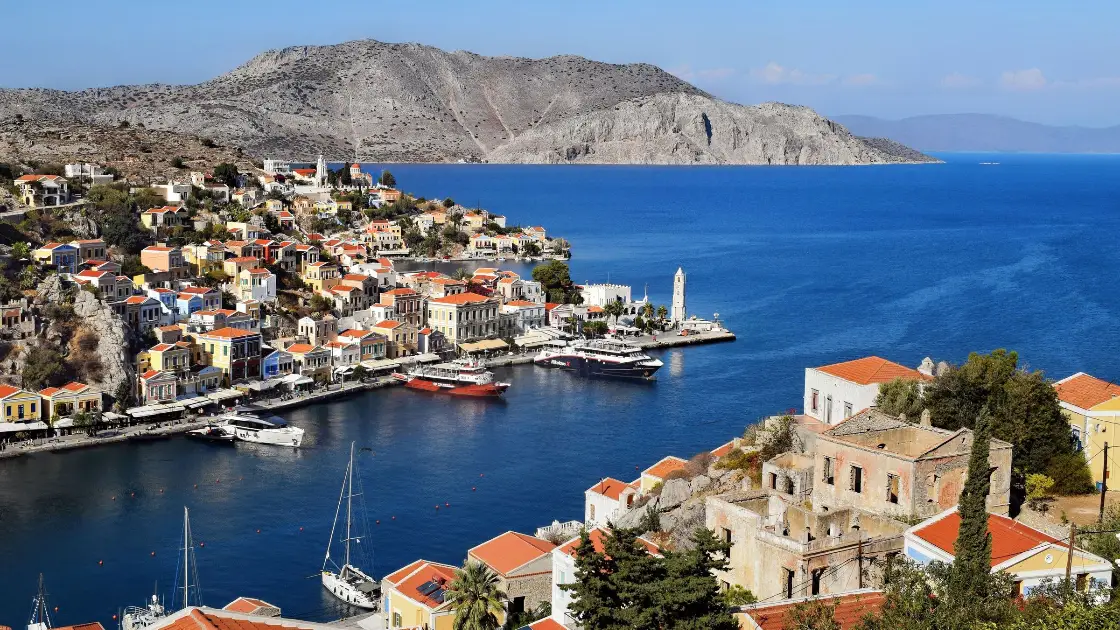
What makes the island look the way it does is money, and the kind of money matters. Unlike the whitewashed cubes of the Cyclades, Symi’s houses are tall neoclassical mansions, painted in ochre, terracotta, faded blue and cream, with pediments, moulded floors and decorated window frames. They went up in the 1800s, when this was one of the wealthier islands of the Aegean, built by merchant and sponge-diving families who wanted their fortunes to show. The colour is not a modern tourist-board choice. It is inherited, and the town has since protected the style, which is why the harbour still reads as one composition rather than a patchwork.
The island is essentially one town in two halves. Gialos is the harbour at the water; Chorio, also called Ano Symi, is the older settlement on the ridge above it. Hold those two names and you have the shape of the place.

Diagram by Greece Trips. Free to reuse with credit - CC BY 4.0.
You can set Symi against its neighbours, and see how it compares to the rest of the group, on the Dodecanese islands page.
The harbour: an amphitheatre of pastel mansions
Symi’s harbour houses are colourful because nineteenth-century sponge and shipping merchants built tall neoclassical mansions and painted them in ochre, terracotta and blue, and the town has since protected that architectural style. So instead of white cubes you get a tiered amphitheatre of pastel facades rising straight from the water. It is one of the most photographed arrivals in Greece, and for once the photograph undersells it, because a still image cannot show how the whole bowl wraps around you as the boat comes in.
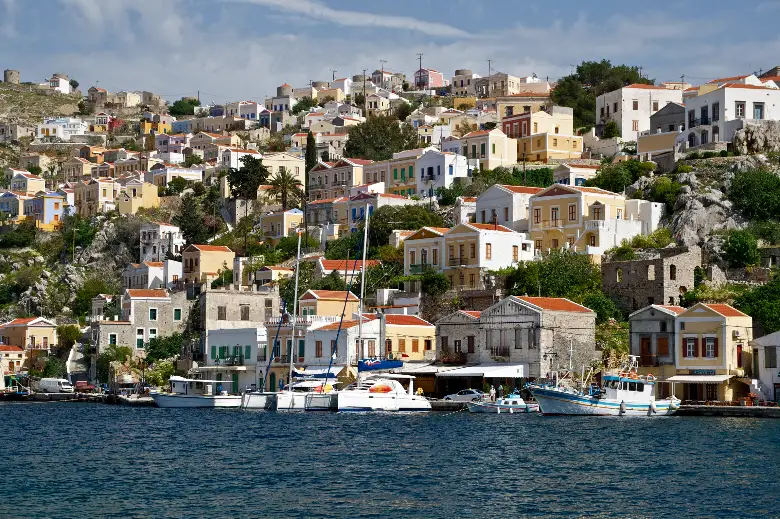
The shape is the point. Gialos sits in a natural stone bowl, and the mansions climb its steep sides in tiers, which is what produces the amphitheatre effect and, later in the day, the trapped heat. The quay runs around the horseshoe of the harbour at sea level, lined with the tall painted fronts. The one long-standing landmark worth fixing on is the stone clock tower at the harbour mouth, which travel and local accounts generally place in the 1880s.
There is a rhythm to the harbour, and it is worth planning around. Around the middle of the day, Gialos fills with day-trip groups off the Rhodes boats, and in high summer it can feel both crowded and hot. Then, in the late afternoon, the excursion boats cast off for the return leg, the groups go with them, and the harbour settles back to the island’s own pace. The buildings you came to photograph are the same either way. The town around them is not. That afternoon shift is the single best argument for staying the night, and it is why the trade the harbour was built on deserves a few lines of its own.
Sponges: the trade that built the harbour
Every mansion on that harbour was paid for by the sea. In the nineteenth and early twentieth centuries Symi grew rich on sponge diving and merchant shipping, and it was one of the great sponge-diving centres of the Aegean, alongside neighbouring Kalymnos and Chalki. Before synthetic sponges existed, the natural sponge was a rare and valuable product, and the handful of islands that knew how to harvest it held something close to a monopoly. The island’s heyday ran through the 1800s and into the early 1900s, and the merchant families spent their fortunes on the houses you now walk beneath.
You will read in places that Symi once had the largest sponge fleet in the world. That is a striking claim and a hard one to stand behind on a single source, so it is fairer to say that Symi ran one of the Aegean’s largest sponge fleets, which the record supports without the superlative.
The trade did not survive the twentieth century. Sponge diving was dangerous work, accidents and diving sickness took a heavy toll on the men who did it, and as the natural-sponge market collapsed the fleet declined and much of the population left for good. What remains is visible in two places. Natural sponges are still sold from stalls and shops along the harbour, to the same day boats the trade once served, and the island’s nautical museum tells the diving story properly for anyone who wants more than the shopfronts. Learn that history and the harbour stops being merely pretty and starts being explained.
Chorio and the Kali Strata: the town above the town
Above the harbour is the other half of the island. Chorio, also called Ano Symi, is the older upper town spread along the ridge, quieter and more residential than Gialos, a warren of narrow car-free lanes and houses in every state of repair. Fewer day-trippers make it up here, which is much of its appeal.
The link between the two towns is the Kali Strata, and it is both the island’s finest walk and its first hard truth about the terrain. It is a broad stone staircase of several hundred steps that climbs from the harbour to Chorio, lined the whole way with neoclassical mansions, some restored, some roofless and waiting. Counts vary between sources, and it is commonly reckoned at around 500 steps.
At the top you reach the Kastro, the old castle site built over an ancient acropolis, and a line of windmills on the ridge, with wide views back down over the harbour bowl and out across the water toward Turkey.
Here is the honest part. Symi is a steps-and-hills island with very little flat ground, and the Kali Strata is a genuine climb, hot and exposed in the middle of the day. For anyone with limited mobility, a knee that objects to stairs, or a pushchair, that shapes the whole visit. The workaround is practical rather than defeating: climb early or late to dodge the midday heat, take it slowly, and rest on the landings. The upper town is reachable by road as well, so the staircase is the main route between the two halves of town rather than the only way to Chorio. If step-free travel is a firm requirement, read accessibility in Greece before you commit to Symi.
Panormitis monastery at the island’s southern tip
At the far southern end of the island, in a sheltered bay a long way from the harbour, stands Symi’s spiritual centre: the Monastery of the Archangel Michael at Panormitis. Archangel Michael is the island’s patron saint, and this is his monastery, set among cypress and olive trees by the water, a winding drive of a dozen kilometres or so from Symi town across the spine of the island.
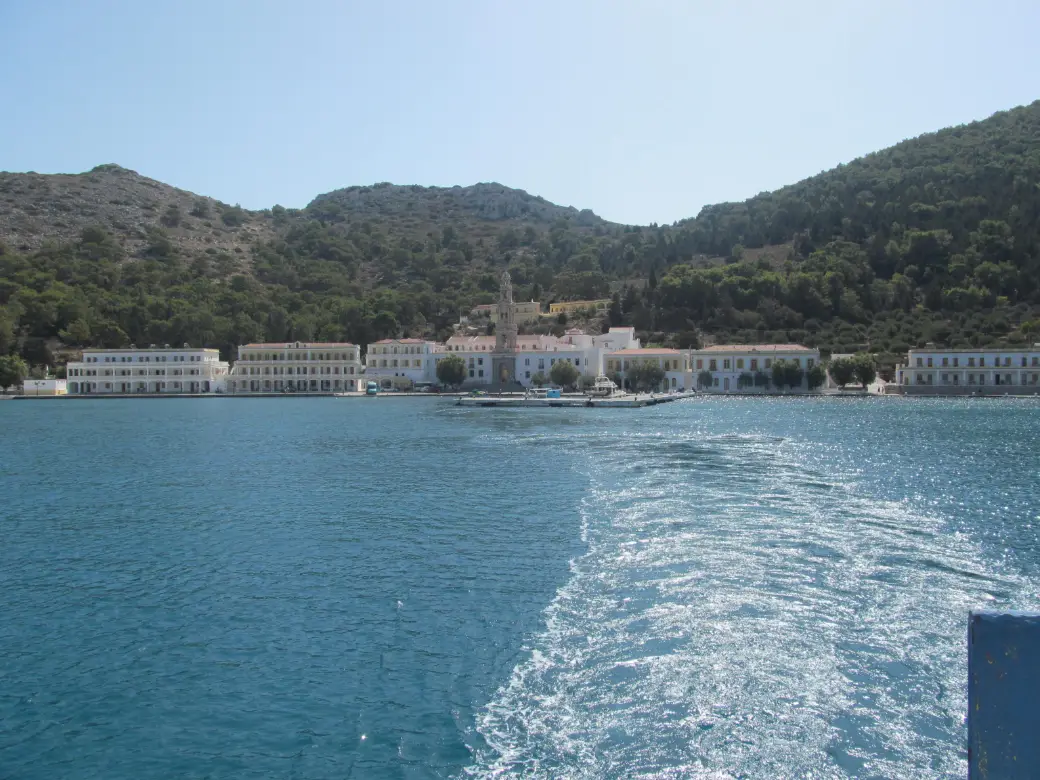
It is a working pilgrimage site, one of the most important in the Dodecanese, and the Metropolis of Symi describes it as a spiritual magnet for the faithful of the whole island group. Behind its walls are the silver-clad icon of the Archangel that pilgrims come to venerate, a carved wooden iconostasis and painted interior from the end of the eighteenth century, and two small museums, one ecclesiastical and one of folklore, alongside the monastery library. The tall bell tower over the gate is later than it looks: it went up in the first decade of the twentieth century, in a Renaissance manner with baroque detailing. The great gathering is the November feast of the Archangel, the Synaxis of the Archangels, which the Orthodox calendar fixes on 8 November.
How old it is depends on which account you trust, and they do not agree: you will see it placed in the Frankish centuries, in the fifteenth century, and later still, with some sources reaching further back. What the Metropolis itself records is narrower and more useful: the monastery grew up around the finding of the icon, whose own date is unknown, its silver revetment was finished in 1724, and the church you walk into today was rebuilt in 1783 by two monks, Neophytos and Kallistos, after pirate raids. So the honest description is a centuries-old monastery in largely its present, eighteenth-century form, and this page will not hand you a single founding year the sources cannot settle.
Location shapes how most people see it. Many day boats from Rhodes call at Panormitis before Gialos, so a typical day trip shows you the monastery in the south and the harbour in the north and little of the island in between, which is much of the case for staying a night.
Beaches, and how you actually reach them
Set your expectations before you think about Symi’s beaches, because they are not the reason the island is famous and they will disappoint anyone picturing a resort strip. They are small, mostly pebbly with little sand, and many are reached only from the water. This is a swimming-in-clear-coves island rather than a lie-on-a-sandbar one, and it becomes a real pleasure once you stop wishing it were the other thing.
The mechanism is the boat taxi. From Gialos harbour, small shuttle boats run out through the day to the coves scattered around the coast, dropping and collecting swimmers. How many run, and how late, follows the season rather than a published timetable, so ask at the quay on the morning you want to go. A couple of beaches near town, Nos and Nimborio, are within walking distance of the harbour, while others such as Agios Nikolaos, Agia Marina, Nanou, Marathounda and Agios Georgios are reached by shuttle boat or a rough track. None of them are large, and there is little to gain from ranking them; pick by how far you want to go and how much company you want when you arrive.
The payoff is the water itself, sheltered and clear in the coves on a calm day. What the Greek sea is actually like, and how much the wind and the season change it, is worth reading before you build a trip around swimming: see what the sea is like for the honest version rather than the brochure one.
Getting to Symi: the boat from Rhodes
Symi has no airport, so you reach it by boat, and for almost everyone that means a boat from Rhodes. The fast catamarans cross from Rhodes to Symi’s main port at Gialos in about fifty minutes; the conventional car ferries take longer, up to around an hour and a half, and a small number of sailings call at Panormitis in the south instead of, or as well as, Gialos.
There are two kinds of boat on that route, and the difference decides what your trip can be. A scheduled ferry or catamaran is one you buy a ticket for and whose times you choose, which is how you stay overnight or carry on island-hopping. An organised day-trip excursion boat is a fixed round trip, usually with a stop at Panormitis and a few hours in Gialos before it turns back. The excursion is the easy afternoon; the scheduled boat is the one that lets you stay. The full logistics of the crossing live on the dedicated Rhodes-to-Symi day trip page.
The long way in exists but is rarely the right one: Blue Star runs the conventional overnight boat from Piraeus, the port of Athens, on a haul of roughly 14 to 17 hours, calling at other Dodecanese islands on the way, a handful of times a week and right through the year. That suits an island-hopper stitching a longer route together far more than anyone wanting a direct trip. Symi sits on the Dodecanese lines with Rhodes, Kos, Tilos and beyond, so it belongs to a Dodecanese hop rather than a Cyclades one; how the network fits together is in the island-hopping guide, and how ferries work in general is in Greek island ferries.
Once you are on Symi, you need very little. The island is small and the two towns are walkable, so most visitors never want a car, and the boat taxis handle the beaches.
When to go, and the heat in the harbour
Symi rewards the shoulder seasons more than most islands do, and there is a specific reason why. Late spring, roughly late April into June, and early autumn, September into October, are the sweet spots: warm, swimmable and clear of the midsummer crush of day boats.
The reason is that stone bowl. The harbour sits in a steep, enclosed basin that traps and radiates heat, so July and August middays in Gialos feel hotter than they would on an open, breezy island, and there is little shade to escape into. That is exactly when the Kali Strata climb is most punishing and the day-trip crowds are largest, which is a poor combination. Come either side of high summer and you get the same harbour with a fraction of the heat and the people.
Outside the season the island turns much quieter, with fewer boats and services and some places closed for winter, though the Piraeus boat keeps running all year. The broad logic of shoulder season in Greece applies here with extra force, and the wider calendar is in the best time to visit Greece.
Who Symi is for, and why an afternoon is not enough
Symi is worth visiting if you want one of the most striking harbours in Greece, a real sense of history and quiet upper-town lanes a short boat ride from Rhodes. It is a weaker choice if you need sandy beaches, nightlife or level, step-free ground, and it rewards an overnight far more than a day trip.
The island fits couples and photographers, walkers after the Kali Strata, and slow-travellers and Dodecanese hoppers who want somewhere near Rhodes without the crowds of Rhodes Town. It fits less well if your evenings need a club: nights here are a harbourfront dinner and a drink by the water, the beaches stay small, and the terrain stays steep. Take the day trip, but if you can, plan it as a day trip from Rhodes that turns into a night. The harbour is worth the afternoon; the island is worth the evening the day boats miss.
Symi FAQ
Where is the island of Symi?
The island of Symi is a small island in the Dodecanese, in the southeastern Aegean, lying just north of Rhodes and close to the Turkish coast. It has no airport, so you reach it by boat, most often from Rhodes. The harbour sits in the north and the Panormitis monastery at the southern tip. It is one of the Dodecanese islands.
How do you get to Symi from Rhodes?
By boat from Rhodes. A fast catamaran crosses to Symi’s main port, Gialos, in about fifty minutes, and the conventional car ferries take up to around an hour and a half; a few sailings also stop at Panormitis. Organised day-trip excursion boats run the same route, while a scheduled ferry is the one that lets you stay overnight. Full detail is on the Rhodes-to-Symi day trip page.
Can you visit Symi as a day trip from Rhodes?
Yes. Symi is one of the most popular day trips from Rhodes, on a fast boat or an organised excursion, giving you a few hours in the harbour and often a stop at Panormitis. The catch is that the harbour is busiest and hottest exactly when the day-trippers are there, so an overnight shows you far more. Plan the day trip if that is the version you want.
Is Symi worth visiting?
Yes, for its harbour of pastel neoclassical mansions, its sponge-trade history and its quiet upper town, which together make one of the most striking arrivals in Greece. It is less suited to travellers who want sandy beaches, nightlife or flat, step-free ground. The amphitheatre harbour is the reason to come, and it rewards an overnight over a day trip.
Does Symi have good beaches?
Symi’s beaches are small and mostly pebbly, and many are reached only by boat taxi from the harbour, so it is a swimming-in-clear-coves island rather than a sandy beach-holiday one. A couple of coves near town, Nos and Nimborio, are walkable. Read what the sea is like before planning a trip around swimming.
What is the Kali Strata in Symi?
The Kali Strata is the broad stone staircase of several hundred steps that climbs from the harbour at Gialos up to the old upper town of Chorio, lined with neoclassical mansions. It is Symi’s signature walk and the main route between the two halves of town, and a real climb best done early or late. Counts vary, and around 500 is the figure usually given. If stairs are difficult, see accessibility in Greece.
When is the best time to visit Symi?
Late spring, from late April to June, and early autumn, September into October: warm, swimmable and quieter, without the midsummer day-boat crush. High summer is very hot, because the harbour sits in an enclosed stone bowl that traps heat, and it is also the busiest and most expensive stretch. See shoulder season in Greece.
How many days do you need on Symi?
One night or two is plenty for most people: long enough to see the harbour after the day boats leave, climb the Kali Strata to Chorio, and take a boat out to a cove or two. A single day trip really only shows you the harbour and Panormitis, so add a night if you want the beaches and the walks as well.
Plan by category
The Symi guides
4 guides, each scoped to a decision you actually have to make.
 Attractions
Things to do
See the attractions → Hotels
Where to stay
Compare the areas →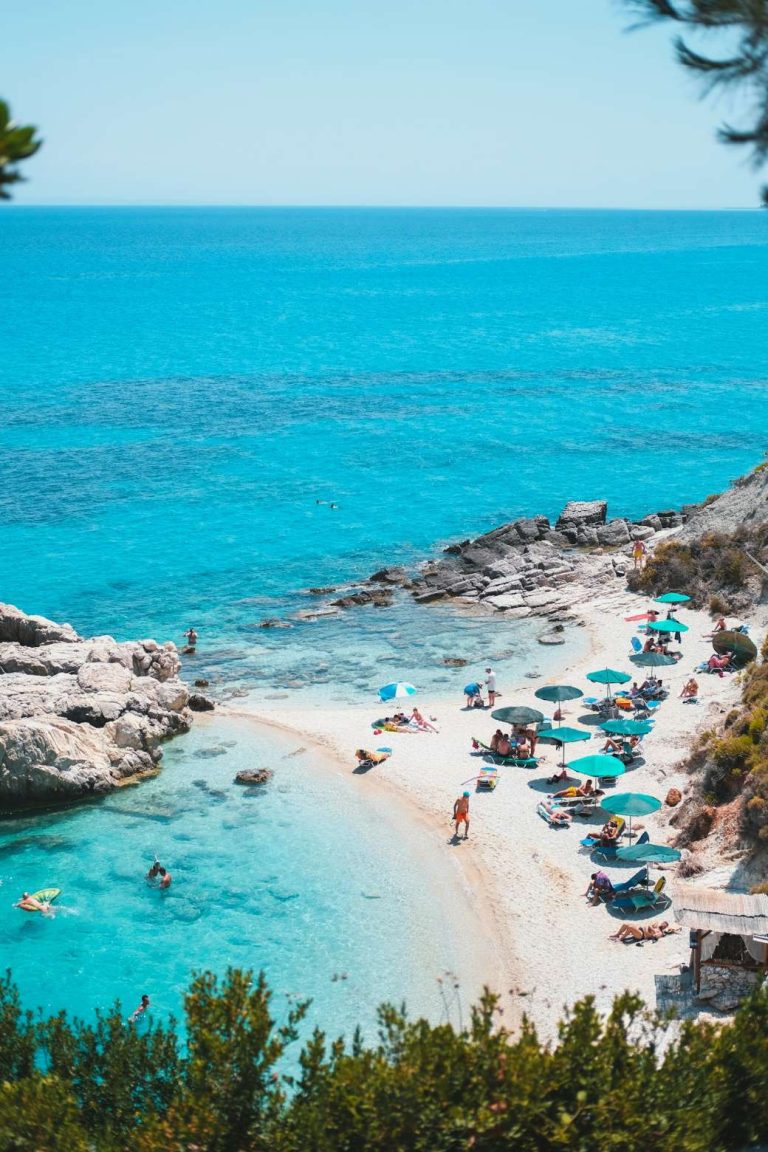 Beaches
The beaches
See the beaches →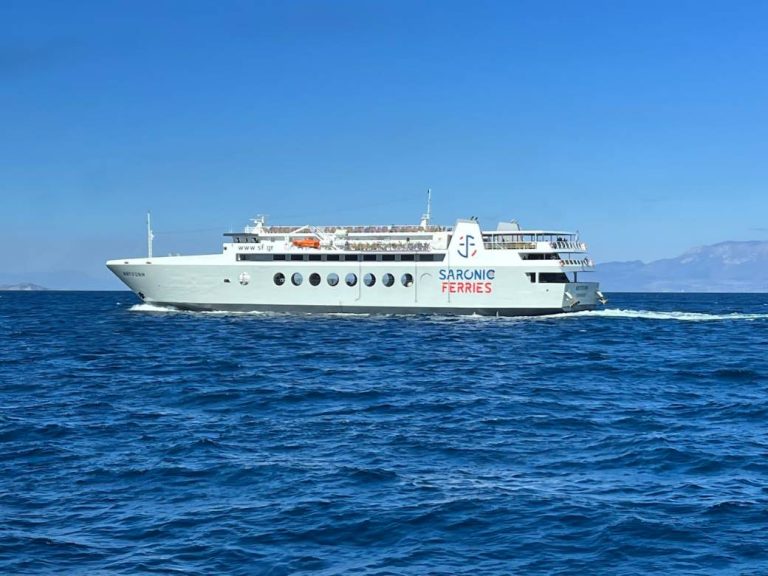 Itinerary
Day by day
See the itinerary →
Booking
We sell nothing and book nothing for you. Every guide on this page tells you how to arrange each piece yourself - which ferry operator, when to book, what to prebook and what to leave loose.