Symi
Things to do in Symi
Symi is a small Dodecanese island with one very large first impression, and almost everything worth doing here sits on a single vertical line: the harbour at the bottom, the older town on the ridge above it, and a long staircase joining the two. The one exception is at the far southern end of the island, and it is the reason many people come at all.
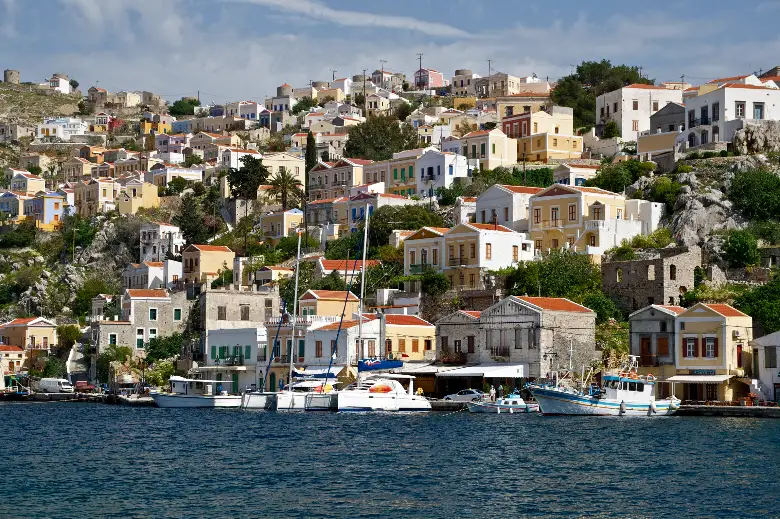
Gialos, the harbour, and why it looks like that. Symi’s harbour houses are colourful because nineteenth-century sponge and shipping merchants built tall neoclassical mansions and painted them in ochre, terracotta and blue, and the town has since protected that architectural style. So instead of white cubes you get a tiered amphitheatre of pastel facades rising straight out of the water. The shape is the point: Gialos sits in a natural stone bowl and the mansions climb its steep sides in tiers, which is what produces the amphitheatre effect and, later in the day, the trapped heat. The one long-standing landmark to fix on is the stone clock tower at the harbour mouth, which travel and local accounts generally place in the 1880s. We print no year, because we could not read the Municipality of Symi’s own pages.
The rhythm of the harbour, which is worth planning around. Around the middle of the day Gialos fills with day-trip groups off the Rhodes boats, and in high summer it can feel both crowded and hot. In the late afternoon the excursion boats cast off for the return leg, the groups go with them, and the harbour settles back to the island’s own pace. The buildings are the same either way; the town around them is not. That shift is the single best argument for staying the night.
The sponge trade, which is the explanation for all of it. Every mansion on that harbour was paid for by the sea. In the nineteenth and early twentieth centuries Symi grew rich on sponge diving and merchant shipping and was one of the great sponge-diving centres of the Aegean, alongside neighbouring Kalymnos and Chalki. You will read that Symi once had the largest sponge fleet in the world. That is a single-source superlative, so the fair version is that it ran one of the Aegean’s largest fleets, which the record supports. The trade did not survive the twentieth century: diving was dangerous, accidents and diving sickness took a heavy toll, and as the natural-sponge market collapsed the fleet declined and much of the population left. What remains is visible in two places, the sponges still sold along the harbour and the island’s nautical museum, which tells the diving story properly.
The Kali Strata, the best walk on the island and its first hard truth. A broad stone staircase climbs from the harbour to Chorio, the older upper town on the ridge, lined the whole way with neoclassical mansions, some restored and some roofless and waiting. Counts vary between sources and it is commonly reckoned at around 500 steps; we assert no number, for the same reason as the clock tower. At the top are the Kastro, the old castle site built over an ancient acropolis, and a line of windmills on the ridge, with views back down over the bowl and out toward Turkey. Chorio itself is quieter and more residential than Gialos, a warren of narrow car-free lanes, and far fewer day-trippers get up there, which is most of its appeal.
The honest part about the stairs. Symi is a steps-and-hills island with very little flat ground, and the Kali Strata is a genuine climb, hot and exposed in the middle of the day. For anyone with limited mobility, a knee that objects to stairs, or a pushchair, that shapes the whole visit. Climb early or late, take it slowly and rest on the landings. The upper town is reachable by road as well, so the staircase is the main route between the two halves of town rather than the only way up. If step-free travel is a firm requirement, read accessibility in Greece before you commit to Symi.
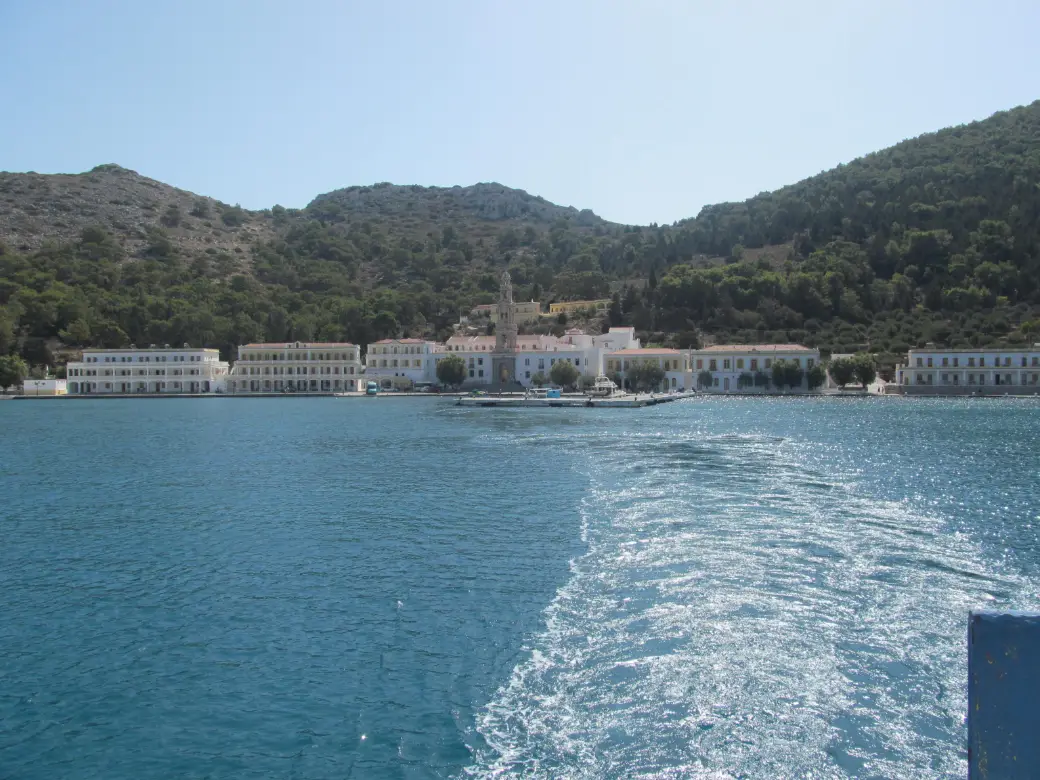
Panormitis, at the far southern tip. The Monastery of the Archangel Michael stands in a sheltered bay a winding drive across the spine of the island from the town. Archangel Michael is Symi’s patron saint, and this is a working pilgrimage site, one of the most important in the Dodecanese. Behind its walls are the silver-clad icon pilgrims come to venerate, a carved wooden iconostasis and painted interior from the end of the eighteenth century, two small museums, one ecclesiastical and one of folklore, and the monastery library. How old it is depends on which account you trust and they do not agree. What the Metropolis of Symi itself records is narrower and more useful: the monastery grew up around the finding of the icon, whose own date is unknown, the silver revetment was finished in 1724, and the church you walk into was rebuilt in 1783 by two monks, Neophytos and Kallistos, after pirate raids. So it is a centuries-old monastery in largely its eighteenth-century form, and this page will not hand you a founding year the sources cannot settle.
The coves, and the boat that reaches them. Symi’s beaches are not the reason it is famous and they will disappoint anyone picturing a resort strip: small, mostly pebbly, and many reachable only from the water. The mechanism is the boat taxi, small shuttles running out of Gialos through the day to the coves and collecting swimmers later. How many run, and how late, follows the season rather than a published timetable, so ask at the quay on the morning you want to go. Nos and Nimborio are walkable from the harbour; Agios Nikolaos, Agia Marina, Nanou, Marathounda and Agios Georgios are shuttle or rough track. There is little point ranking them: pick by how far you want to go and how much company you want when you arrive.
Most day boats from Rhodes call at Panormitis before Gialos, so a typical day trip shows you the monastery in the south and the harbour in the north and very little of the island in between. That, and the late-afternoon emptying of the quay, is the case for a night. The rest is in our Symi guide, the crossing from Rhodes as a day trip, and the group in the Dodecanese.