Island group
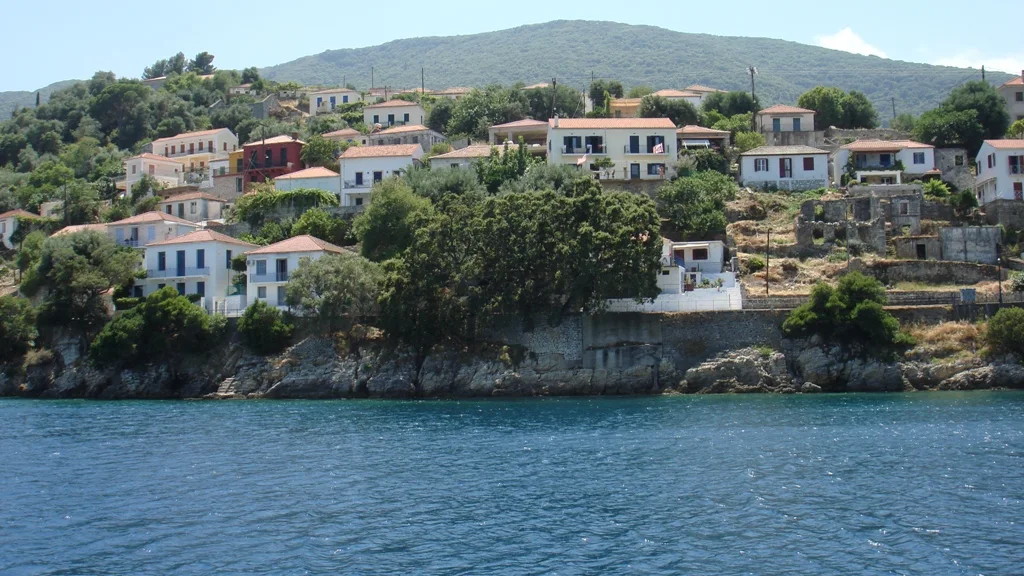
Ithaca (Ithaki) is a small island in the Ionian Sea off western Greece, tucked against the much larger Kefalonia and south of Lefkada. Its capital and only town is Vathy, on a deep natural harbour; the interior is mountainous and green, and the villages were largely rebuilt after the August 1953 Ionian earthquake
Getting there
no airport, and no direct ferry from Piraeus. Almost everyone flies to Kefalonia and crosses on the short ferry, Sami to Pisaetos, about 20 minutes, daily year-round. Pisaetos also takes year-round boats from Astakos and Patras; Frikes takes summer services from Astakos and Lefkada
Getting around
a rental car or scooter is how most people cover the island; the bus is a small operation running out of Vathy that links the northern villages on a handful of departures, taxis run around the clock and meet the boats at Pisaetos and Frikes, and several villages and beaches are easiest reached by boat or on foot
Best months
May-June and September-early October for warm days, swimmable sea and cool-enough hills; July-August is warmest and busiest, though never truly crowded; many tavernas and rooms close in winter
Travel details last checked July 2026.
The shape of Ithaca: two hills, one harbour, no airport
Ithaca is really two mountains tied together by a thread. The island is two hilly lobes, a smaller one in the south and a larger one in the north, joined at the narrow waist of the Aetos isthmus, where the road runs on a few hundred metres of land with the sea close on both sides. The interior is green, steep and terraced, and there is one proper town.
Vathy wraps around a deep, almost enclosed bay in the south, a natural harbour so sheltered you can lose the open sea from the quay. Everything else is a village.
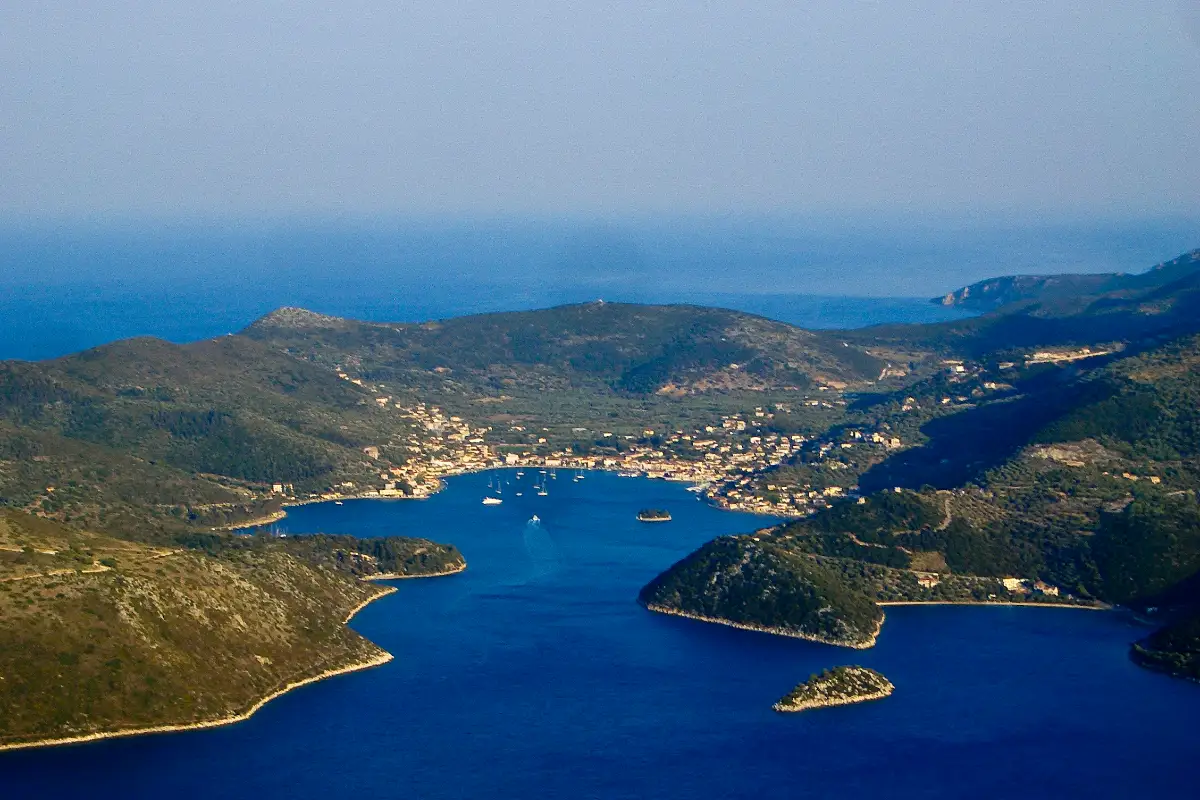

Diagram by Greece Trips. Free to reuse with credit - CC BY 4.0.
The scale is small enough to hold in your head. You can drive the length of the island in about an hour of bends, and a few thousand people live across all of it, most of them in or near Vathy. That is the structural reason Ithaca feels emptier than its size: one town, and a lot of hillside between everything else.
Much of what you see is younger than a place bound to a 3,000-year-old story ought to look. In August 1953 a great earthquake struck the southern Ionian and flattened most of the buildings on Ithaca and neighbouring Kefalonia; the villages were rebuilt in the decades after, which is why the harbours can look tidy and recent rather than antique.
Ithaca sits in the middle of the Ionian islands, off Greece’s west coast, tucked against the much larger Kefalonia to the west and south of Lefkada. That position, hard against a bigger island with an airport, is the whole key to reaching it.
Getting to Ithaca: you change boats at Kefalonia
Ithaca has no airport, and no direct ferry from Piraeus, the port of Athens. So almost everyone arrives the same way: fly to Kefalonia next door, then cross on a short ferry, with the quickest hop leaving from Sami on Kefalonia’s east coast and landing at Pisaetos, Ithaca’s mid-island port. Understand that one boat change and the whole trip falls into place.
Beyond that main route, Ithaca has three small ports, Vathy in the south, Pisaetos in the middle and Frikes in the north, and boats reach them from more than one direction. Pisaetos does most of the work: as well as the Sami crossing, it takes the mainland boats from Astakos and the long run up from Patras, and both of those sail year-round. Frikes is the northern door, served in summer from Astakos and from Lefkada. Vathy handles the least of it. In practice the boat you can catch often decides which of the three ports you land at, rather than the other way round.

Diagram by Greece Trips. Free to reuse with credit - CC BY 4.0.
| From | Usual Ithaca port | Season |
|---|---|---|
| Sami, Kefalonia | Pisaetos, the short main crossing, about 20 minutes | Year-round, daily |
| Astakos, mainland | Pisaetos, and Frikes in summer | Year-round |
| Patras, mainland | Pisaetos, the long way round | Year-round |
| Lefkada | Frikes or Pisaetos | Summer only |
Do not build a same-day plan on a tight connection. The crossings are short, but timetables thin right down outside the summer months and can shift with the weather, so leave yourself slack between the Kefalonia ferry and anything you have booked on the far side. For the mechanics of tickets, operators and timings, see how Greek island ferries work. Ithaca is one of the islands with no runway at all, and the list of which islands have an airport shows where it sits, and why Kefalonia does the flying for it.
When to go to Ithaca
Ithaca runs roughly from April to October, and its best months are the shoulders: May and June, and September into early October. Then the days are warm, the sea is still swimmable, the hills are cool enough to walk, and the summer yachts have thinned. July and August are the warmest and busiest, though Ithaca never gets truly crowded.
The season splits by what you want from it. If you are here to swim and lie on a beach, high summer is the window: the water is warmest and every taverna and rental is open. If you are here to walk, the shoulder months are far kinder, because the exposed climbs are punishing in a July midday and pleasant in June or late September.
Come outside that window and the island turns inward. Many of the small tavernas, rooms and rental outfits close for the winter, ferries drop to a trickle, and Vathy becomes a working village rather than a harbour full of visitors. Spring and autumn give you the best of both, open doors and quiet lanes. For how that fits the wider Greek calendar, see the best time to visit Greece.
The harbours and villages: Vathy, Kioni, Frikes, Stavros
Ithaca is really a handful of harbour villages and the winding roads that join them, and where you sleep sets the tone of the whole trip. There are three broad choices.
Vathy is the capital and the only town, gathered around its deep bay in the south. This is where the ferries and services concentrate: the shops, the boat tickets, the widest choice of rooms and places to eat, and a waterfront that stays awake in the evening. Base here if you want somewhere with a pulse, easy connections and the shortest walk to a morning boat.
Kioni and Frikes are the small northern harbours, a few winding kilometres apart, and they trade choice for stillness. Both are working sailing stops, and on summer evenings their quays fill with yachts moored stern-to, crews eating within a few metres of their boats. Base here if you want harbour-side dinners and quiet water over shops and options; the pace is slower and the nights start earlier.
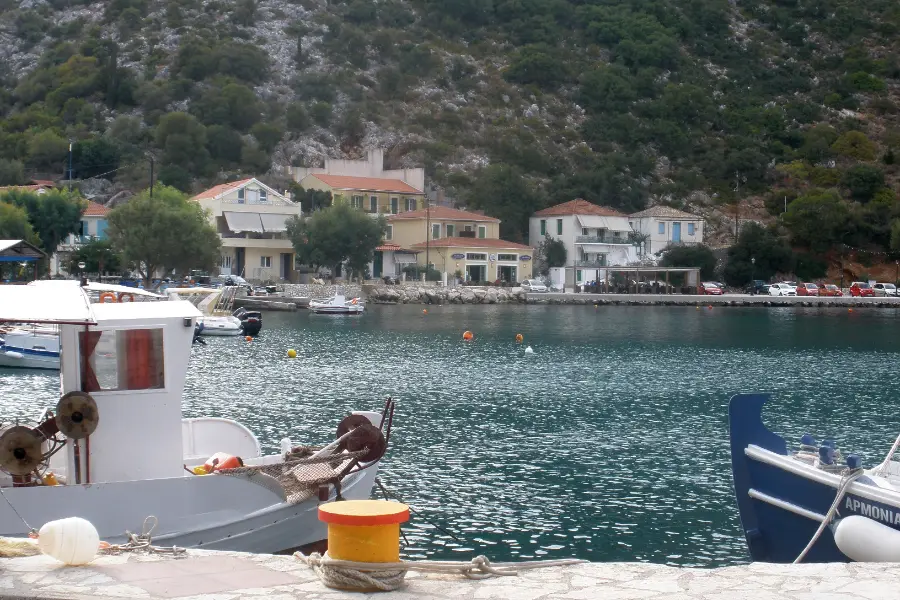
Stavros and the higher villages, Anogi, Exogi and Perachori, sit up in the walking country in the north, older and more agricultural, closer to the trailheads and the archaeological sites than to the sea. Rooms and tavernas are thinner on the ground up here, so this is a base for walkers and drivers who want the hills at the door and do not mind driving down for dinner.
The simple rule: base in Vathy for services and ferries, and go north for quiet and walking. Nowhere is far in kilometres, you can drive between all of them inside an hour, but the roads are slow and dark at night, so most people pick one base and let the boat or a short drive handle the rest. If you like an island this small and unhurried, Paxos in the northern Ionian is its natural cousin, even smaller and just as boat-bound.
Beaches and swimming on Ithaca
The most useful thing to know about Ithaca’s beaches is what they are made of. Most are pebble rather than sand, small, and shelving straight into clear, deep water, and only a few are organised with sunbeds and somewhere to rent an umbrella. Bring water shoes for the stones and carry your own shade and water, and the swimming becomes a pleasure rather than a surprise.
They run along a spectrum of effort. Easiest are the coves near Vathy, Filiatro and Dexa, a short drive from town with room to park. In the north, near Kioni and Frikes, small bays like Sarakiniko and Skinos reward the drive with clearer water and fewer people. And at the far end are the beaches you cannot roll up to: Gidaki, the island’s most admired, is reached on foot over the headland from Vathy or by the little boat that shuttles across in summer, and the walk is exactly why it stays empty.
If your idea of a beach day is soft sand, a row of loungers and a bar serving frappe to your towel, Ithaca will disappoint you, and it is honest to say so. What it offers instead is clear water, small crowds and the sense that you found the cove rather than booked it. That suits swimmers and walkers; it does not suit a family that needs shallow sand and shade laid on. For what Greek sea and beaches are actually like, see what the sea is like in Greece.
Walking Ithaca: the best of the island is on foot
Walking is the reason Ithaca rewards more than a day trip. The best of the island is not a sight you drive to but a network of paths between the villages and up into the hills, and hiking in Ithaca means joining those threads rather than ticking off a single summit.
A few routes carry most of the walkers:
- Anogi to Kioni, a medium hillside descent from the old upper village down to the northern harbour.
- Vathy to Filiatro, a gentle coastal stroll to an easy swimming cove.
- The path over the headland from Vathy toward Gidaki, trading a climb for an empty beach.
- The climb toward Mount Neritos from the Stavros side, the island’s high walk, for long views over Kefalonia and Lefkada.
- The Homer-themed routes in the north, linking the villages with the sites traditionally tied to the Odyssey.
Waymarking varies from route to route: some paths carry painted stones and the occasional signpost, others carry very little, and much of the network is kept clear by local walking guides and enthusiasts rather than by a single signed trail system. The Municipality of Ithaca publishes a walks-and-trails section, but it is a thin page that points you on to local outdoor operators rather than holding the route detail itself. Treat the signage as a help, not a guarantee: carry water and food, wear proper shoes, cover up against the sun, and photograph or download a route before you set off.
Walking here is a shoulder-season pleasure. The exposed climbs, the Neritos route above all, are hard work in a July or August midday and a joy in May, June or late September when the heat backs off. Trailheads are scattered along the island, so most walkers pair the paths with a rental car; more on whether you need a car here. Several of these routes double as Homer-themed walks toward the caves and ruins the island has linked to Odysseus for millennia, which is a good place to be honest about how much of that is settled.
The Odysseus question: home of a hero, or the wrong island?
By tradition, yes: Homer names Ithaca as the home of Odysseus, and travellers have come to the island on that basis for the better part of three thousand years. Whether the modern island called Ithaki is the Ithaca of the poems is a different and unsettled question, and honest visitors hold it open rather than closed.
The argument is real and it has serious names attached. In the early twentieth century the German archaeologist Wilhelm Dörpfeld put Homer’s Ithaca on nearby Lefkada, not here. A century later, in his 2005 book Odysseus Unbound, Robert Bittlestone argued that the Paliki peninsula of western Kefalonia, perhaps a separate island in the Bronze Age before landslips joined it to the rest, fits Homer’s description better than modern Ithaca does. Against those readings, excavations on the present island, including work associated with the British School at Athens, are taken by many as support for the traditional identification. The question has not been settled, and it may never be.
That uncertainty is a reason to walk the sites with curiosity rather than to file them as proof. The Cave of the Nymphs above Polis Bay, the ruins near Stavros long called the School of Homer, the hilltop acropolis at Aetos and the finds in Vathy’s small archaeological museum are all worth your time, as places traditionally tied to the Odyssey, not as verified addresses. Where a sign or a guidebook calls a ruin the palace of Odysseus, read that as tradition speaking, not as a fact anyone has proved, and the walking is better for it.
Who Ithaca is for (and who should skip it)
Ithaca is an easy yes for some travellers and an honest no for others, and knowing which you are saves a wasted ferry. Say yes if you want quiet over busy: couples and independent travellers, walkers, sailors and charter crews, anyone drawn by the Homer connection, and above all anyone already going to Kefalonia who can spare a day or a few nights for the island next door.
Say no, and pick elsewhere, if you want to fly in and be at the hotel in twenty minutes, if you need sandy serviced beaches and a lounger with a bar behind it, or if your evening only starts when the music does. Ithaca’s rooms are guesthouses and small villas rather than big resorts, and its nights run to a long dinner on the quay and a drink among the boats. That is the island working as intended, not a shortfall.
Fitted into a trip, Ithaca sits most naturally as a two-to-four-night add-on to Kefalonia, or one slow stop on a longer Ionian route; the mechanics of stringing those together are in the island hopping guide. So do the obvious thing: pick a base, cross from Kefalonia, walk a route and swim a cove, and leave the checklist on the ferry.
Ithaca FAQ
How do you get to Ithaca, Greece?
There is no airport on Ithaca and no direct ferry from Athens. Most people fly to Kefalonia and take the short ferry across, from Sami to Ithaca’s Pisaetos port, a crossing of about twenty minutes that runs daily year-round. Boats also run to Pisaetos from Astakos and Patras on the mainland, and to Frikes from Lefkada in summer. Schedules thin outside the season.
Is Ithaca worth visiting?
Yes, if you want a small, quiet, green island of harbour villages and hill walks and you do not mind changing boats to reach it. No, if you need an airport, sandy serviced beaches, resorts or nightlife, in which case Kefalonia next door will suit you better. Ithaca rewards travellers who come for stillness rather than a checklist.
Is Ithaca really the home of Odysseus?
By tradition, yes: Homer names Ithaca as Odysseus’s home, and it has been visited on that basis for millennia. But scholars dispute whether the modern island is Homer’s Ithaca, with theories placing it on Lefkada (Dörpfeld) or the Paliki peninsula of Kefalonia (Robert Bittlestone’s book Odysseus Unbound). The question stays open.
Do you need a car on Ithaca?
A car or scooter makes Ithaca much easier: the villages, beaches and trailheads are spread along winding roads, and the bus is a small operation running out of Vathy that links the northern villages on a handful of departures. Taxis run around the clock and meet the boats at Pisaetos and Frikes, and car-free stays based in Vathy, using boats and walks, work well if you plan around them.
Are Ithaca’s beaches sandy?
Mostly no. Ithaca’s beaches are predominantly pebble, small, and often without sunbeds or facilities, and a few, like Gidaki, are reached only by boat or on foot. Bring water shoes, shade and water, and treat pebble-not-sand as the island’s character rather than a flaw.
How many days do you need on Ithaca?
Two to four nights suits most people: long enough to settle into a village, cross from Kefalonia, walk a route or two and swim, without running out of island. A single day trip from Kefalonia works, but it sells the walking short. Shoulder-season days stretch furthest.
Plan by category
The Ithaca guides
2 guides, each scoped to a decision you actually have to make.
 Attractions
Things to do
See the attractions →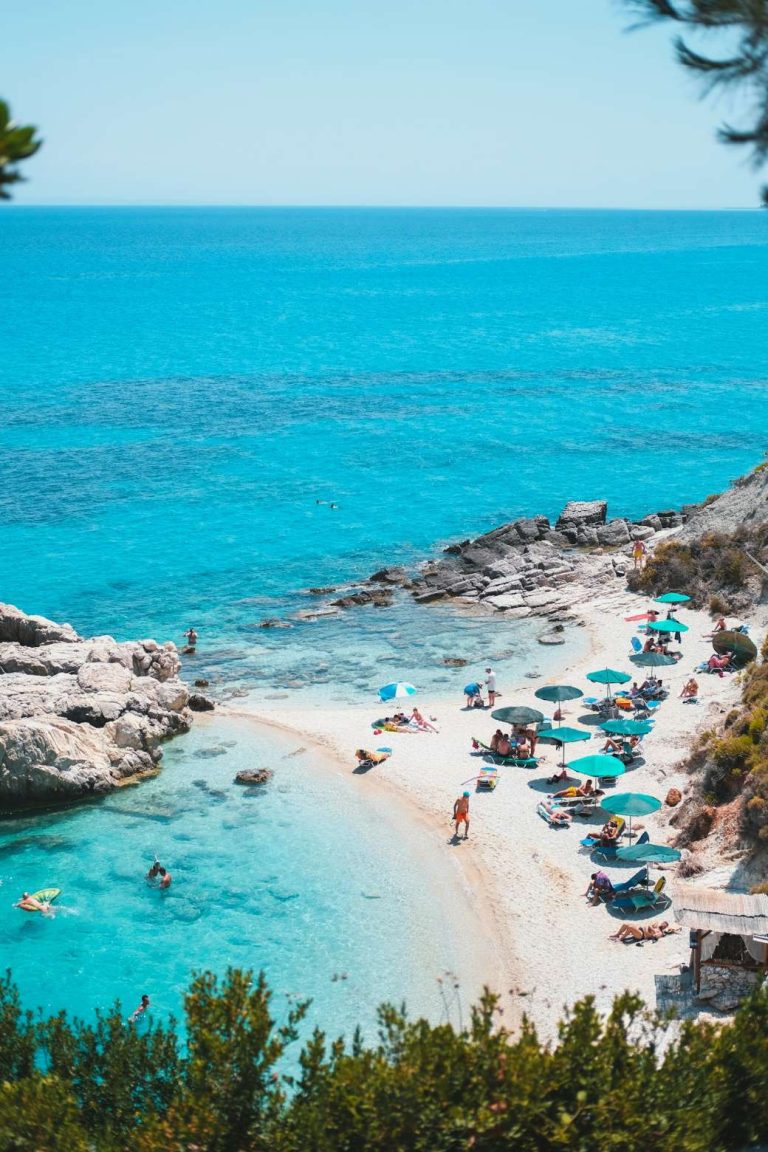 Beaches
The beaches
See the beaches →
Booking
We sell nothing and book nothing for you. Every guide on this page tells you how to arrange each piece yourself - which ferry operator, when to book, what to prebook and what to leave loose.