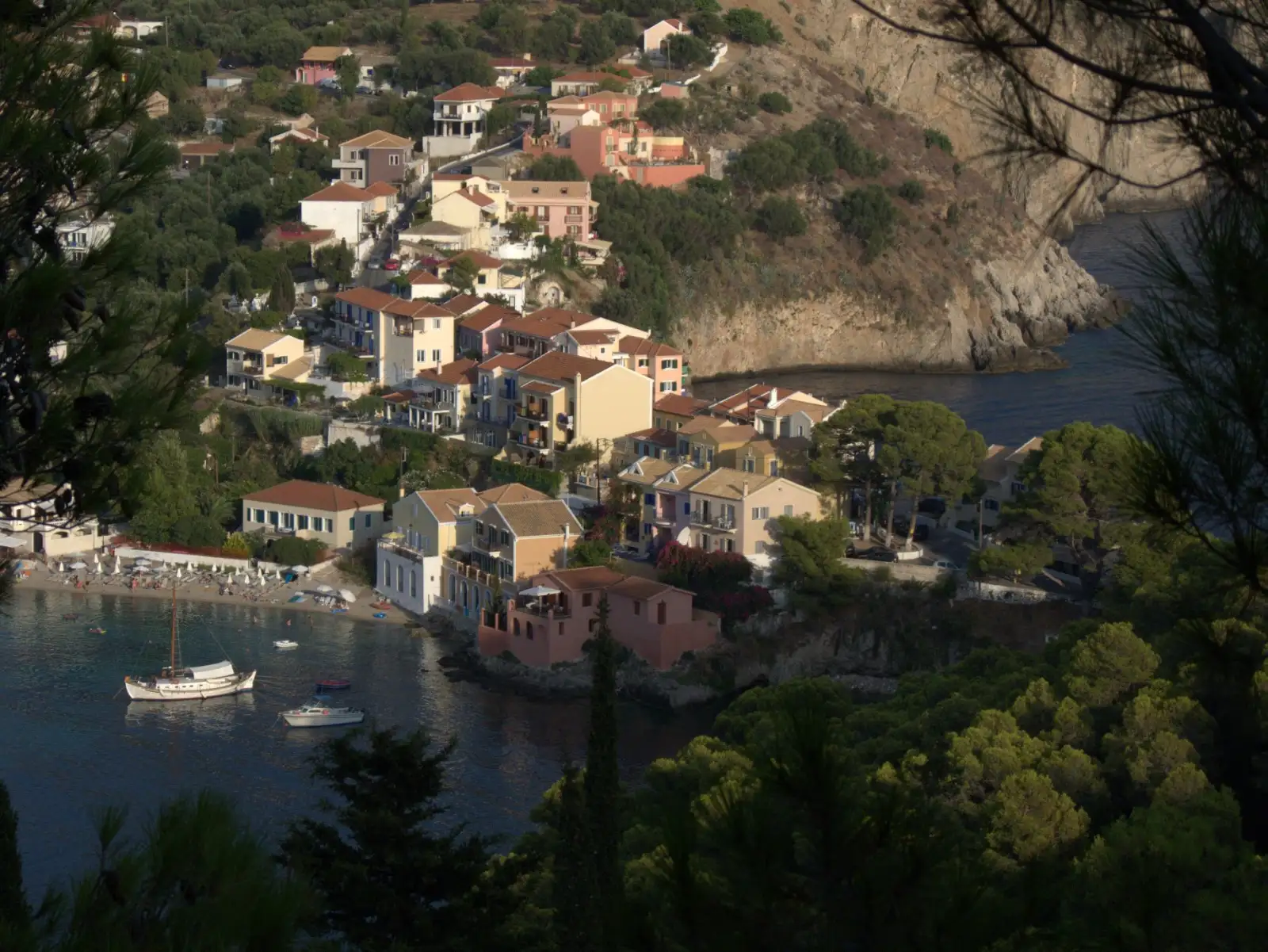
The Ionian islands sit on the western side of the country, facing Italy rather than Turkey, and they break almost every rule the Cyclades taught you. They are green rather than bare. The architecture is Venetian rather than whitewashed. And crucially, they are essentially free of the meltemi.
That is the trade at the heart of the group, and it is worth stating honestly: calmer water and lusher hills, in exchange for more rain. The green comes from somewhere. Winters here are genuinely wet, and even the shoulder seasons carry more cloud than the Aegean. The weather page has the numbers.
If calm water matters to you, or the Aegean wind has already ruined one trip, this is the group to look at.
Which Ionian island
Corfu has the UNESCO Old Town, the fullest history, and the sharpest split on the island: a quiet, mountainous north and a package-holiday south.
Kefalonia is the largest and the one you drive: caves, the long white curve of Myrtos, and distances that surprise people who booked without a car.
Zakynthos is split in two, between a party south wrapped around a loggerhead-turtle marine park and quiet cliffs and sea caves in the north.
Getting there
The Ionians are reached differently from the Aegean islands: there is no ferry from Piraeus. You fly in, or you cross from the western mainland ports. Getting around Greece covers the land legs, and each island guide has its own route in.
Every island in the group
Each one has its own guide. The line after the name is the reason to pick it.
- corfu - A Venetian old town, and the greenest of the group
- kefalonia - Caves, Myrtos, and a mountain in the middle
- zakynthos - The shipwreck cove, turtles, and a loud south
- lefkada - The one you can drive onto, with the west-coast beaches
- ithaca - Small, green and quiet, with the Odyssey attached
- paxos - Three harbours, blue caves and no airport
- meganisi - A short ferry off Lefkada, and another pace
- kythira - Administratively Ionian, geographically nowhere near