
Diagram by Greece Trips. Free to reuse with credit - CC BY 4.0.
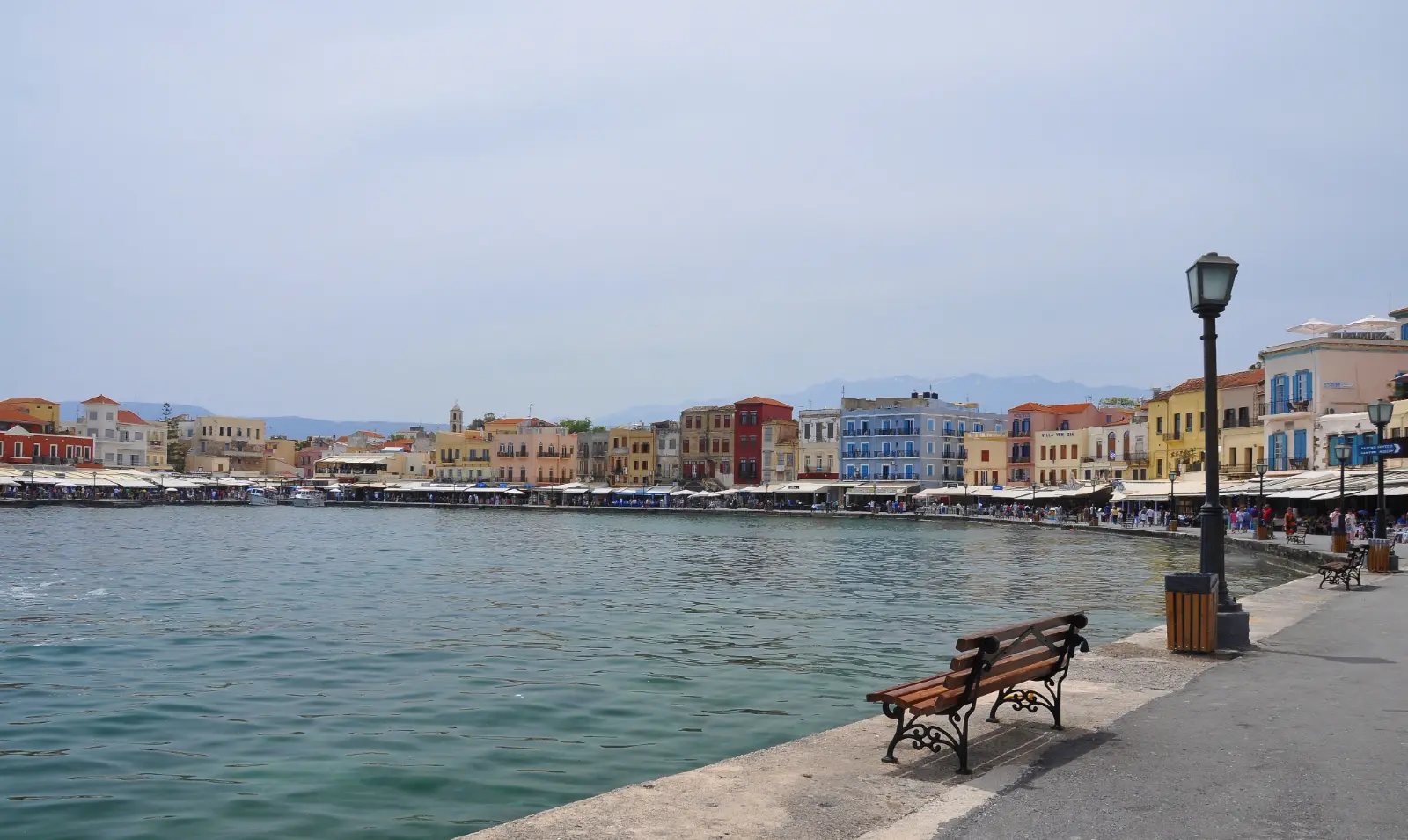
The centre of it is the harbour, a near-circle of water enclosed by a curving stone mole, and the walk around that mole is the single thing everyone does here.
What is around the harbour
- The lighthouse at the end of the mole, in its present form built during the Egyptian occupation in the nineteenth century, standing on Venetian foundations. The walk out to it is about fifteen minutes on exposed stone and gives the view back at the town.
- The Kucuk Hasan mosque, the pink-domed Ottoman building on the eastern quay, the oldest on Crete and now used for exhibitions rather than worship.
- The Venetian arsenali, the long vaulted shipyards along the east side, built to shelter galleys under construction, some restored and some deliberately left as shells.
- The Firkas fortress at the western entrance, which holds the naval museum and a bastion you can walk out onto.
Behind the front row
The waterfront is the postcard and also the most expensive coffee on the island. The old town proper runs back from it in a grid nobody has straightened since the Venetians drew it.
Splantzia is the quarter to aim for: a square with a plane tree, a church that was a mosque, and tavernas whose customers are as likely to be local as not. It is five minutes from the harbour and a different temperature of place.
The covered market sits at the edge of the old town in a cross-shaped hall from 1913, and the leather lane, Skrydlof, still has workshops among the shops.
Practical notes
- The old town is cobbles, steps and no cars in most of it. Luggage across it is a known misery; check how close a vehicle can get to your door.
- The harbour walk is fully exposed and unshaded, which matters in the middle of a Cretan summer day.
- Parking is outside the old town. If you have a car, expect to leave it and walk in. See driving in Greece.
- Chania is a base as well as a sight. Our where to stay in Chania page sets its areas against each other properly, and Balos and Falassarna are the west-coast days people run from here.
Last checked August 2026. Opening arrangements for individual buildings change - see our editorial policy.
Common questions
What is there to see in Chania old town?
The Venetian harbour and its mole, the nineteenth-century lighthouse, the Kucuk Hasan mosque, the Venetian shipyards, the Firkas fortress and naval museum, and the lanes and squares behind the front, especially Splantzia.
How long do you need in Chania old town?
A half day covers the harbour, the lighthouse walk and the main lanes. A full day, or an evening and a morning, is better if you want Splantzia and the market too.
Is Chania old town walkable?
Yes, and largely car-free, but it is cobbled with steps in places and the surfaces are worn smooth.
Is the lighthouse walk worth doing?
It is the best view back at the town and takes about fifteen minutes each way along the mole, with no shade at any point.
What is Splantzia?
The quarter east of the harbour, built around a square with a plane tree and a church that spent time as a mosque. It is the quieter half of the old town.
Next
Read things to do in Crete, where to stay in Chania, or Rethymno old town.