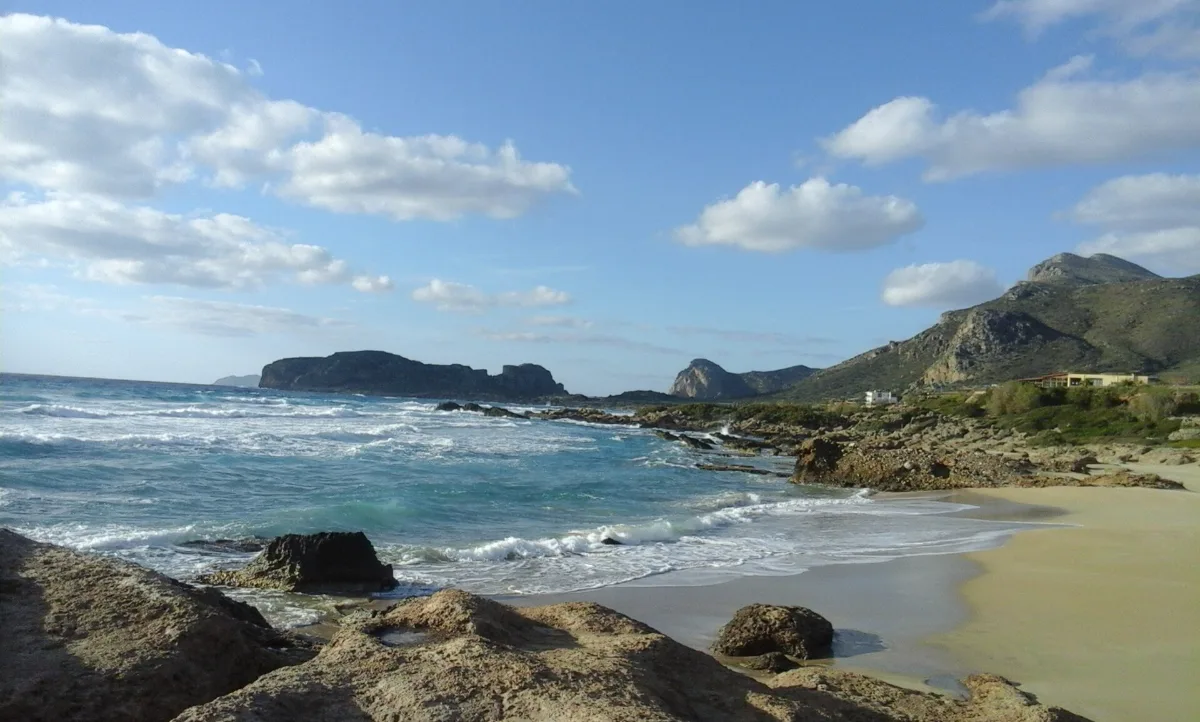
Falassarna sits at the far north-west corner of Crete, about an hour and a half from Chania, and it is the island’s great open beach: a long run of pale sand facing directly into the open sea with nothing between it and the horizon.
That exposure explains everything about it - the surf, the sunsets, and the days when the wind makes it hard work.

Diagram by Greece Trips. Free to reuse with credit - CC BY 4.0.
What the exposure actually means
Most of Crete’s famous beaches sit inside something. Balos is a lagoon behind a sandbar; Elafonisi is a shallow shelf. Falassarna is the opposite: it faces the open water square-on.
So:
- There are waves. Not surf-break waves every day, but real swell often enough that children and nervous swimmers should be watched. On calm days it is flat and enormous.
- There is wind. The same afternoon breeze that cools you can pick up sand, and on a strong day the north end becomes uncomfortable.
- The sunset is the best on the island, because there is nothing in the way. This is the one beach on Crete people drive to specifically to watch the sun go down.
- The water is cold-ish and very clear, because it is open sea rather than a warm shallow shelf.
The beach is bigger than it looks in photographs
Falassarna is not one beach but a series of bays along a couple of kilometres, and the crowds concentrate in a small part of it.
The main organised stretch has sunbeds, umbrellas and a few tavernas behind. Walk fifteen minutes in either direction and the density drops sharply. The northern end is generally the quietest and the most exposed.
The sand is genuinely pale - unusual for Crete - and fine, and it squeaks underfoot in places.
The ancient city nobody visits
At the northern end there is an archaeological site: the remains of the ancient city and harbour of Falassarna, a Hellenistic port whose stone harbour works are still visible, now sitting well inland of the water.
That last detail is the interesting part. The whole western end of Crete was lifted several metres by an earthquake in antiquity, which left a working harbour stranded above the sea. You can stand in a dry stone dock.
It is unfenced, free, and almost always empty while the beach a few hundred metres away is full.
Getting there, and the road
Falassarna is a drive - roughly 90 minutes from Chania, and you want a car. The last stretch descends through greenhouses and olive groves to the coastal plain, and it is straightforward.
There is parking behind the main stretch, and it fills through the afternoon in August as the sunset crowd arrives.
Take water and something to eat if you are going to the quieter ends. The tavernas cluster behind the organised section only.
What to take from this page
Come in the afternoon and stay for sunset - that is the trip. Expect open water rather than a lagoon, check the wind before committing the whole day, and walk north to the old harbour, which is the part of Falassarna almost nobody sees.
Last checked August 2026. Conditions and facilities change with the season - see our editorial policy.
Common questions
Is Falassarna beach sandy?
Yes, and unusually pale for Crete. It is fine, light-coloured sand across a long run of bays rather than pebble.
Why is Falassarna windy?
It faces the open sea square-on at the north-west corner of Crete with no shelter. The same exposure that gives it the sunset gives it the wind and the waves.
Is Falassarna good for children?
On a calm day, yes. It is open water rather than a lagoon, though, so there can be real swell, and it is worth checking conditions before settling small children there. Elafonisi is the shallower option.
How far is Falassarna from Chania?
Roughly an hour and a half by road. You want a car.
Is Falassarna the best sunset in Crete?
It is the best known, and the geography supports the claim: it faces due west into open sea with nothing on the horizon.
What is the archaeological site at Falassarna?
The remains of an ancient harbour town. An earthquake in antiquity lifted this whole coast several metres, leaving the stone harbour works stranded inland of the modern shoreline.
Next
Read best beaches in Crete, compare with Balos and Elafonisi, or choose a base with where to stay in Crete.