The Venetians laid out the streets and built the doorways and fountains. The Ottomans added minarets and wooden overhanging balconies. Unusually, both survived.

Diagram by Greece Trips. Free to reuse with credit - CC BY 4.0.
What to actually look at
The old town is small and dense, and the pleasure is walking it. The fixed points:
- The Fortezza. An enormous Venetian fortress on the headland above the town, built in the sixteenth century and one of the largest the Venetians built anywhere. Inside it is mostly open ground with a domed former mosque at the centre. The circuit of walls has the view.
- The Rimondi Fountain, a Venetian fountain of 1626 with lion-head spouts, tucked into a small square in the middle of the lanes.
- The Neratze mosque, a Venetian church converted to a mosque, with the minaret that gives the skyline its shape. It functions as a music school and concert hall.
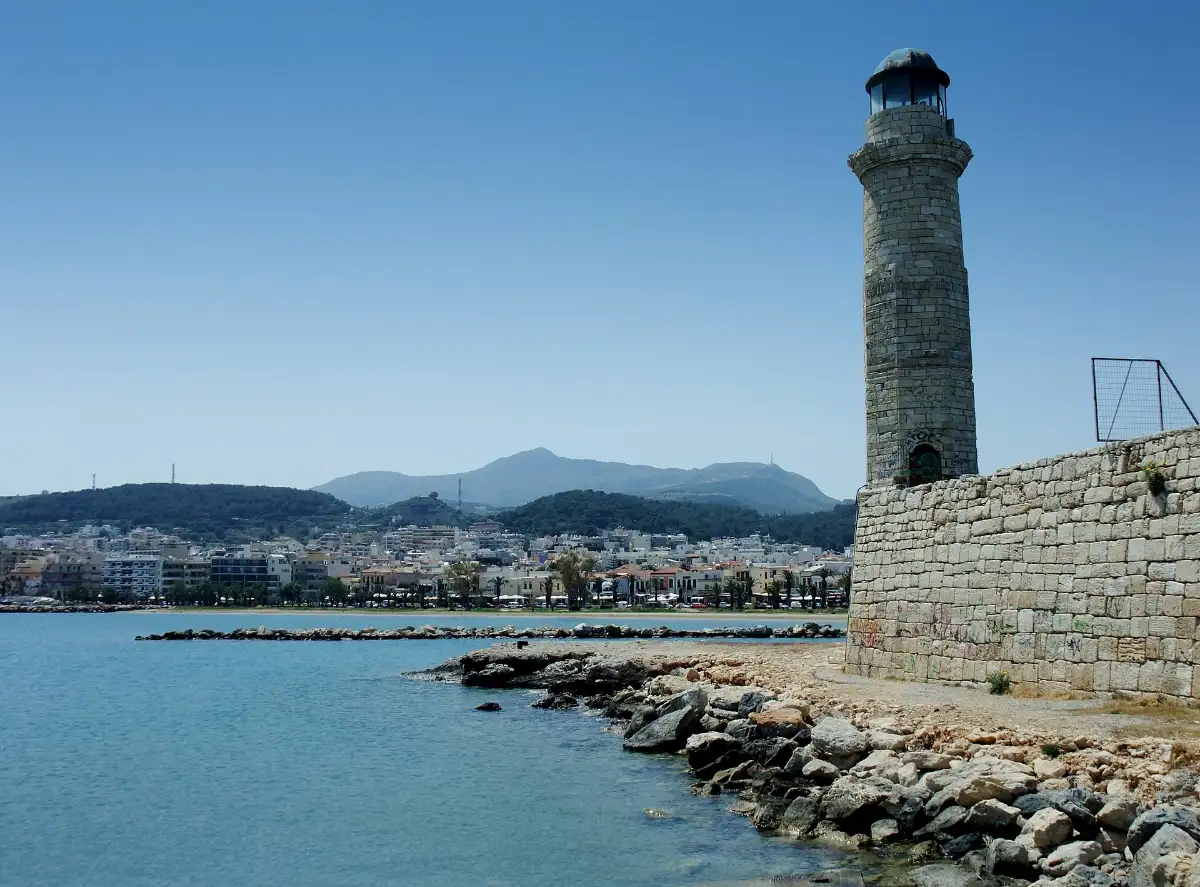
- The Venetian harbour, a small curved basin with the lighthouse on its arm - the postcard view, and a smaller, quieter version of the same idea at Chania.
Why it feels different from Chania
Both are Venetian harbour towns with old quarters, and visitors often ask which to see. Honestly:
- Chania is larger, grander, busier and more polished. The harbour is bigger and so are the crowds.
- Rethymno is smaller, less restored, and still has ordinary shops and residents inside the old town rather than only tourist businesses. The Ottoman layer is much more visible.
If you are basing yourself in the west, see both - they are an hour apart. If you can only do one and you prefer atmosphere to spectacle, Rethymno.
The beach is at the end of the lanes
Not something the photographs make obvious: Rethymno has a long sandy town beach running east from the old quarter, with the usual promenade behind it. You can come out of the medieval lanes and be swimming in a few minutes.
It is a town beach - organised, busy in season, not the reason to come to Crete - but the combination of a preserved old town and sand within walking distance is unusual and genuinely convenient.
Practical notes
- Driving. Do not attempt the old town by car. It is narrow, one-way in places, and pedestrianised in others. Park outside and walk in.
- Time. Half a day covers the lanes and the fountain; add an hour or more for the Fortezza.
- Heat. The lanes are shaded and the Fortezza is not. Do the fortress early or late.
- Where it fits. Rethymno is the natural middle base for anyone who refuses to choose an end of Crete - see where to stay in Crete.
What to take from this page
Give it half a day rather than a photo stop. Walk the lanes for the doorways and the minarets, climb the Fortezza for the walls and the view, and swim afterwards.
Last checked August 2026. Opening hours for the Fortezza and museums change - see our editorial policy.
Common questions
Is Rethymno old town worth visiting?
Yes. It is the best-preserved old town on Crete, with the Venetian street plan and Ottoman minarets and balconies still standing, and it is markedly quieter than Chania.
What is the fortress in Rethymno?
The Fortezza, a large sixteenth-century Venetian fortress on the headland above the town. Inside is largely open ground with a domed former mosque; the walls carry the view.
Rethymno or Chania - which is better?
Chania is bigger, grander and busier. Rethymno is smaller and less restored, with a more visible Ottoman layer and real residents in the old town. They are an hour apart, so see both if you can.
Does Rethymno have a beach?
Yes, a long sandy town beach running east from the old quarter, within a few minutes’ walk of the medieval lanes.
How long do you need in Rethymno old town?
Half a day for the lanes and the harbour, plus an hour or so for the Fortezza.
Can you drive into Rethymno old town?
You should not. The lanes are narrow, partly pedestrianised and one-way in places. Park on the edge and walk.
Next
Read things to do in Crete, the Chania guide, or choose a base with where to stay in Crete.