
This page explains the system rather than the prices. What a lounger costs on any given beach changes every season and is exactly the sort of number that is wrong by next summer, so we do not print it. What does not change so fast is how the arrangement works, what your rights of access are, and the official channel for checking and reporting it.

Diagram by Greece Trips. Free to reuse with credit - CC BY 4.0.
What an organised beach actually is
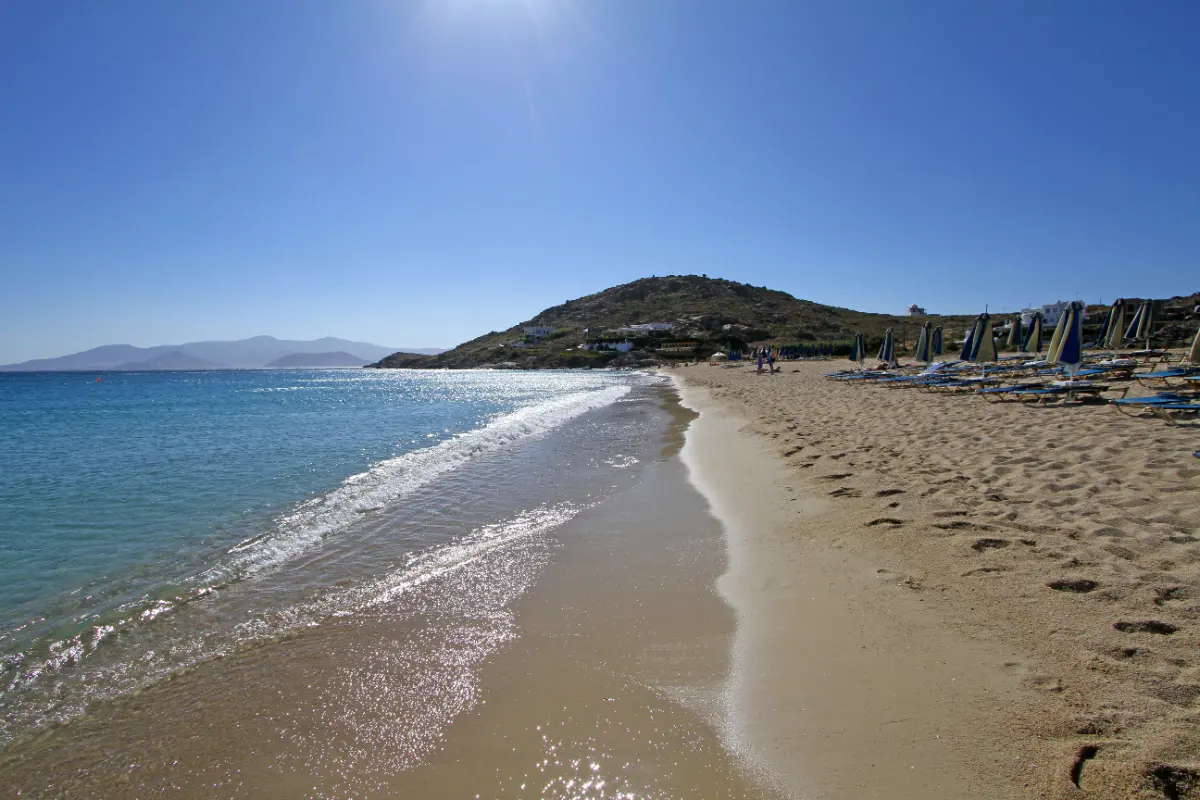
An organised beach in Greece is a concession. A business leases a defined area of the shore from the state, and in return for that lease it sets out sunbeds and umbrellas, charges for them, and usually provides facilities such as showers, toilets and somewhere to buy a drink. That is the model our Vouliagmeni beach guide describes in Attica and the one the Crete beaches run on too.
Three things follow from the word lease, and they are the whole point.
It is a defined area, not the whole beach. The concession covers a specific, bounded patch that the state has agreed to. Beyond its edges, the beach is public.
It is not a private club. Paying for a lounger buys you the lounger, not the beach. You are never obliged to hire a sunbed to be on a Greek beach, and a concession that behaves as though the sand belongs to it is overstepping its lease.
And it is not the same as a free public beach, where you bring your own umbrella, there are no facilities, and nobody charges you for the ground. Many Greek beaches are entirely free and unorganised; many others are part-organised, with a leased strip beside open public sand. Our Kolymbithres guide is one where the ground itself, rather than a concession, decides the day.
How much of a beach has to stay free
The principle that matters is simple even where the exact figures are technical: a large share of every beach must remain free of sunbeds and umbrellas, so that anyone can use the shore without paying. Recent Greek legislation tightened this considerably, setting minimum free proportions of each beach, higher proportions in protected natural areas, a cap on how large a single concession can be, and a required clear gap between the sunbed rows and the water so the waterline itself stays open to walk along.
We deliberately do not print the exact percentages, the maximum concession size or the fine amounts here, for two reasons. They are set by law and have been revised more than once, so a number typed today may not be the number next season. And there is a better source for the specifics than any travel page, described below, which shows the actual permitted limits for the actual beach you are standing on.
What is durable, and worth carrying in your head: most of a Greek beach is supposed to be free, the free part includes the water’s edge, and the busier the concession looks, the more worth checking it is.
MyCoast: the official app that shows the limits and takes reports
The most useful thing on this page is a government tool, not an opinion. In 2024 the Greek state launched an application called MyCoast, developed under the Ministry of Digital Governance for the Ministry of Economy and Finance, through which the public can look up beach concessions and report breaches.
Two things it does that matter to a visitor. It shows the concession for a beach: the location, the lease, and the area the business is actually permitted to occupy, which is precisely the information you would otherwise have no way to know. And it provides an official channel to report a concession that is exceeding its area or blocking free access, which routes the complaint to the authorities responsible for enforcement rather than leaving you to argue on the sand.
In its first summers the app drove a large programme of inspections and business checks across the country, and the authorities reported improving compliance as a result. You do not need to know those figures to use it; you need to know it exists and that it is the official primary for what any given concession is allowed to do.
This is not legal advice, and it is not a confrontation guide
Two limits on what this page is for.
It is not legal advice. It describes how the system is structured and where the official channels are. It does not tell you what your position would be in a specific dispute, which depends on the specific beach, lease and circumstances.
And it is not an instruction to confront anyone. The point of an official reporting channel is that you do not have to. If a concession is overstepping, the app is the route, and the enforcement is the authorities’ job rather than yours. Standing your ground on free sand is your right; policing the lease is not your task.
Reading a beach before you sit down
A short, practical way to use all of this on the day.
Look for the edges of the concession. The leased area has a boundary, and beyond it the sand is free. If the loungers seem to run the entire width of the beach with no public space left, that is the situation the law and the app exist to correct.
Keep the waterline in mind. The strip along the water is meant to stay clear, so a row of sunbeds pushed right to the sea is a flag rather than the norm.
Know that free is always an option. You can bring your own umbrella and use the public part of any beach without paying, on the organised ones as much as the wild ones. What you give up is the facilities, not the right to be there.
And separate the concession question from the safety question entirely. Whether a beach has a lifeguard, and what the sea is doing on a given day, is a different matter that a lounger operator does not settle. The presence or absence of a concession says nothing about the water, which is covered in what the sea is like.
Where this fits in the budget
Because the free part of every beach is genuinely free, the sunbed decision is optional spending, not a gate you have to pay to reach the sea. On a long trip that adds up: a family that brings its own shade and uses the public sand can cut a real line out of the daily cost, and reserve the paid loungers for the days it wants the shower and the drinks service. How that fits the wider picture is in what a Greece trip costs.
The islands vary in how organised their beaches are, from heavily concessioned resort strips to beaches with nothing on them at all, and the islands overview and each destination’s beach guide, such as Corfu, Kefalonia and Naxos, give the local texture.
Last checked July 2026. What gets re-checked here: the MyCoast app and the ministry responsible for it, and the fact that beach-access proportions are set by a law that has been revised. No percentage, concession-size limit, fine amount or sunbed price is printed on this page by design, because those are set by law and change; the app shows the current, beach-specific limits.
Quick answers
Do you have to pay for sunbeds on Greek beaches?
No. You can always use the free, public part of a Greek beach without paying, bringing your own umbrella and towel. Sunbeds and umbrellas are rented by a concession that leases a defined part of the beach, and hiring one is optional. Paying buys the lounger and the facilities, never the right to be on the sand, which is free.
How much of a Greek beach has to be free of sunbeds?
Most of it. Greek law requires a large share of every beach to stay free of loungers and umbrellas, with a higher proportion in protected natural areas and a clear strip kept along the water’s edge. We do not print the exact percentage here because it is set by a law that has been revised; the official MyCoast app shows the permitted limits for a specific beach.
What is the MyCoast app?
MyCoast is an official Greek government application, launched in 2024 under the Ministry of Digital Governance, that lets the public look up a beach concession and report breaches. It shows where a concession is, its lease, and the area the business is actually allowed to occupy, and it routes complaints about blocked access or oversized concessions to the authorities who enforce the rules.
Can a beach bar or hotel stop you using the beach in Greece?
No. A concession leases a defined area for its sunbeds; it does not own the beach, and it cannot legally block public access to the free part of the shore or to the water. If one is obstructing access or occupying more than its permitted area, that is exactly what the MyCoast reporting channel exists for. You are not obliged to buy anything to be there.
Are all beaches in Greece organised with sunbeds?
Far from it. Greek beaches range from fully organised resort strips with rows of loungers and facilities, through part-organised beaches with a leased section beside open public sand, to completely wild beaches with nothing on them at all. Which kind you get is a big part of choosing a beach, and each destination’s beach guide describes the local mix.