Karpathos
Things to do in Karpathos
Karpathos is far enough from everywhere that the distance shapes it, and two things follow from that. A northern village kept customs the rest of the island let go, and a long north-south spine funnels the summer wind down one coast. Those are the two reasons to come, and they suit almost opposite kinds of traveller.
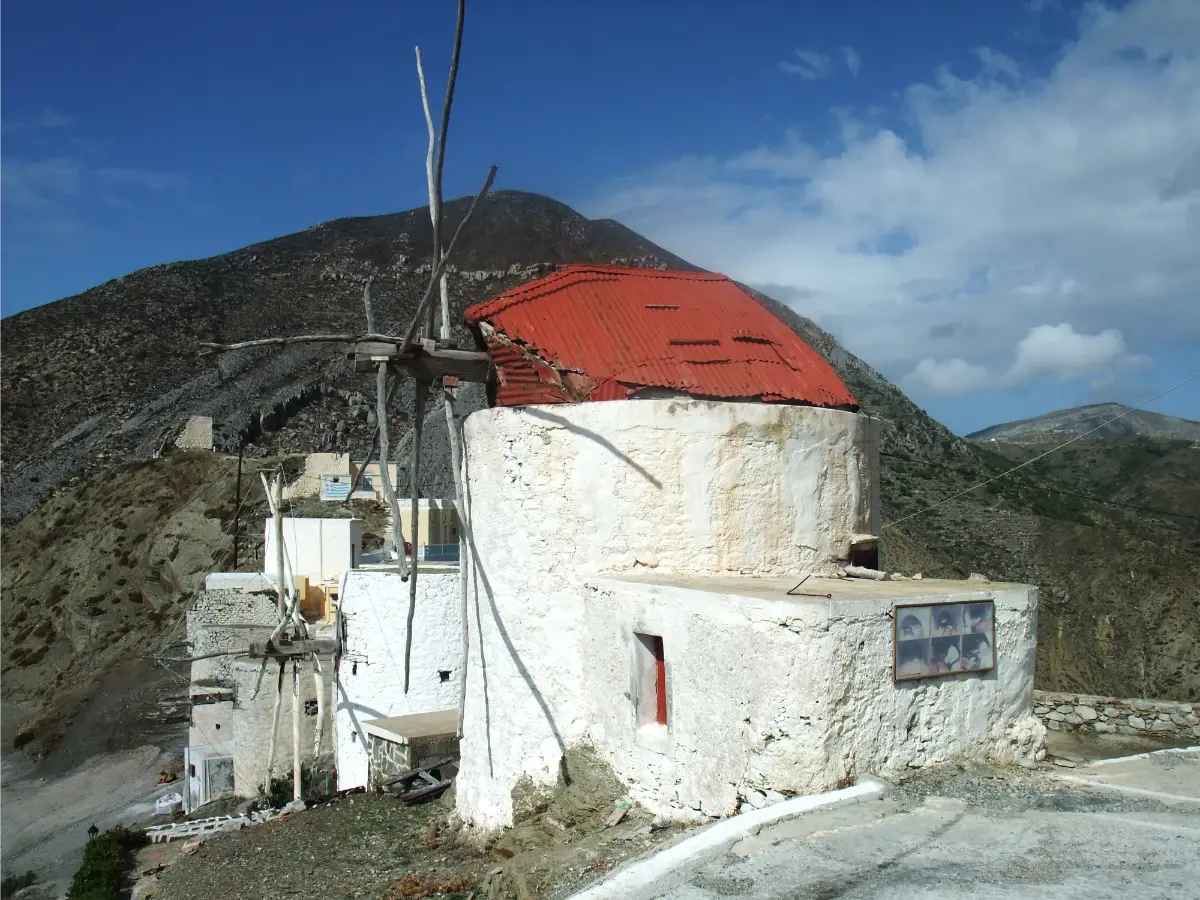
Olympos, and why it is not a costume show. A working mountain village near the northern end of the island, whose traditions survived for a plain reason: until recently, almost nobody could get to it. Isolation, not a decision to perform for visitors, is why the north kept what the rest of the island let go.
What is documented, and what is only reported. The village has its own dialect, which linguists and locals describe as unusually archaic. You will read that it preserves elements of ancient Doric Greek, and that is a claim to report with care rather than state as settled fact. The custom most written about is inheritance: traditionally the firstborn daughter, the kanakara, inherited her mother’s house and the bulk of the family property, and a newly married couple settled with the wife’s family rather than the husband’s. That matrilineal inheritance and matrilocal residence gave women in Olympos an unusual economic standing, documented in detail by reputable reporting.
Two qualifications that belong right beside it. The practice is declining rather than thriving, described as one of Europe’s last such societies and near its end, with the young increasingly leaving or marrying out. And the popular “island where women rule” framing oversimplifies it: what is documented is matrilineal inheritance and matrilocal residence, which is not the same thing as a political matriarchy. Repeating the slogan flattens a specific custom into a headline.
The dress, on the same terms. Today it is mainly older women who wear the traditional dress day to day; younger women and girls put on the embroidered festive version for feast days, above all the Assumption on 15 August. What you will not see is a whole village dressed up for your benefit. Olympos is lived in, not staged.
How to visit it, which is mostly a question of timing. Tour groups fill the lanes around midday and thin out by evening, so come early or stay the night. Reach it by the mountain road of steep hairpins, or by boat to Diafani and up. Either way, it is somebody’s home rather than an exhibit, and behaving accordingly is the whole instruction.
The wind, and the sport that lives on it. The island’s long north-south spine funnels the summer meltemi straight down the southern coast, so from roughly May to September the afternoons blow hard and reliably, hardest in July and August. The windsurf centres and spot guides that work this coast report July and August afternoons in the region of 35 to 40 knots, which is small-sail weather. Treat that as what the people who sail here every summer say, rather than as a measured average.
Afiartis, the hub. More properly the Kipi-Afiartis settlement beside the airport in the south. A short run of bays sorts riders by level: a shallow sheltered bay for beginners and freestylers, a larger bay that builds a rideable wind-wave for bump-and-jump and slalom, and an exposed bay with the strongest wind that has hosted speed-sailing championships. Dedicated kitesurf water sits a little apart, around Agrilaopotamos, and the windsurf and kite zones are kept separate during centre hours.
The shortlist, if you want one. Sail the Afiartis bays; spend a morning in Olympos before the tour boats arrive; walk the old mountain paths between the northern villages; take a boat from Diafani to the islet of Saria; and swim the sheltered east-coast bays out of the wind. That last one is the payoff for everyone who did not come to sail: the same wind that makes Afiartis great makes the whole exposed south blustery. The beaches page sorts the coast by exactly that, our Karpathos guide has the practicalities, and where to stay covers north versus south.