Folegandros
Things to do in Folegandros
Folegandros is small and most of what there is to do on it stacks vertically: a port at sea level, a sheer cliff, a town perched on the edge of it, and a church higher still on the hill. Understand that stack and you have understood the island. What follows is that line from the bottom up, plus the farming half nobody photographs.
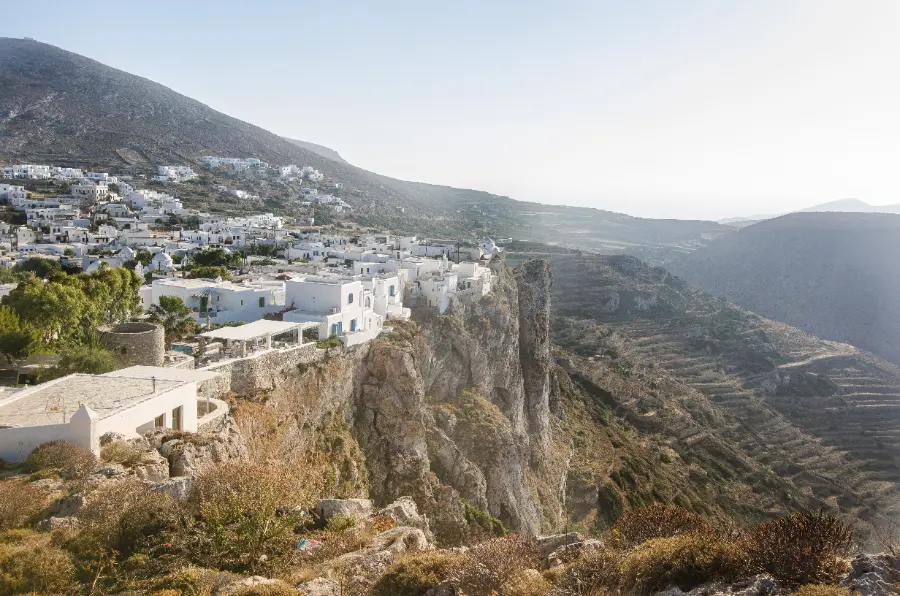
Chora, which is the reason most people come. The capital sits on the very edge of a high sea cliff, a drop commonly given as around 200 metres, and it is a pedestrianised warren of whitewashed houses whose lanes keep opening into a run of linked, plane-shaded squares. Cars stop at the edge of town; from there you walk. The squares are where the day slows down and the evening happens, one flowing into the next under the trees. None of Chora is a photo you take from the road. It is a place you walk into and stay in until dark.
The Kastro, inside the town. The medieval quarter the Venetians fortified is reported to date from the early thirteenth century, though the sources genuinely conflict on that and we do not settle it here. Its tall houses stand shoulder to shoulder along the cliff edge, their back walls forming a continuous rampart against the drop, and people still live in them. You enter through old gates and come out on lanes barely wide enough for two.
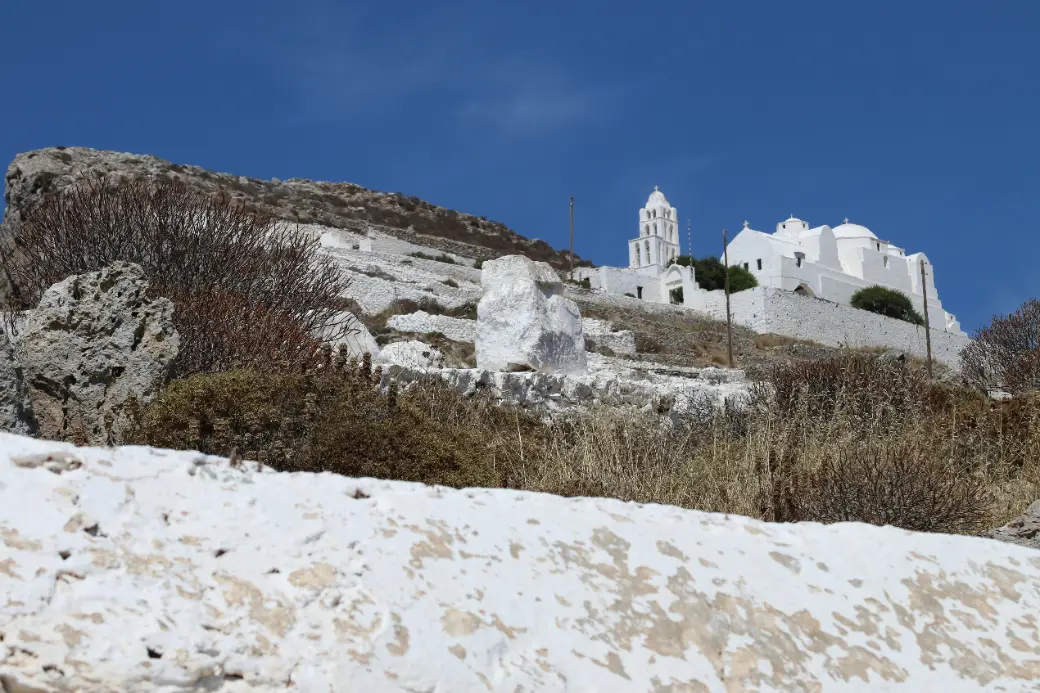
The climb to Panagia, which is the thing to time well. The church stands on the hill above Chora, reached by a zig-zag paved path that switchbacks up from the top of the village: a short walk but a steep one, roughly ten to fifteen minutes. It is the island’s trademark view and where people gather for sunset. Go up before the sun actually drops, both for the light on the way and to be there ahead of the small crowd. Wear real shoes. If you step inside, it is a working church, so cover your shoulders and knees; how to behave at Greek churches and monasteries covers the rest.
What the church is standing on. The municipality’s own account has it built on the site of an ancient temple, using stone taken from it, and you do not have to take that on trust: ancient inscriptions, carved fragments and statue bases are set into the courtyard and the interior, where anyone can see them. Which god the sanctuary served is looser. The inscriptions recorded there are described as dedications to Artemis the Light-bearer and her brother Apollo the Protector, so if you have read that the church sits on a temple of Apollo, that is half the story at best, because the dedications lead with Artemis.
Ano Meria, which is the island nobody photographs. Beyond Chora and the port the island opens into a long, thin farming settlement strung along the northwest road. It is not a village with a centre so much as a scatter of old stone farmsteads, the thimonia, with small churches between them and an ecomuseum, set in one such farmstead, laying out the island’s rural past. It keeps a short summer season and opens in the late afternoon and evening rather than through the day, so check before you make the trip out. This is working Folegandros, the part that never turned into a resort, and it is the clearest answer to anyone who calls the island empty.
The paths, which stitch the whole thing together. Folegandros carries a network of footpaths linking Chora, Ano Meria and the coves along old stone tracks, and the municipality lists five routes totalling about twenty kilometres. That is enough for a gentle village loop in an afternoon or a longer through-walk with big sea-and-cliff views for a serious morning. The paths are a large part of why the quiet here reads as character rather than emptiness: there is plenty to do, it just moves at walking pace. The country picture is in hiking in Greece.
The one real caution is heat, not difficulty. The trails are exposed and largely shadeless, and high summer is hard on them. Walk in the cool of the morning or come in the shoulder season, and carry more water than you think you need.
And the evenings, honestly. This is not a party island and nobody should sell it as one. After dark the linked squares of Chora fill with tavernas and a handful of small bars, and the scene is a long dinner, a drink and a stroll between the trees. Our Folegandros guide has the island in full, the beaches explain the boat-or-hike reality, and Santorini to Folegandros is how most people arrive.