
Diagram by Greece Trips. Free to reuse with credit - CC BY 4.0.
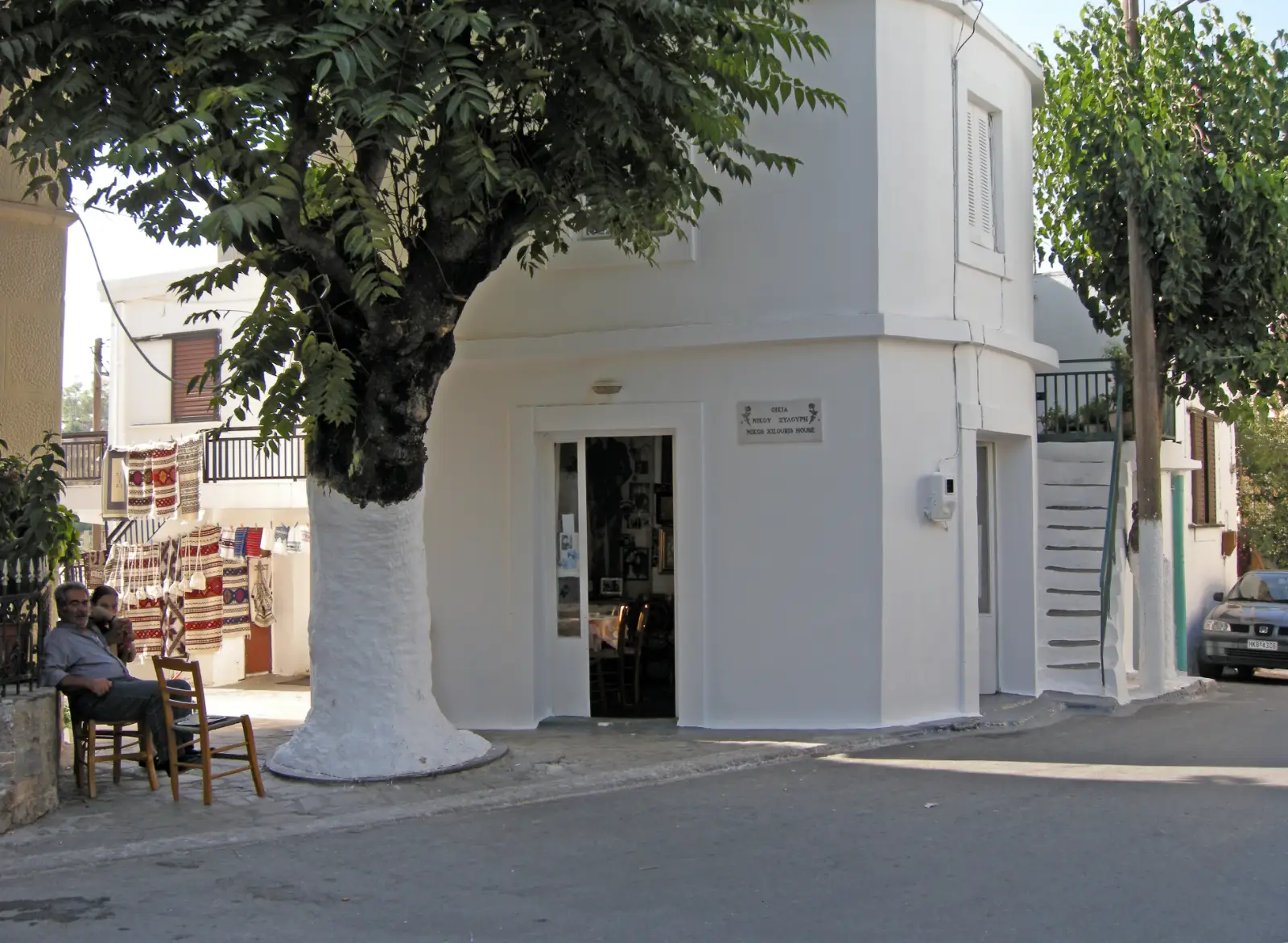
The first thing a visitor notices is that the buildings look newer than they should. The reason is the village’s history: Anogia was destroyed during the Second World War in reprisal for its part in the resistance, and what stands today was rebuilt afterwards.
What that means to see
The village is not picturesque in the way a Venetian harbour is picturesque. What it has instead is character of a different kind:
- Weaving, which is the village’s traditional trade and still visibly present in the shops along the main street.
- A tradition of Cretan music strong enough that Anogia is known across Greece for it. The lyra players who came from here are household names in Crete.
- A memorial to what happened, which the village has not tidied away.
- Shepherding, which is the actual economy: this is a working stock-raising village on a mountain.
The mountain behind it
Anogia is the last village before the Nida plateau, the high bowl on Ida used for summer grazing, and the road up to it continues past the village to around 1,400 metres.
On the plateau is the Ideon Cave, one of two Cretan caves that claim to be the birthplace of Zeus, the other being Dikteon on the Lasithi plateau. The claim is ancient in both cases and unresolvable, which is part of the fun.
The plateau road is the start of the walking route to the summit of Ida, which is a serious mountain day rather than a stroll.
Practical notes
- It is high, and it is cold in winter. This is the part of Crete that gets snow.
- The drive up from the north coast climbs steadily; the plateau road beyond the village is rougher and can be closed by weather.
- It works as a half day from Heraklion or Rethymno, usually combined with the plateau.
- Arkadi Monastery to the west has the other great resistance story on the island, and the two make a coherent pair.
Last checked August 2026. Mountain road access is seasonal - see our editorial policy.
Common questions
Where is Anogia?
High on the northern slopes of Mount Ida in central Crete, at around 700 metres, between Heraklion and Rethymno inland.
Why does Anogia look modern?
The village was destroyed during the Second World War in reprisal for its role in the resistance, and the buildings standing today were put up afterwards.
What is Anogia known for?
Weaving, shepherding, and a tradition of Cretan music strong enough that the village is known for it across Greece.
What is the Ideon Cave?
A cave on the Nida plateau above Anogia, one of two Cretan caves traditionally named as the birthplace of Zeus. The other is Dikteon on the Lasithi plateau.
Can you drive up to the Nida plateau?
Yes, on the road that continues past the village to around 1,400 metres, though it is rougher than the approach and can be closed by weather.
Next
Read things to do in Crete, Arkadi Monastery, or Rethymno old town.