
Diagram by Greece Trips. Free to reuse with credit - CC BY 4.0.
What happened in 1866
During the Cretan revolt against Ottoman rule, hundreds of people, fighters and the families sheltering with them, were besieged inside the monastery. Rather than surrender, the powder store was detonated.
The explosion killed most of those inside and a large number of the attacking force with them. The effect abroad was immediate: the story of Arkadi turned the revolt into an international cause and made the monastery a symbol of Cretan resistance. It is the reason Greek visitors come here with a seriousness that surprises foreign ones.
The roofless powder magazine still stands as it was left, and it is the part of the site to sit with rather than photograph.
What you see
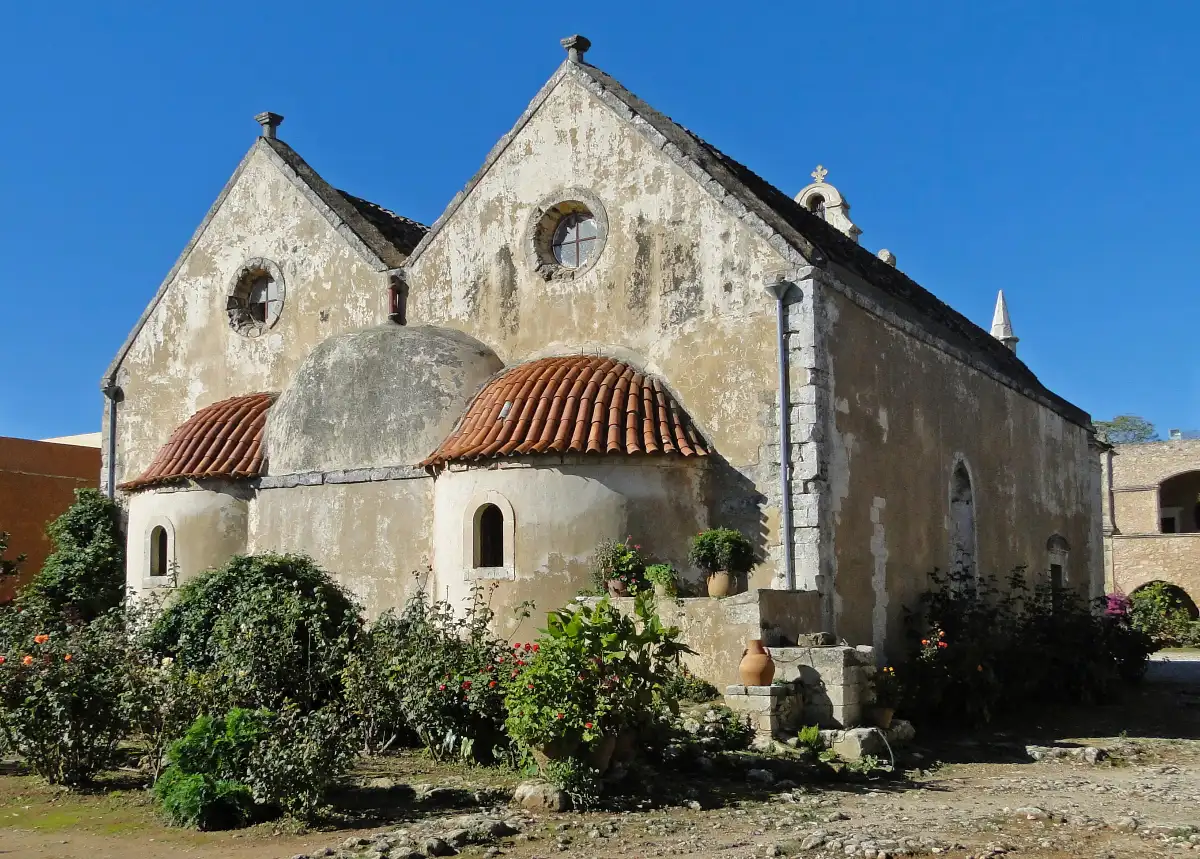
- The church facade, a Venetian-influenced front of the sixteenth century, and the most photographed piece of religious architecture on the island.
- The courtyard it faces, enclosed by the monastery buildings.
- The powder magazine, kept as a ruin.
- A small museum of icons, vestments, documents and objects from the siege.
- An ossuary nearby holding the remains of the dead.
Visiting it well
It is a working monastery and a memorial as well as a monument. Modest dress is expected, quiet more so, and it is not the place for a photo shoot.
The setting does a lot of the work: cypress and olive on a high plateau, air noticeably cooler than the coast, and very little noise. An hour covers the site properly.
Getting there
Arkadi is a drive of roughly half an hour inland from Rethymno on a good road that climbs steadily. There are seasonal buses; a car makes it simple, and where to stay in Crete explains why that is true of the island generally.
It pairs naturally with Rethymno old town in the same day: the monastery in the morning, the Venetian streets and harbour in the late afternoon.
Last checked August 2026. Hours, dress rules and bus routes change - see our editorial policy.
Common questions
What is Arkadi Monastery known for?
The events of 1866, when those besieged inside detonated the powder store rather than surrender during the Cretan revolt against Ottoman rule. It became a symbol of Cretan resistance.
How long do you need at Arkadi Monastery?
About an hour, including the church, the courtyard, the powder magazine and the small museum.
Where is Arkadi Monastery?
In the hills south-east of Rethymno, roughly half an hour inland by car on a climbing but well-surfaced road.
Is there a dress code at Arkadi?
It is a working monastery, so modest dress covering shoulders and knees is expected, as at religious sites across Greece.
Can you visit Arkadi without a car?
Seasonal buses run from Rethymno, but a car or a taxi gives you the flexibility the timetable does not.
Next
Read things to do in Crete, Rethymno old town, or where to stay in Crete.