Three cruise shapes, three verdicts
Every cruise to Greece makes the same trade: your logistics for your hours ashore. Which version of it you are being offered depends on which of these three you were actually looking at.
| Shape | Length | Best for | Not for |
|---|---|---|---|
| Mediterranean itinerary touching Greece | 7 to 12 nights | A first Mediterranean sampler | Anyone who came for the Greek islands |
| Greece-focused small ship | 3 to 8 nights | Short trips, mixed-mobility groups | A full week and normal mobility |
| Sailing or catamaran charter | About a week | When the water is the point | Anyone needing space or privacy |
If you have a week, ordinary mobility and the islands are why you are coming, the honest default is none of the three: take the ferries and sleep ashore. How independent island hopping works is the method.
Each shape below names what to check before you commit.
What a cruise gives you, and what it quietly takes
A cruise to Greece is worth it when the constraint is real: a short trip, a mobility limit, or a group that cannot agree on anything. It is not worth it when the islands themselves are the point, because a port call buys you the busiest hours of the day and none of the good ones.
Take the gains seriously, because they are real. There is no ferry to book and no ferry to miss. You unpack once, and the bed moves while you sleep. A cancelled sailing cannot break your route, because the route is the ship. The headline cost is known before you leave the house, which is more than an independent trip can promise. And when the meltemi blows hard enough to ground the light high-speed catamarans, a big ship sails anyway.
Now the other half. A port call gives you most of one working day ashore, and it hands it to you in the same window as every other ship in the anchorage. Your excursion runs on a clock. You get no morning and no evening anywhere, and the evening is the point: the tenders and the day boats leave at about the same hour, and that is when the islands stop performing and start being islands again.
We should say where we stand. Greece Trips is built on independent island hopping, so the case above argues against our own interest, and we have made it anyway. A page that only tells you what a cruise to the Greek islands takes from you is not honest, it is a different advertisement. What a ferry day actually involves is the alternative, in full.
The three shapes a Greece cruise actually takes
Most disappointment with a cruise of the Greek islands comes from booking one shape while imagining another. There is no single best cruise for the Greek islands, and any page that names one is selling it. There is only the shape that fits your trip.
The Mediterranean itinerary that touches Greece
Read the day-by-day, not the brochure. Royal Caribbean’s seven-night Greek Isles cruise from Rome sails Rome, a sea day, Santorini, Kusadasi in Turkey, Mykonos, a sea day, Naples, Rome (the line’s own itinerary). Two Greek islands. Two sea days. Two ports that are not in Greece.
There is no trickery in that. It is a Mediterranean cruise with Greek stops, sold under a Greek name. Ships carry thousands. Embarkation is usually a foreign port, Rome or Venice or Ravenna and sometimes Piraeus, so the flights that get you to the ship are a trip of their own and never appear in the fare. Most of the sailing is done overnight, and at Santorini the largest ships anchor rather than berth, because the caldera has no quay built for them, which is why passengers come ashore by tender.
It genuinely suits some people. Someone sampling several countries in one week. A first-time cruiser. A traveller who needs the ship as a fixed base. A family who will treat the ship as the holiday and the ports as excursions. On those terms it delivers, and it delivers a great deal of ship.
Who should not book it: anyone whose sentence starts “I want to see the Greek islands”. This itinerary gives you two afternoons of Santorini and Mykonos, and two afternoons is not those islands. Count the Greek ports before you book, because the name of the cruise will not do it for you.
The Greece-focused small ship, and the short Aegean cruise
This shape comes in two halves, and both are built for Greece rather than through it.
The first is the short round-trip out of Piraeus or Lavrio: a few nights, an Aegean loop, back where you started. Piraeus is close to central Athens and Lavrio is a good deal further, which matters on the morning you land. These sailings tend to time some calls into the late afternoon and evening rather than the midday scrum, which is the whole reason to prefer them. Which calls, on which sailing, and for how long, is the thing to check before you pay, because it moves by season and by ship.
The second is the genuine small ship, and it is the shape we are warmest about. Variety Cruises publishes eight-day Greek voyages on yachts taking up to about fifty guests, reaching harbours a megaship cannot enter, Kythira and Hydra among them. Other sailing-yacht and small-ship operators work the same category: passengers in the low hundreds rather than the low thousands, and a habit of staying later in port. Treat the late stays and any overnight as a claim to verify on your specific sailing rather than a feature of the category.
The advantage is worth naming plainly. Fifty people going ashore is not four thousand going ashore. The ship can dock where there is no airport and thin ferry service, and it can stay after dark. The catch is that you pay a premium per night, and the ship still chooses the islands.
Who it suits: short trips, mixed-mobility groups, and anyone drawn to Hydra, Patmos or Symi rather than the postcard two.
The sailing charter: a week on a catamaran, not a cruise at all
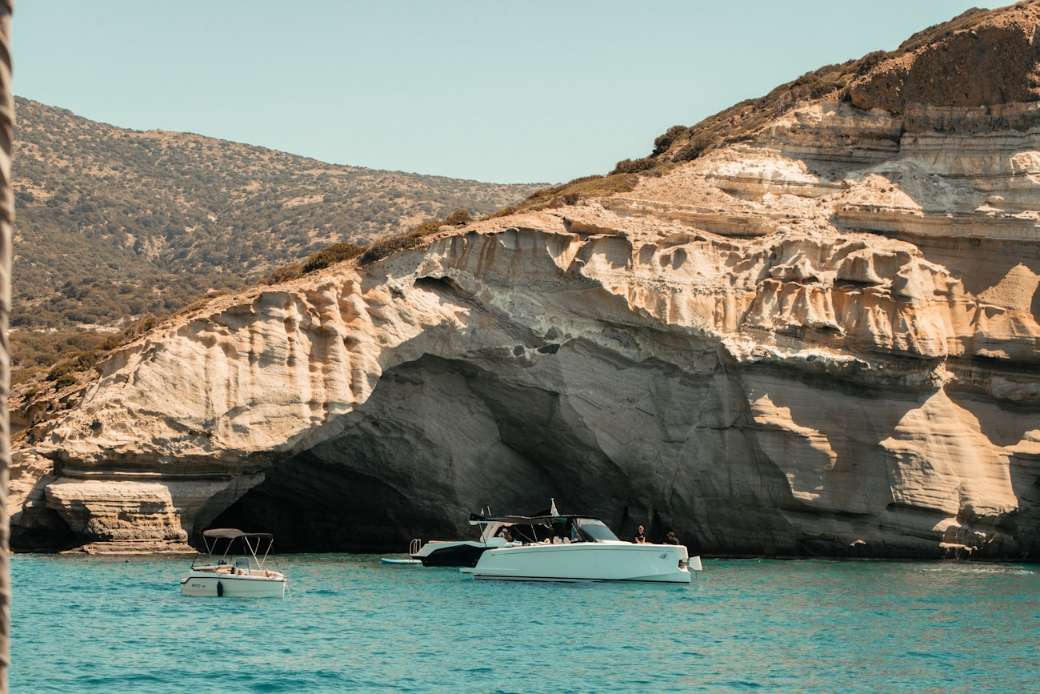
A charter is not a cruise, and people who book one expecting a cruise are unhappy by the third day. You take the whole boat with your own group, or one cabin on a boat shared with strangers. A skipper sails it, often with a host who cooks. The days are short hops with a swim stop in a cove, and most nights you tie up in a harbour, which means dinner ashore and the evening a cruise would have taken from you.
The geography decides the week. The Saronic, Hydra and Poros and Spetses, is the gentle route and the closest to Athens. The Cyclades are exposed, and at the meltemi’s peak from July into September they are hard work on a small boat, which is why a Cyclades charter can quietly become an Ionian one; the Ionian is the calm-water default in high summer. The Saronic is where most first charters belong, and when to go sets the wind.
The failure mode is close quarters. If you need privacy, space, or a way to get away from the people you came with, this is the wrong boat.
The six-hour island: what a port day really contains
A port call does not give you a short day on the island. It gives you the island’s worst hours, shared with every other ship in the anchorage.
| Shape | Time in port | What comes off the top | What you actually own |
|---|---|---|---|
| Megaship | Most of a daylight working day | Tender, cable car or coach, the excursion clock | An afternoon, most of it in the crowd |
| Greece-focused short cruise | A shorter call, sometimes running into the evening | A short transfer; the ship usually docks | Most of the call, some after dark |
| Small ship or yacht | A long call, sometimes an overnight | Little; you walk off | Most of it, evening included |
| Charter | You sleep in the harbour | Nothing | The evening and the morning |
Santorini is the worked example. The ship anchors in the caldera because there is no berth for it. You queue for a tender, cross, and queue again for the cable car up the cliff, and on a day with several ships in the anchorage that second queue is what travellers complain about most: a substantial part of the call can go before you have seen anything at all. Only then does the clock start on Santorini, and Oia is a bus ride further on.
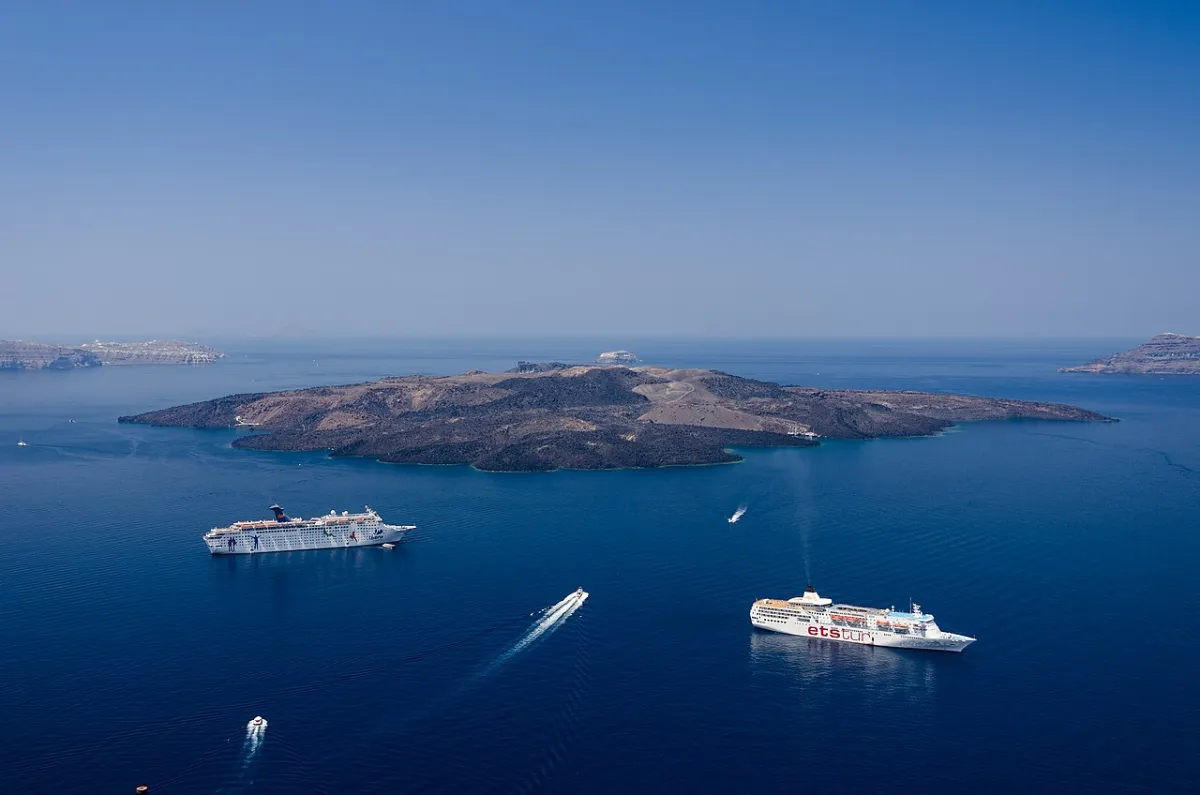
The arrival is the part no cruise page prints. The ships do not merely give you few hours, they give you the same hours as each other: several thousand people discharged into one late-morning window, into the two towns everyone photographs, in the heat, and gone again before the island empties. The evening happens without you.
Be fair where fairness is due. Some lines do advertise late Santorini calls, and the Greece-focused ships time calls into the evening on purpose. True, and it changes less than it sounds: a late call gives you the sunset, not the island. You still never wake up there.
Two facts no cruise page mentions. Greece charges cruise passengers a levy to step ashore, tiered by port and season and reported highest at Mykonos and Santorini in high summer; more on that below. And Santorini now rations cruise passengers, with a cap on how many can come ashore in a day and a system that allocates berths in advance. Either way, which ship calls on which day is now allocated rather than chosen.
When a cruise is the right call
Four constraints beat any ferry route we could design for you. If one of them is yours, a cruise is not a compromise, it is the correct answer.
A short trip. Four or five days is not enough to hop: our own pace rule is about one island per three nights with a two-night floor, which over a long weekend buys one island and a lot of packing. A three or four-night Greece-focused cruise from Piraeus puts several in front of you instead. Book that shape, and accept what it is: hours on each island, not days.
Mobility and health. This is the strongest pro-cruise case on the page and it deserves better than a grudging line. A ship removes the things that actually defeat people: luggage over a gangway, a port transfer at dawn, stairs into a hill village, a 6am fast boat in a swell. Accessible cabins are level, and the excursion comes coach-shaped. One real caution: tender ports are the weak link, and at Santorini the big ships tender, so ask the line what happens on that specific call before you book rather than after.
A group that cannot agree. Multi-generation trips fail at the planning stage, not in Greece. The ship ends the argument: one dining room, one route, and anyone can skip a day without wrecking it for the rest. If Greece is the point rather than the ship, take the Greece-focused vessel over the megaship. Greece with family has the rest of that decision.
A first look. Travellers on the forums who cruised first tend to say the same thing: it gave them a feel for how the country works and a shortlist to come back to. That is a fair use of a week. The honest version is that a cruise is a good way to choose your next Greek trip and a poor way to have it.
One footnote in the cruise’s favour: in the windiest weeks the light catamarans are the first sailings pulled and the big ship keeps its schedule, so a cruise buys route certainty the ferries cannot.
When the ferries win, and they usually do
Same seven days, two different trips. A week on a big ship is two Greek islands for an afternoon each. A week of ferries is Athens plus two islands at roughly one island per three nights: the morning before the ships arrive, the evening after they leave, dinner at 9pm, and one town you actually learn your way around.
The method belongs on another page. What belongs here is the answer to the four fears that push people onto ships.
- The ferries look complicated. They are bookable online well ahead and run frequently in season. How the ferries work.
- A cancellation will ruin the trip. Build in a slack day, and put a conventional boat on any leg you cannot miss.
- The luggage. Two islands means two moves, not seven.
- The planning. A ready seven-day plan does the sum for you, and the island-hopping method explains why it is shaped that way.
On money, one sentence and no figures: a cruise fare is a single known number that looks all-inclusive and is not, while an independent trip is a set of numbers you control, and either can come out ahead depending on the islands and the month.
And if what you want is the Greek islands without cruise ships, they are not hard to find. The ships call at a short list of ports, so everything off that list is cruise-free by default, and even the ports on it belong to whoever is still there at 8pm. The island groups are where to start.
What the fare covers, and what it does not
The fixed price is the cruise’s best feature and its best trick: the number you book is not the number you spend. What is typically extra, in rough order of how much it changes the trip:
- Shore excursions, the line that decides whether a port day is yours or the coach’s
- Drinks packages
- Wi-fi
- Gratuities
- Port transfers at either end
- The flights to a foreign embarkation port, which never appear in a cruise fare
- The Greek disembarkation levy
That last one is recent enough that most planning pages have not caught up. Greece has introduced a per-person fee for cruise passengers coming ashore, reported as tiered by port and by season, highest at the busiest islands in high summer, and usually collected through the cruise line (Euronews). We print no amount here; check the tier for your port and month when you book.
The fair counterweight is that excursions are optional, and in several Greek ports you can walk off the ship and simply be somewhere. Rhodes Old Town starts close to the quay and Corfu old town is walkable from the berth. Santorini is a tender, a queue and a cliff, and Katakolon is a ride inland to Olympia and not much else.
Which feeds the decision: if the fare only works for you before the extras, the ferry trip you were avoiding is probably the cheaper holiday. What a Greece trip actually costs does that maths in ranges, because it does not belong here.
The season sets which shape works
The cruise season runs roughly from spring to late autumn and peaks in high summer, which is exactly when the islands it visits are least themselves. For a cruise, the case for the shoulder months is arithmetic rather than weather: fewer ships share the anchorage on the same day, so the tender queue is shorter and the town is merely busy. When to go, month by month makes that call properly, and the weather calendar holds any number you want.
The consequences run by shape. The megaship is the most weather-proof and the most crowded, and it will sail its route in nearly anything. The small ship is the best compromise and the first to sell out in the shoulder months, so it wants booking early. The charter is the most weather-exposed of the three, and the meltemi from July into September is why a Cyclades week can turn into an Ionian one at short notice.
Santorini’s cap adds one more variable: with calls allocated in advance, ships get moved to other dates, so how many ships share your Tuesday is no longer a matter of who turned up.
Who should skip the cruise entirely
Skip the cruise, in any of its shapes, if:
- the islands are the reason you are coming
- you want an evening in Oia, or a morning in Naxos town before the day boats
- you would resent arriving alongside several thousand people
- you want to choose your islands rather than accept the ones a route sold you
- organised excursions and coach clocks are not how you travel
- you have a week or more, in which case the logistics you are paying to avoid amount to about two ferry rides
- you would rather eat where the menu is not in four languages
None of that makes cruising wrong. It makes it a different holiday, and the people who love it are almost always the ones who booked it knowing exactly what it was.
If that list is you, plan the hop instead, or start from a finished route.
So should you cruise Greece?
Most travellers, with a week and ordinary mobility, should not. Take the ferries and sleep on two islands. We could have spent this page selling you a cruise, and the ferries are still the better trip.
Then the exceptions, and they are real ones. A long weekend, a mobility constraint, or a group that cannot agree: take the Greece-focused small ship from Piraeus, and check which of its calls run into the evening. A first Mediterranean trip where Greece is one chapter of several: the big-ship itinerary is honest about what it is, so take it knowing you are buying two Greek days out of seven. The sea itself as the point: charter the catamaran and keep your evenings. There is no best Greek cruise, only the shape that answers your constraint.
Which is what the whole argument comes down to. The islands are not what you see from the tender. They are what happens after it leaves. Plan the hop, pick a route, or start from the map.
Common questions about a cruise to Greece
Is a cruise the best way to see the Greek islands?
No, not for most travellers. A cruise is the best way to sample the Greek islands and a poor way to experience them, because a port call buys five to eight busy midday hours and no evening. It is the right call when time, mobility or group logistics are the binding constraint. Otherwise independent island hopping wins on the axis that matters, which is hours ashore.
What is the best cruise line for the Greek islands?
The best line depends on which shape you want, and anyone naming one line for everybody is selling it. Greece-focused lines sailing round-trip from Piraeus or Lavrio give you the most Greece per night. Small-ship and sailing-yacht operators give you smaller harbours and later evenings. The mass-market Mediterranean ships give you the most ship and the least Greece. We have not sailed them, and we do not rank ships.
How many hours do you get on each island on a Greek islands cruise?
Most of one daylight working day on a large ship, a shorter call on the Greece-focused cruises, and occasionally an overnight on a small ship. Then subtract the rest: at Santorini, the tender across the caldera, the cable-car queue on multi-ship days, and the bus out to Oia. What you actually own is an afternoon, most of it shared.
How many Greek islands does a Greek Isles cruise actually visit?
Fewer than the name suggests. Royal Caribbean’s seven-night Greek Isles itinerary from Rome calls at two Greek islands, Santorini and Mykonos, with two sea days and stops in Turkey and Italy. A three-night Greece-focused cruise from Piraeus can beat that. Read the day-by-day before the headline, and count the Greek ports yourself.
Is it better to cruise the Greek islands or island hop by ferry?
Ferry-hop if you have a week, ordinary mobility and any real interest in the islands. Cruise if the constraint is time, mobility, or a group that cannot agree on anything. Measured in hours: a ferry week is two islands with their mornings and evenings, and a big-ship week is two islands for an afternoon each. The island-hopping method is the alternative in full.
Can you see the Greek islands without cruise ships?
Easily. The ships call at a short list of ports, so any island off that list is cruise-free by default, and the ports on it are cruise-free by evening. The mechanism is infrastructure: ships go where the anchorage is deep enough and the coaches are waiting. The island groups show you what sits off the circuit.
What is the best small ship cruise of the Greek islands?
Judge it on four things rather than a name. Passenger count, because under about 100 changes the product completely. Whether the ship overnights in port. Which islands it reaches that a ferry does not reach easily. And whether the route is Greek or Mediterranean. We do not rank operators, and any operator you shortlist should be checked on this season’s own itinerary rather than on a list like this one.
When is the best time to take a Greece cruise?
The season runs from spring to late autumn. For the cruise itself, the shoulder months beat high summer for a reason that has nothing to do with temperature: fewer ships share the anchorage on any given day, so the tender queue is shorter and the town is busy rather than overrun. The best time to visit Greece makes the month-by-month call.
Do you need a visa for a Greek islands cruise that stops in Turkey?
It depends on your nationality and on whether you go ashore, and cruise lines handle group arrangements differently. This is not a question to settle from a travel page: check Turkey’s official e-visa service and your own government’s advice, then confirm what your line arranges for its passengers. Visas and entry requirements covers the Greek side.
Booking
We sell nothing and book nothing for you. Every guide on this page tells you how to arrange each piece yourself - which ferry operator, when to book, what to prebook and what to leave loose.