What it is
the historic walled centre of Corfu Town, on the UNESCO World Heritage List. Inscription year, criteria and reference number are deliberately not printed here: UNESCO’s own page refused our requests and we do not print citation details we have not read
Venetian
around four centuries of Venetian rule built the two fortresses and produced the town’s tall buildings and narrow lanes
The two fortresses
the Old Fortress on the promontory east of the centre, and the New Fortress on the rise to the north-west
The lanes
kantounia, many of them too narrow for a vehicle
French
the Liston, an arcaded terrace on the western side of the Spianada, built during the French periods around the turn of the nineteenth century. The origin of the name is disputed and is left disputed here
The Spianada
the open ground between the town and the Old Fortress, originally cleared as a field of fire and later laid out as a promenade. Often called the largest square in Greece; we could not source that and print it as a claim
British
the Ionian Islands were a British protectorate until union with Greece in 1864. Cricket is still played on the Spianada, and the Hellenic Cricket Federation is based on Corfu
Saint Spyridon
the church holding the relics of the island’s patron saint, in constant devotional use
How long
a full day, or half a day for the lanes, the church and one fortress. Our judgment; no authority publishes one
Crowds
driven by cruise calls. Look at the port rather than at a timetable
Tickets and hours
set by the authorities running each site. Deliberately not reprinted here. Walking into the town costs nothing
Travel details last checked July 2026.
Tall shuttered buildings four and five storeys high, lanes too narrow for a car, arcades, campaniles, a fortress on a promontory and another on a hill. It reads as an Adriatic town because for four centuries it was administered like one, and then two more powers had a go at it before Greece did.
The Old Town of Corfu is on the UNESCO World Heritage List. We are going to leave that at the bare statement, because we could not open the UNESCO page ourselves and we do not print citation details we have not read.
What we can do is tell you what is actually there and who built it, which is more useful anyway.
Venice built the shape
Four centuries of Venetian rule are why the town looks the way it does, and the influence is structural rather than decorative.
Two fortresses hold the ends of the town. The Old Fortress sits on a rocky promontory east of the centre, cut off from the town by a channel, and it is the one you see from every arriving ferry. The New Fortress rises on the ground behind the town to the north-west. Both are Venetian military engineering, and they exist because Corfu sat on the sea route into the Adriatic and Venice spent a very long time keeping other people out of it.
Everything between them is a consequence of those walls. A town that cannot spread sideways grows upward and inward, which is why the buildings here are unusually tall for a Greek island town and why the lanes between them are so narrow. They have their own name: kantounia, and many of them are too tight for a vehicle.
Walk them without a destination for the first hour. The Old Town is small enough that you cannot get seriously lost and dense enough that a map is nearly useless, and the pleasure of the place is entirely in the turning of corners. Laundry, church doors, a sudden square, a campanile, and then the sea again.
At the centre of it stands the church of Saint Spyridon, which holds the relics of the island’s patron saint and is the devotional heart of Corfu rather than a monument on a list. It is a working church in constant use. Treat it as one.
France built the arcade
The Venetian period ended at the close of the eighteenth century and the French arrived, twice, around the turn of the nineteenth.
What they left is the Liston: an arcaded terrace of tall arches running along the western edge of the Spianada, with cafe tables under it looking out at the green. It is the single most recognisable thing in Corfu and it is explicitly a piece of imported Paris.
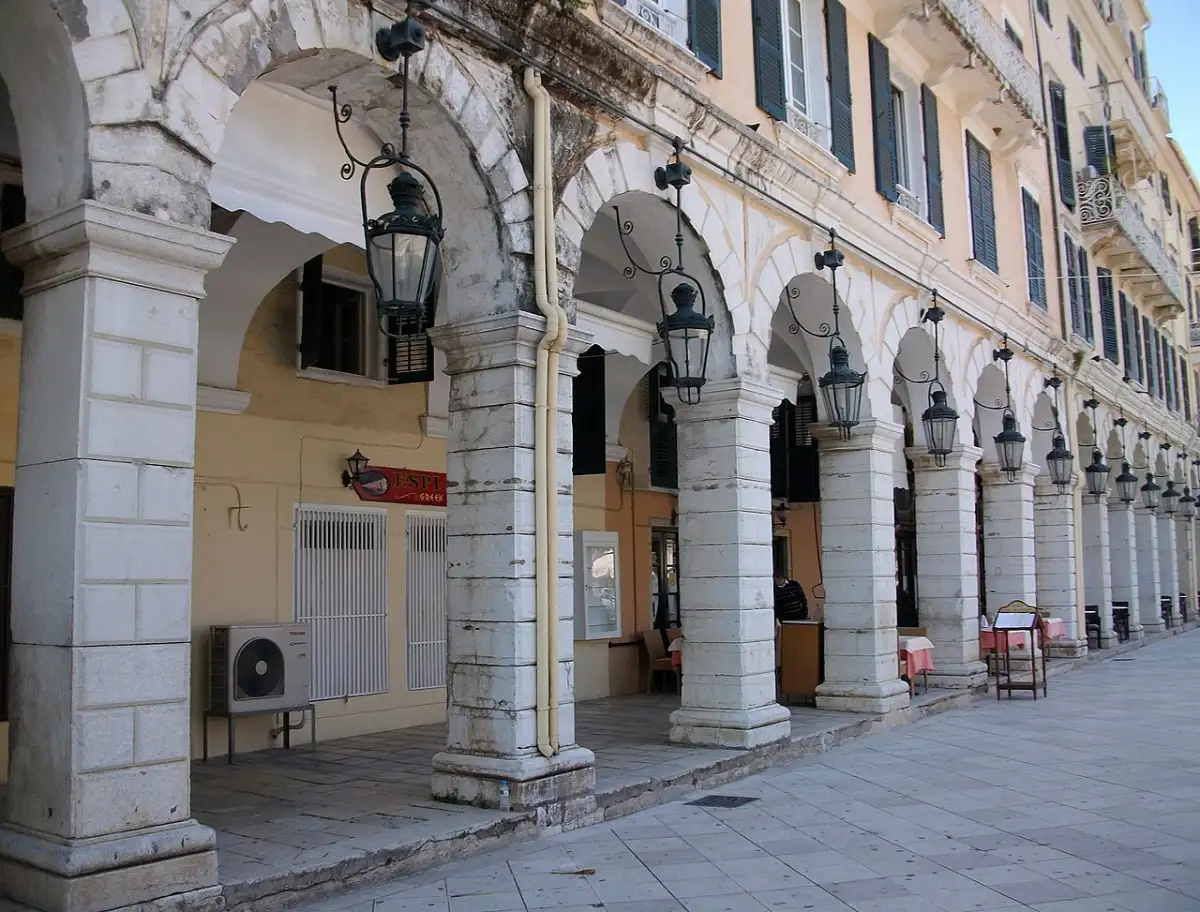
Where the name comes from is genuinely disputed, and we are going to leave it disputed. One account traces it to the Rue de Rivoli model the arcade was built on; another derives it from a Venetian word for the evening promenade. Both come from sources of similar weight and we could not settle between them, so we are not going to invent a winner.
The Spianada in front of it is the open ground between the town and the Old Fortress, and it is there for an unromantic reason: it was cleared as a field of fire, so the fortress guns had nothing to shoot around. Later it was laid out as a promenade with trees and paths. That is the town in one space: military geometry converted into a place to walk in the evening.
You will read that it is the largest square in Greece. It is repeated everywhere and we could not source it, so we are printing it as the claim it is rather than as a measurement.
Britain left a cricket pitch
This is the detail people remember, and it is not a novelty item. It is the most visible surviving trace of the third occupation.
The Ionian Islands were a British protectorate through the first half of the nineteenth century, until union with Greece in 1864. In that time cricket took root on the Spianada, and it is still played there. Corfu is the only place in Greece where the game has a real following, and the Hellenic Cricket Federation is based on the island.
Sit under the Liston on a Sunday and you may well watch a cricket match on the green in front of a Venetian fortress with a French arcade behind you. There is not a more efficient summary of this town available.
The British period left other things: the aqueduct that supplied the town, the classical public buildings at the northern end of the Spianada, and a habit of ginger beer that survives locally under its own name. Those are the kind of details that make a walking morning here better than the sum of its monuments.
It also left the town’s most useful habit of mind. Corfu spent the nineteenth century being administered by people who thought of it as a place to be improved rather than merely held, which is why the public infrastructure here is grander than an island town of this size would otherwise have built. The result is that the Old Town has three different kinds of ambition stacked on the same few hectares: Venetian defence, French display and British administration, each of which left buildings the others would not have bothered with.
The two fortresses are worth treating differently, because they do different jobs for a visitor. The Old Fortress is the one to climb: it is out on its promontory, it is largely about the walk and the view back over the roofs, and it is where the town’s plan becomes legible. The New Fortress is the one to go into for the fabric itself, the tunnels and galleries and the sheer thickness of the walls, and it is quieter. If you only do one, do the Old Fortress and do it in the morning.
How to walk it, and when not to
Give the Old Town a full day if you can, and split it.
The morning belongs to the lanes. Start in the kantounia while they are still in shade and while the shops are opening rather than full, work generally toward Saint Spyridon, and let the turnings do the routing. The Old Fortress is the other half of the morning: it is a walk out along the causeway and a climb once you are there, and the view back over the roofs is what fixes the town’s layout in your head.
The middle of the day is the Liston’s, which is what it was built for.
The late afternoon is when to do the New Fortress and the northern end of the town, and the evening is when the Spianada fills with people walking, which is a real local habit rather than a performance for visitors.
Two honest warnings.
The first is the cruise tide. Corfu Town is a major cruise call, the port is close, and the Old Town fills and empties accordingly. The mechanism is more useful than any timetable we could print: look at what is tied up in the port, because that is a better forecast of your afternoon than any schedule. Cruises covers that side of a Greek trip.
The second is the ground. The Old Town is stone lanes, steps between levels, and a fortress approach that climbs. We describe it and we do not grade it: what a particular person can manage on a particular surface is not a judgment this page is in a position to issue. Accessibility in Greece is the wider guide.
On cars, the answer is the same as in every walled town in Greece. Leave it outside and walk in. Whether you need one at all on Corfu is a separate question and which islands need a car answers it properly.
We print no admission price and no opening hours for the fortresses or for any museum in the town. They are set by the authorities that run them and revised seasonally, and a travel page reprinting them is wrong within a season while sounding authoritative.
Admission to the fortresses and museums is bought at each site, and walking into the Old Town itself costs nothing. We sell nothing here and take no commission.
Is it worth a day of a Corfu holiday?
Yes, and it is the strongest argument for not spending a whole week on one beach.
Corfu is a big island with a resort coast, and the Old Town is the thing that makes it a place with a history rather than a shoreline with hotels on it. It is also unusual in Greek terms: an inhabited walled town that grew under three foreign administrations and kept something legible from each of them, rather than a site you buy a ticket to enter.
Who it suits: anyone who likes walking without a plan, anyone interested in how a town’s politics ends up in its street widths, and anyone who has done the white-cube Cyclades and wants a Greek island that looks nothing like them.
Who it suits less: anyone whose holiday is organised entirely around a beach, and anyone who wants monuments to be big and few rather than small and everywhere.
Give it the day. Then let the rest of the island be the beaches. The Corfu hub sets out how the coasts differ, where the island goes out is a separate question with a separate answer, and Corfu sits in the Ionian islands, which are greener and wetter than the Aegean and reward a different kind of trip. Getting around Greece and the ferries guide cover the arrival.
Last checked July 2026. What we re-read before every update: the UNESCO listing, which our fetcher has not been able to open and whose inscription details we therefore do not print, and the current visiting arrangements at the two fortresses. How we date and check facts is set out in our editorial policy.
Common questions
What is Corfu Old Town?
The historic centre of Corfu Town: an inhabited walled town of tall shuttered buildings and very narrow lanes, held between two Venetian fortresses, with a French-built arcade along one side of a large open green. It is on the UNESCO World Heritage List. It looks Italian rather than Greek because it spent four centuries under Venetian administration, followed by short French periods and a British protectorate.
Why does Corfu Old Town look Italian?
Because it was governed from Venice for around four centuries, and the town’s physical form is a consequence of that. The fortresses are Venetian military engineering built to hold the sea route into the Adriatic. Because the town was confined inside its defences it grew upward instead of outward, which produced the unusually tall buildings and the very narrow lanes, known locally as kantounia, that give the place its character.
What is the Liston in Corfu?
An arcaded terrace of tall arches along the western side of the Spianada, built during the French period and modelled on Parisian arcade architecture, now lined with cafe tables looking out over the green. Where the name comes from is disputed: one account ties it to the Rue de Rivoli model, another to a Venetian word for the evening promenade. We could not settle between them and do not pretend to.
Is there really cricket in Corfu?
Yes, on the Spianada, and it is a survival of the British protectorate of the Ionian Islands, which ended with union with Greece in 1864. Corfu is the only place in Greece where cricket has a genuine following, and the Hellenic Cricket Federation is based on the island. Watching a match on the green in front of a Venetian fortress, from under a French arcade, is the most efficient possible summary of the town.
Is Corfu Old Town a UNESCO World Heritage Site?
Yes, the Old Town of Corfu is on the World Heritage List. We deliberately print no inscription year, no criteria and no reference number, because UNESCO’s own page has refused our requests and we do not print citation details we have not read ourselves. Read them on the World Heritage Centre’s own listing if you want them exactly.
How long do you need in Corfu Old Town?
A full day does it properly: a morning in the lanes and the Old Fortress, the middle of the day on the Liston, the New Fortress and the northern end in the afternoon, and the Spianada in the evening when the town comes out to walk. Half a day covers the lanes, Saint Spyridon and one fortress. That is our judgment from the size of the town rather than a published figure.
Can you drive into Corfu Old Town?
Treat it as a walking town. Many of the kantounia are physically too narrow for a vehicle, which is a consequence of the town having been built inside its fortifications, and the sensible approach is to leave the car outside and walk in. We print no parking arrangement, fee or traffic rule, because we confirmed none at an authority. Whether you want a car on Corfu at all is a separate question.
When is Corfu Old Town least crowded?
Early morning and evening. Corfu Town is a significant cruise call and the port is close to the walls, so the town fills and empties over the middle of the day rather than filling steadily. Rather than looking for a timetable, look at what is tied up in the port: that is a better forecast of your afternoon than any schedule a travel page could print, and it is right on the day.
Booking
We sell nothing and book nothing for you. Every guide on this page tells you how to arrange each piece yourself - which ferry operator, when to book, what to prebook and what to leave loose.