What it is
an ancient sanctuary of Asklepios, the god of healing, built on three terraces on a wooded hillside above Kos town
Distance
about 3.4 km from Kos town. One authority gives the direction as south-west and another as north-west, so we print neither
Middle terrace
a large altar of about the middle of the fourth century BC, a temple of Asklepios of the third century BC, and a temple of Apollo of the second century AD
Upper terrace
the large Doric temple of Asklepios, first half of the second century BC
Date of the remains
Hellenistic, after the fourth century BC
Hippocrates
conventionally fifth and early fourth century BC, so earlier than the standing sanctuary. The association is traditional and is repeated by the authorities; this page does not place him inside these buildings
The plane tree in Kos town
a traditional attribution, not an established fact. No age printed
Excavated by
Rudolf Herzog, with Iakovos Zarraftis, in the early twentieth century
How long
one to one and a half hours. Our estimate; no authority publishes one
Tickets and hours
set and published by the Hellenic Ministry of Culture. Deliberately not reprinted here
Travel details last checked July 2026.
It is the most substantial ancient site on the island and it is designed to be walked upward. Each terrace is a different thing, and the sequence is the point: you climb through a healing sanctuary the way a patient would have, and the view gets wider at every level.
It is also the site of a chronology problem that almost every page about it repeats without noticing. Hippocrates is on every sign, in every leaflet and in the island’s name for itself. The buildings you walk through are later than he was.
What stands on each terrace
The site is built on three levels, which the Municipality of Kos calls by the Greek term for them, andera. Read them from the bottom up.
The lower terrace is the entrance level and the practical one: this is where those who came to be healed arrived and where they were accommodated. A sacred spring is generally placed here, and springs are not decorative at a healing sanctuary, they are the mechanism.
The middle terrace is the oldest dated part of the site and the one worth slowing down for. The Municipality dates the large altar here to about the middle of the fourth century BC, a temple of Asklepios to the third century BC, and a temple of Apollo to the second century AD. Three structures, six centuries apart, on one platform. That spread is the honest picture of a Greek sanctuary: not a building, but a place that kept being rebuilt because people kept coming.
The upper terrace carries the large Doric temple of Asklepios, dated by the Municipality to the first half of the second century BC. This is the top of the climb and the widest view, and it is where the site stops being an archaeological plan and starts being a place.
The surviving remains as a whole date to the Hellenistic period, after the fourth century BC. Hold on to that sentence, because everything in the next section rests on it.
The Hippocrates problem, stated plainly
Kos sells itself as the island of Hippocrates, and the Asklepion is where that sale is made.
The Municipality of Kos states on its own monument page that this is where Hippocrates founded his school and taught medicine. The Hellenic Ministry of Culture’s record for the sanctuary says something similar: that he taught in a school he instituted within the sanctuary’s area. Those are not fringe sources. They are the local authority and the national one.
And they sit awkwardly against the dates on the same municipal page.
Hippocrates is conventionally placed in the fifth and early fourth centuries BC. The earliest structure the Municipality dates at this site is that altar on the middle terrace, from about the middle of the fourth century BC, and the sanctuary’s surviving remains are Hellenistic, after the fourth century BC. Whatever Hippocrates did on this island, he did not do it inside these buildings, because these buildings came later.
So this page will not put him in them.
What is true, and better, is this. Kos had a medical tradition of real weight, associated with Hippocrates, and the sanctuary that grew up here afterwards was the institutional expression of it: inscriptions from the site record patients treated by physicians on lines associated with Hippocratic practice. The place is downstream of him rather than around him. That is a more interesting building to stand in than a lecture hall with a famous name attached, and it does not require anyone to fudge a century.
The same caution applies to the plane tree in Kos town, the one presented as the tree under which Hippocrates taught. It is a traditional attribution, repeated for a very long time, and no authority we could read supports the identification. Enjoy the tree. Do not date it.
Why a healing sanctuary was built here at all
The setting is not incidental, and it is the thing the site does best.
An Asklepieion was a place people travelled to when they were ill. What it offered was a combination of things a modern visitor has to hold together: a god, a spring, a diet, a regime, a period of rest, a night spent sleeping in the sanctuary in the hope of a dream, and physicians who treated patients in the same precinct. It was medical and religious at once, and the terraces are laid out to move you through that sequence.
Which is why the site is on a hillside, in trees, above a town and facing open water. The air, the water and the view were part of the treatment, not a bonus. Stand on the top terrace and the therapeutic logic of the place is immediately legible, in a way that a plan on a board never manages.
That is also the best argument for going early in the day. The climb is in the open, the hillside faces the sea, and the middle of a Dodecanese summer afternoon is when the site is least like the thing it was designed to be. What the Greek summer does to a trip is the longer version, and what to pack covers the rest.
There is one more thing the setting tells you, and it is geographical rather than medical. The sanctuary faces the strait, and across that water is the coast of Asia Minor, close enough to read as landscape rather than as horizon. Kos was not a remote island with a shrine on it. It sat on a busy corner of the eastern Aegean, within easy reach of the mainland cities, and a healing sanctuary is only worth building on that scale where people can actually get to it. The view from the top terrace is also the catchment.
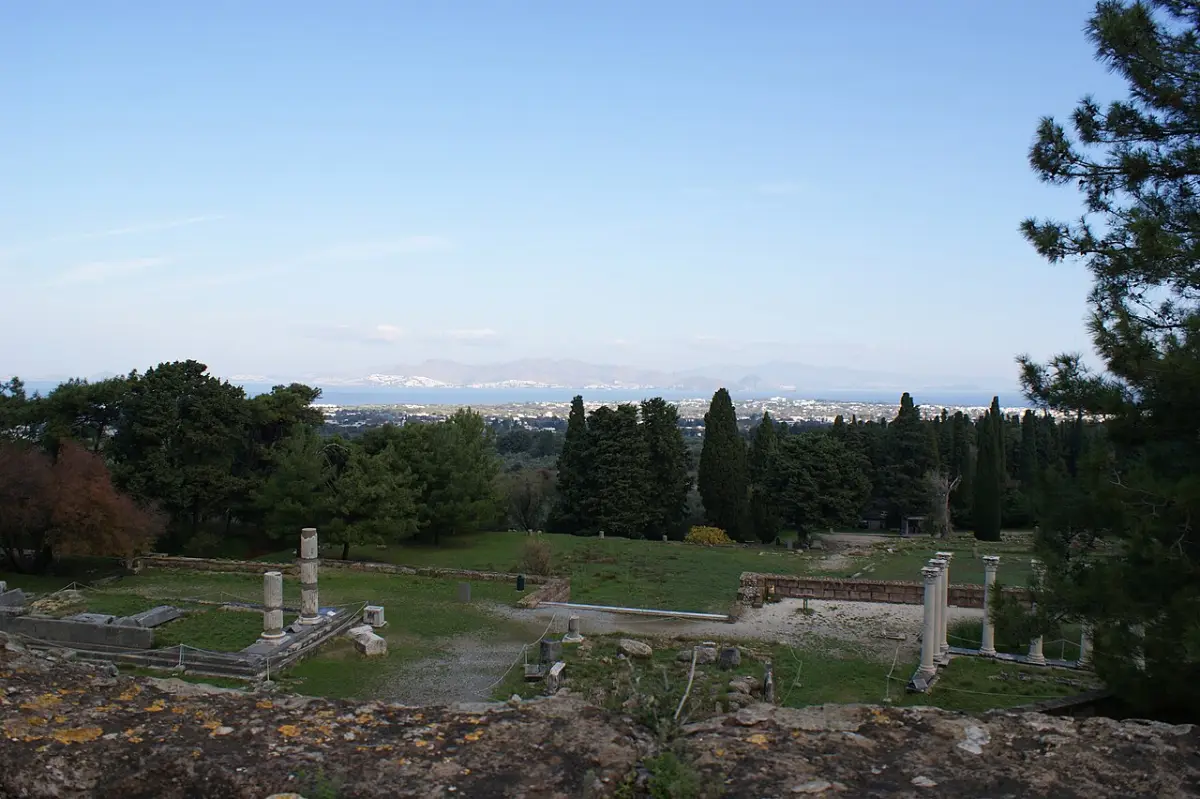
What the site’s own inscriptions record is the practical side of that: patients treated by physicians, in the sanctuary, on lines associated with Hippocratic practice. Medicine and religion were not two competing explanations here. They were the same building.
The site was excavated in the early twentieth century by the German archaeologist Rudolf Herzog, working with the Koan scholar Iakovos Zarraftis. What you walk through is a site that spent most of the last two thousand years buried, which is worth remembering when the foundations look low: this is not a ruin that weathered slowly in the open, it is one that was dug back out.
Getting there, and how long it takes
The sanctuary is about 3.4 km from Kos town, which puts it in the awkward band: too far to be a stroll in August, too close to be a journey.
It is reachable by road, by bicycle on a flat island where cycling is genuinely normal, or on foot if the temperature is on your side. We name no bus route, no operator and no fare, because those change every season and the operators publish them, and a printed route number on a travel page is wrong the first time a timetable moves. Getting around Greece covers the general mechanics.
Allow an hour to an hour and a half on the site. That is our estimate from its size and shape rather than a figure any authority publishes: the walk up through three terraces, time on the top level, and the way back down. Adding the Archaeological Museum in Kos town makes a comfortable half-day, and the two genuinely explain each other.
The climb between terraces is by steps, on an outdoor archaeological site, in the open. We describe the ground and do not grade it: what a particular person can manage on a particular surface on a particular day is not a judgment this page is in a position to issue. Accessibility in Greece is the wider guide, and the site’s own staff are better than any page on the internet.
We print no admission price, no opening hours and no closed days. The Hellenic Ministry of Culture sets and publishes them, revises them seasonally, and is the only source that is right on the day. Greek state sites also do particular things on particular dates, which public holidays and what closes covers.
Admission is sold by the Hellenic Ministry of Culture at the site and through its own e-ticketing service. We sell nothing here and take no commission. Read the Ministry’s published arrangements before you set off.
Is it worth going out of your way for?
Yes, and for a reason that is not the one on the brochures.
Kos is a beach island with an airport, and most of its visitors are on it for the sea. The Asklepion is the thing that makes the island make sense as somewhere with a history rather than a coastline: a large, legible, unusually well-sited ancient sanctuary within cycling distance of the main town, on a hillside facing another continent.
It is not Delos and it is not Delphi. The standing architecture is modest and much of what you read is foundations. What it has instead is a design you can feel: three levels, a climb, a view that opens as you go, and a purpose that explains every part of the layout.
Go early, walk up rather than around, and stand on the top terrace for longer than you think you need to. Then go and look at the town’s tree, knowing exactly what it is and is not.
The rest of Kos is on the hub, and the island sits in the Dodecanese alongside Rhodes, which is the obvious pairing and a very different kind of trip.
Last checked July 2026. What we re-read before every update: the Municipality of Kos’s own datings for the three terraces, and the Ministry’s published visiting arrangements, which we deliberately do not reprint. How we date and check facts is set out in our editorial policy.
Common questions
What is the Asklepion of Kos?
An ancient healing sanctuary dedicated to Asklepios, the god of medicine, built on three artificial terraces cut into a wooded hillside about 3.4 km from Kos town. People travelled here to be treated, in a regime that combined religious ritual, spring water, rest, diet and physicians working in the same precinct. It is the most substantial ancient site on the island, and its surviving remains are Hellenistic, from after the fourth century BC.
Did Hippocrates teach at the Asklepion of Kos?
The Municipality of Kos and the Hellenic Ministry’s own record both say he founded a school and taught here. The dates on the same municipal page make that difficult: Hippocrates belongs to the fifth and early fourth centuries BC, and the earliest structure dated on the site is an altar from about the middle of the fourth century BC, with the surviving remains Hellenistic. The buildings are later than his lifetime. The association between Hippocrates and Kos is real and old; putting him inside these particular buildings is not something the dating supports.
What is on each terrace of the Asklepion?
The lower terrace was the arrival and accommodation level, generally associated with a sacred spring. The middle terrace holds the oldest dated structures: a large altar of about the middle of the fourth century BC, a temple of Asklepios of the third century BC and a temple of Apollo of the second century AD. The upper terrace carries the large Doric temple of Asklepios, dated to the first half of the second century BC, and the widest view.
How far is the Asklepion from Kos town?
About 3.4 km, according to the Municipality of Kos. That is walkable outside high summer, easy by bicycle on a flat island where cycling is ordinary, and short by road. We name no bus route and print no fare, because those change every season and the operators publish them. Note that one authority describes the site as north-west of the town and another as south-west, so navigate by map rather than by compass.
How long do you need at the Asklepion?
An hour to an hour and a half covers the climb through the three terraces, time on the upper level and the walk back down. That is our estimate from the size and shape of the site, not a published figure. Pairing it with the Archaeological Museum in Kos town makes a good half-day, and the objects and the site explain each other in a way that neither manages alone.
Is the plane tree of Hippocrates real?
The tree in Kos town is genuinely old and genuinely a plane. Whether Hippocrates taught beneath it is a traditional attribution rather than an established fact, and no authority we could read supports the identification. It is worth seeing as a piece of the island’s long relationship with its own legend. It is not evidence of anything, and we print no age for it.
What is the best time of day to visit?
Early morning. The site is an open hillside with a climb in it, facing the sea, and it was designed around air and light rather than shade. In July and August the middle of the day is the least rewarding time to be on those terraces, and the first hour after opening is when the place is closest to what it was built to be.
Is the Asklepion worth visiting if you are on Kos for the beach?
Yes. It is close enough to the main town to fit into a morning, it is the one thing on the island that gives it a history rather than a coastline, and its setting on a terraced hillside above the sea does more work than its standing architecture. Go early, walk up through the levels rather than wandering across them, and give the top terrace real time.
Booking
We sell nothing and book nothing for you. Every guide on this page tells you how to arrange each piece yourself - which ferry operator, when to book, what to prebook and what to leave loose.